

Nobody ends up searching “debt help Winnipeg” because things are going well. Usually it’s a specific moment: a letter that looks more serious than the last one, a call from a number you don’t recognize, or just the quiet realization at the end of the month that the math stopped working a while ago and you’ve been avoiding doing it properly. Wherever you’re reading this from, the goal of this particular page isn’t to sell you on one solution. It’s to act as the map, so you can figure out roughly where you stand and which of our more detailed guides actually applies to you, instead of reading five articles cover to cover before you find the one that matches your situation.
- Start by figuring out which stage you’re actually in
- What wage garnishment actually looks like here, since almost nobody understands it until it happens
- The debt relief industry has a scam problem, and it’s worth naming directly
- The resources worth calling before anything else
- The one thing worth remembering through all of this
Start by figuring out which stage you’re actually in
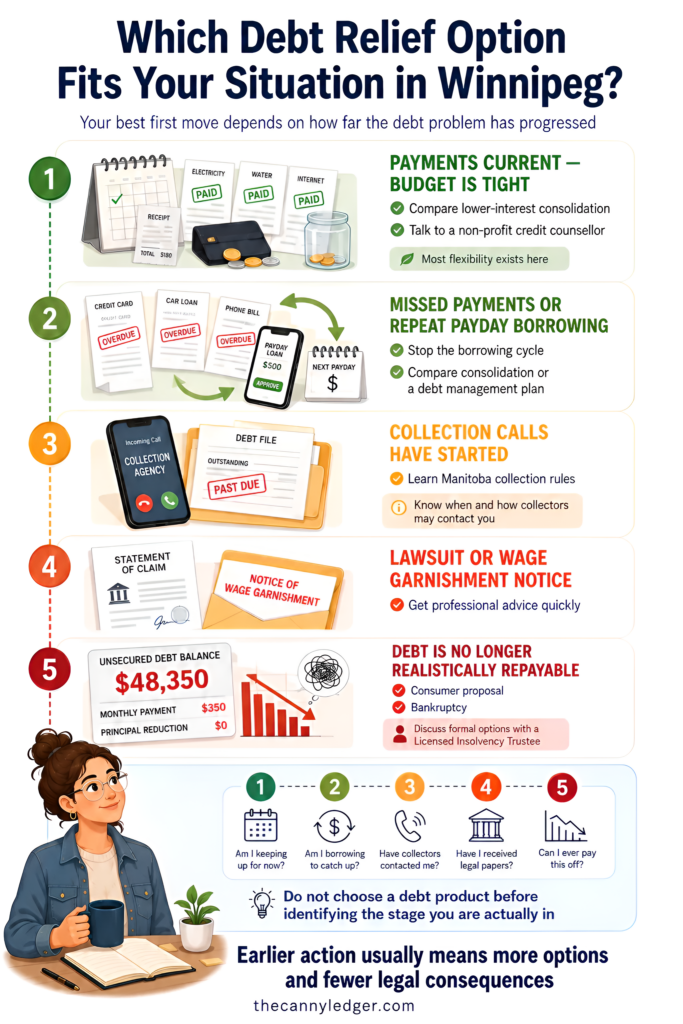
Debt problems don’t all look the same, and the right first move depends heavily on which of these you’re closer to.
If you’re current on payments but the math is tight every month, with little or nothing left over and no real cushion for an unexpected expense, you’re in the earliest and most flexible stage to act from. This is the point where a personal loan or line of credit at a fraction of your current interest rate can genuinely fix things, and it’s worth reading our personal loans in Winnipeg and Winnipeg credit unions compared guides before your situation has a chance to get worse. It’s also the ideal time for a free conversation with a non-profit credit counsellor, not because your situation is dire, but because catching a structural budget problem early is far easier than catching it after several months of minimum payments have compounded. Our credit counselling in Winnipeg guide covers exactly which agencies serve the city and what a first session looks like.
If you’ve missed a payment or two, or you’re leaning on a payday loan or a cash advance to bridge a gap that keeps reappearing, the situation has moved from tight to actively compounding, and it’s worth understanding exactly how that compounding works before it gets worse. Our payday loans in Winnipeg guide breaks down the real cost of that specific product and why rolling one into another tends to dig the hole deeper rather than filling it. This is also usually the point where a formal debt consolidation option, whether a loan, a line of credit, or a structured debt management plan through a non-profit counsellor, starts to make more sense than trying to out-earn the problem on your own. Our debt consolidation in Winnipeg guide walks through all five major routes and which tends to suit which situation.
If collection calls have started, whether from the original creditor’s internal team or a separate collections agency, you’re in a stage where knowing your actual legal rights matters more than anything else. Manitoba has specific, enforceable rules about how and when a collector is allowed to contact you, and a meaningful number of people don’t realize how much of what feels like relentless pressure is actually against those rules. Our credit and collection agencies in Winnipeg guide covers exactly where that line sits and how to report a company that’s crossed it.
If a creditor has already sued you, or you’ve received notice of a wage garnishment, the clock is now genuinely running in a way it wasn’t before, and this is the stage where getting professional advice quickly matters more than getting it perfectly. We’ll cover what garnishment actually looks like in Manitoba in the next section, since it’s the part of this process people tend to understand least until it’s already happening to them.
If your total unsecured debt has grown well beyond what any of the above could realistically resolve, or if you have little to protect in the way of assets, it’s worth having the bigger conversation directly. Our bankruptcy in Winnipeg guide covers both bankruptcy itself and the consumer proposal alternative, including Manitoba’s specific asset exemption rules, which differ meaningfully from what people assume based on general Canadian bankruptcy information found elsewhere.
What wage garnishment actually looks like here, since almost nobody understands it until it happens
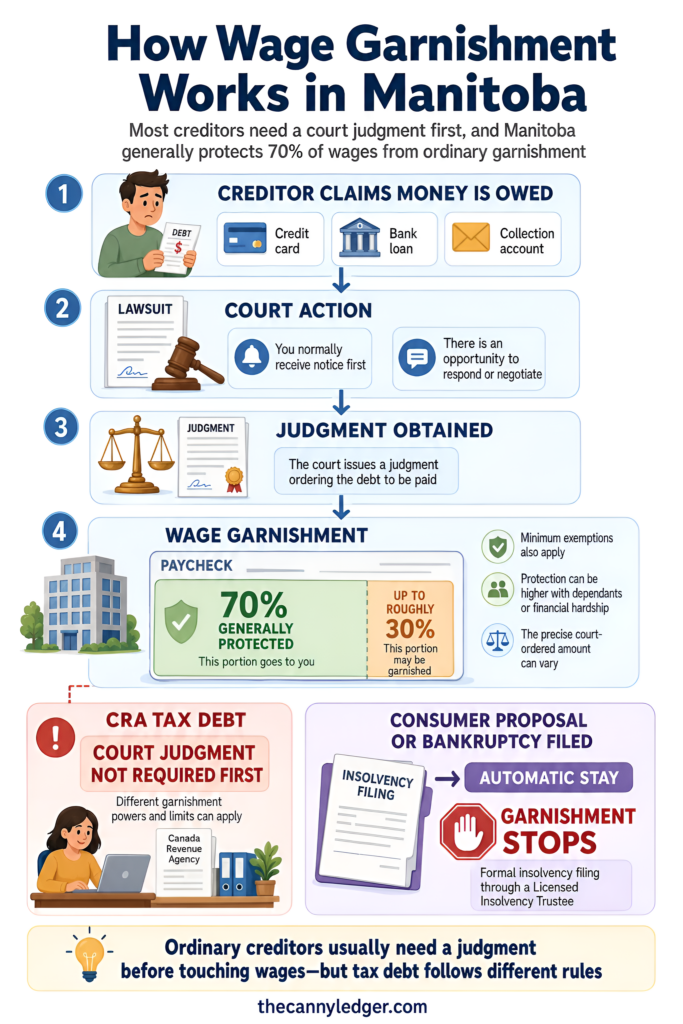
Manitoba’s rules around wage garnishment come from the province’s own Garnishment Act, and they’re more protective than a lot of people assume, though not protective enough to ignore the possibility entirely. Most creditors, banks, credit card companies, and collection agencies among them, need an actual court judgment before they can garnish your wages at all. That means you’d typically receive notice of a lawsuit first, with a window to respond, dispute the debt, or negotiate before any judgment is ever issued, rather than a garnishment simply appearing out of nowhere.
Once a judgment is obtained, Manitoba law protects 70 percent of your wages from seizure, with a guaranteed minimum exemption on top of that percentage regardless of how low your income is, higher if you have dependents. In practice, this caps most wage garnishments at roughly 30 percent of net income, though the exact figure a court orders can come in lower depending on your specific financial hardship and household circumstances. The Canada Revenue Agency is the significant exception to nearly all of this: for unpaid tax debt, the CRA can garnish wages without first obtaining a court judgment and isn’t bound by the same percentage limits that apply to ordinary commercial creditors, which is one of several reasons tax debt deserves faster attention than most other categories.
If you’re already facing a garnishment or a lawsuit that’s likely to lead to one, it’s worth knowing that filing a consumer proposal or bankruptcy triggers an automatic legal stay that stops garnishment in its tracks, immediately, regardless of where the court process currently stands. That’s covered in more detail in our bankruptcy guide, but it’s worth flagging here specifically because people facing an active garnishment often don’t realize how quickly that particular tool can bring relief once a Licensed Insolvency Trustee is involved.
The debt relief industry has a scam problem, and it’s worth naming directly
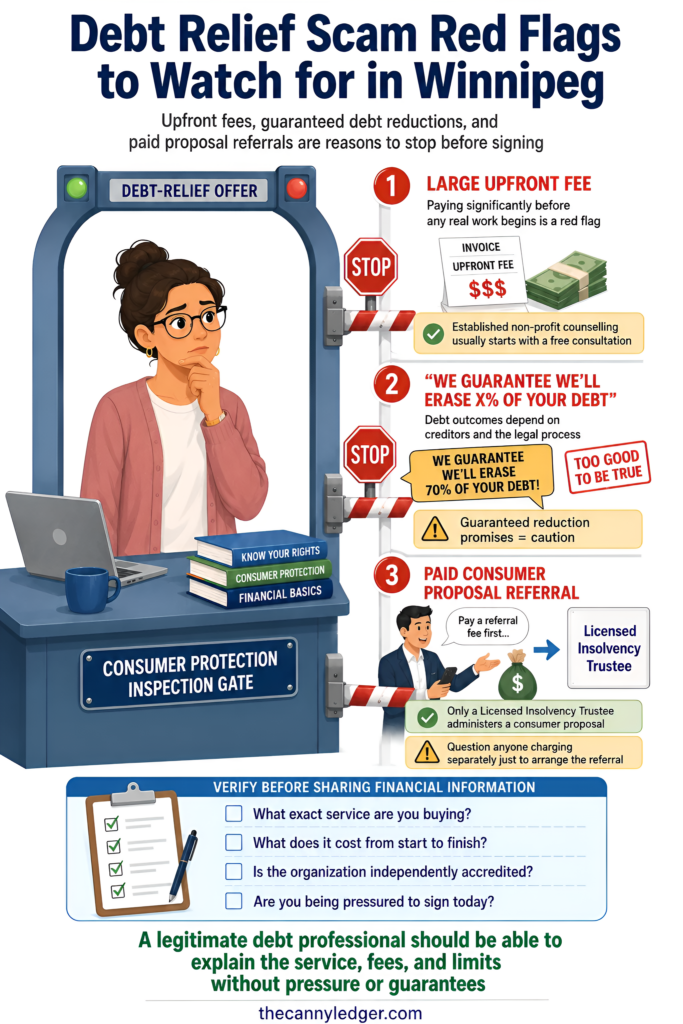
Alongside every legitimate non-profit and Licensed Insolvency Trustee operating in Manitoba, there’s a parallel industry of for-profit debt settlement companies, some operating from outside the province entirely, that advertise aggressively toward exactly the search terms that brought you here. A few patterns show up consistently enough to be worth memorizing rather than discovering the hard way.
Any company asking for a significant upfront fee before doing anything on your behalf is a red flag on its own. Legitimate non-profit credit counselling in Manitoba, the kind covered in our credit counselling guide, offers a free initial consultation as standard practice, and any fees tied to an actual debt management plan are modest and disclosed clearly before you commit to anything.
Any company that isn’t a Licensed Insolvency Trustee but is charging you separately to arrange or refer you toward a consumer proposal is engaging in a practice that’s explicitly prohibited by the accreditation standards legitimate counselling agencies are held to, since only a Licensed Insolvency Trustee is legally permitted to charge for administering a proposal in the first place.
Any company promising to erase a specific percentage of your debt as a guarantee, rather than explaining that outcomes depend on your creditors’ willingness to negotiate, is overpromising in a way a properly accredited agency generally wouldn’t. The Financial Consumer Agency of Canada specifically advises checking whether an agency belongs to a recognized provincial or national association before handing over any personal or financial information, and that check takes about two minutes and can save considerably more than that in regret later.
The resources worth calling before anything else
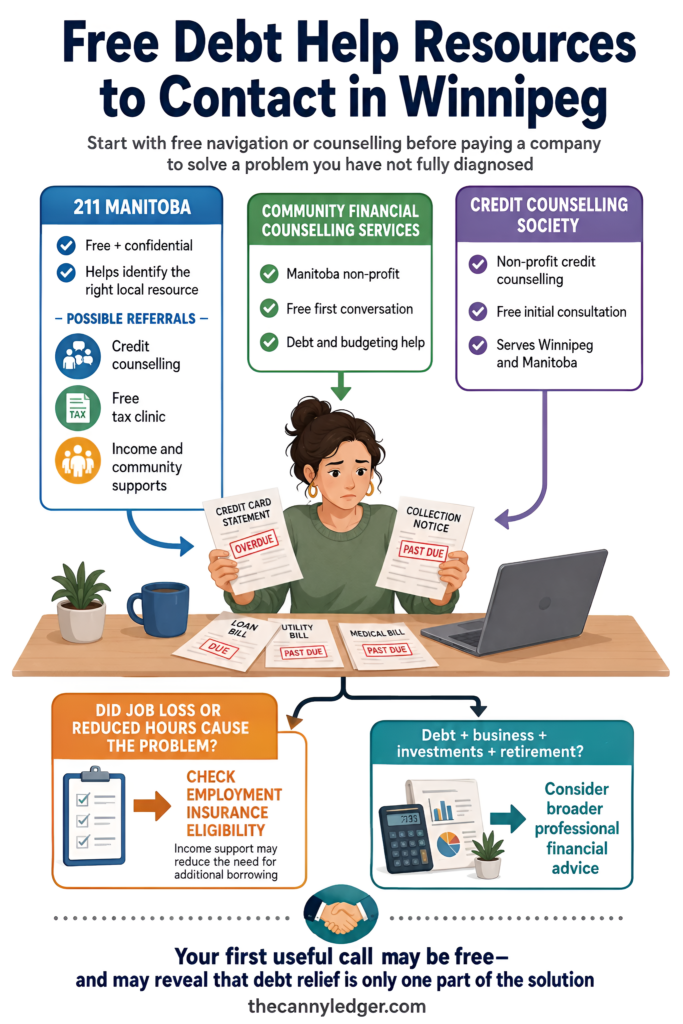
211 Manitoba is a genuinely underused starting point for people who aren’t sure which category their situation falls into yet. It’s a free, confidential phone and online service that can point you toward the right specific resource, whether that’s a credit counselling agency, a free tax clinic, or something entirely outside the financial world if debt turns out not to be the whole picture. Our 211 Manitoba page explains exactly how to reach it and what to expect from the call. Two of the agencies it’s likely to point you toward directly are Community Financial Counselling Services, Manitoba’s own non-profit, and the Credit Counselling Society, both of which offer a free first conversation regardless of how far along your situation already is.
If your financial pressure traces back to a job loss, reduced hours, or a gap between employment, it’s worth confirming what income support you might already qualify for before assuming debt relief tools are your only option. Our employment insurance in Winnipeg guide covers eligibility and the application process, and a meaningful number of people going through financial hardship qualify for support they haven’t yet looked into.
And if your situation is complex enough that you want a broader financial picture rather than a single-issue conversation, whether that’s balancing debt relief against retirement savings, an inheritance, or a business you’re trying to protect, a conversation with one of the professionals in our financial advisors in Winnipeg roundup can sometimes shortcut months of piecemeal research into a single sit-down.
The one thing worth remembering through all of this
Every legitimate path described across our debt coverage, credit counselling, consolidation, consumer proposals, and bankruptcy, exists specifically because the Bankruptcy and Insolvency Act and the non-profit counselling system built alongside it assume people occasionally end up in more debt than they can manage, through job loss, illness, a divorce, or simply years of a budget that never quite balanced. None of these tools require you to have done everything right to qualify for help, and none of the professionals involved, from a non-profit counsellor to a Licensed Insolvency Trustee, are in the business of judging how you got here. The only real mistake available to you at this stage is waiting long enough that the options narrow on their own. A free phone call this week costs you nothing and tends to be the thing that turns an overwhelming pile of maybes into an actual, specific plan.