

CPP and OAS get lumped together constantly, two federal retirement programs, both funded by government, both meant to keep seniors afloat. They don’t run on the same clock at all. CPP adjusts once a year, every January, in a single calculation. OAS adjusts four separate times a year, checking inflation every three months instead of waiting for one annual snapshot. Two programs that look interchangeable from the outside are actually built on two entirely different cost of living adjustment mechanisms, and knowing which one applies to which cheque changes how predictable your own income actually is.
- What COLA Actually Means, and What It Doesn’t
- CPP’s Once-a-Year Adjustment
- OAS Runs on a Faster Clock
- Your Tax Bracket Adjusts Too, on a Completely Different Calendar
- Why Benefits and Tax Brackets Don’t Update on the Same Day
- Minimum Wage Uses the Same Underlying Idea, Provincially
- When COLA Comes From a Union Contract Instead of a Government Formula
- What This Actually Means for Budgeting Your Own Income
- Questions Worth Sorting Out Next
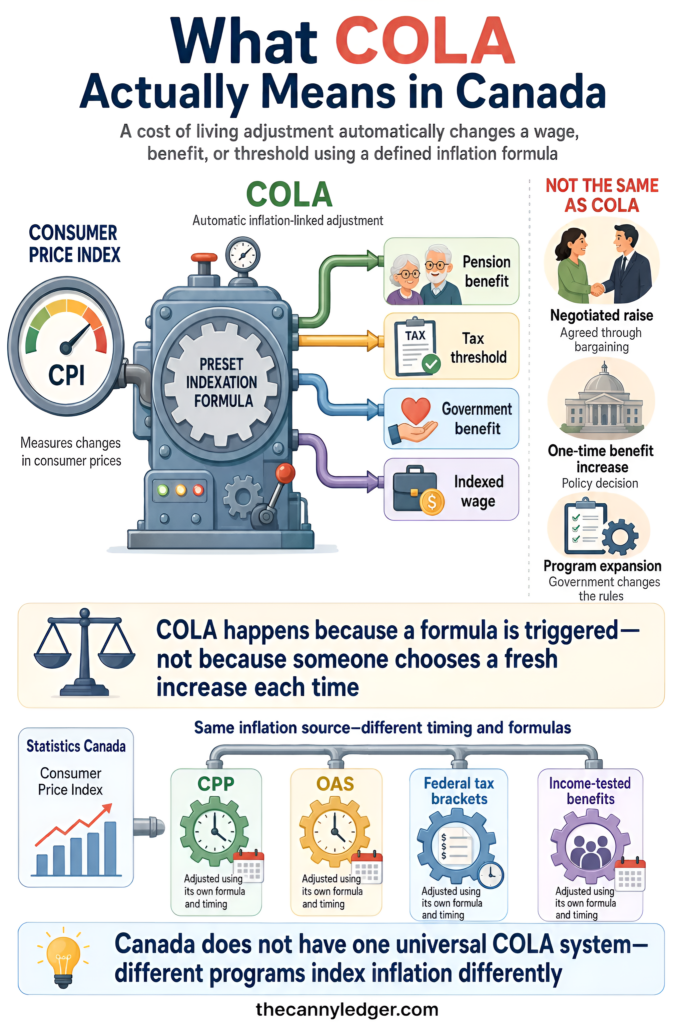
A cost of living adjustment, or COLA, is an automatic increase applied to a wage, benefit, or tax figure to keep pace with inflation, measured through Canada’s Consumer Price Index. In Canada, COLA isn’t one single system. CPP adjusts annually every January, OAS adjusts quarterly, federal tax brackets adjust every January 1, and income-tested benefits like the Canada Child Benefit adjust every July 1, each using its own specific CPI comparison window. Understanding that these are separate mechanisms, not one unified process, is the first thing that clears up most of the confusion around when and why a number on a government cheque actually changes.
What COLA Actually Means, and What It Doesn’t
A cost of living adjustment is specifically an increase tied to a measured inflation figure, applied through a formula rather than decided fresh each time by a person or a committee. That distinction matters, since it separates COLA from a raise, a benefit expansion, or a policy change, all of which can also increase what someone receives but aren’t triggered by the same inflation-tracking mechanism. A union negotiating a 4% wage increase in a new contract isn’t applying a COLA. A government indexing CPP to the Consumer Price Index every January is.
Canada’s Consumer Price Index, maintained and published by Statistics Canada, is the shared measurement most COLA formulas in this country actually rely on, even though the specific comparison period, calculation method, and timing differ wildly depending on the program. That shared foundation is why multiple, seemingly unrelated numbers, a pension payment, a tax bracket, a benefit threshold, can all move in roughly the same direction in a given year without being the product of one single decision.
CPP’s Once-a-Year Adjustment
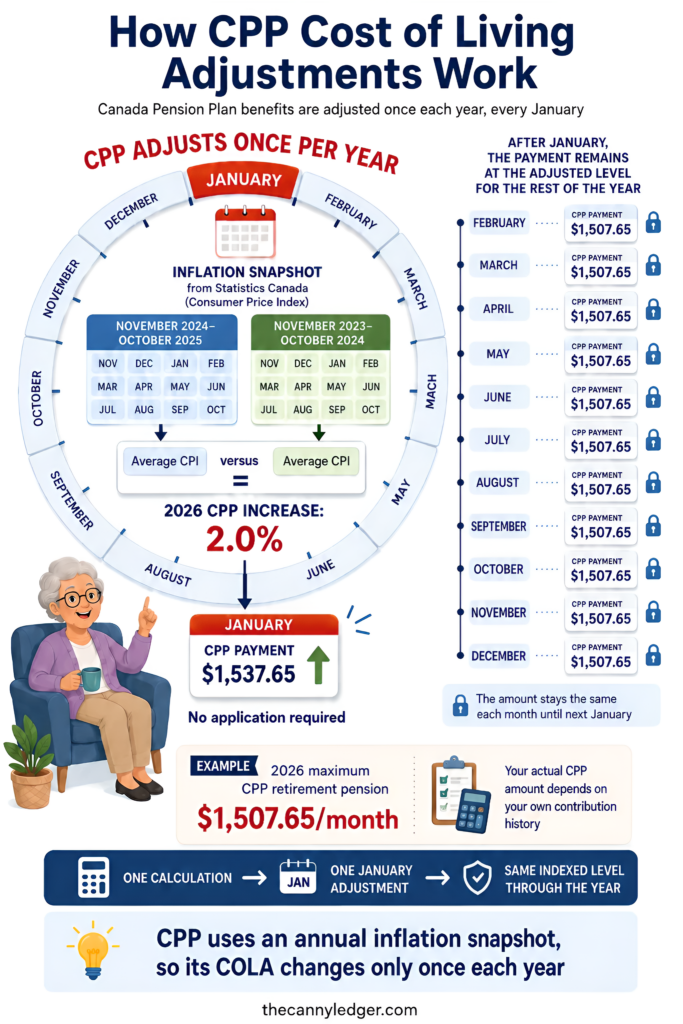
The Canada Pension Plan runs on the simplest schedule of any major federal program tied to inflation. According to the Government of Canada’s own explanation of CPP indexation, CPP benefit amounts are adjusted once a year, every January, based on the percentage change in average CPI between two specific twelve-month periods. For the January to December 2026 adjustment, the calculation compared the average CPI from November 2024 to October 2025 against the same measurement from November 2023 to October 2024, landing on a 2.0% increase applied automatically to every CPP benefit starting that January.
No CPP recipient needs to apply for this increase or take any action to receive it. It’s built directly into the legislation governing the program, which is exactly what separates a true COLA from a discretionary benefit increase a government might announce as a one-time political decision. The maximum CPP retirement pension for 2026 sits at $1,507.65 a month as a direct result of that 2.0% calculation, up from the 2025 maximum, though the specific amount any individual receives still depends on their own contribution history, worth checking directly against Manitoba’s own average income figures if you’re trying to picture how CPP fits into a broader retirement budget.
OAS Runs on a Faster Clock
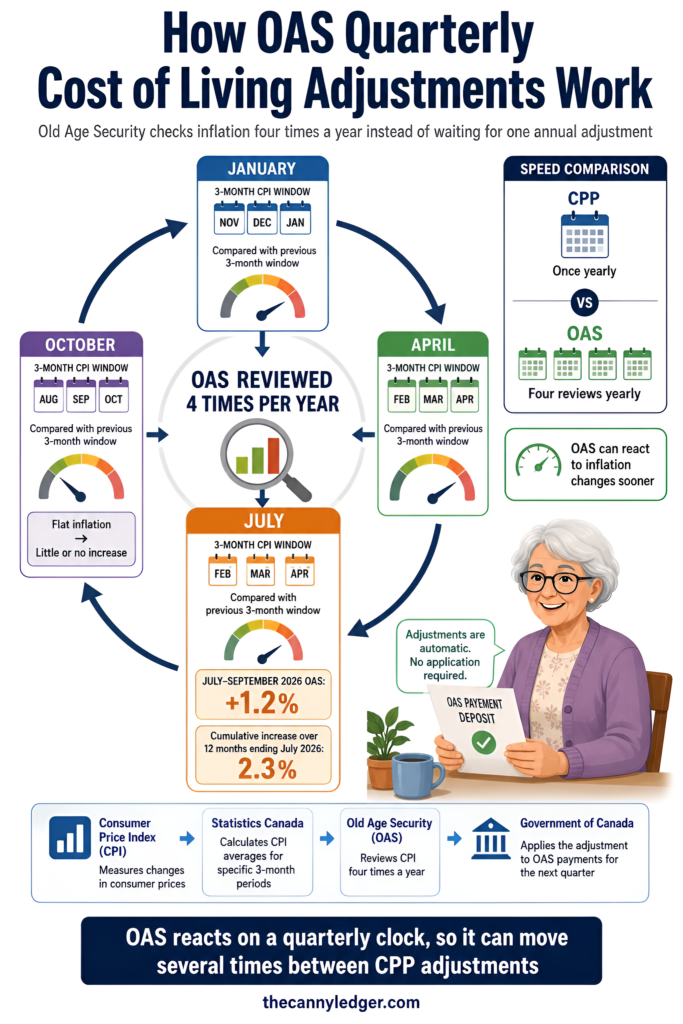
Old Age Security takes an entirely different approach to the same underlying goal, and the difference is worth understanding directly if you receive both benefits and have ever noticed they don’t seem to move together. OAS payment amounts are reviewed four times a year, in January, April, July, and October, each time comparing a rolling three-month average CPI figure against the previous comparison period rather than waiting for one annual calculation the way CPP does. For the July to September 2026 quarter specifically, OAS benefits increased 1.2%, calculated by comparing the average CPI from February through April 2026 against the average from the prior comparison window, bringing the cumulative OAS increase to 2.3% over the twelve months ending in July 2026.
That quarterly structure means OAS responds to inflation faster than CPP does, for better or worse. A sudden inflation spike shows up in an OAS adjustment within a few months rather than waiting up to a year the way it would for CPP, but it also means OAS payments can technically see a quarter with a negligible increase, or even no increase at all, if inflation happens to be flat during that specific three-month comparison window, something that’s functionally impossible to observe with CPP’s single annual snapshot.
Your Tax Bracket Adjusts Too, on a Completely Different Calendar
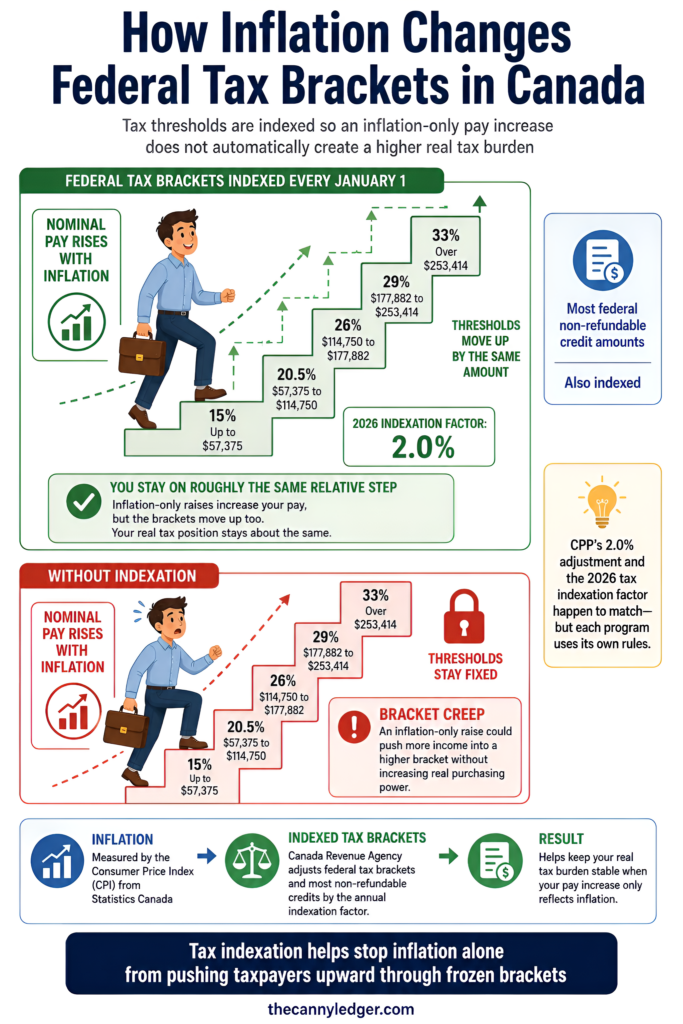
This is the piece of the COLA system most people never think about as an adjustment at all, since it doesn’t arrive as a cheque or a payment increase. According to the Canada Revenue Agency’s own indexation adjustment page, federal tax bracket thresholds and most non-refundable credit amounts are indexed to inflation using Statistics Canada’s CPI data, with the CRA confirming a 2.0% indexation factor for the 2026 tax year, identical to CPP’s own 2.0% figure for the same year, a coincidence of shared underlying inflation data rather than one program copying the other’s formula.
The practical effect of this indexation is called avoiding bracket creep, the situation where a purely inflationary raise pushes someone into a higher tax bracket without any real increase in their purchasing power. Without annual indexation, a worker whose wage only kept pace with inflation could still end up paying a higher effective tax rate purely because the dollar figures marking each bracket stayed frozen while their nominal income rose. Indexing the brackets themselves prevents that outcome, which is exactly why this adjustment matters even though it never shows up as a distinct payment landing in anyone’s account.
Why Benefits and Tax Brackets Don’t Update on the Same Day
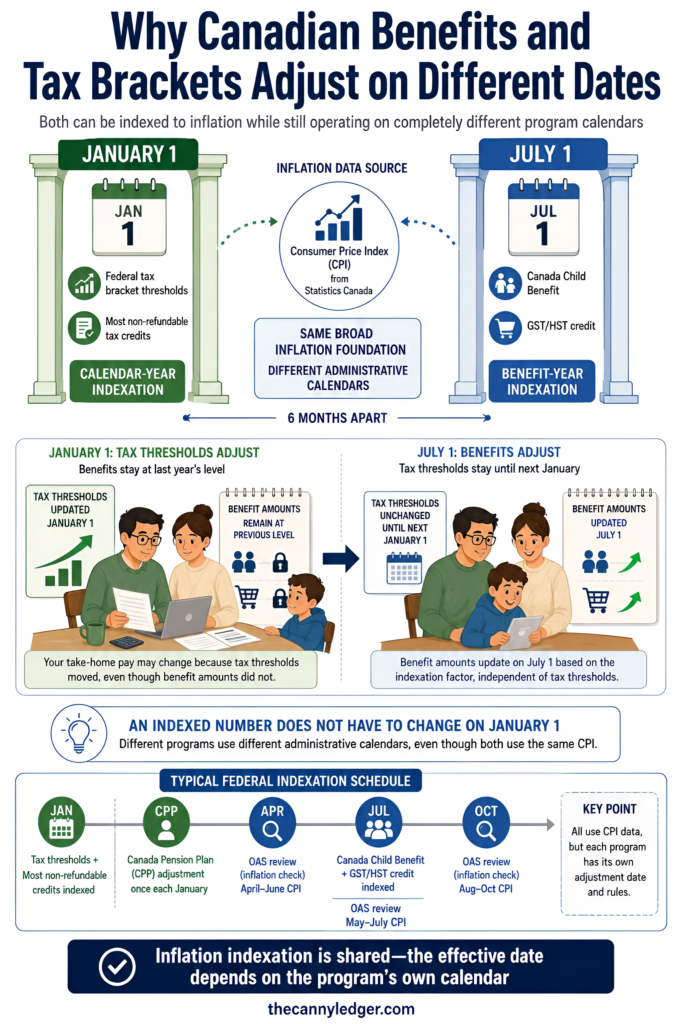
Here’s a detail that trips people up specifically because it seems like it should be simpler than it is. The CRA’s own indexation page states plainly that increases to tax bracket thresholds and non-refundable credit amounts take effect January 1, while increases to income-tested benefits like the goods and services tax credit and the Canada Child Benefit take effect July 1 instead, timed to coincide with the start of that benefit’s own program year rather than the calendar year.
That split explains why someone might notice their tax bracket numbers change at the start of a new year while their Canada Child Benefit payment, or their GST and HST credit, stays flat for another six months before jumping in July. Both are truly indexed to the same underlying CPI data and the same broad indexation factor, they’re simply built around two different administrative calendars that happen to overlap the same tax year without ever landing on the same specific date.
Minimum Wage Uses the Same Underlying Idea, Provincially
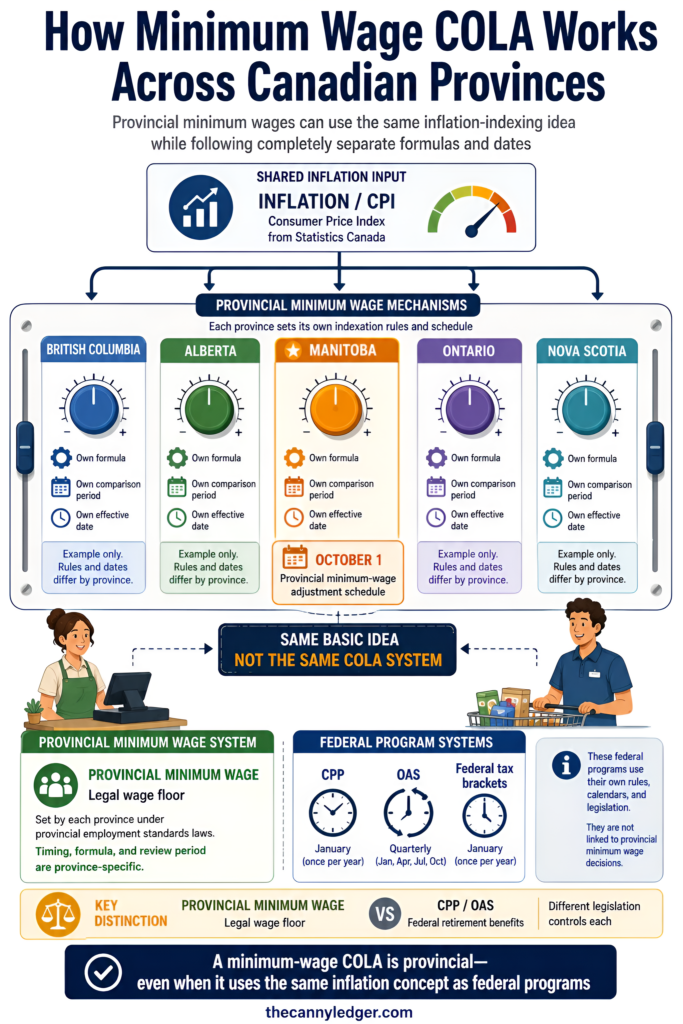
Provincial minimum wage indexation, covered in detail elsewhere on this site, operates on the same core COLA logic, tying an annual increase to a measured inflation figure, but with each province running its own formula, comparison period, and effective date entirely independently of the federal programs above, a history worth reading in full if you want to understand how that shift toward automatic formulas happened in the first place. That’s worth flagging here specifically because it means a Manitoba worker watching their own minimum wage rise every October 1 is experiencing a real cost of living adjustment, just one governed by an entirely separate provincial mechanism with no direct link to how CPP, OAS, or federal tax brackets are calculated.
When COLA Comes From a Union Contract Instead of a Government Formula
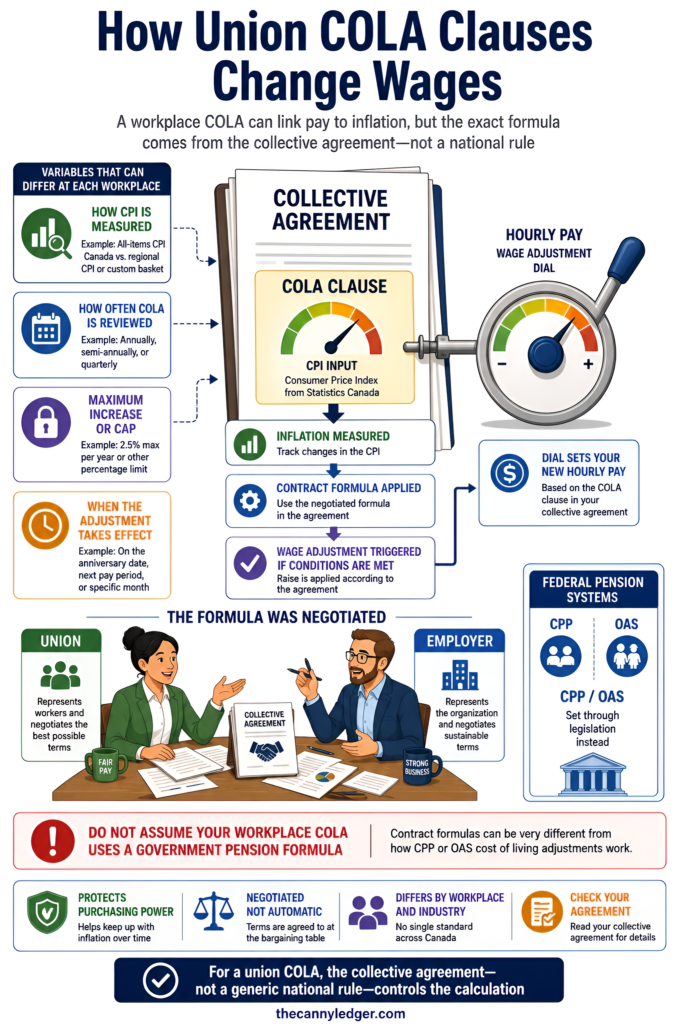
Outside government programs entirely, the term COLA shows up regularly in unionized workplaces, where it means something slightly different again. A collective agreement can build in its own COLA clause, an automatic wage adjustment tied to CPI and negotiated directly between a union and an employer, functioning independently of any federal or provincial program. These clauses vary enormously from one contract to the next in how they’re calculated and how often they trigger, and unlike CPP or OAS, there’s no single national formula to point to, since each one is the product of a specific negotiation rather than legislation.
What This Actually Means for Budgeting Your Own Income
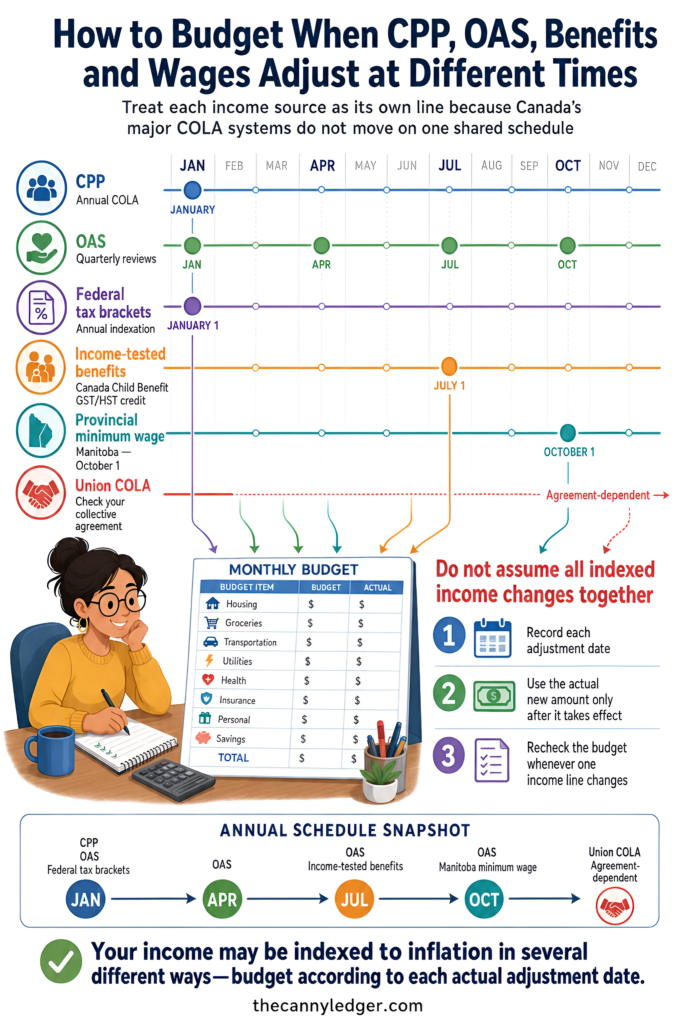
Anyone receiving both CPP and OAS should track them as two separate lines with two separate adjustment schedules rather than assuming they move together, since a year with a small January CPP bump can still see OAS moving several more times before the calendar resets. Planning around a tax refund or a benefit payment specifically means checking whether the number you’re waiting on falls under the January indexation calendar or the July one, since assuming the wrong date can throw off a budget built around when money is actually expected to change. And a union COLA clause in your own paycheque shouldn’t be assumed to work the same way as any federal program, since the formula behind it was negotiated specifically for your workplace, not set by a piece of national legislation.
Questions Worth Sorting Out Next
Does COLA ever mean a benefit decreases? No, in the sense that Canada’s major federal COLA formulas are built to move with inflation upward, not to reduce a benefit if prices fall. A quarter with very low or flat inflation can produce a minimal OAS increase, but the mechanism itself isn’t designed to claw money back through deflation.
Is provincial income tax indexed the same way as federal tax? Not necessarily. Most provinces do index their own tax brackets to inflation, but each uses its own provincial indexation factor rather than automatically adopting the federal 2.0% figure, so the exact increase can differ between your federal and provincial tax brackets in the same year.
If I’m not receiving CPP or OAS yet, does indexation still matter to me? Yes, indirectly. The Year’s Maximum Pensionable Earnings figure that determines how much CPP you and your employer contribute each year is itself adjusted annually using the same CPP indexation framework that governs the benefit side, which means the contribution side of the system moves with the same broader inflation-tracking logic, even before you’re the one collecting a cheque.