
No single grocery store in Winnipeg is reliably cheapest across every category every week. Discount banners like No Frills, FreshCo, and Walmart tend to win on packaged staples and pantry basics, while full-service stores like Sobeys and Safeway often run deeper loss-leader promotions on meat and dairy. The only way to actually save is comparing flyers weekly, not picking one “winner” and sticking with it.
- Why “The Cheapest Store” Is the Wrong Question
- The Discount Tier: Where Packaged Staples Are Usually Cheapest
- The Full-Service Tier: Where the Best Weekly Deals Actually Hide
- Winnipeg’s Only Locally Owned Grocery Chain
- The Loyalty Programs Actually Worth Carrying
- How to Actually Compare Prices This Week
- Where Grocery Costs Are Actually Headed in Manitoba
- Mistakes That Cost Winnipeggers Real Money at the Register
- What to Actually Do With This
- Frequently Asked Questions
That’s not a satisfying answer if you wanted a clean ranking. It’s the honest one, and it’s worth understanding why, because once you know how the ownership and pricing actually works underneath these store names, you’ll shop smarter than anyone chasing a single “cheapest store” headline ever will.
Why “The Cheapest Store” Is the Wrong Question
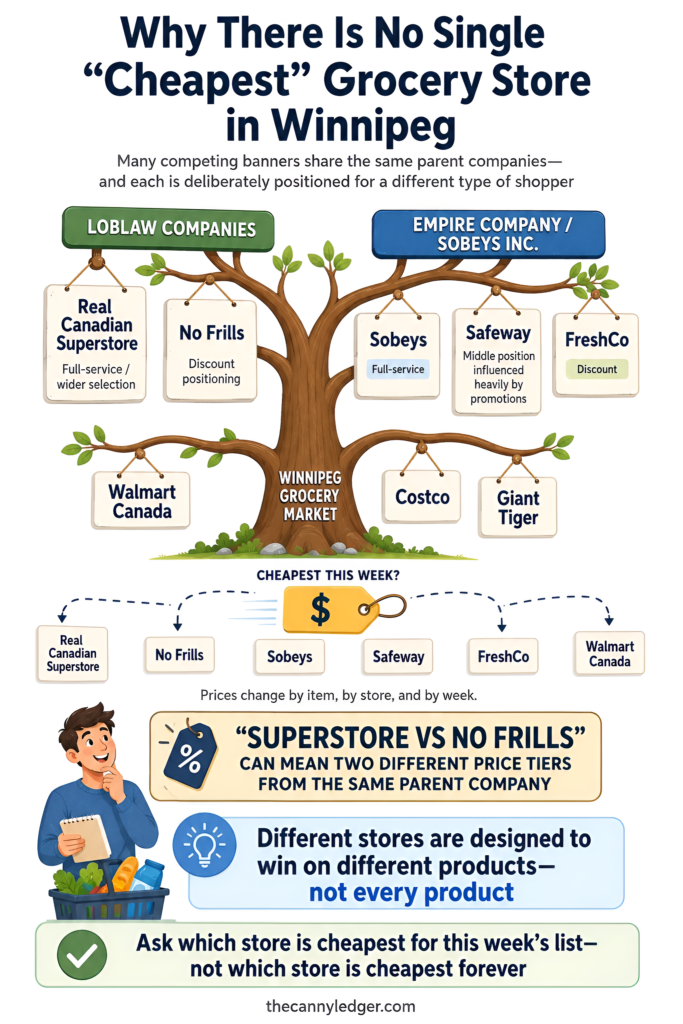
Three corporate groups control almost every major grocery banner in Winnipeg, and that consolidation is exactly why store-to-store price wars look the way they do. Loblaw Companies owns Real Canadian Superstore and No Frills. Empire Company, operating through its subsidiary Sobeys Inc., owns Sobeys, Safeway, and FreshCo. Walmart Canada and Costco are separate, and Giant Tiger is its own independent company. When you’re comparing “Superstore versus No Frills,” you’re often comparing two banners owned by the exact same parent company, each deliberately positioned to hit a different price point and shopper.
This matters more than it sounds like it should. A discount banner like No Frills exists specifically to undercut its own sister brand, Superstore, on basic packaged goods, while Superstore keeps a wider selection and nicer store experience at a slightly higher average price. Loblaw isn’t trying to make one banner win. It’s trying to capture your spending no matter which price tier you shop at. Empire runs the identical strategy with Sobeys as the full-service option and FreshCo as the discount play, with Safeway sitting somewhere in the middle depending on the location and how aggressively that particular store runs its weekly promotions.
The Discount Tier: Where Packaged Staples Are Usually Cheapest
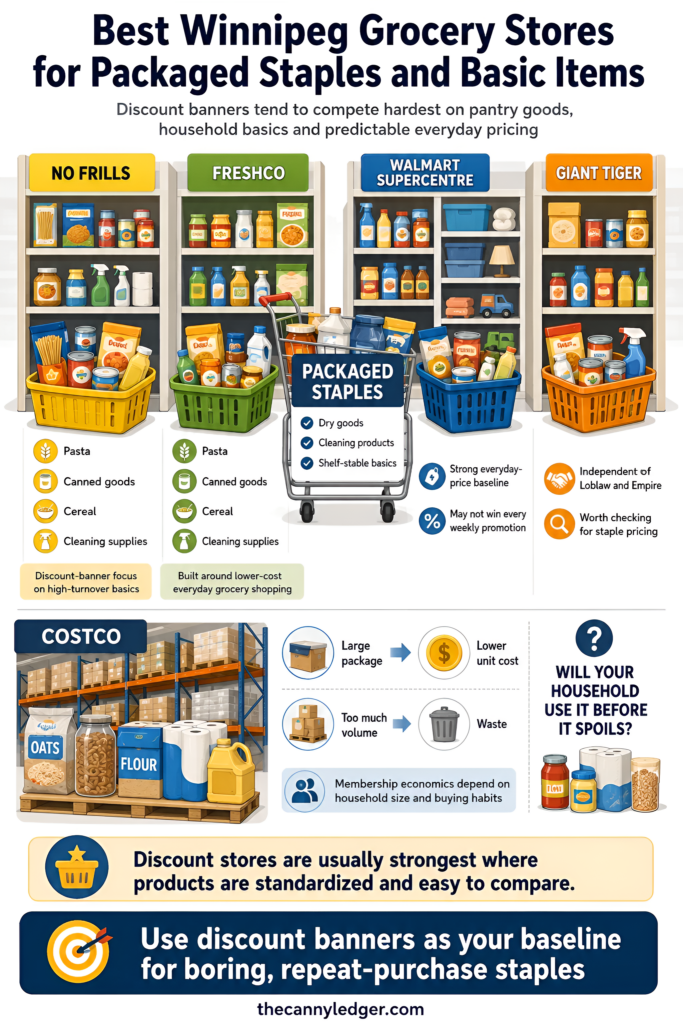
No Frills and FreshCo exist to compete on the boring stuff: pasta, canned goods, cereal, cleaning supplies, the pantry items you buy the same way every single week. Their stores are smaller, staffing is leaner, and the shopping experience is stripped down on purpose, all in service of keeping shelf prices lower on high-turnover items.
Walmart Supercentre locations run a full grocery section alongside general merchandise, and its pricing philosophy leans the same direction, everyday low prices rather than deep weekly loss leaders. That makes Walmart a strong baseline for a predictable grocery run, even if it rarely wins the single lowest price on any one item during someone else’s promotional week.
Costco plays an entirely different game built around bulk volume rather than per-unit price wars, and a membership only pays off if your household actually consumes what you buy before it goes bad. If you’re weighing whether the annual fee makes sense for your household size, Costco membership math in Winnipeg is worth running before you sign up.
Giant Tiger rounds out the discount tier as the one major banner with no ties to Loblaw or Empire at all. It’s smaller-format and general-merchandise-heavy, but its grocery pricing on staples regularly lands in the same range as No Frills and FreshCo, which makes it worth checking even though it rarely gets mentioned in the usual “big three” grocery conversations.
The Full-Service Tier: Where the Best Weekly Deals Actually Hide
Real Canadian Superstore, Sobeys, and Safeway sit in the full-service tier, larger stores with wider selection, in-house bakeries and delis, and generally higher shelf prices on everyday items than their discount siblings. But shelf price isn’t the same as what you’ll actually pay, and this is where a lot of “discount store is always cheaper” advice falls apart.
Full-service banners run the deepest loss-leader promotions in the province, meat and dairy items priced at or below cost specifically to pull shoppers through the door. A Safeway “Buy 2 Save” promotion on ground beef or a Superstore PC Optimum bonus points week can undercut every discount banner’s regular shelf price on that specific item, even while the rest of that same store’s basket runs higher than No Frills down the street. The practical upshot is that a purely discount-banner shopping habit can actually cost you more on meat and proteins than checking a full-service flyer first.

Winnipeg’s Only Locally Owned Grocery Chain
Every banner covered so far is either a national conglomerate or a multinational retailer, which makes Red River Co-op the one genuine outlier in Winnipeg’s grocery landscape. It’s a member-owned cooperative headquartered right here in the city, with five food stores inside Winnipeg (Grant Park, Southdale, St. Norbert, St. Vital, and Seasons) plus locations in Gimli, Stonewall, Lorette, and Selkirk. Membership costs a small one-time fee, and Red River Co-op stocks more than 600 Manitoba-made products on its shelves, from bakery items to ground beef the co-op describes as 100 percent Manitoba-raised.
The co-op’s history ties directly back to the national grocery consolidation story above. When Sobeys acquired Safeway in 2013, the federal Competition Bureau forced the sale of several Winnipeg locations to prevent Sobeys from controlling too much local market share, and four of those divested stores became the foundation of Red River Co-op’s current food store network. It’s a genuinely different ownership model sitting in the middle of a market otherwise split between three corporate giants, and it’s worth a visit even if you’re not chasing rock-bottom prices, since co-op members share in annual profit distributions that a conventional grocery chain simply doesn’t offer.

The Loyalty Programs Actually Worth Carrying
Every major Winnipeg banner runs a points program now, and which one is worth your wallet space depends entirely on where you already shop most. Loblaw banners, meaning Superstore and No Frills, run PC Optimum, where points redeem at a fixed rate of 10,000 points for $10 in free groceries, roughly 0.1 cents per point on standard purchases.
Sobeys, Safeway, and FreshCo all run Scene+ instead, the loyalty program co-owned by Empire, Scotiabank, and Cineplex. Scene+ points redeem at a similar rate, about $10 in savings for every 1,000 points at participating Empire banner stores, but the real advantage is flexibility. Points earned buying groceries at Sobeys can go toward a movie at Cineplex or a hotel booking through Expedia, which PC Optimum’s grocery-focused ecosystem doesn’t match.
Neither program is going to meaningfully offset a bad shopping habit. But if you’re already loyal to one banner family, signing up costs nothing and quietly returns real value over a year of regular trips.

How to Actually Compare Prices This Week
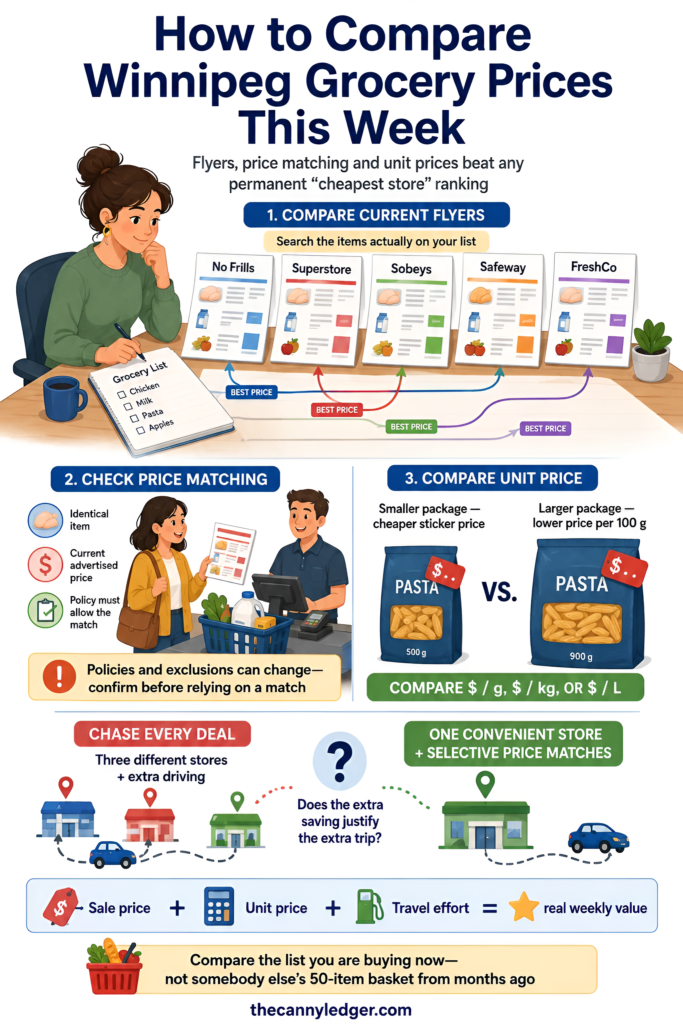
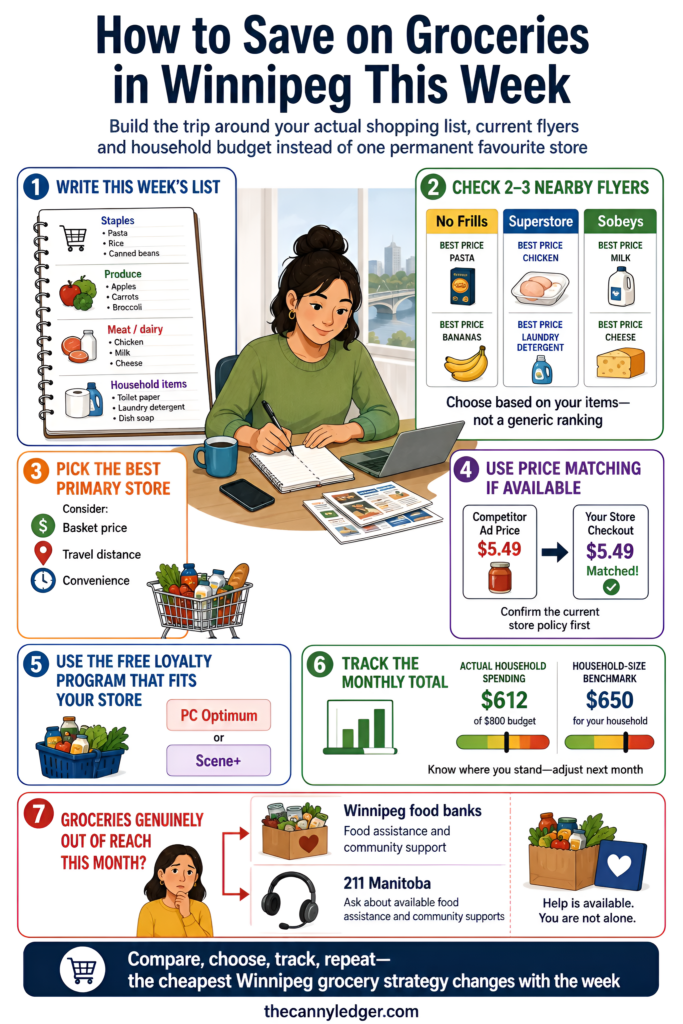
Real price comparison happens weekly, not once. Flyer aggregator apps pull every major Winnipeg banner’s current flyer into one place, letting you scan No Frills, Superstore, Sobeys, Safeway, and FreshCo side by side before you decide where to shop, rather than trusting a single store’s weekly email.
Price matching is the other tool most Winnipeggers underuse. Several discount banners in the city will match a competitor’s advertised flyer price on an identical item, meaning you can build most of your list around one store’s location convenience while still capturing the best price on individual items from a competitor’s flyer, without physically visiting multiple stores. Policies and exclusions vary by banner and change without much notice, so it’s always worth confirming at customer service before you count on it for a specific item.
Unit pricing matters more than the sticker total, especially on items sold in wildly different pack sizes across stores. A cheaper total price on a smaller package is often a worse deal per gram or per litre than a pricier bulk option, and most Winnipeg stores now post unit price alongside the shelf tag specifically so shoppers can catch this.
Where Grocery Costs Are Actually Headed in Manitoba
This isn’t just a Winnipeg curiosity. Manitoba posted the highest food inflation increase of any Canadian province between April 2025 and April 2026, at 4.9 percent, roughly a full percentage point above the national average, according to Statistics Canada data. Manitoba’s overall inflation rate tied for the highest in the country over that same period, and rising food costs were named as one of the primary drivers behind it.
That context reframes the whole “which store is cheapest” question. When an entire province is running hotter on food inflation than the rest of the country, the gap between the cheapest and priciest banner on any given week matters less than developing a habit of comparing before you shop at all. A few dollars saved per trip compounds fast against a background of rising prices, in a way that loyalty to a single “always cheapest” store never quite manages to.

Mistakes That Cost Winnipeggers Real Money at the Register
A few patterns show up again and again in how people overspend on groceries here without realizing it.
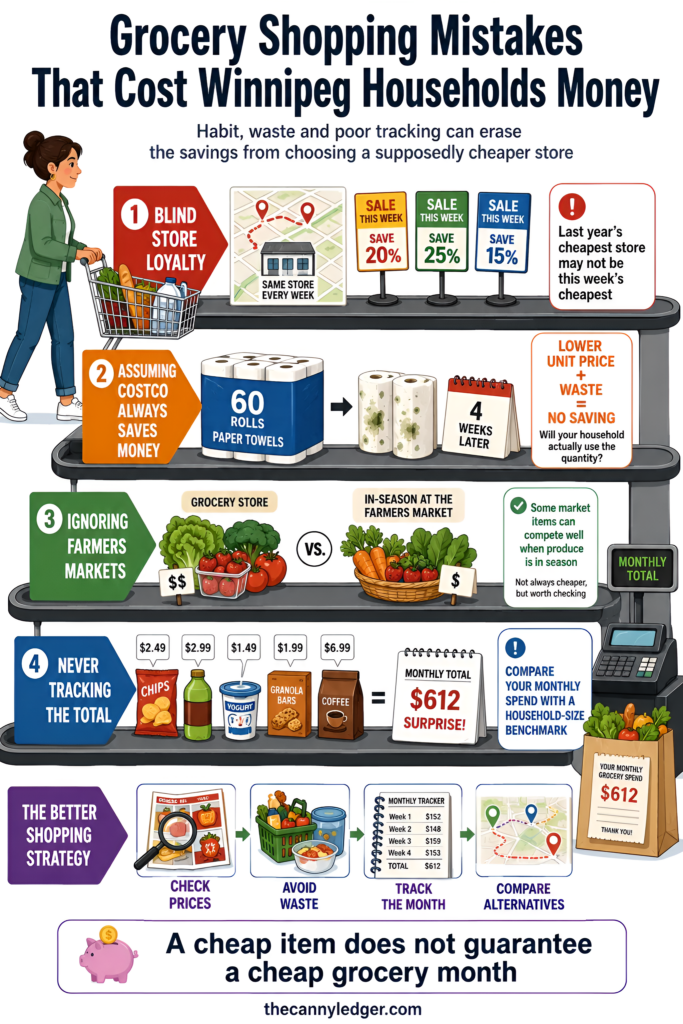
The first is brand loyalty to a single banner out of habit, without ever checking whether that store’s regular prices have drifted higher than a competitor’s over time. Grocery pricing shifts constantly, and a store that was genuinely cheapest two years ago isn’t guaranteed to hold that position today.
The second is treating a Costco membership as an automatic win. Bulk pricing only saves money if the household actually uses the volume before it spoils, and for a single person or a couple, that math frequently doesn’t favour the membership fee at all.
The third is ignoring Winnipeg’s farmers markets entirely on the assumption they’re automatically pricier than a grocery store. That’s true for some categories and false for others, particularly in-season produce bought directly from a grower, which is worth checking against your usual store’s price before writing markets off.
The fourth, and the one that actually costs the most, is not tracking your total grocery spend against what’s typical for a household your size. If you’ve never compared your own bill to a benchmark for average grocery costs in Winnipeg, you have no real way of knowing whether your current shopping pattern, whichever store you favour, is actually saving you anything at all.
What to Actually Do With This
Pick one week and try something different: before you shop, pull up flyers for two or three banners near you and build your list around whichever store wins on the specific items you’re actually buying that week, rather than defaulting to the same store out of habit. Sign up for whichever loyalty program matches your regular banner, since it costs nothing and pays out automatically. And if your household income has been feeling squeezed by Winnipeg’s broader cost of living, it’s worth checking your grocery spending against what’s typical for your household income bracket rather than guessing.
If grocery costs are genuinely tight this month rather than just an area to optimize, Winnipeg’s food banks exist for exactly that situation, and 211 Manitoba can point you toward broader food assistance programs across the city if you’re not sure where to start looking.
Frequently Asked Questions
Is Costco actually cheaper than a regular grocery store in Winnipeg? On a per-unit basis for bulk items, often yes, but only if your household consumes the volume before it spoils. For single people or small households, a regular grocery store frequently works out cheaper overall once the membership fee and food waste are factored in.
Do price matching policies work the same at every Winnipeg store? No. Policies, eligible competitors, and exclusions vary by banner and change periodically, so it’s worth confirming current terms at customer service rather than assuming last year’s rules still apply.
Are No Name and other store-brand products actually worth buying over name brands? For most pantry staples, packaged goods, and cleaning supplies, store brands from any Winnipeg banner typically cost noticeably less than name-brand equivalents with comparable quality, making them one of the most reliable ways to cut a grocery bill without changing where you shop.