

“Grant,” “bursary,” and “scholarship” get used almost interchangeably by students searching for money to help pay for school, and that confusion actually costs people real dollars. A grant, strictly speaking, is need-based, non-repayable government funding. A bursary is also need-based and non-repayable, but typically comes from an institution or a specific fund rather than directly from a government program. A scholarship is merit-based rather than need-based, awarded for academic performance, a specific talent, or a defined set of criteria, regardless of financial circumstance. All three are worth pursuing, all three show up under different applications with different deadlines, and a meaningful number of students leave money unclaimed simply because they assumed applying for one covered all three. This guide walks through what’s actually available in Winnipeg specifically, sorted by where it comes from and what you need to do to actually get it.
- Federal grants: the largest non-repayable piece for most students
- The Manitoba Bursary: provincial, automatic, and easy to overlook
- University entrance awards: the automatic-versus-apply distinction that trips people up
- Indigenous-specific funding worth knowing about directly
- International students: a genuinely different funding landscape
- Looking beyond your own institution
- Rounding out your funding picture
- The bottom line
Federal grants: the largest non-repayable piece for most students
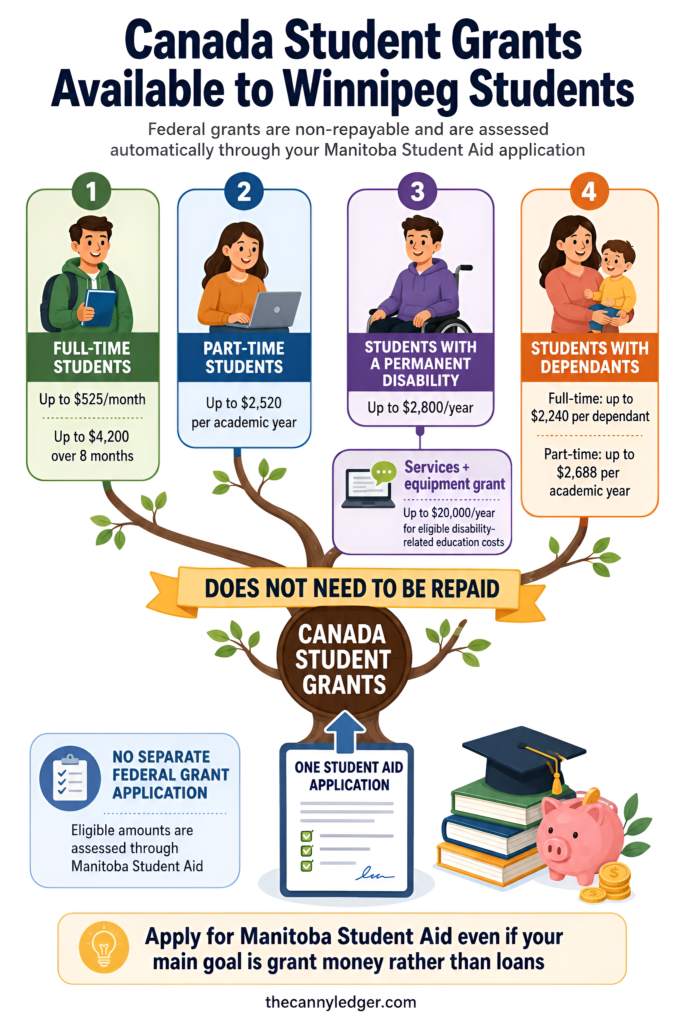
Canada Student Grants form the backbone of non-repayable funding for the majority of students, distributed through the same integrated application covered in our Manitoba Student Aid guide rather than a separate process. Full-time students can receive up to $525 a month, working out to as much as $4,200 across a standard eight-month academic period. Part-time students qualify for up to $2,520 per academic year under a separate stream. Students with a documented permanent disability can receive up to $2,800 annually, on top of a separate Grant for Services and Equipment for Students with Disabilities worth up to $20,000 a year for disability-related educational costs specifically. Students supporting dependants qualify for additional amounts on top of their base grant, up to $2,240 per dependant for full-time students and $2,688 per academic year for part-time students. None of this needs to be repaid, and it’s automatically assessed as part of the same Manitoba Student Aid application, meaning there’s no separate form to track down for the federal grant piece specifically.
The Manitoba Bursary: provincial, automatic, and easy to overlook
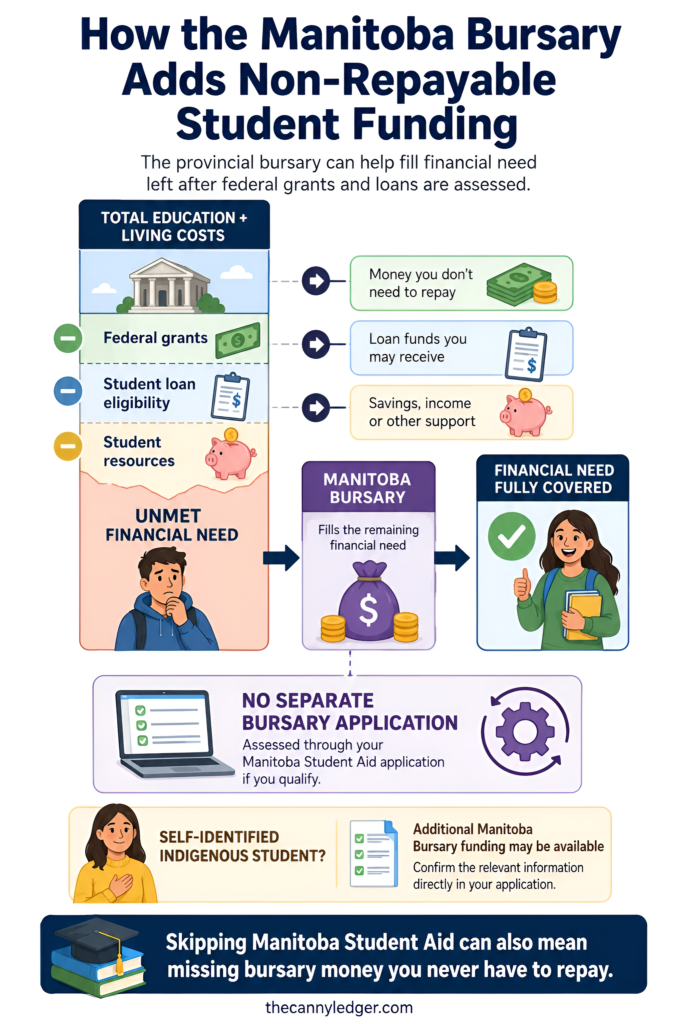
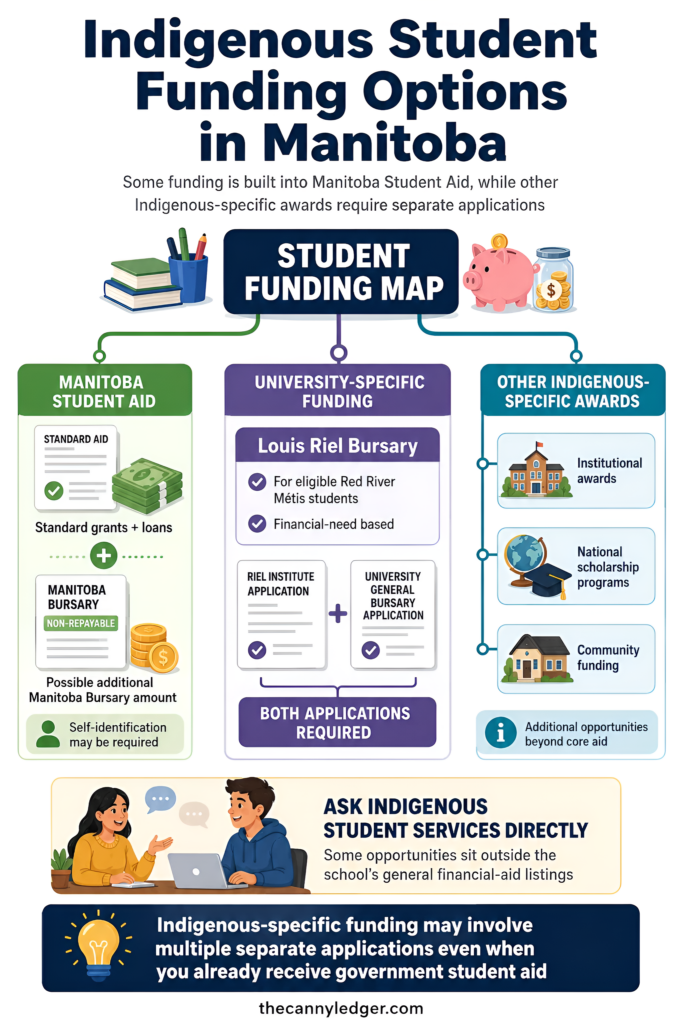
The Manitoba Bursary is the province’s own non-repayable contribution, calculated after your federal grant and loan eligibility has been assessed, specifically to reduce whatever remaining need your federal funding doesn’t cover. It’s disbursed automatically as part of your overall Manitoba Student Aid package if you meet the income thresholds, meaning there’s genuinely no separate application to submit, a detail worth knowing specifically because it means the biggest mistake a student can make here is simply not applying for Manitoba Student Aid at all under the assumption that only loans are on offer. Self-identified Indigenous students may qualify for an additional Manitoba Bursary amount on top of the standard calculation, worth confirming directly on your application rather than assuming it’s applied automatically without that self-identification step.
University entrance awards: the automatic-versus-apply distinction that trips people up
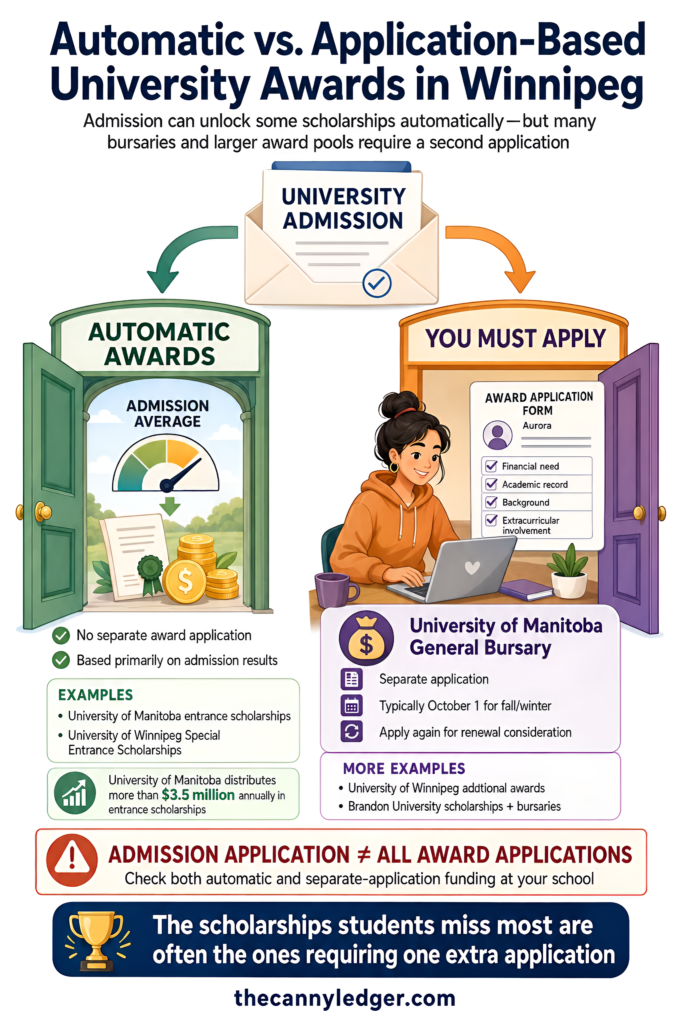
This is genuinely the most overlooked category of student funding in Winnipeg, and understanding one specific distinction changes how much of it you actually claim. Both major Winnipeg universities award a meaningful share of their scholarship money automatically, based purely on your admission average, with no separate application required at all. The University of Manitoba distributes over $3.5 million annually in entrance scholarships this way, and eligible incoming students are considered automatically through the regular admissions process. The University of Winnipeg runs a comparable automatic system through its Special Entrance Scholarships, again triggered by your admission average with no extra paperwork.
Where students consistently leave money on the table is in the second category: awards that require a genuinely separate application, distinct from admission itself and distinct from the government aid application covered elsewhere in this series. The University of Manitoba’s General Bursary, need-based and worth anywhere from a few hundred dollars up to well over a thousand, requires its own application through the university’s Aurora student portal, with a fall/winter deadline that typically falls October 1st and a separate spring/summer window. It’s renewable for up to three years provided you maintain a full-time course load and a modest minimum grade point average, but renewal isn’t automatic either; you file the same application again each year you want to be considered. The University of Winnipeg runs a comparable structure, with additional entrance scholarships beyond the automatic ones requiring an application through its own awards portal that weighs academic record, financial need, background, and extracurricular involvement together rather than admission average alone.
Brandon University, Manitoba’s third public university, distributes a comparable share of its own funding, close to $3.8 million annually, through a mix of automatic entrance awards tied to high school average and additional application-based scholarships and bursaries. Whichever institution you’re attending or considering, the practical takeaway is the same: check your specific school’s financial aid or awards office directly for both categories, since the automatic money arrives whether you ask or not, but the application-based money, often the larger and more numerous pool, requires you to actually submit something before a fixed deadline.
Indigenous-specific funding worth knowing about directly
Beyond the additional Manitoba Bursary amount available through self-identification, Manitoba’s universities run dedicated funding streams specifically for Indigenous students. The University of Manitoba’s Louis Riel Bursary, administered jointly through the university and the Riel Institute, is available to Red River Métis students demonstrating financial need, requiring both a Louis Riel Bursary application through the Riel Institute and the university’s own general bursary application, submitted separately by the same October deadline. Similar dedicated funding exists at other institutions and through Indigenous-specific scholarship programs run by national organizations, and it’s worth asking your institution’s Indigenous student services office directly about the full range available, since these programs frequently sit outside the general financial aid office’s standard advertising.
International students: a genuinely different funding landscape
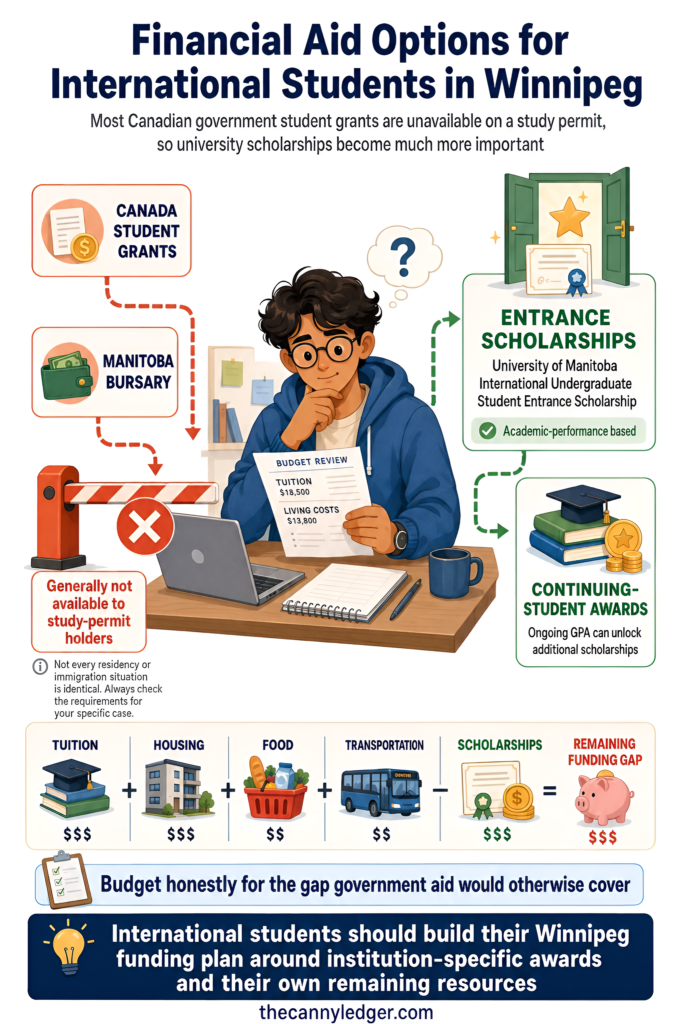
If you’re studying in Winnipeg on a study permit, most of the government funding described above, Canada Student Grants and the Manitoba Bursary among them, isn’t available to you, since these programs are generally restricted to Canadian citizens, permanent residents, and protected persons. University-specific international scholarships fill some of that gap instead: the University of Manitoba’s International Undergraduate Student Entrance Scholarship offers tiered awards based on high school academic performance, and continuing international students can qualify for renewal scholarships based on ongoing GPA. Our cost of living in Winnipeg for international students guide covers the broader financial picture worth planning around alongside whatever scholarship funding you’re able to secure, since the gap left by ineligibility for government aid is real and worth budgeting for honestly rather than assuming scholarships alone will close it.
Looking beyond your own institution
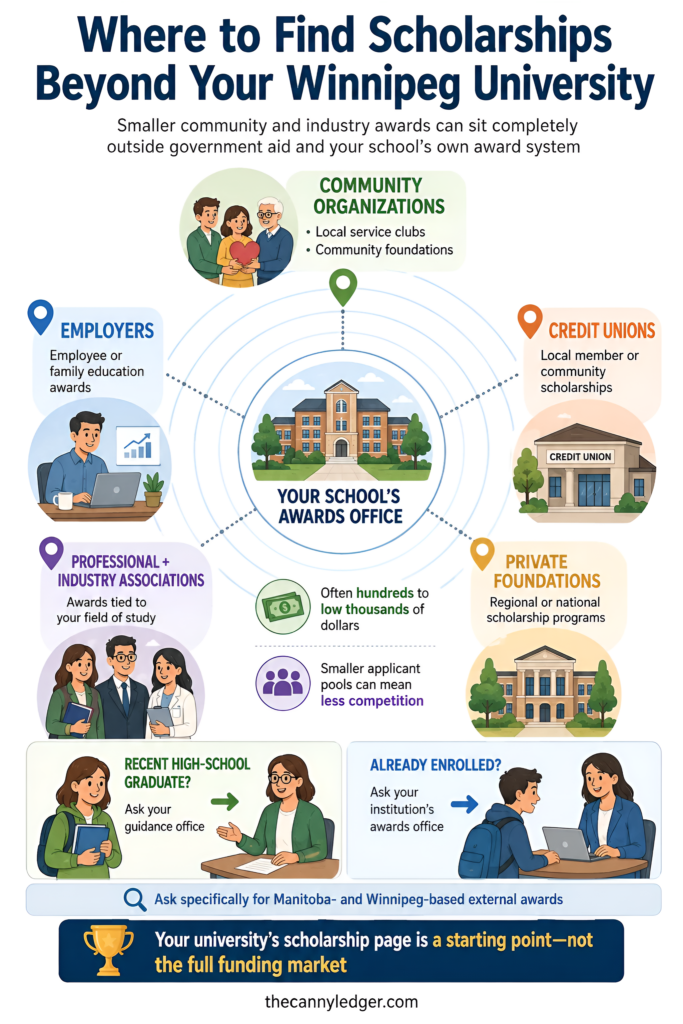
Community organizations, employers, professional associations, and private foundations all run scholarship programs that don’t route through either the government aid system or your school’s own awards office, and they’re worth actively searching out rather than assuming your institution’s financial aid office has already surfaced everything available to you. Local service clubs, credit unions, and industry associations tied to a specific field of study frequently offer smaller awards, often in the few-hundred to low-thousands range, that carry considerably less competition than large national scholarships precisely because fewer students know to look for them. Your high school guidance office, if you’re a recent graduate, and your post-secondary institution’s awards office, if you’re already enrolled, are both worth asking directly whether they maintain a list of these smaller, less-publicized opportunities specific to Manitoba or Winnipeg.
Rounding out your funding picture
Grants and bursaries rarely cover a student’s full costs on their own, and it’s worth pairing what you’ve secured here against the rest of your financial plan. Our student loans in Winnipeg guide covers the repayable side of Manitoba Student Aid if grants and bursaries don’t close the full gap, and our student line of credit in Winnipeg guide covers supplemental borrowing options beyond the government system if you need to bridge further. Our student jobs in Winnipeg and student housing in Winnipeg guides are worth reading alongside your funding plan too, since a realistic budget almost always combines grant money with at least some income and a housing decision that fits the total picture rather than assuming grants alone will cover everything.

The bottom line
The money genuinely available to Winnipeg students spans federal grants, a provincial bursary, university-specific entrance and need-based awards, Indigenous-specific funding streams, and a wider pool of community and private scholarships most students never think to search for. None of it arrives automatically except the narrow slice tied directly to your admission average, which means the real work here isn’t finding out this funding exists, it’s building the habit of checking every application window separately and actually submitting before each one closes. That habit, more than any single scholarship, is what separates students who fund their education efficiently from those who leave real money unclaimed simply because nobody told them a second application existed.