
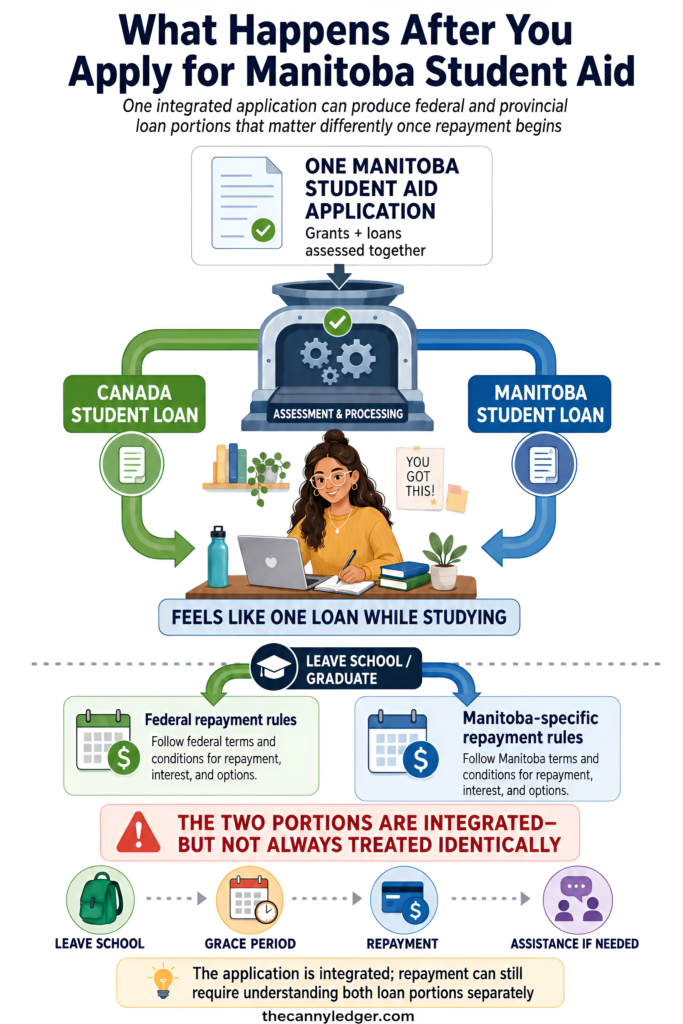
Manitoba borrowers deal with a quirk that catches a lot of graduates off guard the first time they run into it: your student loan isn’t actually one loan, it’s two, a federal Canada Student Loan and a separate Manitoba provincial loan, bundled together for the application and disbursement but not always treated identically once repayment starts. Most provinces have fully folded their repayment assistance into the same federal system, but Manitoba is one of a small handful where you may need to deal with the province directly, not just the federal loan centre, when your income drops and you need help with payments. That distinction, more than anything else, is worth understanding clearly before you’re actually in repayment and trying to figure out who to call.
- The application, briefly
- What “interest-free” actually means right now
- The six-month grace period, and what to do with it
- How the standard repayment schedule works
- The Repayment Assistance Plan: your safety net if income is tight
- The part specific to Manitoba borrowers
- Other relief options worth knowing about
- What happens if you simply don’t pay
- Fitting this into your broader financial picture
- The bottom line
The application, briefly
If you haven’t already gone through the application process itself, our companion guide, Manitoba Student Aid: How to Apply & What’s Covered, covers eligibility, the single integrated application, and what actually gets funded in far more depth than makes sense to repeat here. This guide picks up from where that one leaves off, focused specifically on what happens to the loan portion of your funding once you leave school, since that’s the part with the most moving pieces and the most room for a graduate to make an avoidable, costly mistake.
What “interest-free” actually means right now
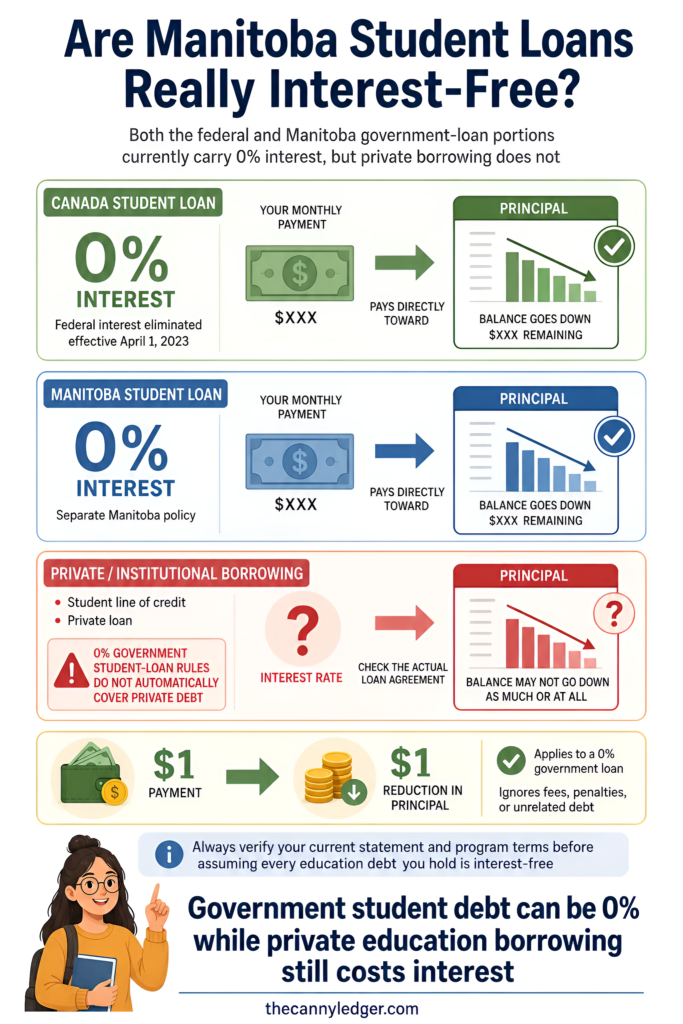
Both halves of a Manitoba-integrated student loan currently carry 0 percent interest, but the two got there through different mechanisms worth understanding. The federal government made Canada Student Loans permanently interest-free effective April 1, 2023, a policy change rather than a temporary pause, meaning every payment you make on the federal portion goes entirely toward principal with nothing skimmed off for interest, for as long as that policy remains in place. Manitoba’s provincial loan portion is interest-free on a separate basis specific to the province, and Manitoba is among a small group of provinces, alongside Nova Scotia, New Brunswick, Newfoundland and Labrador, and Prince Edward Island, that have eliminated provincial student loan interest entirely, a genuinely different position from provinces like Ontario, Saskatchewan, or Quebec, where the provincial portion still accrues interest at a rate tied to prime even though the federal portion doesn’t.
Practically, this means a Manitoba graduate’s real cost of borrowing is close to the principal amount alone, provided both federal and provincial policy stay where they currently sit. It’s worth checking your specific loan statement rather than assuming this applies automatically to every dollar you borrowed, particularly if you took out any private or institutional financing alongside your government loans, since none of what’s described here extends to non-government lending.
The six-month grace period, and what to do with it
Repayment doesn’t begin the day you finish school. You get a six-month grace period, with your first payment due on the first day of the seventh month after you leave your program, whether that’s through graduation, withdrawal, or dropping below full-time status. No interest accrues on the federal portion during this window, and Manitoba’s permanent 0 percent policy means none accrues on the provincial portion either. This grace period is genuinely useful time, not just a courtesy delay: any voluntary payment you make during those six months goes entirely toward your principal balance, meaning it’s one of the few moments in the entire repayment process where paying early has a direct, uncomplicated benefit rather than simply shifting money around a still-accruing balance.

How the standard repayment schedule works
Once repayment begins, the National Student Loans Service Centre, the federal body that administers loan repayment even for the provincial portion of an integrated loan, automatically assigns a repayment term based on your total balance, ranging from as short as 18 months for smaller balances up to the standard 114-month term, just under ten years, for balances above roughly $7,000, which describes the majority of borrowers carrying a meaningful amount of debt. You’re not locked into this default: you can request a different term directly through the NSLSC before your first payment comes due, and you can also pay ahead of schedule at any point with no prepayment penalty, which is worth doing whenever your finances allow it given that every extra dollar goes straight to principal on an interest-free loan.

The Repayment Assistance Plan: your safety net if income is tight
If your income after graduation doesn’t comfortably support the standard payment schedule, the Repayment Assistance Plan exists specifically to prevent that gap from turning into default. Under recent enhancements to the program, no borrower is required to make any payment at all until they’re earning at least $40,000 a year, a threshold that adjusts upward based on family size, and for borrowers above that line, the required monthly payment is capped at no more than 10 percent of household income rather than the full standard payment. If your reduced RAP payment doesn’t cover the interest that would otherwise accrue, the government covers that gap directly, meaning your balance doesn’t grow even while you’re paying less than the standard amount.
You can apply for RAP as soon as you enter repayment, and at any point afterward if your circumstances change, but approval isn’t permanent: you need to reapply every six months to stay on the plan, which makes it worth calendaring a reminder rather than assuming an approval carries forward automatically. No borrower under RAP will be required to repay for longer than 15 years total, or 10 years for borrowers with a documented disability, after which any remaining balance is forgiven outright.

The part specific to Manitoba borrowers
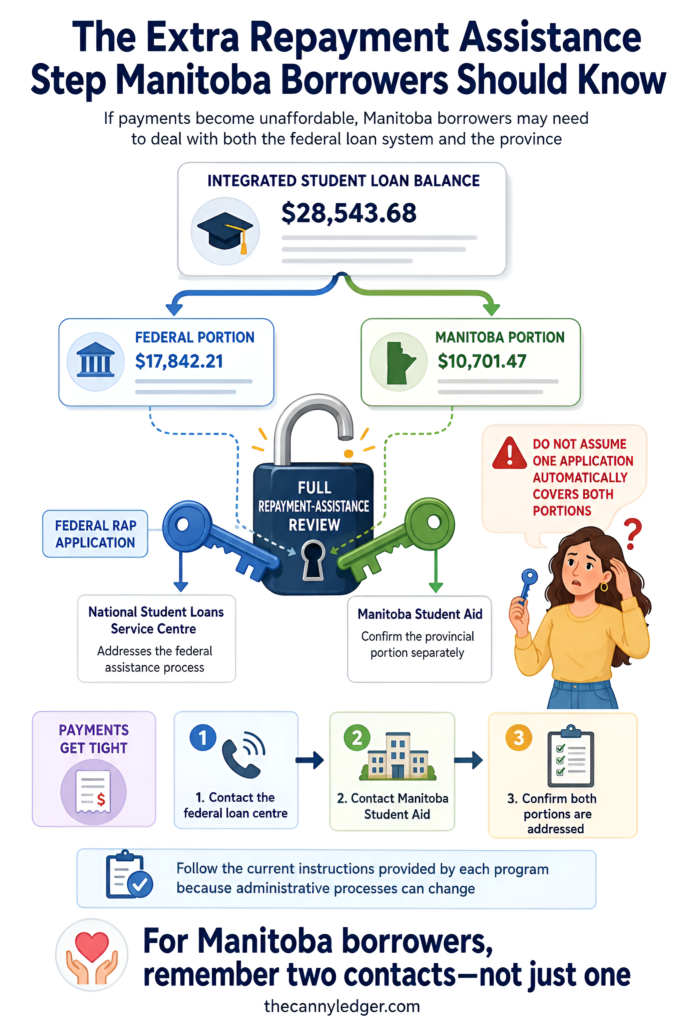
Here’s the detail that catches people off guard: while most provinces have fully integrated their repayment assistance into the single NSLSC application, Manitoba is specifically named, alongside Prince Edward Island, as a province where borrowers must also apply for repayment assistance directly with the province, not just through the federal NSLSC system, to get relief on the provincial portion of an integrated loan. Skipping this second step doesn’t just mean missing out on provincial help, it can mean the provincial portion of your loan continues accruing payment obligations even while your federal portion is successfully enrolled in RAP. If you’re struggling with payments, treat the federal RAP application and a direct call to Manitoba’s student aid office as two separate, both-necessary steps rather than assuming one covers the other.
Other relief options worth knowing about
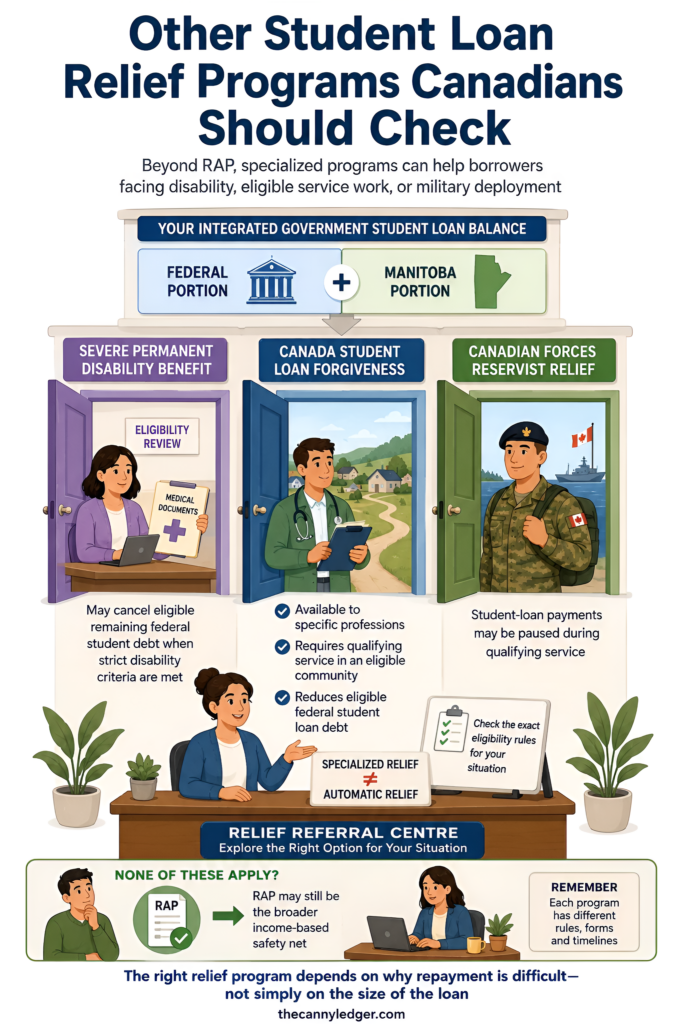
Beyond RAP, a handful of other programs exist for specific circumstances. The Severe Permanent Disability Benefit can result in outright cancellation of remaining federal student debt for borrowers whose disability limits their ability to work for the rest of their life, a genuinely significant benefit worth exploring directly with the NSLSC if this applies to your situation. Canada Student Loan Forgiveness exists for graduates working in specific eligible occupations, family physicians, nurses, and certain other health professionals prominently among them, within eligible underserved communities, forgiving a portion of federal loan debt in exchange for service in areas facing genuine shortages. And Canadian Forces reservists on a designated operation are not required to make payments on their student loans during that period. None of these apply broadly, but each is worth a direct check if your situation might qualify.
What happens if you simply don’t pay
Missing payments without engaging any of the relief options above has real consequences. Missed payments get reported and negatively affect your credit rating, the same as any other missed debt obligation, which can follow you into future borrowing, an apartment rental credit check, or other situations where your credit history gets pulled. If you’re behind on payments right now, the better move is contacting the NSLSC and Manitoba’s provincial office directly rather than letting the situation continue unaddressed, since both RAP and the direct provincial process are available to borrowers already behind, not just those proactively managing on-time payments.

Fitting this into your broader financial picture
Student loan payments, even at zero interest, are still a real monthly obligation worth budgeting against honestly alongside everything else. Our Manitoba and Winnipeg personal income tax guide is worth reading if you’re trying to understand how any remaining interest paid on non-government student debt, or other education-related amounts, factors into your annual return, and our tax refunds in Winnipeg guide covers what to do with a refund if you’re weighing extra loan payments against other financial priorities.
If your student loan is one piece of a broader debt picture that’s grown harder to manage, our credit counselling in Winnipeg guide covers free, non-profit options for a full financial review, and our debt consolidation in Winnipeg guide is worth reading specifically to understand how student debt typically fits, or doesn’t, into a broader consolidation plan. And if you’re still in school and weighing whether additional borrowing beyond your Manitoba Student Aid package makes sense, our student line of credit in Winnipeg guide covers that supplemental option directly, including how its interest terms differ meaningfully from the government loan programs covered throughout this guide.

The bottom line
A Manitoba student loan today is about as favourable a debt as exists in this country, permanently interest-free on both the federal and provincial portions, with a genuine six-month runway before payments start and a real safety net if your income doesn’t support the standard schedule right away. The one thing worth committing to memory before you need it: if repayment gets tight, apply for RAP through the NSLSC and contact Manitoba’s student aid office directly, not one or the other, since this is one of the few provinces where both steps genuinely matter.