
A teacher working in a small Manitoba town has had up to $30,000 in student loan forgiveness available since December 31, 2025, and most teachers in that exact situation have no idea the program exists yet. The federal government quietly expanded Canada Student Loan Forgiveness that day, adding ten professions that had never qualified before, teachers, social workers, dentists, dental hygienists, pharmacists, midwives, physiotherapists, psychologists, early childhood educators, and personal support workers, to a program that had previously covered only family doctors and nurses. It’s one of the most concrete, dollar-specific forms of genuine debt forgiveness available in Canada right now, and it sits alongside a much murkier picture for other debt types, where the word “forgiveness” gets used far more loosely than what actually happens.
Student Loan Forgiveness Just Got Meaningfully Bigger
The core program itself has existed since 2013, originally built around a straightforward problem, rural and remote communities across Canada struggle to attract doctors and nurses, and forgiving student debt was designed as a direct financial incentive to work there. Family physicians and family medicine residents working in an eligible community can now have up to $60,000 in Canada Student Loan debt forgiven over five years, and nurses or nurse practitioners up to $30,000, following a 50 percent increase to both amounts that took effect in November 2023. The eligibility bar for what counts as a qualifying community also expanded around the same time, now covering any population centre or rural area with 30,000 residents or fewer.
The genuinely new part is the expansion to ten additional professions effective December 31, 2025. Teachers, social workers, physiotherapists, psychologists, dentists, dental hygienists, pharmacists, and midwives can now access up to $30,000 in forgiveness over five years under the same rural and remote framework, while early childhood educators and personal support workers qualify for up to $15,000 over the same period. The forgiveness amount builds gradually rather than arriving all at once, a smaller amount in year one climbing to a larger figure by year five, structured specifically to reward staying in the community rather than a single short placement. Applications from these newly eligible professions began processing through the National Student Loans Service Centre in March 2026, and the benefit applies directly against your outstanding federal loan balance rather than arriving as cash in hand. This is real forgiveness in the fullest sense of the word, your actual loan balance goes down, permanently, with no repayment obligation attached to the forgiven portion. It only applies to the federal share of a Canada Student Loan specifically, not a provincial loan, a private loan, or a loan that’s already been converted to a line of credit, and it requires genuinely working and providing in-person services in an eligible community rather than simply living near one.

What Actually Happens To Credit Card Debt
Real forgiveness for credit card debt is far narrower than student loan forgiveness, and it’s worth being direct about that gap. Outside a formal consumer proposal filed through a Licensed Insolvency Trustee, where creditors legally agree to accept less than the full balance owed, there’s no standard program that simply erases credit card debt in Canada. Individual card issuers occasionally negotiate directly with a struggling cardholder, but this happens case by case rather than through any published, guaranteed program, and it’s not something to count on as a plan. Our full breakdown of debt management plans against formal debt settlement covers the structured options that actually exist for this specific debt type, since a debt management plan through a non-profit counsellor reduces interest rather than principal, while a consumer proposal is the genuine path to reducing what you actually owe.

The Medical Debt Myth That Doesn’t Quite Apply Here
A lot of debt forgiveness content online, including plenty that ranks well for Canadian searches, was written for an American audience dealing with a genuinely different problem, medical debt from uninsured or underinsured treatment. Canada’s universal healthcare system means the category of debt that dominates American debt relief conversations, unpaid hospital bills from a medical emergency, simply doesn’t exist here in the same form. That doesn’t mean Canadians never owe money related to healthcare, cosmetic procedures, dental work beyond what a plan covers, or prescription costs can absolutely create real debt, but the specific “medical debt forgiveness” programs and nonprofits that show up in American search results generally have no Canadian equivalent, since the underlying problem they were built to solve doesn’t exist the same way north of the border.

Where Government Debt Fits Into This Picture
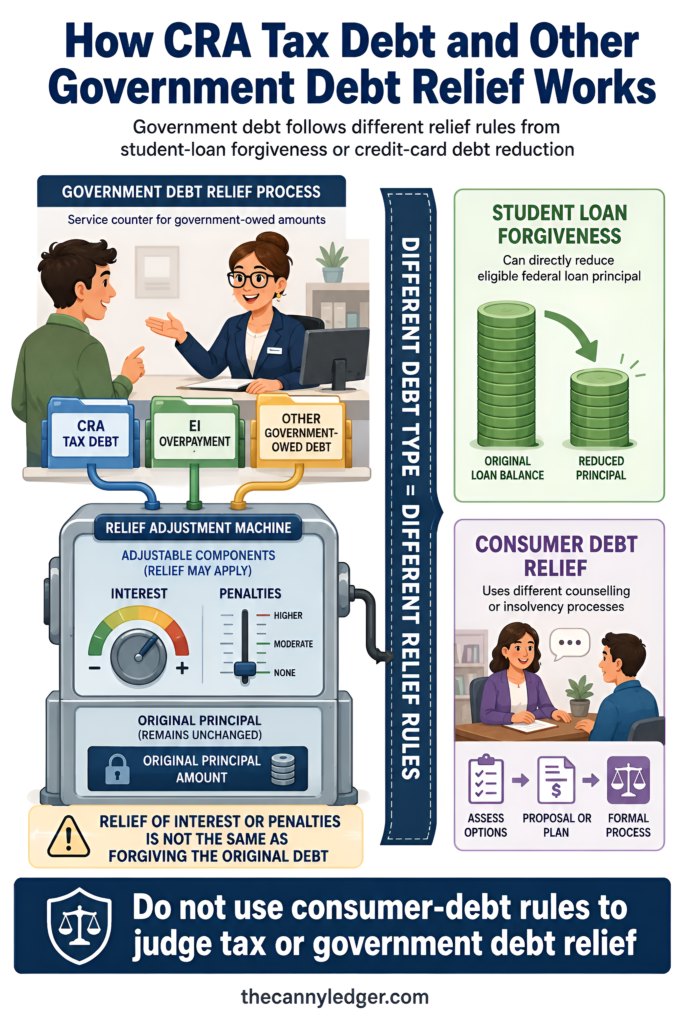
CRA tax debt, EI overpayments, and other government-owed debt follow an entirely separate relief system from anything covered here, one built around interest and penalty relief rather than forgiving the actual amount owed. Our broader guide to debt relief in Canada covers that government-specific system in full, since it operates on different rules than either the student loan forgiveness program or the consumer debt landscape covered in this piece.
What Forgiveness Actually Costs You Elsewhere
Every genuine form of debt reduction covered here carries some kind of tradeoff, even when the word “forgiveness” makes it sound consequence-free. Student loan forgiveness through this specific program costs you nothing beyond the actual work of qualifying, no credit impact, no application fee, since it’s a direct federal benefit rather than an insolvency process. A consumer proposal is a different story entirely, since reducing your credit card principal through that route comes with a real, multi-year mark on your credit file, a tradeoff covered in more depth in our guide to getting out of debt in Canada. Knowing which kind of forgiveness you’re actually pursuing, a clean federal benefit or a formal insolvency process with real consequences, matters as much as knowing whether you qualify in the first place.

Checking Where You Actually Stand
If you work in an eligible profession in a smaller community, specifically check your eligibility for Canada Student Loan Forgiveness directly through the National Student Loans Service Centre rather than assuming a program you’ve heard of only applies to doctors and nurses, since that assumption is now genuinely out of date. If credit card debt is the real problem, a conversation with a credit counsellor about whether your situation calls for a debt management plan or something more formal is worth having before assuming forgiveness in any real sense is on the table. And if you’re carrying student loan debt that doesn’t qualify for this specific forgiveness program, the Repayment Assistance Plan covered in our broader debt relief guide remains available regardless of your profession or location, a second, genuinely useful federal option worth exhausting before assuming nothing exists to help.