

Most Winnipeg food banks operate as part of Harvest Manitoba’s network, accessed by phone registration rather than a walk-in visit, requiring a Manitoba Health card or an accepted alternative for students and newcomers. Independent organizations like Agape Table and Siloam Mission also provide food support directly, some through daily meal programs rather than the hamper model Harvest coordinates, and 211 Manitoba is the most reliable live directory for finding a specific location’s current status.
- Harvest Manitoba: The Hub Behind Most Winnipeg Food Banks
- How to Actually Register and What You’ll Need
- Home Delivery for Seniors and People With Disabilities
- Beyond Harvest: Independent Food Programs Worth Knowing About
- The Meal Programs vs the Hamper Programs
- Finding the Right One Near You Right Now
- Beyond Food: Related Support Worth Knowing About
- Common Questions About Winnipeg Food Banks
Harvest Manitoba: The Hub Behind Most Winnipeg Food Banks

Harvest Manitoba operates as the central warehouse and distribution point supplying hundreds of member food banks and agencies across the province, including the majority of neighbourhood food bank locations operating inside Winnipeg itself. Rather than running as one single physical location, Harvest coordinates a network, churches, community centres, and local agencies that each host their own food bank days, all supplied from Harvest’s central warehouse and food collection operations. This structure means the specific food bank you end up attending, whether it’s at a church hall or a community centre, is almost certainly drawing its food supply from the same central organization even though it operates under a different name and location day to day.
How to Actually Register and What You’ll Need
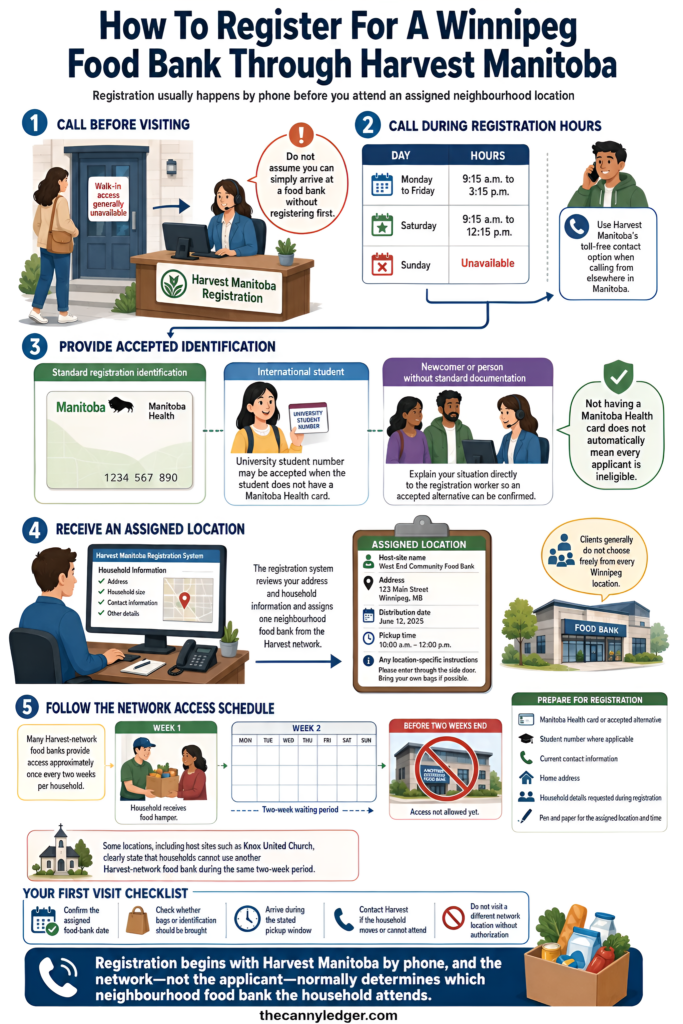
This is the part that catches a lot of first-time visitors off guard: walk-in access generally isn’t available. Registration happens by phone first, and Harvest Manitoba’s returning client line operates Monday to Friday from 9:15 a.m. to 3:15 p.m. and Saturday from 9:15 a.m. to 12:15 p.m., with a separate toll-free number for anyone calling from outside Winnipeg. A Manitoba Health card number is the standard piece of identification needed to register, though this isn’t a hard barrier for everyone, international students without a Manitoba Health card can register using their university student number instead, a detail worth knowing since it isn’t always obvious from a general food bank listing. Once registered, Harvest determines which specific food bank location you’ll be assigned to attend, rather than letting clients pick freely from the full list of network locations, and most individual food banks limit access to roughly once every two weeks per household, a detail confirmed by community host sites like Knox United Church, which specifically notes that families visiting its Tuesday food bank won’t be eligible for another Harvest-network food bank within that same two-week window.
Home Delivery for Seniors and People With Disabilities

Not every eligible person can realistically get to a scheduled food bank date in person, and Harvest Manitoba runs a delivery option specifically for seniors and people living with disabilities, arranged through the same central phone line used for standard registration. This is worth asking about directly when calling to register rather than assuming it isn’t available, since it doesn’t appear to be prominently advertised the way the standard hamper program is.
Beyond Harvest: Independent Food Programs Worth Knowing About
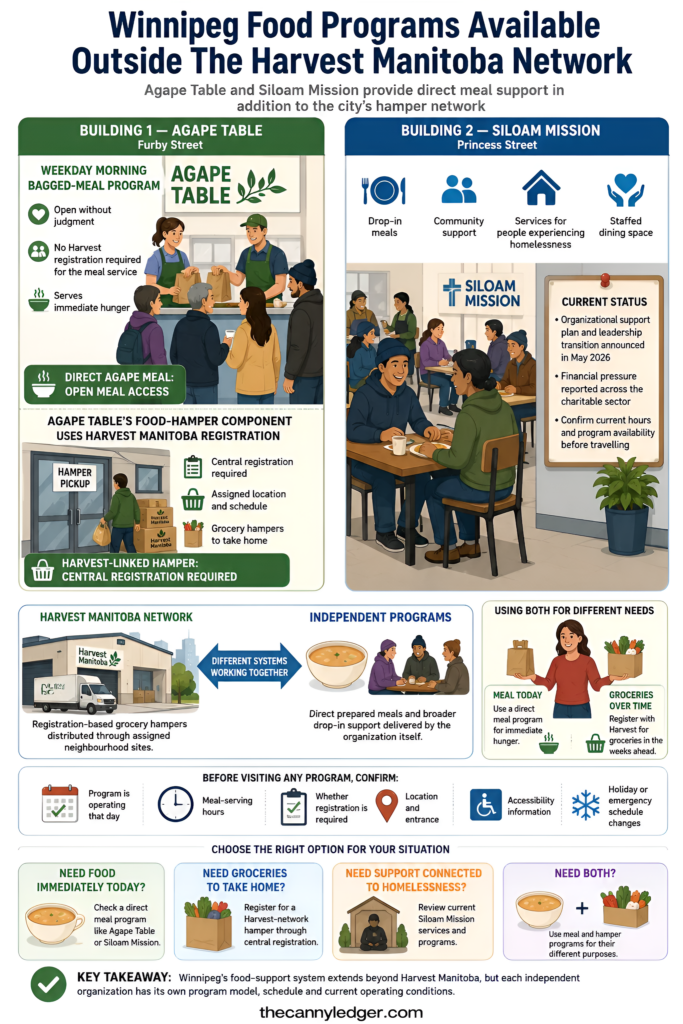
Not every source of food support in Winnipeg runs through the Harvest network, and a couple of independent organizations are worth knowing separately. Agape Table, based on Furby Street, serves a bagged meal program on weekday mornings open to anyone without judgment or eligibility screening, feeding several hundred guests on a typical weekday, alongside a separate weekly food hamper program that does route through Harvest Manitoba registration specifically for that hamper component. Siloam Mission on Princess Street has long run community drop-in meals and broader supports for people experiencing homelessness in Winnipeg, though it’s worth knowing the organization announced a six-month organizational support plan and leadership transition in May 2026, citing financial pressure across the charitable sector, so confirming current program hours and availability directly before visiting is more important here than usual given that recent instability.
The Meal Programs vs the Hamper Programs

It’s worth understanding the real difference between these two models before assuming one covers what you actually need. A hamper program, the kind Harvest Manitoba coordinates through its network of food banks, provides groceries and pantry items to take home, meant to supplement a household’s food supply over roughly two weeks between visits. A meal program, the kind Agape Table and Siloam Mission both run, serves prepared food on the spot, no registration or health card required in most cases, meant to address immediate hunger rather than ongoing household grocery needs. Someone facing food insecurity might reasonably need both at different points, a hot meal today and a hamper registration process started for the coming weeks, rather than treating them as interchangeable options.
Finding the Right One Near You Right Now

Rather than relying on a static list that inevitably goes out of date, the most reliable way to find a specific, currently operating food bank or meal program near a specific Winnipeg address is 211 Manitoba, reachable by dialing 211 directly, by phone at 1-855-275-1197, or through their online chat and search tool. This service is specifically built to stay current on which community organizations are actually operating, their hours, and their eligibility requirements, which matters given how often small, volunteer-run food bank host sites shift their schedules or, occasionally, close entirely.
Beyond Food: Related Support Worth Knowing About
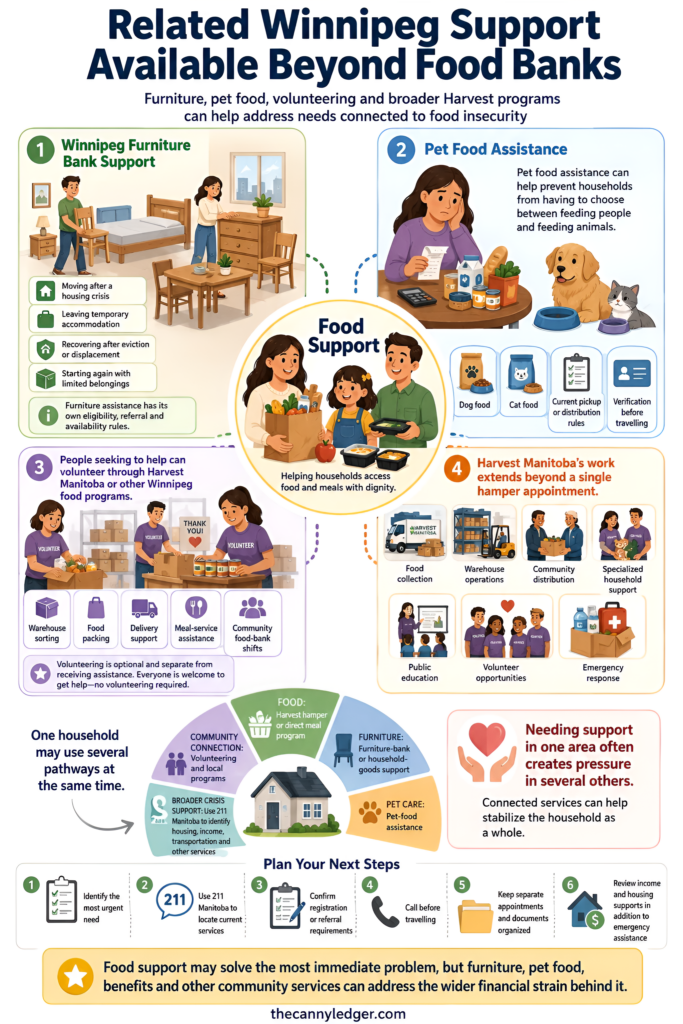
Food insecurity rarely shows up in isolation, and a few related resources are worth knowing about even if they’re not food banks themselves. Winnipeg’s furniture bank helps households furnish a home affordably, useful for anyone rebuilding after a move, an eviction, or a housing crisis alongside a food insecurity issue. Pet owners facing the same financial strain shouldn’t have to choose between feeding themselves and feeding an animal, and Winnipeg’s animal food bank exists specifically to close that gap. For anyone wanting to give back rather than access support, volunteering at a Winnipeg food bank covers exactly how that process works, and a full, dedicated look at Harvest Manitoba’s history, programs, and full scope goes considerably deeper than this overview can.
Common Questions About Winnipeg Food Banks
Do I need to be unemployed or on social assistance to use a food bank? No. Food banks in Winnipeg generally don’t require proof of employment status or income level as a condition of access, food insecurity affects working households too, and organizations like Agape Table explicitly serve anyone who’s hungry without means-testing.
Can I choose which food bank location I attend? Not typically through the Harvest Manitoba network. Registration determines your assigned location based on where you live and current capacity across the network, rather than personal preference, which is worth knowing before assuming you can simply pick the most convenient site yourself.
What happens if I need food support more often than once every two weeks? The standard hamper program’s biweekly limit is built around regular grocery supplementation rather than emergency same-day need, so anyone facing an urgent gap sooner than that should look toward the meal programs covered above, which don’t carry the same frequency restriction, or contact 211 Manitoba directly to ask about emergency food support options outside the standard hamper schedule.
Call ahead, have identification ready, whether that’s a Manitoba Health card or a student number, and don’t assume a walk-in visit will work the way it might elsewhere. Between Harvest Manitoba’s coordinated network and the independent meal programs running alongside it, real food support exists across Winnipeg, but reaching it means understanding the actual process rather than showing up at a location and hoping.