

Winnipeg’s 2026 operating budget totals $1.49 billion, funded primarily by property taxes ($842 million, 56 percent of city spending), alongside business taxes, user fees, and provincial grants, with police and fire-paramedic services consuming the largest single share. A separate $1.2 billion capital budget covers infrastructure and equipment, and unlike the federal or provincial government, the city is legally required to balance its books every year rather than run a deficit.
- Operating vs Capital: Two Very Different Budgets
- Where the Money Actually Comes From
- Police and Fire-Paramedic Eat Nearly Half the Operating Budget
- The Rest of the Pie: Transit, Public Works, and Everything Else
- Why the City Can’t Just Run a Deficit
- The Four-Year Plan Behind Every Single Year’s Number
- How Residents Actually Get a Say
- Common Questions About Winnipeg’s Budget
Operating vs Capital: Two Very Different Budgets
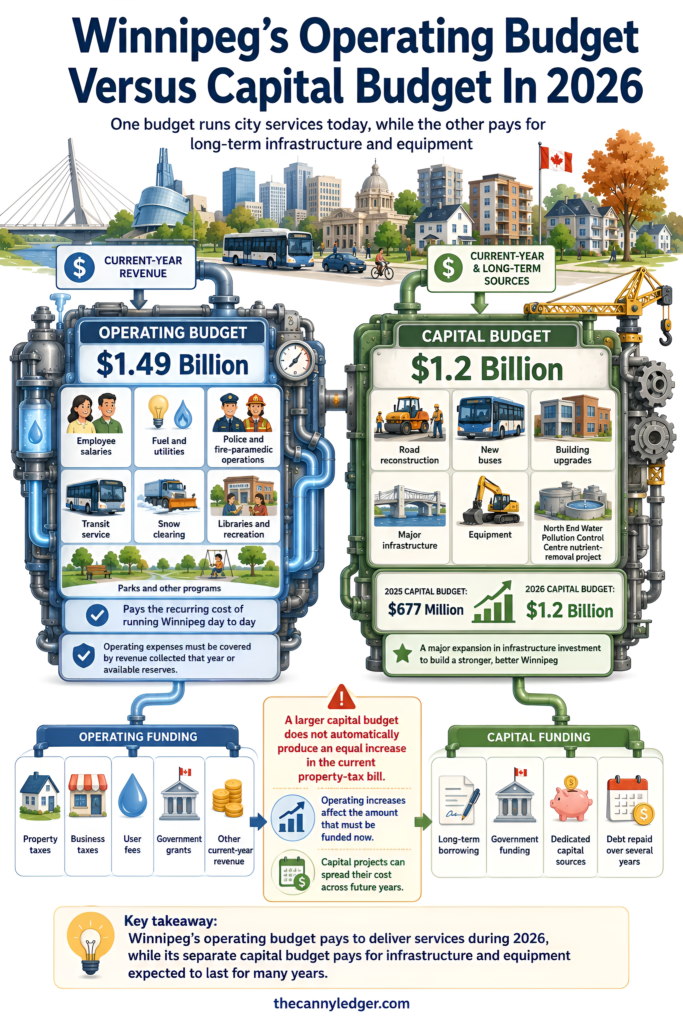
Winnipeg runs two entirely separate budgets that get discussed together but work differently. The operating budget, $1.49 billion for 2026, covers the ongoing cost of actually running the city day to day, salaries, fuel, utilities, program delivery, everything that keeps services running this year. The capital budget, $1.2 billion for 2026, up sharply from $677 million in 2025, covers one-time infrastructure and equipment spending, road reconstruction, new buses, building upgrades, and major projects like the North End Water Pollution Control Centre nutrient removal facility. Capital spending is largely funded through borrowing repaid over years, while operating spending has to be covered by revenue collected in that same year, which is exactly why a jump in capital spending doesn’t automatically mean a matching jump in your property tax bill the way an operating budget increase does.
Where the Money Actually Comes From
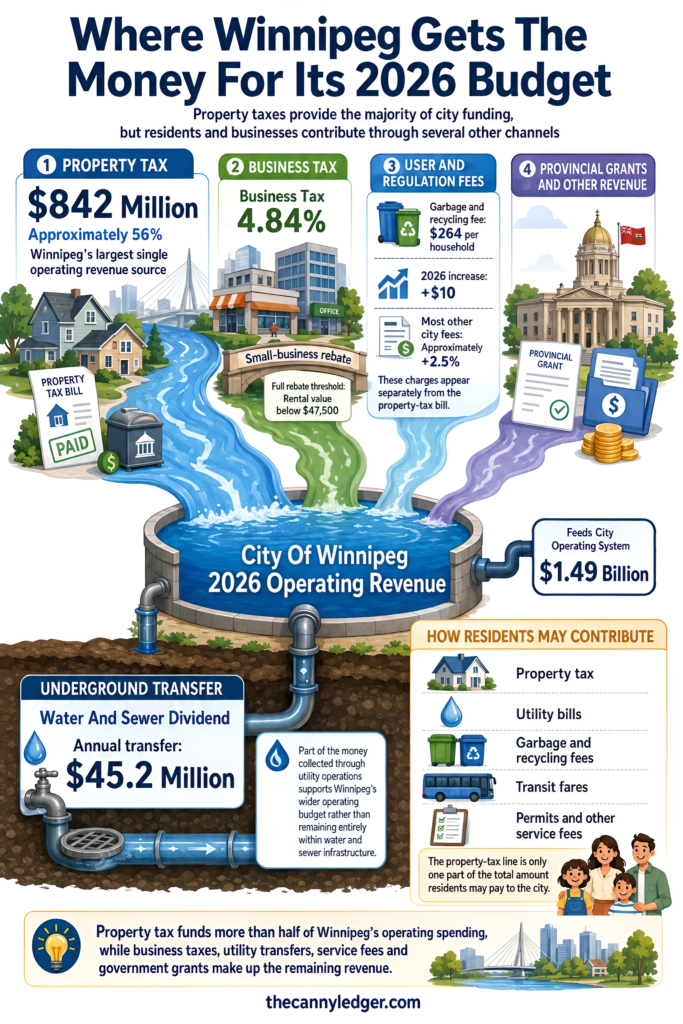
Property tax dominates the revenue side more than most residents realize. The city’s projected 2026 property tax haul of $842 million covers 56 percent of total city spending, making it by far the largest single revenue source, ahead of business tax, regulation fees, and provincial grants combined. Business tax stays at 4.84 percent for 2026, though every small business with a rental value under $47,500 receives a full rebate, exempting a meaningful share of Winnipeg’s small business community from the tax entirely. A less obvious revenue mechanism: the city diverts a $45.2 million dividend from water and sewer revenues into the general operating budget each year, meaning utility bills aren’t purely funding utility infrastructure, a portion effectively subsidizes the broader budget. Garbage and recycling fees rose $10 per household to $264 for 2026, and most other city fees increased by 2.5 percent, both landing on residents separately from the property tax line itself.
Police and Fire-Paramedic Eat Nearly Half the Operating Budget
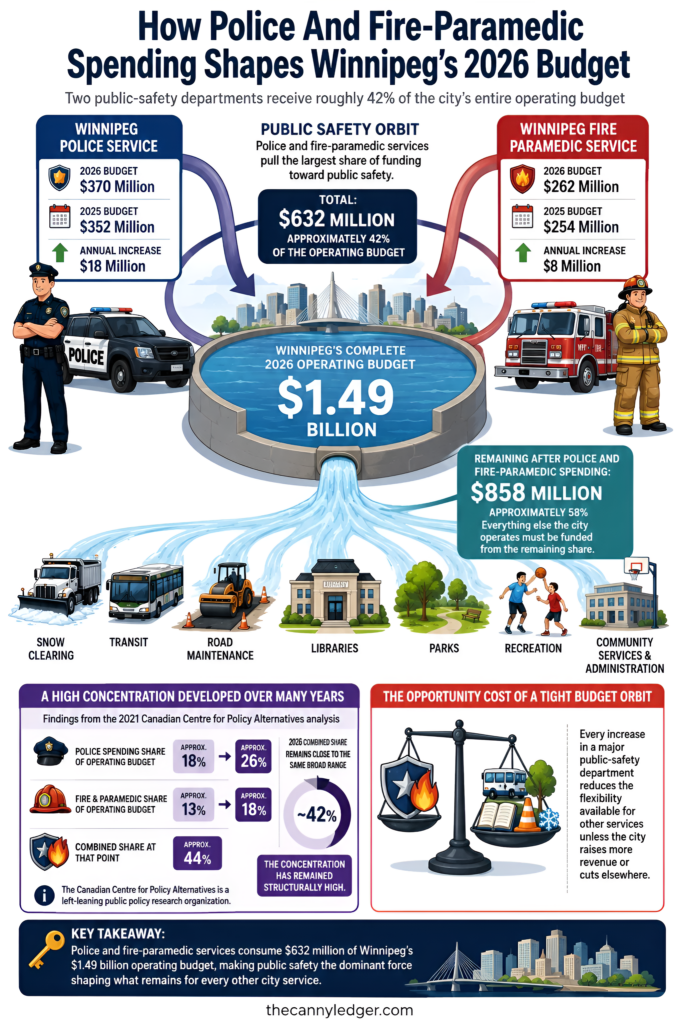
This is the single biggest structural fact about how Winnipeg spends money. For 2026, the Winnipeg Police Service budget sits at $370 million, up $18 million from $352 million in 2025, while Fire Paramedic Service sits at $262 million, up $8 million from $254 million. Together that’s $632 million, or roughly 42 percent of the entire $1.49 billion operating budget, funding two departments before anything else in the city gets covered. This isn’t a one-year spike either. A 2021 analysis from the Canadian Centre for Policy Alternatives, a left-leaning policy research organization, found police spending had grown from 18 to 26 percent of the city budget over the prior two decades, with fire and paramedic services rising from 13 to 18 percent over the same stretch, for a combined 44 percent of the entire budget by that point. The 2026 numbers land close to that same territory, suggesting this concentration has held steady rather than continuing to climb, but it remains the dominant fact shaping what’s actually left over for everything else the city runs.
The Rest of the Pie: Transit, Public Works, and Everything Else
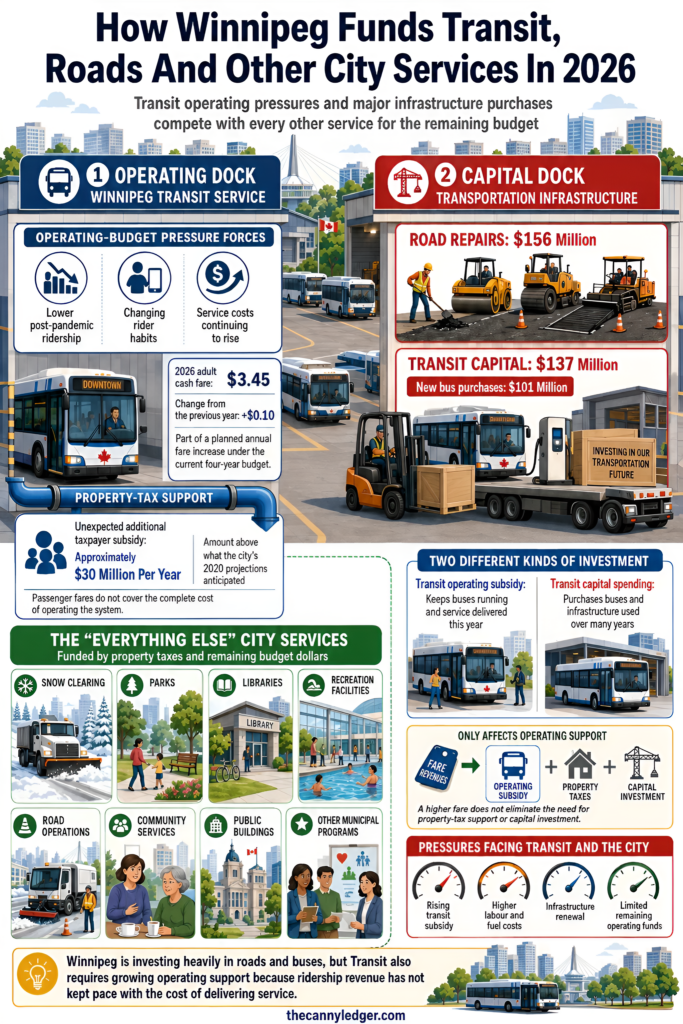
Winnipeg Transit represents one of the fastest-growing cost pressures in the entire operating budget, and not because of expanding service alone. Property tax subsidies flowing into Transit have climbed well past original projections, with the city noting taxpayers were covering $30 million more per year in Transit operating subsidies than 2020 projections anticipated, driven by lower post-pandemic ridership and changing rider habits even as service costs kept rising. Adult transit fares rise another 10 cents for 2026, to $3.45, continuing a planned annual increase built into the current four-year plan. On the capital side, road repairs alone account for $156 million of the 2026 capital budget, while Transit’s capital allocation nearly doubled to $137 million, with $101 million of that specifically for new bus purchases.
Why the City Can’t Just Run a Deficit
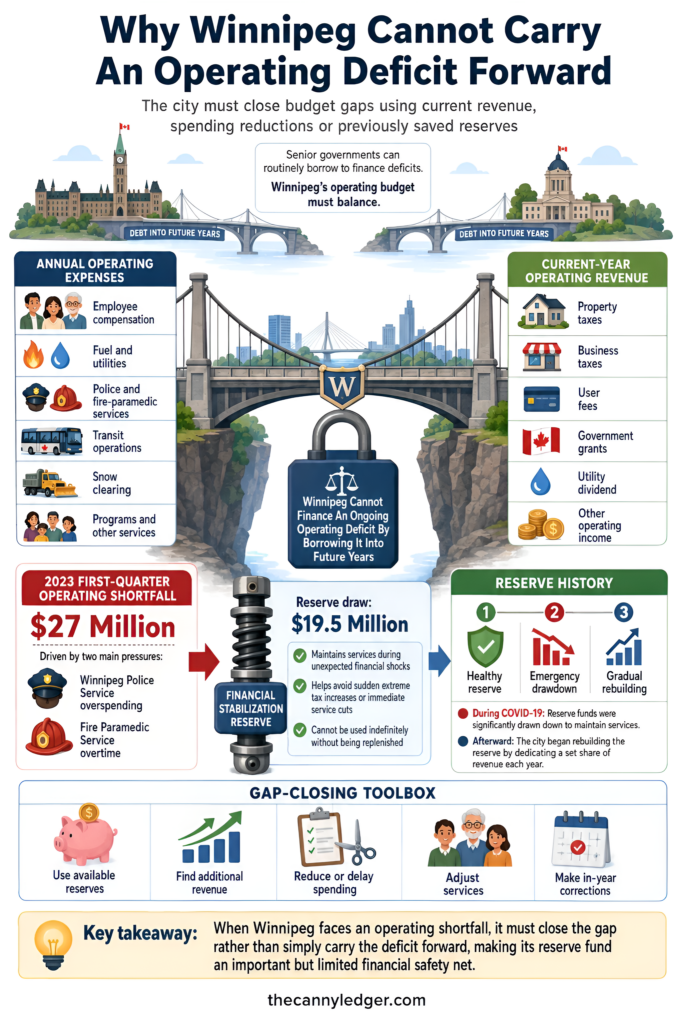
Unlike the federal or provincial government, Winnipeg is legally barred from carrying an ongoing operating deficit forward, it has to balance the books using current revenue or previously saved reserves, not by borrowing against future years the way senior governments routinely do. That constraint became very real in 2023, when the city’s first-quarter financial report projected a $27 million operating shortfall driven largely by Winnipeg Police Service overspending and Fire Paramedic Service overtime, with a $19.5 million reserve fund draw covering part of the gap. The city’s Financial Stabilization Reserve exists specifically to absorb shocks like this, but it was significantly drawn down during the COVID-19 pandemic to maintain services without steep tax hikes, and the city has since been rebuilding it, dedicating a set percentage of revenue toward the reserve each year rather than treating it as a one-time fix.
The Four-Year Plan Behind Every Single Year’s Number
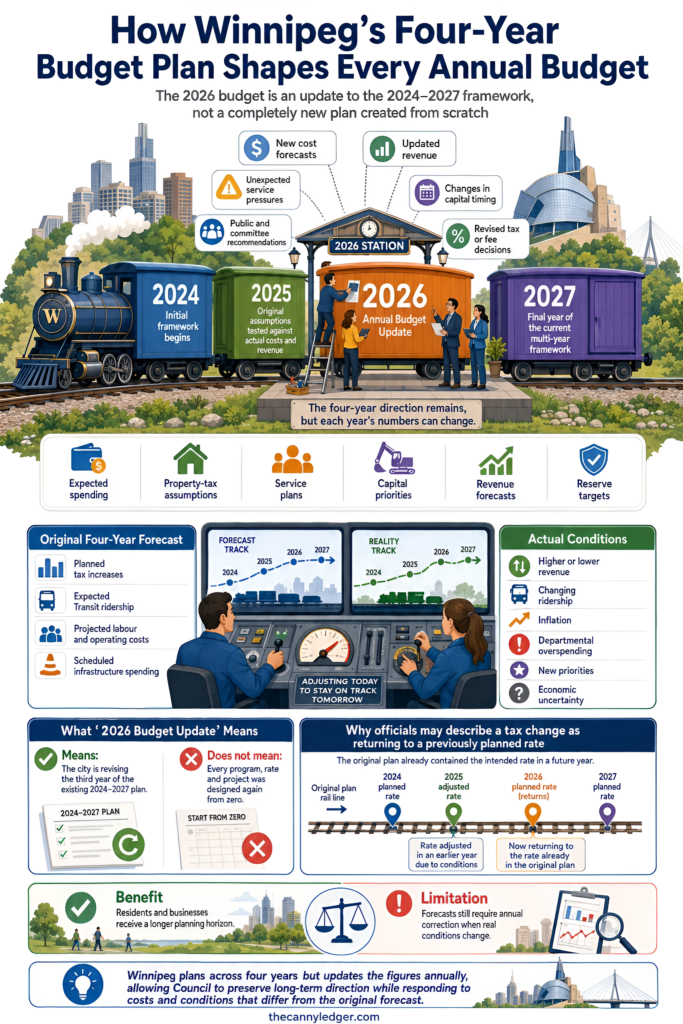
Winnipeg doesn’t set its budget fresh each January the way some cities do. The city runs on a rolling multi-year budget, currently the 2024-2027 Multi-Year Budget, which sets a general spending and tax framework for four years at once, then gets revisited and updated annually as actual conditions shift. The 2026 numbers covered throughout this piece are technically a Budget Update within that four-year plan, not a brand new budget built from scratch, which is part of why officials describe the 2026 property tax increase as returning to a previously planned rate rather than announcing a new one. This structure gives residents and businesses a longer planning horizon than an annual budget alone would, though it doesn’t eliminate the need for real adjustments when a specific year, like 2025, comes in noticeably rougher than the original four-year plan assumed.
How Residents Actually Get a Say
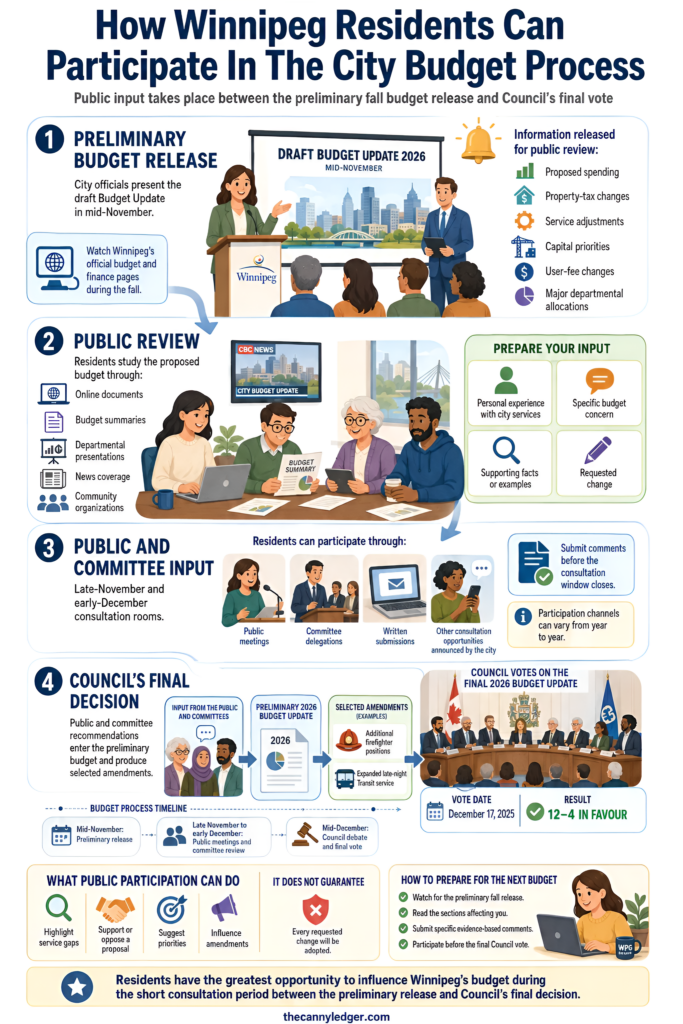
Each year’s budget update goes through a public consultation period before Council votes on it, typically running from the preliminary release in mid-November through public meetings in late November and early December, before a final vote closes out the process. Winnipeg’s 2026 Budget Update passed by a 12-4 Council vote on December 17, 2025, after that consultation window, with several enhancements added to the preliminary version based on public and committee input, including additional firefighter positions and expanded late-night Transit service. Anyone wanting to weigh in on next year’s budget can watch for the same annual cycle, a preliminary release in the fall, followed by a window for public input before the final vote, typically covered directly on the city’s own budget and finance pages.
Common Questions About Winnipeg’s Budget
Does the city budget include school taxes too? No, and this is a common point of confusion since both appear on the same property tax bill. School division budgets are set independently by each of Winnipeg’s eight school divisions, not by City Council, and the full mechanics of how that split works are covered separately, since the city budget discussed here covers only the municipal portion.
Why does the capital budget jump around so much more than the operating budget year to year? Capital spending is driven by specific, large, often multi-year infrastructure projects, a sewage treatment upgrade or a major road reconstruction, that don’t repeat annually the way salaries and routine service delivery do. A single major project starting or wrapping up can swing the capital budget by hundreds of millions in a way the more predictable operating budget rarely does.
If police and fire already take 42% of the budget, why do they keep growing? Public safety costs are driven substantially by collective agreements, overtime, and workers’ compensation claims, cost pressures that tend to compound rather than stay flat, and Council has consistently prioritized frontline hiring in recent budget cycles. Whether that share should keep growing relative to everything else the city funds is a genuine, ongoing policy debate rather than a settled question.
Every dollar in this budget traces back to a specific decision, a department’s negotiated costs, a Council priority, a provincial funding gap the city had to fill itself. Understanding that structure explains far more about your actual tax bill than the single headline percentage each December, since the “why” behind Winnipeg’s spending sits in exactly these department-by-department numbers, not in one abstract citywide average.