

Ask ten different people what happens when someone declares bankruptcy in Canada, and at least half will describe something closer to an American movie plot: sheriffs at the door, everything you own hauled onto a truck, your name in the paper. None of that is how it actually works here, and the gap between the reputation and the reality is wide enough that it stops a lot of people from even looking into whether the process might genuinely help them.
- The single most important fact to understand before anything else
- Signs it’s worth having the conversation
- Step one: the free consultation
- Step two: filing and the immediate stay of proceedings
- Step three: what you keep, and what Manitoba actually protects
- Step four: surplus income, and the part nobody explains well upfront
- Step five: discharge, and what changes the day after
- What it costs, and why “free” bankruptcy advertising deserves scrutiny
- The credit impact, and how long it actually lasts
- Rebuilding afterward
- When it’s genuinely the wrong tool
This article is written for the person who’s already tried the less drastic options, credit counselling, maybe a consolidation loan, maybe a consumer proposal conversation, and is now wondering whether bankruptcy is the thing that actually fits their situation. We’ll walk through what the process looks like from the first phone call to the day you’re discharged, what Manitoba’s specific rules protect and don’t protect, what it costs, and honestly, when it’s the wrong tool even for someone drowning in debt.
The single most important fact to understand before anything else
Bankruptcy in Canada is federally regulated legislation, the Bankruptcy and Insolvency Act, administered only by Licensed Insolvency Trustees who are overseen by the Office of the Superintendent of Bankruptcy. There’s no shortcut version, no do-it-yourself filing, and no unlicensed company that can legally put you through it, no matter what their advertising implies. If a business is offering to “file your bankruptcy” without being a Licensed Insolvency Trustee, that’s a red flag worth walking away from immediately.
The process exists specifically to give an honest but unfortunate debtor a genuine fresh start, and that phrase, honest but unfortunate, comes directly from how courts and trustees describe the intent of the legislation. It isn’t designed to punish people, and it isn’t a tool for someone trying to dodge debts they could otherwise reasonably pay. Those two things sitting side by side, relief for people who genuinely need it and real scrutiny of anyone trying to abuse it, shape almost every rule described below.

Signs it’s worth having the conversation
There’s no single dollar figure or life event that makes bankruptcy the automatic right call, but a few patterns tend to show up consistently in the situations where a Licensed Insolvency Trustee ends up recommending it over the alternatives.
Your unsecured debt has grown well past what a consumer proposal’s typical reduction could realistically bring down to an affordable monthly payment, even after accounting for the interest freeze and reduction a proposal offers. Our debt consolidation in Winnipeg guide covers where that line tends to sit and why a proposal is usually tried first if the numbers allow it.
You have little to no equity in assets that would be exposed anyway, meaning bankruptcy’s asset-exemption rules would let you keep essentially everything you have, which changes the calculation considerably compared to someone with significant home equity.
Collection pressure has become constant enough that it’s affecting your ability to function day to day, and a debt management plan’s voluntary nature or a proposal’s negotiation period feels too slow relative to the legal stay of proceedings that bankruptcy triggers immediately upon filing. Our credit and collection agencies in Winnipeg page explains what collectors are and aren’t legally allowed to do in the meantime, which is worth reading regardless of which route you take.
You’ve genuinely run the numbers, ideally with a free consultation already booked, and a trustee has confirmed that your specific debt load, income, and asset picture make bankruptcy the option that gets you to a stable footing fastest. That last point matters more than the first three combined, because the honest answer for a meaningful share of people who walk into that consultation expecting to file is that a consumer proposal or a structured payment plan actually serves them better. A good trustee will tell you that rather than steering you toward the option that happens to be the one you asked about.

Step one: the free consultation
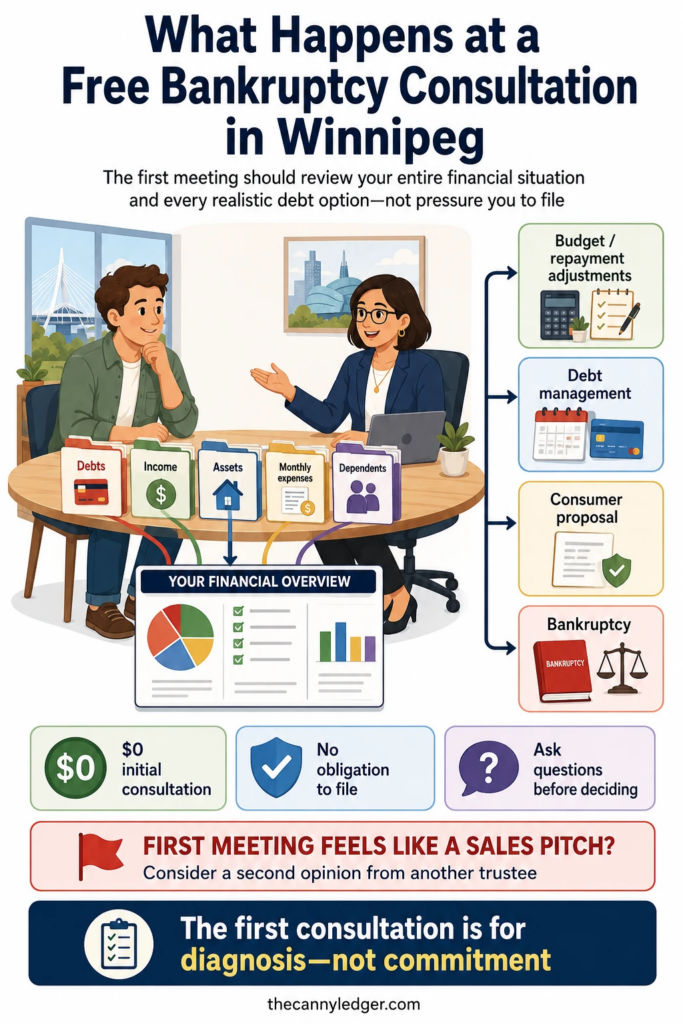
Every Licensed Insolvency Trustee offering services in Winnipeg provides an initial consultation at no cost and with no obligation to proceed. This meeting exists specifically to lay out your full financial picture, debts, income, assets, dependents, and walk through every option available to you, not just bankruptcy, before you commit to anything. If a first meeting feels like a sales pitch pushing you toward filing rather than an honest review of your options, that’s worth noticing and, if needed, seeking a second opinion from another trustee.
Step two: filing and the immediate stay of proceedings
If you and your trustee decide bankruptcy is the right path, filing involves signing an Assignment in Bankruptcy and a Statement of Affairs, a detailed accounting of everything you owe, own, and earn. Your trustee files this with the Office of the Superintendent of Bankruptcy and formally notifies your creditors.
The moment that filing happens, an automatic stay of proceedings takes effect. This is the part of the process that tends to bring the most immediate relief: creditors are legally required to stop calling you, stop pursuing lawsuits, and stop garnishing your wages, and from that point forward, they’re required to direct all communication to your trustee instead of you directly. A handful of debts fall outside this protection, including most student loans if you’ve been out of school less than seven years, court-ordered support payments, and certain fines, so it’s worth confirming with your trustee exactly what is and isn’t covered in your specific case.

Step three: what you keep, and what Manitoba actually protects
This is where Manitoba’s rules diverge in some important and sometimes surprising ways from what people assume, and it’s worth understanding the specifics rather than relying on a general sense of “they can’t take everything.”
Manitoba’s exemptions come from the province’s Executions Act and Judgments Act, and they protect a defined list of property from seizure. Household furniture and appliances up to a set value, ordinary clothing for you and your family with no limit, six months’ worth of food and fuel or its cash equivalent, and the tools of your trade up to a set value are all protected outright. One motor vehicle is protected up to a modest dollar amount if it’s genuinely necessary for work or commuting, though that figure is considerably lower than a lot of people expect a “protected vehicle” exemption to be, so a newer or higher-value vehicle can still be exposed above that threshold.
RRSPs, RRIFs, and similar registered retirement plans are protected under a separate piece of Manitoba legislation, generally in full, with one important exception: contributions made within the twelve months immediately before filing are typically not protected, which is a detail worth knowing well before you’d ever consider filing rather than discovering it after the fact.
The part that surprises the most people, and the part most worth sitting with if you’re a homeowner, is Manitoba’s home equity exemption. It sits at a strikingly low figure, protecting only a small amount of equity in a principal residence, less if you co-own the property with someone else. Compare that to provinces like Saskatchewan or the Northwest Territories, where the equivalent exemption runs into the tens of thousands of dollars, and Manitoba’s number looks almost symbolic by comparison. Practically, this means that homeowners with real equity built up are very often better served by a consumer proposal, which lets you keep your home regardless of equity as long as you keep making payments, rather than bankruptcy, where equity above that small threshold can mean your trustee needs to sell the property or you need to buy out the difference to keep it. If you’re a homeowner weighing this specific trade-off, it’s worth reading alongside our Winnipeg housing market page to get a realistic sense of what your equity position might actually look like before assuming either outcome.

Step four: surplus income, and the part nobody explains well upfront
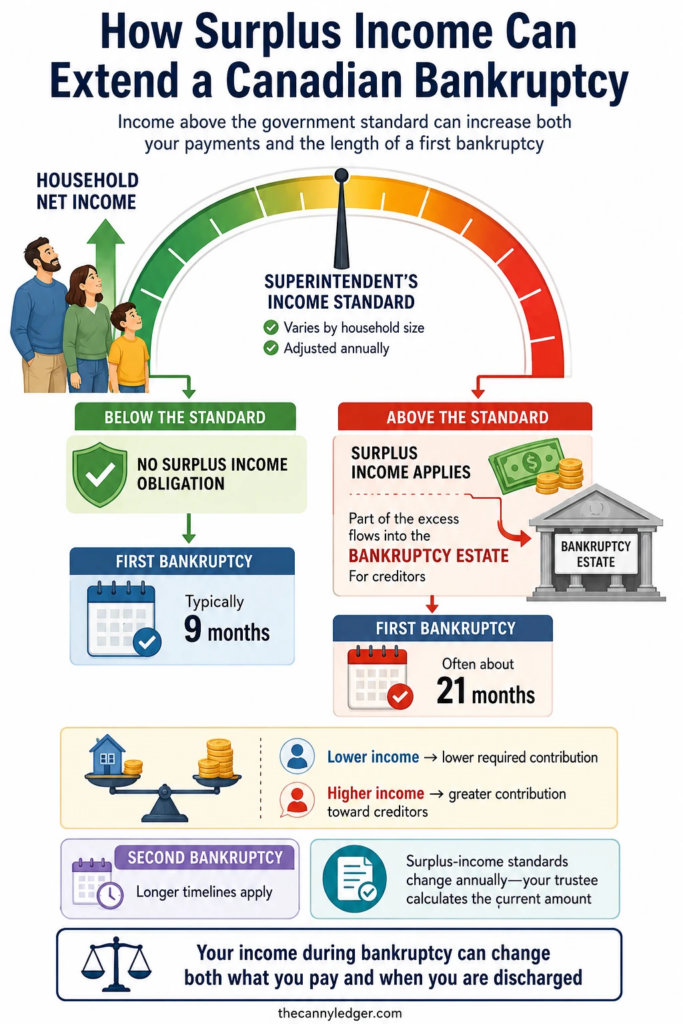
If your income during bankruptcy exceeds a government-defined standard based on household size, you’re required to pay a portion of that excess, called surplus income, into your bankruptcy estate for the benefit of your creditors. This isn’t a punishment so much as a fairness mechanism: someone earning a comfortable income during their bankruptcy is expected to contribute more toward their debts than someone with barely enough to cover basic needs, and the standard used to calculate this is set nationally through the Superintendent’s directive on surplus income and adjusted annually.
Practically, surplus income is also the single biggest factor in how long your bankruptcy lasts. A first-time bankruptcy with no surplus income obligation typically reaches discharge in nine months. If surplus income applies, that timeline extends, often to somewhere around twenty-one months, since the surplus payment period is built directly into the discharge conditions. A second bankruptcy takes considerably longer to discharge than a first, which is one of several reasons trustees emphasize getting the first one right rather than treating it as a process you might repeat.
Step five: discharge, and what changes the day after
Discharge is the formal legal event that releases you from your eligible unsecured debts. To reach it, you need to complete two mandatory financial counselling sessions with your trustee, file all required income and expense reports on schedule, and meet any surplus income obligation that applies to your case. Assuming those conditions are met and nothing unusual complicates the file, most first-time bankrupts are automatically discharged without needing to appear before a court at all.
Once discharged, your eligible debts, most credit cards, personal loans, lines of credit, and payday loans among them, are legally eliminated. What doesn’t disappear includes most student loan debt within the seven-year window mentioned earlier, court-ordered family support, certain fines and penalties, and any debt arising from fraud. It’s worth having your trustee walk through your specific debt list line by line rather than assuming everything you owe falls into the eliminated category.

What it costs, and why “free” bankruptcy advertising deserves scrutiny
Bankruptcy isn’t free, and any advertisement implying otherwise is describing the free initial consultation, not the process itself. Trustee fees for a basic, no-surplus-income first bankruptcy are set under a federal fee schedule and typically total a bit under two thousand dollars, usually payable in monthly installments over the course of the process rather than as a lump sum upfront. More complicated files, involving surplus income, business assets, or unusual circumstances, cost more, and your trustee is required to disclose the fee structure clearly before you file anything.
Compared to the interest a large unsecured debt load accumulates every month it sits unresolved, this cost is often small relative to what staying in the debt itself would continue to cost, but it’s a real expense and worth budgeting for honestly rather than assuming the process is costless because a trustee’s first meeting was free.

The credit impact, and how long it actually lasts
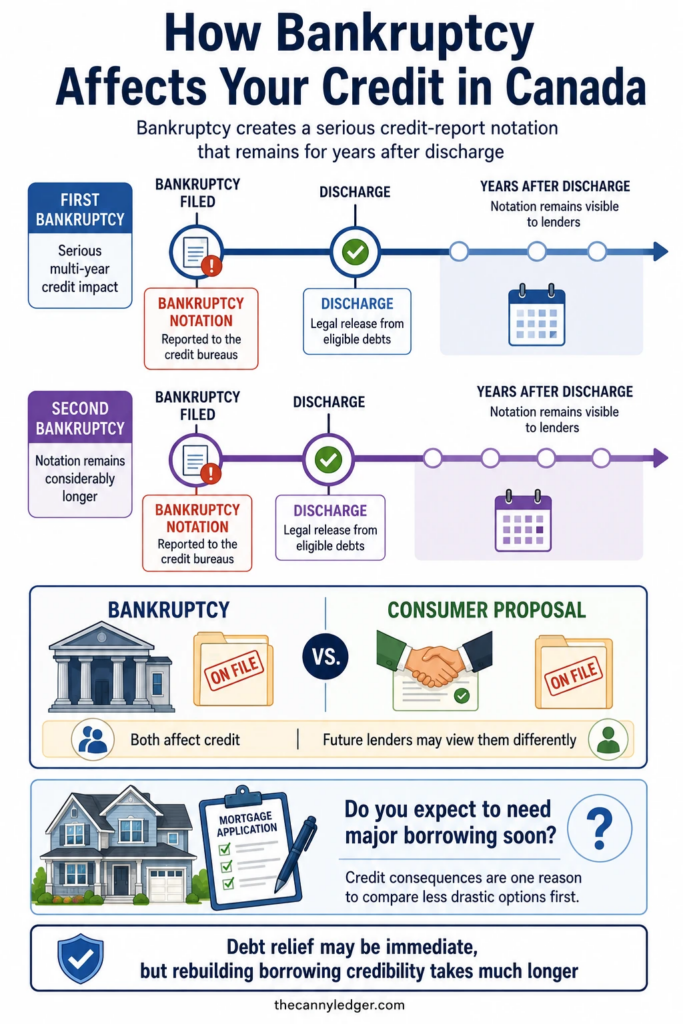
A bankruptcy filing has a serious and lasting effect on your credit report, showing up as a specific notation that both major credit bureaus in Canada retain for a number of years following your discharge, considerably longer for a second bankruptcy than a first. This is one of the more legitimate reasons to explore every other option first, since a consumer proposal, while still visible on your credit report, tends to be viewed somewhat differently by future lenders than a bankruptcy notation, particularly for anyone hoping to qualify for a mortgage in the next several years. Our debt relief and debt help in Winnipeg page compares the practical, longer-term consequences of each path side by side, which is worth reading before, not after, you decide which route to take.
Rebuilding afterward
Discharge is the legal endpoint, but it isn’t the end of the practical story, and it’s worth going into the process knowing what rebuilding actually looks like rather than treating discharge day as a finish line. A secured credit card, one backed by a cash deposit you control, is usually the fastest legitimate way to start re-establishing a positive credit history immediately after discharge, since on-time payments there get reported the same way any other credit account’s history does. Rebuilding a relationship with a local credit union, the kind covered in our Winnipeg credit unions compared guide, can also matter more than people expect, since credit unions often weigh a member’s full relationship and current financial picture more heavily than a credit score still recovering from a recent bankruptcy notation.
If income instability contributed to the situation that led here in the first place, whether through a layoff, a reduced-hours job, or a gap between jobs, it’s worth knowing what income supports exist going forward. Our employment insurance in Winnipeg page covers what EI actually provides and how to apply, since a lot of people going through financial hardship qualify for support they haven’t looked into.

When it’s genuinely the wrong tool
It’s worth ending on this rather than burying it, because a responsible article on this topic has to say it plainly: bankruptcy is the wrong choice for someone with meaningful home equity above Manitoba’s low exemption threshold who could instead protect that equity through a consumer proposal, for someone whose debt load a straightforward consolidation loan or debt management plan would resolve without the credit-report consequences of a bankruptcy filing, and for anyone who hasn’t yet had the free consultation that would tell them, with actual numbers instead of assumptions, which option truly fits. If any part of your situation feels uncertain after reading this, that uncertainty is reason enough to book that first, no-obligation conversation with a Licensed Insolvency Trustee before deciding anything, and to walk in ready to hear “a proposal or a counselling plan would actually serve you better” as a legitimate answer, not a disappointing one. A free, judgment-free call with a non-profit agency like Community Financial Counselling Services is also a reasonable place to start if you’re not even sure which category of help you need yet.

