
Most “best debt consolidation company” lists online are written by for-profit affiliate sites ranking each other, and the organizations Canadians have actually relied on the longest, non-profit credit counselling agencies with decades of operating history, barely show up in those paid search results at all. This comparison is built from research into each organization’s actual structure, accreditation, and service model, not from personal use of any of them, since a genuine comparison here has to be honest about that distinction rather than pretending otherwise.
- The Non-Profit Credit Counselling Agencies
- Alberta’s Unique Program Deserves Its Own Mention
- Where For-Profit Lenders And Home Equity Companies Fit
- The Category Of Company Actually Worth Avoiding
- Comparing The Main Options Side By Side
- Vetting Whoever You’re Actually Considering
- Making The Actual Decision
What follows covers the established non-profit credit counselling agencies operating across Canada, where for-profit lenders and home equity companies fit into the picture, a real warning about a category of company worth avoiding entirely, and how to actually vet whoever you’re considering before signing anything. Our companion piece on how debt consolidation actually works covers the underlying mechanics this comparison builds on.
The Non-Profit Credit Counselling Agencies
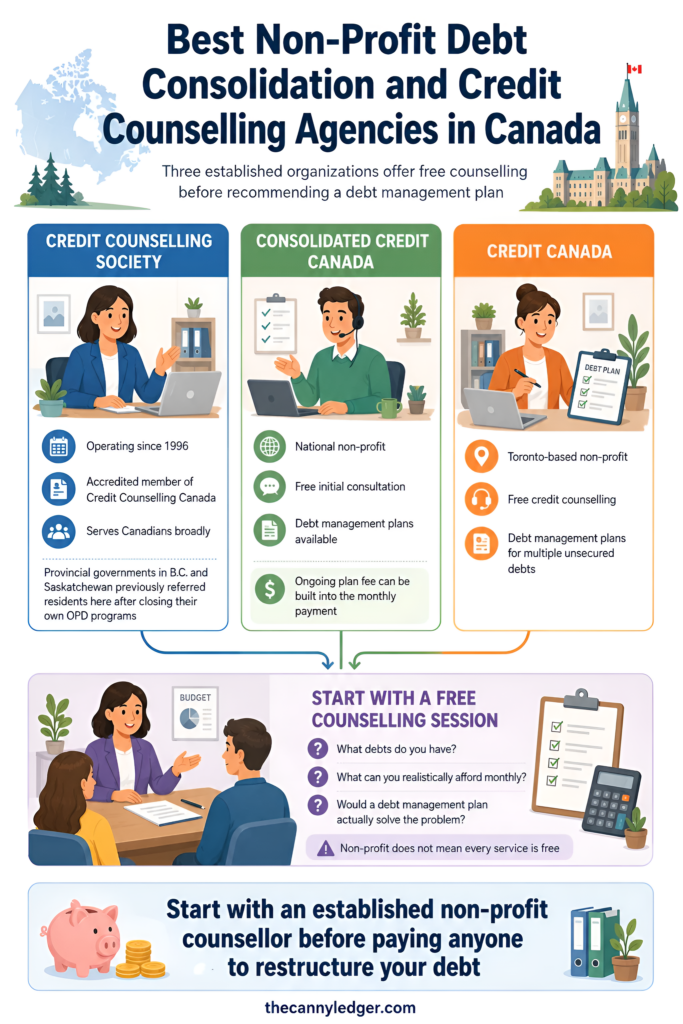
Three names come up consistently as the most established non-profit options serving Canadians broadly, and each has a genuinely long operating history rather than being a recent entrant chasing search traffic. The Credit Counselling Society has operated since 1996, holds the Better Business Bureau’s highest rating continuously since that year, and is an accredited member of Credit Counselling Canada, the national association that sets accreditation standards for non-profit credit counselling in this country. Notably, both British Columbia and Saskatchewan’s provincial governments closed their own in-house Orderly Payment of Debts programs in 2002 and 2012 respectively, referring residents to the Credit Counselling Society instead, a genuine vote of confidence from two separate provincial governments rather than a marketing claim.
Consolidated Credit Canada operates on a similar non-profit model nationally, offering a free initial consultation before enrolling anyone in a debt management plan, with its ongoing fee built into the single monthly payment a client makes rather than charged separately upfront. Credit Canada, based in Toronto, rounds out the major national non-profits, offering free credit counselling alongside its debt management program specifically for Canadians carrying multiple unsecured debts.
Alberta’s Unique Program Deserves Its Own Mention
If you live in Alberta specifically, Money Mentors runs the province’s Orderly Payment of Debts program exclusively, a court-supervised debt repayment option that can include debts most other consolidation routes can’t touch, income tax owed to the CRA, employment insurance overpayments, and student loans. That’s a genuinely distinct advantage over a standard debt management plan, since DMPs generally only cover unsecured consumer debt like credit cards and personal loans, not government debt. Anyone in Alberta carrying a mix of consumer and government debt should know this program exists before assuming a standard DMP is the only structured option available.

Where For-Profit Lenders And Home Equity Companies Fit
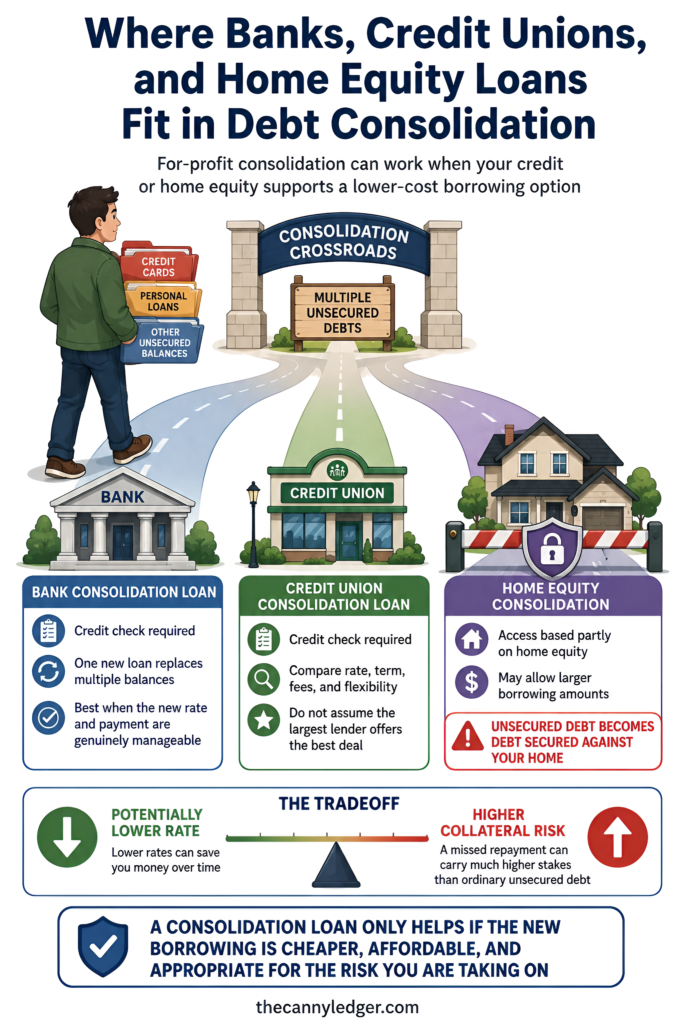
A personal loan through either type of lender remains the most conventional path if your credit qualifies. For homeowners specifically, companies like Alpine Credits specialize in home equity lending as a consolidation tool, offering access to a larger share of home equity than a standard unsecured loan would allow. That structure genuinely suits someone with substantial home equity and a clear repayment plan, but it converts unsecured debt into debt secured against your house, a meaningfully higher-stakes trade than a standard personal loan carries.
The Category Of Company Actually Worth Avoiding
This distinction matters enough to state plainly rather than bury in a footnote. The Financial Consumer Agency of Canada has issued a specific consumer alert about debt settlement companies, warning about high-pressure sales tactics and upfront fees charged before any actual work gets done, often advertised with promises of settling debt for pennies on the dollar. Debt settlement is a genuinely different service from the debt management plans the non-profits above offer, even though the marketing language between the two frequently sounds identical. A legitimate non-profit credit counselling agency doesn’t charge a large fee before doing any work, and doesn’t pressure you into a decision on the first call. If a company does either, that’s a real red flag worth treating seriously rather than talking yourself past.

Comparing The Main Options Side By Side
| Option | Type | Credit check required | Covers government debt |
|---|---|---|---|
| Credit Counselling Society | National non-profit | No | No |
| Consolidated Credit Canada | National non-profit | No | No |
| Credit Canada | Non-profit (Toronto based) | No | No |
| Money Mentors OPD | Alberta only, court supervised | No | Yes, in Alberta |
| Bank or credit union loan | For-profit lender | Yes | No |
| Alpine Credits or similar | For-profit, home equity secured | Yes, plus home equity | No |

Vetting Whoever You’re Actually Considering
Confirm accreditation directly rather than trusting a logo on a website, since Credit Counselling Canada maintains a member list you can check independently before committing to anyone claiming membership. Ask specifically whether you’re being offered a debt management plan or debt settlement, since the two get marketed with nearly identical language despite carrying genuinely different structures, costs, and credit consequences, a distinction our full comparison of debt management plans versus debt settlement covers in more depth. Walk away from any company demanding a large fee before doing any actual work on your file, and if you’re unsure which category a specific company falls into, a free consultation with an established non-profit like Winnipeg’s own credit counselling services is a reasonable, no-cost way to get a second opinion before signing anything with a company you found through a paid search result.

Making The Actual Decision
Start with a non-profit consultation before comparing a single for-profit lender, since the initial assessment costs nothing and gives you a genuinely independent read on which structured option, if any, actually fits your situation. If a bank loan or credit union loan is realistically within reach given your credit, get that quote alongside the non-profit’s recommendation rather than choosing blind, since the two paths solve genuinely different problems depending on your credit and debt load. And whichever option you’re leaning toward, if the debt is severe enough that even a well-run consolidation plan won’t resolve it, that’s worth raising directly rather than assuming a lower monthly payment alone is the finish line, whether that means bankruptcy or a formal consumer proposal, since our broader guide to how to get out of debt in Canada covers what comes after consolidation stops being enough on its own.