
A lot of Winnipeg mobile home owners think of themselves the same way any homeowner would, and in most day-to-day ways, that’s fair. But hand your address to an insurance underwriter and something changes immediately: if you’re in one of the city’s land-lease communities, you own a structure sitting on land that belongs to someone else, and that single fact reshapes almost everything about how mobile home insurance in Winnipeg actually works. It’s closer to insuring a very large, very permanent piece of property than to insuring a house on your own lot, and treating the two the same way is where most confusion starts.
- Why Mobile Home Insurance Isn’t Just Home Insurance With a Different Name
- Land-Lease vs. Owned Land: Why It Changes Everything About Your Coverage
- What a Mobile Home Policy Actually Covers
- Winnipeg’s Mobile Home Communities
- What It Actually Costs
- Common Coverage Gaps to Ask About
- Mistakes That Cost Manitoba Mobile Home Owners Money
- What to Actually Do Next
Mobile home insurance in Manitoba covers your home’s structure, your belongings, your liability, and your living expenses if you’re displaced, the same core categories as standard home insurance. What changes is the land underneath it. If you’re on leased land in a mobile home park, you’re not insuring the ground your home sits on, since you don’t own it, and that distinction affects everything from what coverage you actually need to how your home is classified for financing.
The rest of this walks through exactly where that distinction matters, what a policy needs to include, and a few Manitoba-specific details worth knowing before you assume your coverage matches a standard homeowner’s.
Why Mobile Home Insurance Isn’t Just Home Insurance With a Different Name
A manufactured home in Canada is built to a specific national standard, the CSA Z240 series, which governs everything from structural strength to how oil and gas appliances get installed at the factory. A home carrying that certification, visible on a CSA label typically found near the electrical panel or inside a kitchen cabinet, has been verified against a recognized safety standard the same way a site-built home gets verified through municipal building codes.
That label matters more than most owners realize until they’re trying to insure, finance, or sell the home. Without visible proof of CSA certification, insurers, lenders, and buyers all have less confidence the structure meets the standards they’re pricing risk against, and that uncertainty can mean a harder time getting coverage at all, not just a higher premium. If you’re buying a mobile home in Manitoba, whether new or resale, asking directly for proof of CSA certification is worth doing before you get attached to a specific unit.

Land-Lease vs. Owned Land: Why It Changes Everything About Your Coverage
This is the distinction that actually separates mobile home insurance from a standard home policy, and it comes down to a straightforward question: do you own the land your home sits on, or are you leasing a pad in a mobile home park?
Manitoba’s Homesteads Act treats these two situations differently at a legal level, and it’s worth understanding even outside the insurance context. A mobile home can qualify as a homestead under that Act, but only if it’s occupied by the owner as their primary residence and the land beneath it is owned by that same person. A mobile home sitting on rented land in a park doesn’t meet that definition, regardless of how long you’ve lived there or how permanent the setup feels.
For insurance purposes, this splits your coverage needs cleanly. If you own the land, you’re insuring both structure and property in a way that more closely resembles standard home insurance. If you’re on leased land, typically paying a monthly lease fee to the park operator that covers services like snow removal, garbage, and water, you’re insuring the home itself, your belongings, and your personal liability, while the park operator generally carries separate insurance covering the shared grounds and common infrastructure. Knowing which category you fall into before you call a broker saves a round of confused back-and-forth about coverage you don’t actually need.

What a Mobile Home Policy Actually Covers
A standard mobile home insurance policy in Manitoba covers the same core categories most home policies do, adapted for the specific realities of a manufactured home.
Structure coverage protects the home itself, walls, roof, and the built structure, against covered perils like fire, wind, and theft. Detached structures on the property, such as a small shed or a deck built separately from the home, typically need to be specified for coverage rather than assumed to fall under the main structure limit automatically. Contents coverage protects your belongings inside the home, whether they’re damaged while inside or, in many policies, even while outside the home in some circumstances, like a bike stolen from the yard. Liability coverage protects you if someone is injured on your property and pursues a claim, and loss of use coverage helps pay for temporary living expenses if the home becomes uninhabitable after a covered event.

Winnipeg’s Mobile Home Communities
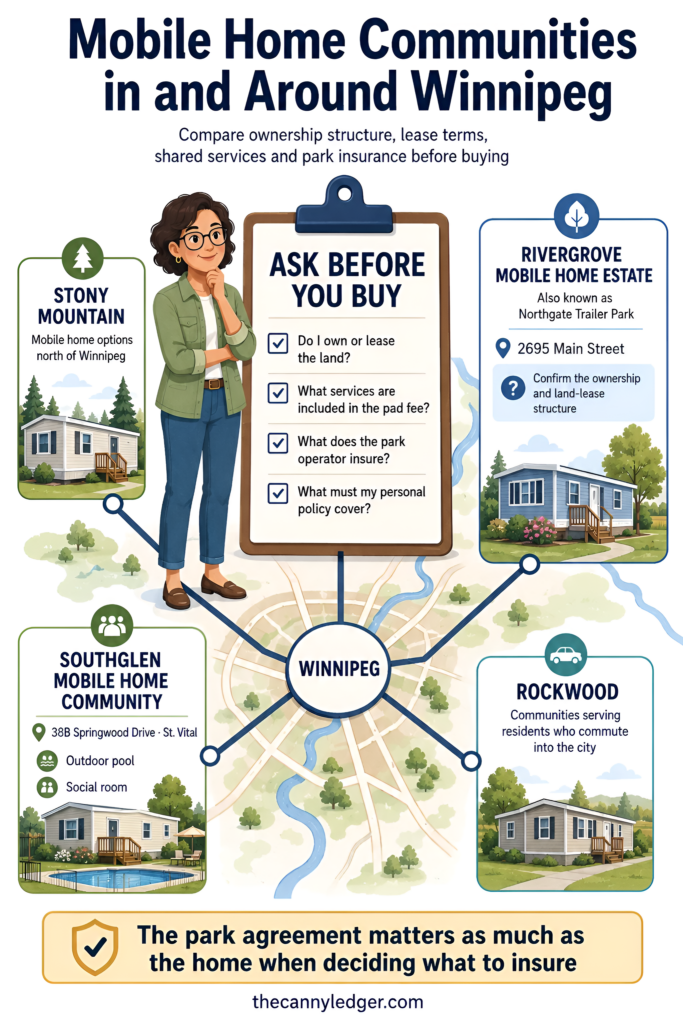
Winnipeg has a small number of established mobile home communities worth knowing about if you’re shopping for a unit or trying to understand your own park’s setup. Rivergrove Mobile Home Estate, also known as Northgate Trailer Park, sits at 2695 Main St and is described by local listings as one of Manitoba’s larger manufactured home communities, with its own distinct ownership structure that’s worth confirming directly since it affects whether you’re buying into a land-lease arrangement. Southglen Mobile Home Community, at 38B Springwood Drive in the St. Vital area, is another established park offering shared amenities like an outdoor pool and social room as part of its lease arrangement.
Communities outside city limits, in areas like Stony Mountain and Rockwood just north of Winnipeg, also serve a meaningful share of people who work in the city but chose a mobile home community over a standard subdivision. Wherever you land, confirming the specific lease terms and what the park operator’s insurance does and doesn’t cover is worth doing before you assume your own policy needs to fill every gap.
What It Actually Costs
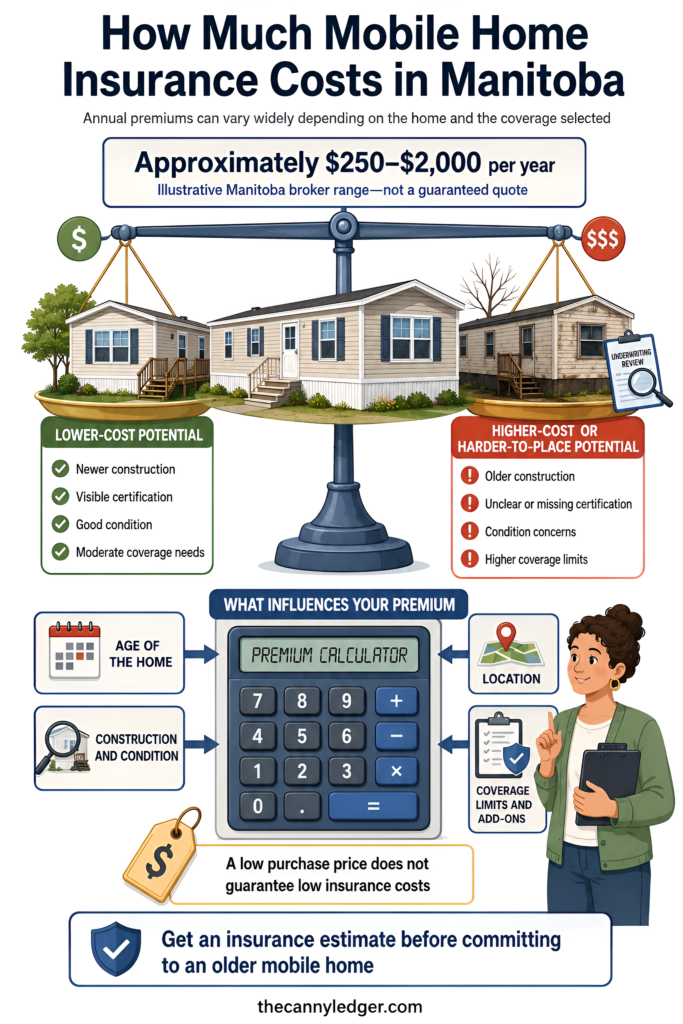
Mobile home insurance in Manitoba varies widely, with Manitoba brokers commonly quoting a range from roughly $250 to $2,000 a year depending heavily on the home’s age, construction, location, and the coverage limits chosen. That’s a wider spread than you’ll typically see quoted for standard home insurance, and it reflects how differently one manufactured home can be priced from another based on age and condition alone.
An older mobile home, particularly one built before CSA certification became standard practice, will generally cost more to insure and may be harder to place with some insurers altogether, compared to a newer, certified unit. This is worth factoring into the total cost of buying an older unit, not just the purchase price itself. For context on how this compares to what a standard house costs to insure in this city, Winnipeg’s home insurance cost breakdown is worth reading alongside this one.
Common Coverage Gaps to Ask About
A few gaps show up consistently in mobile home policies, and none of them are automatically included without asking.
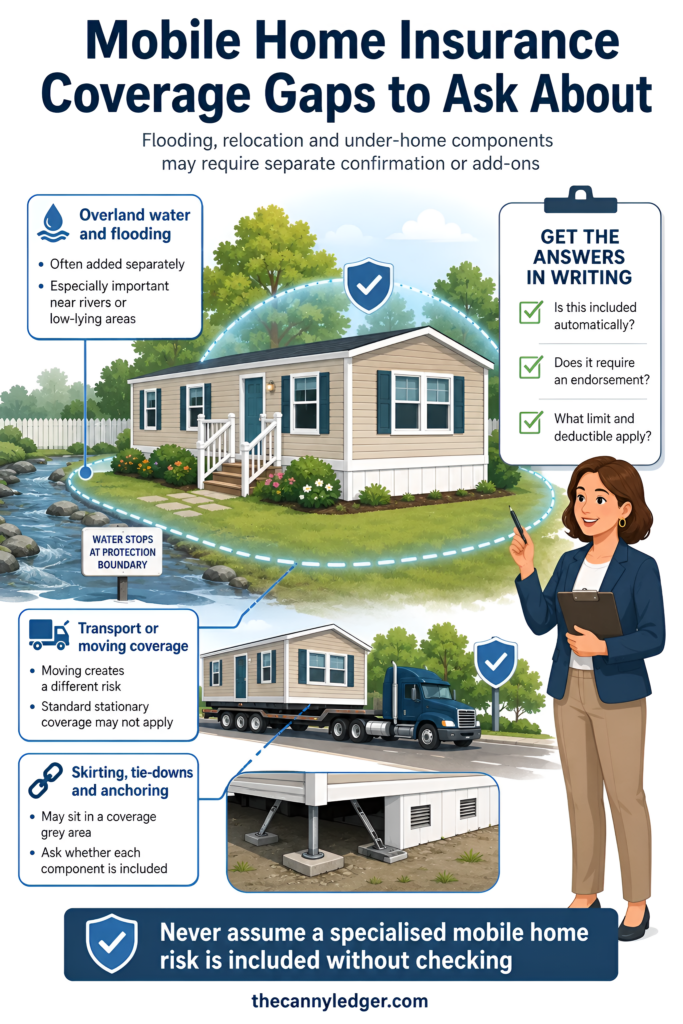
Overland water and flood coverage typically needs to be added separately, which matters given Manitoba’s history of spring flooding, particularly for communities near rivers or low-lying areas. Transport or moving coverage, protecting the home during an actual relocation from one site to another, is a distinct add-on most standard policies don’t include by default, since it covers a genuinely different risk than a stationary structure faces. And skirting, the material enclosing the space beneath a mobile home, along with tie-downs and anchoring systems, sometimes falls into a grey area between structure coverage and something requiring its own explicit mention, worth clarifying directly with your broker rather than assuming.
Mistakes That Cost Manitoba Mobile Home Owners Money
The most common and costly mistake is assuming standard home insurance is not legally required in Manitoba, which is true, but then concluding coverage itself is optional in practice. Most mortgage or financing arrangements on a mobile home will require proof of insurance as a condition of the loan, the same way conventional home financing does, so skipping coverage rarely stays a real option once financing enters the picture.
A second recurring mistake is buying or inheriting an older unit without ever confirming CSA certification exists, then discovering during a claim or a sale attempt that the lack of documentation is complicating everything. And a third is treating a park’s shared insurance as covering more than it does, when in most land-lease arrangements the park operator’s policy stops at the shared grounds and never extends to protect an individual owner’s home, belongings, or personal liability.

What to Actually Do Next
Locate your home’s CSA label before you shop for a policy or a lender, since that single piece of documentation shapes how easily you’ll be insured and financed either way. If you’re in a land-lease community, request written confirmation from your park operator about exactly what their own insurance covers, so you know precisely where their coverage ends and yours needs to begin. And when you’re ready to get quotes, working with one of Winnipeg’s local insurance brokers who specifically handles manufactured homes will get you a more accurate picture than a generic online tool built around standard house policies, and understanding how to choose a broker is worth a read first if you haven’t done this before.
If you’re weighing a mobile home purchase against other paths into homeownership in this city, it’s worth browsing what’s currently listed among mobile homes for sale in Winnipeg to get a real sense of pricing and park terms before committing to one community over another.