
A full-fare Winnipeg Transit rider paying for a 28-day e-pass spends $110.05. The same rider buying what sounds like the equivalent product, a Monthly pass, pays $119.35 for the exact same unlimited access. Winnipeg Transit fares include two products that look interchangeable but genuinely aren’t, and most riders default to the more expensive one purely out of habit, never realizing a cheaper, more flexible option sits right next to it on the same rate card.
Here’s the direct answer: as of January 1, 2026, a single cash fare on Winnipeg Transit costs $3.45 for a full-fare adult, dropping to $3.10 with e-cash loaded on a peggo card. Reduced fares apply for youth, seniors, and post-secondary students, and a 50 percent discount is available through the WINNpass program for eligible low-income riders.
That’s the baseline. The rest of this covers every fare tier in full, how the passes actually differ from each other, and the specific product mix-up that costs regular riders real money over a year of commuting.
The Full 2026 Fare Table
Winnipeg Transit’s current rates took effect January 1, 2026, confirmed directly through the City of Winnipeg’s own fares page. Here’s the complete breakdown.
| Fare product | Full Fare | Youth | Senior | Post-Secondary |
|---|---|---|---|---|
| Cash | $3.45 | $2.95 | $2.95 | $3.45 |
| e-cash / paper ticket | $3.10 | $2.30 | $1.55 | $3.10 |
| 24-hour e-pass | $11.45 | $8.50 | $5.75 | N/A |
| 5-day e-pass | $27.90 | $20.70 | $13.95 | N/A |
| 7-day e-pass | $31.00 | $23.00 | $15.50 | $24.80 |
| 28-day e-pass | $110.05 | $81.65 | $55.05 | $88.05 |
| Monthly e-pass | $119.35 | $88.55 | $59.70 | $95.50 |
| Semester e-pass | N/A | N/A | N/A | $324.65 |
| WINNpass e-cash | $1.55 | $1.55 | N/A | N/A |
| WINNpass monthly | $59.70 | $59.70 | N/A | N/A |
A one-time $5 fee applies to purchase a peggo card, Winnipeg Transit’s reloadable fare card, whether you’re loading e-cash or a pass onto it.

Who Actually Qualifies for Each Fare Tier
The fare categories aren’t just about age. Winnipeg Transit defines each tier with specific rules that trip up riders more often than the pricing itself does.
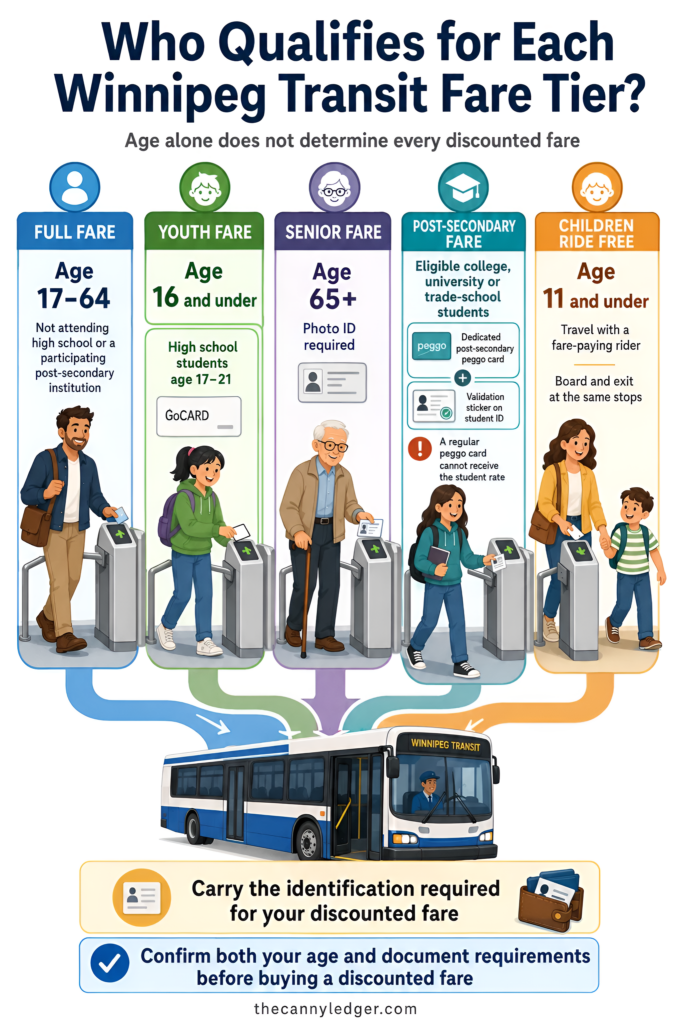
Full fare covers anyone aged 17 to 64 who isn’t currently attending high school or a participating post-secondary institution. Senior fare applies at age 65 and up, with photo ID required to board at that rate. Youth fare covers riders 16 and under automatically, and extends to high school students aged 17 to 21 specifically if they carry a GoCARD. Post-secondary fare is restricted entirely to students at eligible universities, colleges, and trade schools, and it only works on a post-secondary peggo card purchased directly through the school, with a validation sticker attached to the student’s ID at the point of sale. A regular peggo card loaded with post-secondary rates from home doesn’t work; the eligibility check happens in person at the institution.
Children 11 and under ride completely free when accompanied by a fare-paying rider, no photo ID required, though the child needs to board and exit at the same stops as the adult they’re travelling with.
The Pass Most Riders Overpay For
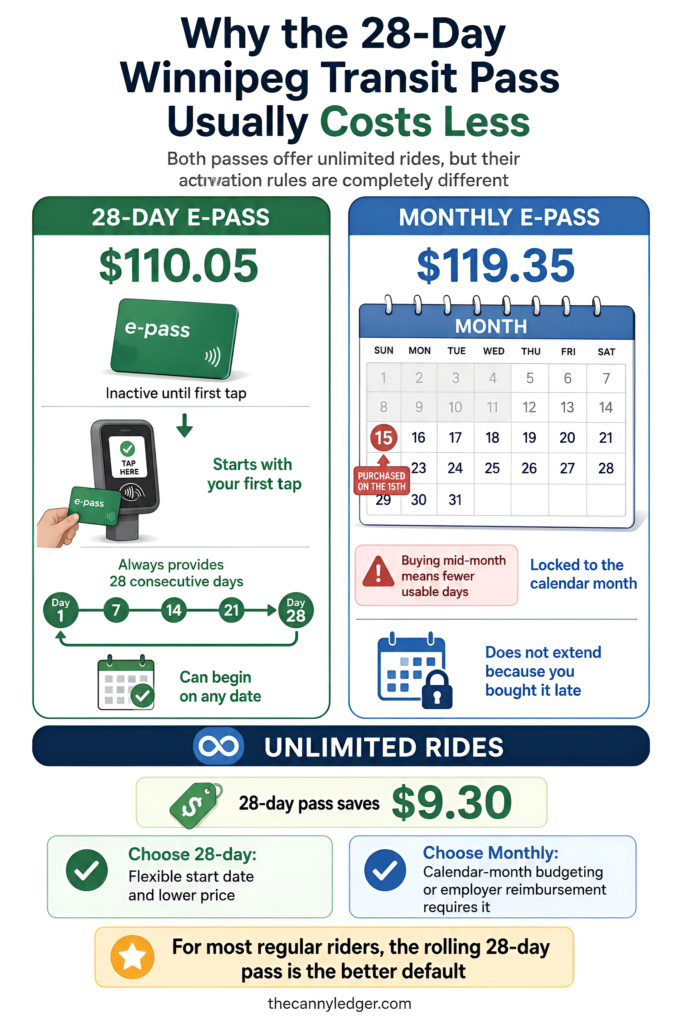
This is the detail worth reading twice. The 28-day e-pass and the Monthly e-pass both give unlimited rides, and at full fare they sit $9.30 apart for essentially the same access. The difference isn’t coverage. It’s timing.
A 28-day pass is a rolling product: it activates the first time you tap it and runs for 28 consecutive days from that exact moment, regardless of the calendar date. A Monthly pass, by contrast, is locked to the calendar, valid from the first day of a given month through the last day of that same month, no matter when in the month you actually bought or activated it.
That timing difference matters more than it sounds like. Someone who buys a Monthly pass on the 15th of the month is paying full price for a product that’s already half expired. The 28-day pass sidesteps that entirely, since it always gives a full 28 days of use starting from whenever you load it, and at full fare, it’s also $9.30 cheaper than the Monthly option for essentially the same unlimited access. Unless your commute genuinely needs to align with calendar months for budgeting or reimbursement reasons, the 28-day e-pass is the better default for most riders buying an unlimited pass, and it’s easy to miss simply because “Monthly” sounds like the obvious, standard choice.
WINNpass: Winnipeg’s Low-Income Transit Discount
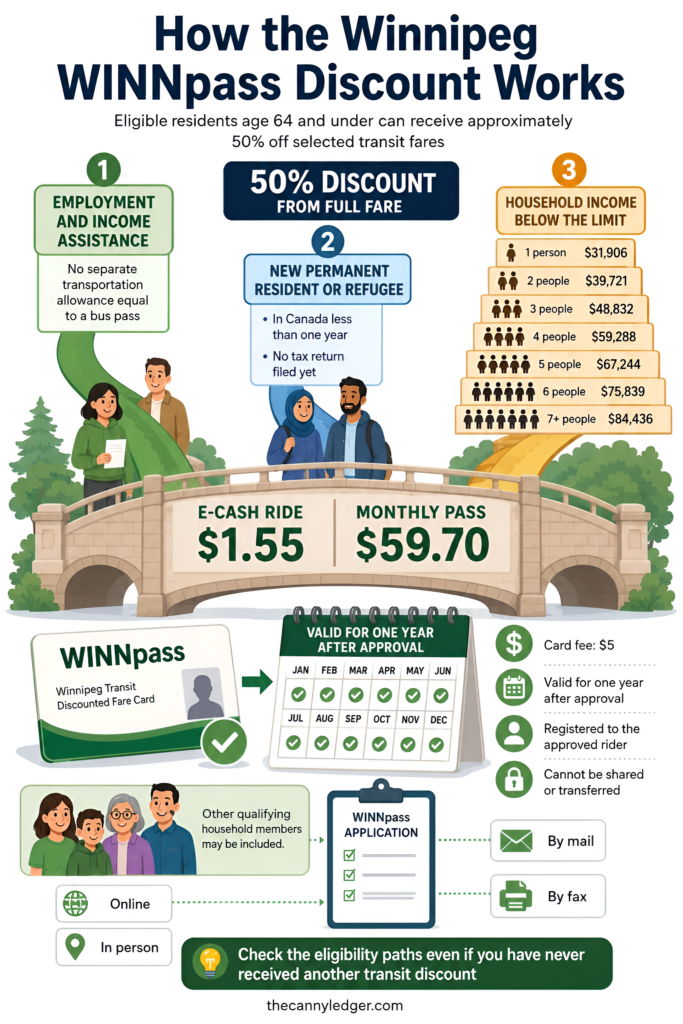
WINNpass provides a 50 percent discount off full-fare rates on monthly passes and e-cash rides for eligible Winnipeg residents aged 64 and under. In 2026, that works out to $59.70 for the WINNpass monthly product and $1.55 per ride using WINNpass e-cash.
Eligibility runs through three separate paths. You qualify if you’re receiving Employment and Income Assistance and don’t already receive a transportation allowance equivalent to a bus pass, if you’re a new permanent resident or refugee who has lived in Canada for less than a year and hasn’t yet filed a tax return, or if your household income falls below the Low Income Cut-Off threshold for your household size:
| Household size | Income threshold |
|---|---|
| 1 person | $31,906 |
| 2 people | $39,721 |
| 3 people | $48,832 |
| 4 people | $59,288 |
| 5 people | $67,244 |
| 6 people | $75,839 |
| 7 or more | $84,436 |
If your application is approved, other members of your household may also qualify for the same discount under your application. A WINNpass card carries its own $5 fee, stays active for one year from approval, and cannot be shared or transferred, since it’s registered specifically to the approved individual. Applications go through Winnipeg Transit directly, either online, by mail, in person at a Transit Customer Service Centre, or by fax.
Cash vs. e-cash vs. Paper Tickets
Every fare tier costs less through e-cash or paper tickets than through cash, and the gap is consistent enough to matter over time. A full-fare rider paying cash spends $3.45 per trip; the same rider loading e-cash onto a peggo card pays $3.10, a difference of 35 cents every single ride. Over a regular five-day work commute, that gap alone adds up to a meaningful amount saved simply by switching payment methods, without changing how or where you ride at all.
Paper tickets, sold in sheets of five or ten at Transit Customer Service Centres and select retail locations, match the e-cash rate exactly. The real advantage of e-cash over paper tickets is convenience and loss protection: e-cash lives on a registered peggo card, so a lost or stolen card doesn’t mean losing the balance, while lost paper tickets are simply gone.

The peggo Card Itself
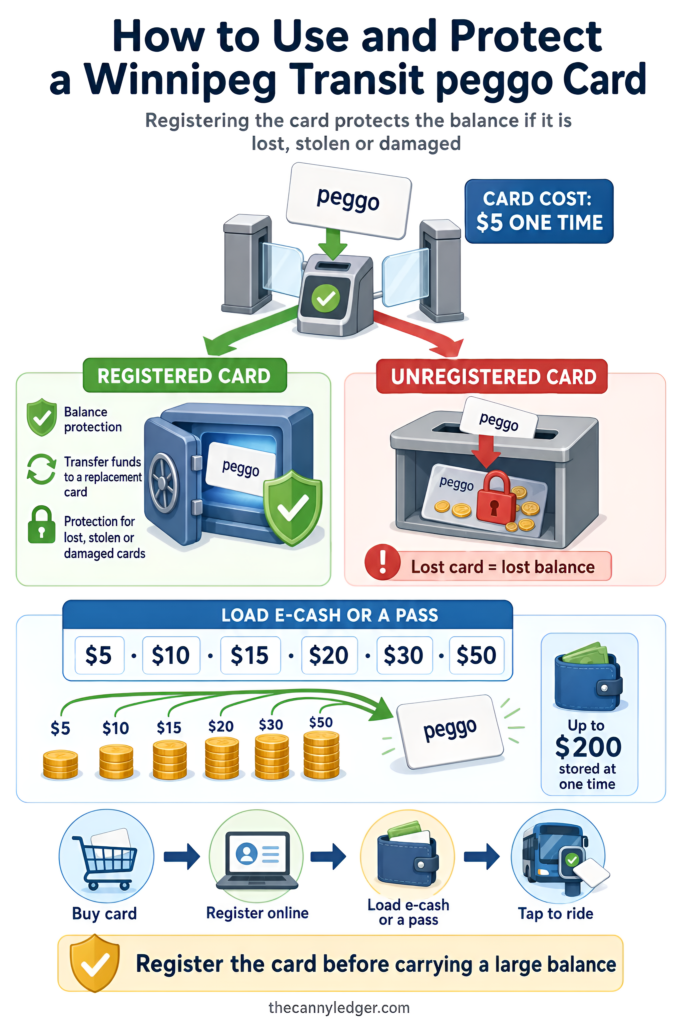
A peggo card costs $5 as a one-time purchase, separate from whatever fare product you load onto it. Register the card online after buying it, since registration is what protects your balance if the card is ever lost, stolen, or damaged. An unregistered card that goes missing takes whatever balance was on it right along with it, with no way to recover it, while a registered card’s balance can be transferred to a replacement.
E-cash loads in fixed denominations of $5, $10, $15, $20, $30, and $50, combinable up to a maximum stored balance of $200 on the card at any time.
Transfers and Fare-Free Travel for Kids
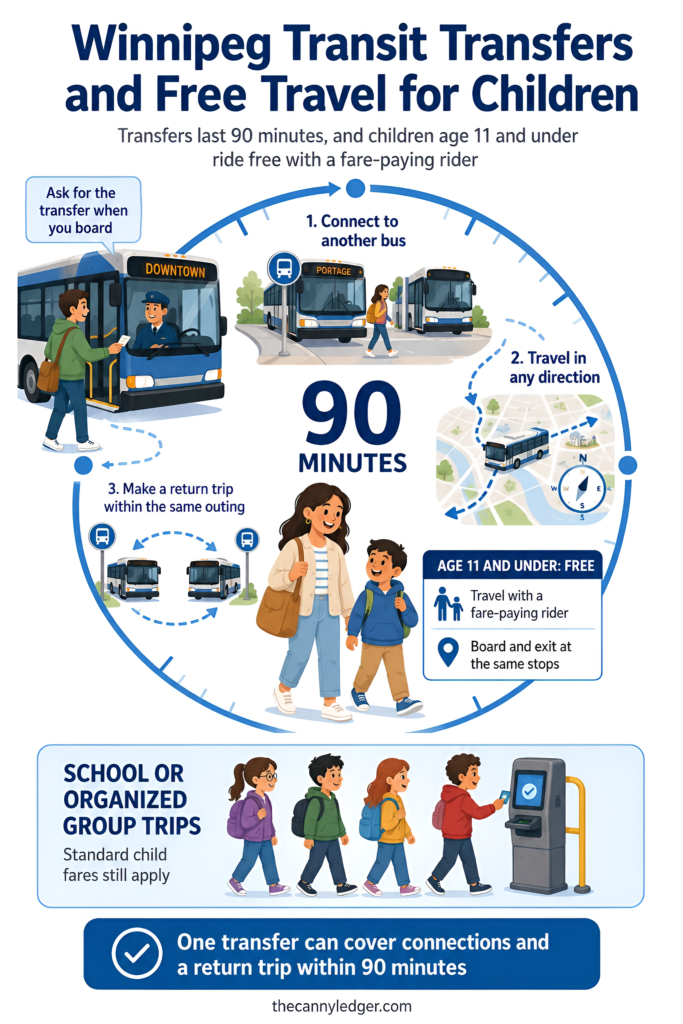
Ask your operator for a transfer when boarding if you’ll need one. Transfers are valid for 90 minutes from issue and work for any trip in any direction, including a return trip on the same outing, not just a one-way connection.
Children 11 and under ride free system-wide, provided they’re travelling with a fare-paying rider, whether that’s a parent, guardian, sibling, grandparent, or babysitter. This doesn’t extend to organized group outings like school field trips, where standard fares still apply for each child.
What to Actually Do Next
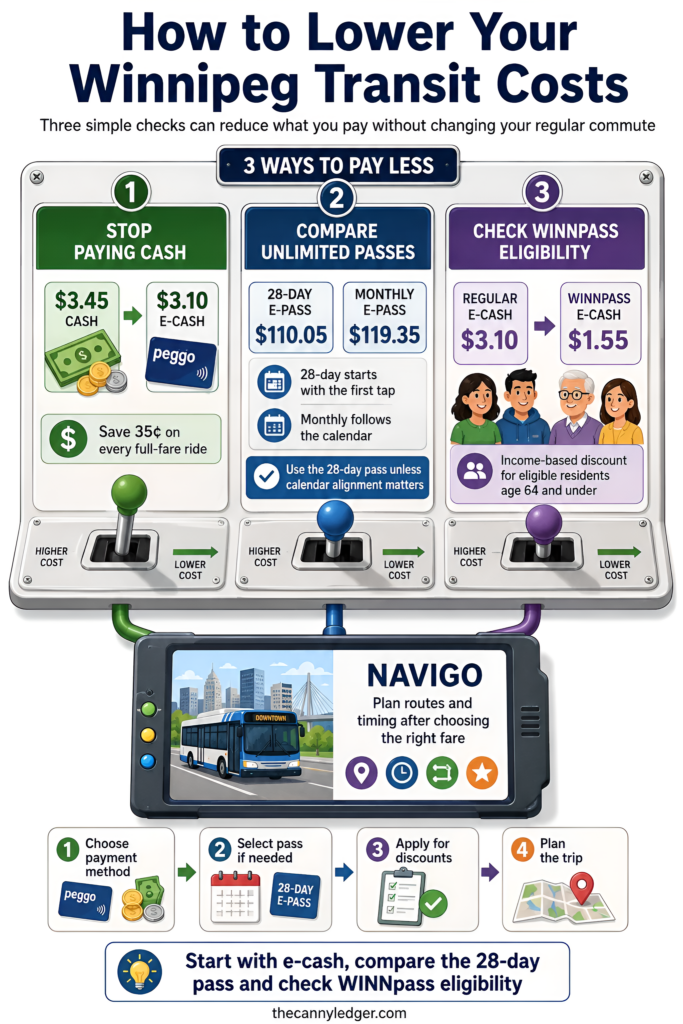
If you’re riding regularly, switching from cash to e-cash on a peggo card is the single easiest change that saves money without changing anything about your actual commute. If you’re currently paying for a Monthly pass out of habit, do the math on switching to the 28-day e-pass instead, since it’s both cheaper and untethered from the calendar. And if your household income falls anywhere near the WINNpass thresholds above, it’s worth applying, since the paperwork is straightforward and the 50 percent discount applies to both single-ride and monthly costs.
For trip planning once your fare is sorted, Winnipeg Transit’s Navigo tool maps out routes and timing, and if you’re new to the system altogether, the full Winnipeg Transit guide covers the rest of what riding actually looks like day to day.
Frequently Asked Questions
Can I use a full-fare peggo card to get post-secondary pricing if I’m a student? No. Post-secondary rates only apply on a dedicated post-secondary peggo card purchased at your school, with a validation sticker attached to your student ID. A regular peggo card won’t be charged the discounted rate even if you’re an eligible student.
Does the 28-day e-pass ever expire if I don’t use it right away? The 28-day period only begins once you first tap the pass to activate it, so an unused pass sitting loaded on your card doesn’t start counting down until you actually use it for the first time.
Is WINNpass the same as the youth or senior discount? No. WINNpass is a separate, income-based program for residents 64 and under, layered on top of the standard fare structure rather than replacing the youth or senior tiers, which are based on age alone.