
When COVID-19 started killing people by the tens of thousands across Canada, a reasonable question crossed a lot of minds. Would a pandemic, an event no underwriter had priced into anyone’s policy, actually get paid out. It did, without exception or asterisk. Insurers confirmed publicly that death from the virus was treated exactly like death from any other illness, and the Canadian Life and Health Insurance Association went further, confirming that vaccination status would never be used to deny a claim either. The system got stress-tested by something genuinely unprecedented, and the coverage held. That’s a better answer to what life insurance actually covers than any list of bullet points, since it shows the breadth of the promise under real pressure rather than in theory.
- The Short List of What Actually Isn’t Covered
- The Contestability Period Deserves Its Own Explanation
- Medically Assisted Death Gets Treated as What It Actually Is
- Pre-Existing Conditions Change the Price, Not the Coverage
- High-Risk Activities and Occupations Need to Be Disclosed, Not Avoided
- What the Payout Can Actually Be Used For
- The Exclusion Almost Nobody Thinks to Ask About
- What This Actually Means When You’re Deciding on Coverage
- Frequently Asked Questions
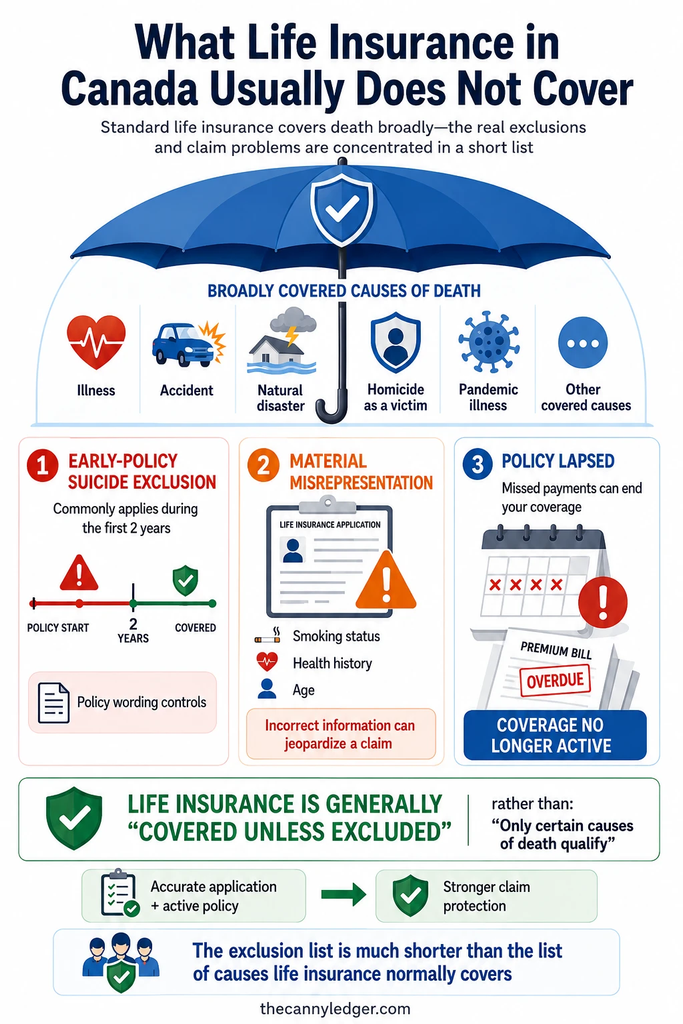
Life insurance in Canada covers death from virtually any cause, including illness, accident, natural disaster, homicide as a victim, and medically assisted death, once a policy is active and past its contestability period. The genuine exclusions are a short, specific list. Suicide within the first one to two years of a policy, material misrepresentation discovered on the original application, and a lapsed policy where premiums weren’t kept current.
The Short List of What Actually Isn’t Covered
Rather than a long table of qualifying and disqualifying conditions, it’s more accurate to think of standard life insurance as covering everything by default, with a small number of specific carve-outs, a structure the Financial Consumer Agency of Canada reflects in its own general guidance on the product. A death by suicide within the contestability period, commonly the first two years a policy is active, is the best known exclusion, and even then most policies refund the premiums paid rather than simply keeping the money. Beyond that specific window, suicide is treated the same as any other cause of death. A death connected to material misrepresentation on the original application, lying about smoking status, hiding a serious diagnosis, or misstating age, gives an insurer grounds to deny a claim, and this exception applies regardless of whether the misrepresentation had anything to do with the actual cause of death, a point RBC Insurance outlines among the most common reasons a payout gets disqualified. And a policy that’s lapsed due to missed premiums simply isn’t active anymore, which isn’t really an exclusion so much as the coverage no longer existing at all.
The Contestability Period Deserves Its Own Explanation
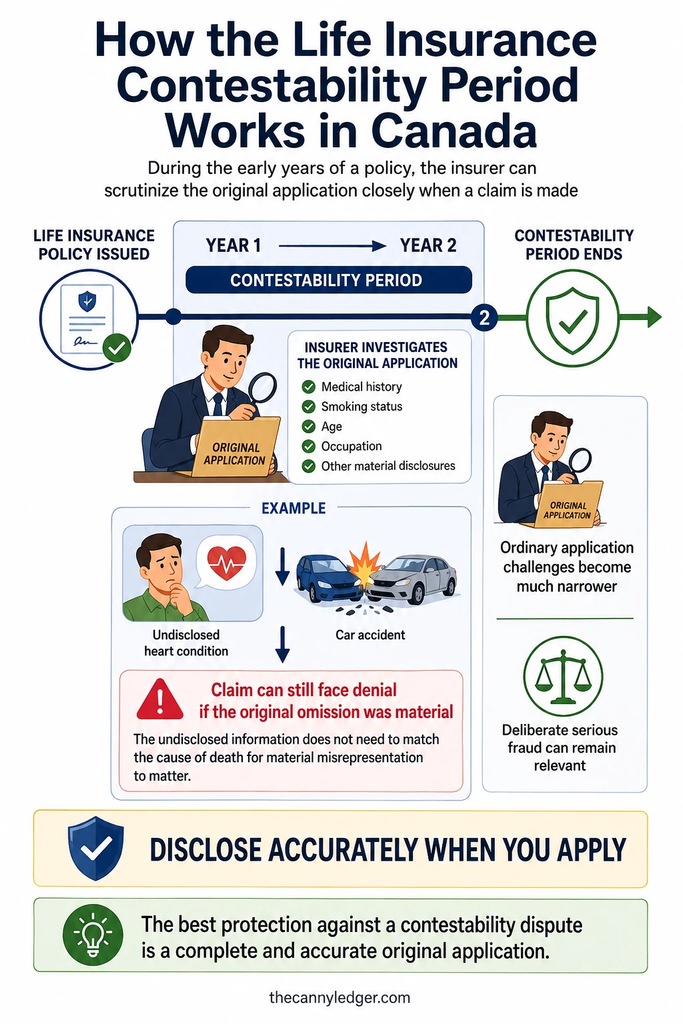
This window, typically the first two years after a policy is issued, is where most denied claims actually originate, and it works differently than people assume. During this period, an insurer investigating a claim isn’t just checking whether the stated cause of death matches what was disclosed. It’s checking the entire original application for anything materially untrue, and if it finds something significant, the claim can be denied even when the misrepresented detail had nothing to do with how the person actually died. Someone who didn’t disclose a heart condition and later dies in a car accident can still have a claim denied if the omission is considered material, a detail that catches people off guard since it feels disconnected from the actual cause of death. After the contestability period closes, this kind of retroactive investigation into the original application effectively ends, barring evidence of deliberate, serious fraud, which is why accurate disclosure at the time of application matters more than most people realize going in.
Medically Assisted Death Gets Treated as What It Actually Is
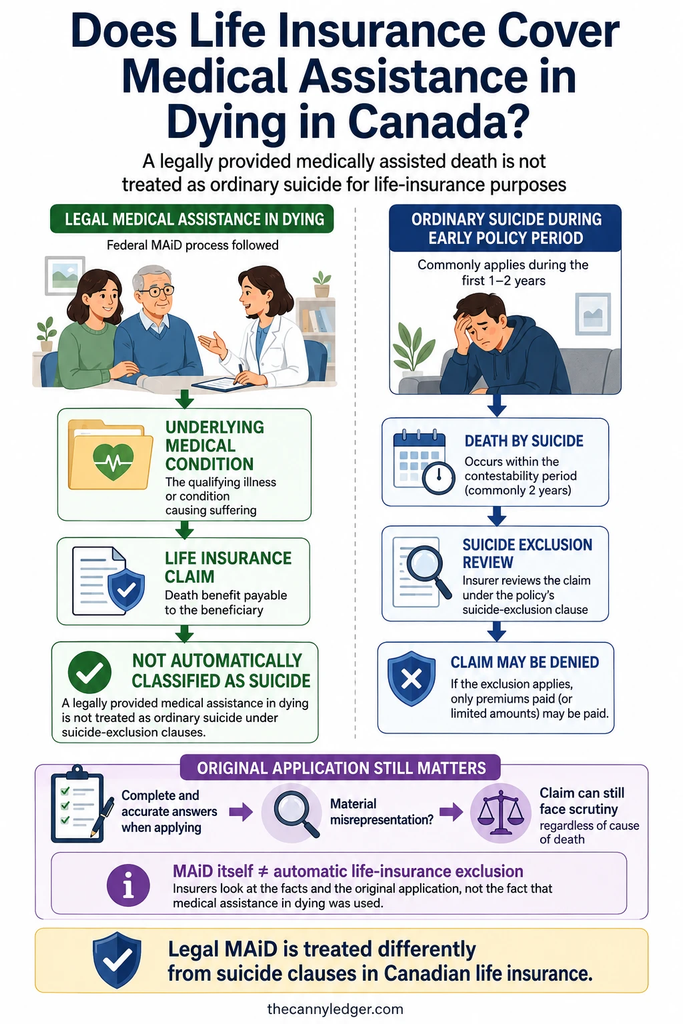
This is a genuinely interesting area of Canadian insurance practice that most general coverage explanations skip entirely. Medical assistance in dying became legal across Canada under federal legislation starting in 2016, and the insurance industry had to decide how to treat it relative to the standard suicide exclusion. The Canadian Life and Health Insurance Association’s own position, issued that same year, states plainly that medically assisted death, when it follows the legal process set out by government, will not be treated as suicide for life insurance purposes. In practice, this means MAiD is treated as a natural death connected to the underlying condition that made someone eligible for it in the first place, not as a self-inflicted death subject to the contestability-period suicide clause. The same general exceptions still apply on top of this, a claim can still face scrutiny if the original application involved a material misrepresentation, but the mere fact that death occurred through a legal medically assisted process isn’t treated as a reason to deny a claim.
Pre-Existing Conditions Change the Price, Not the Coverage
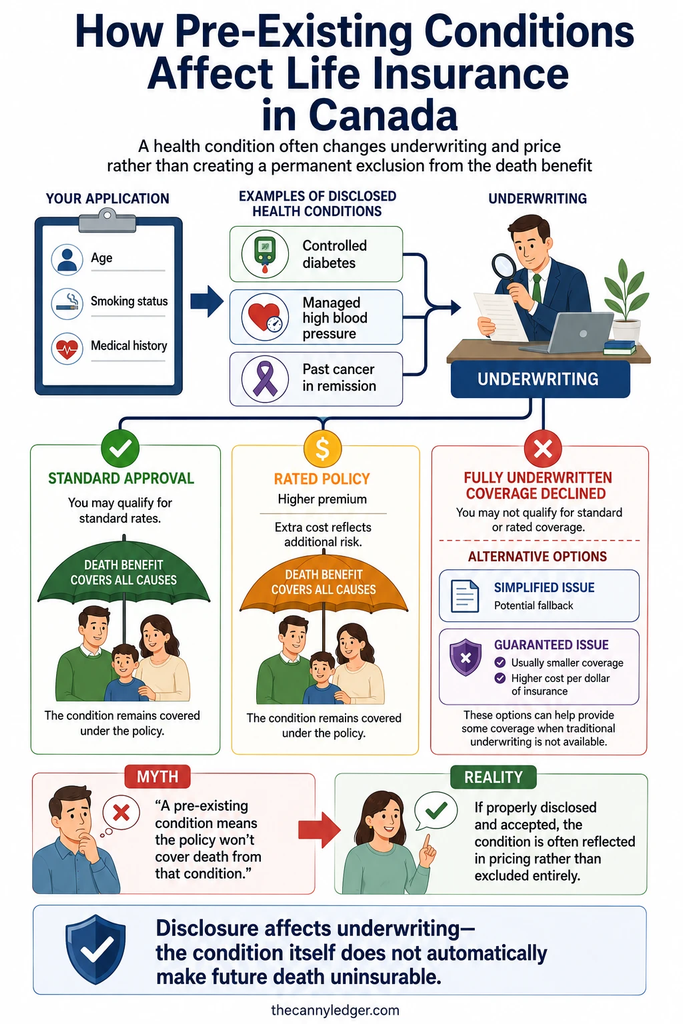
A common fear keeps people from even applying, the assumption that an existing health condition disqualifies them from coverage entirely. That’s rarely how it actually works. Most applicants with a manageable condition, diabetes, controlled high blood pressure, a past cancer diagnosis in remission, get approved through standard underwriting at a higher premium, often called a rated policy, rather than being turned away outright. The condition itself doesn’t get carved out of what the policy covers going forward. It simply factors into how the insurer prices the risk at the time of application, the same way age or smoking status would. Genuinely severe or unmanaged conditions can still result in a decline for fully underwritten coverage, but even then, simplified issue or guaranteed issue coverage typically remains available as a fallback, just at a smaller coverage amount and higher cost per dollar of protection.
High-Risk Activities and Occupations Need to Be Disclosed, Not Avoided
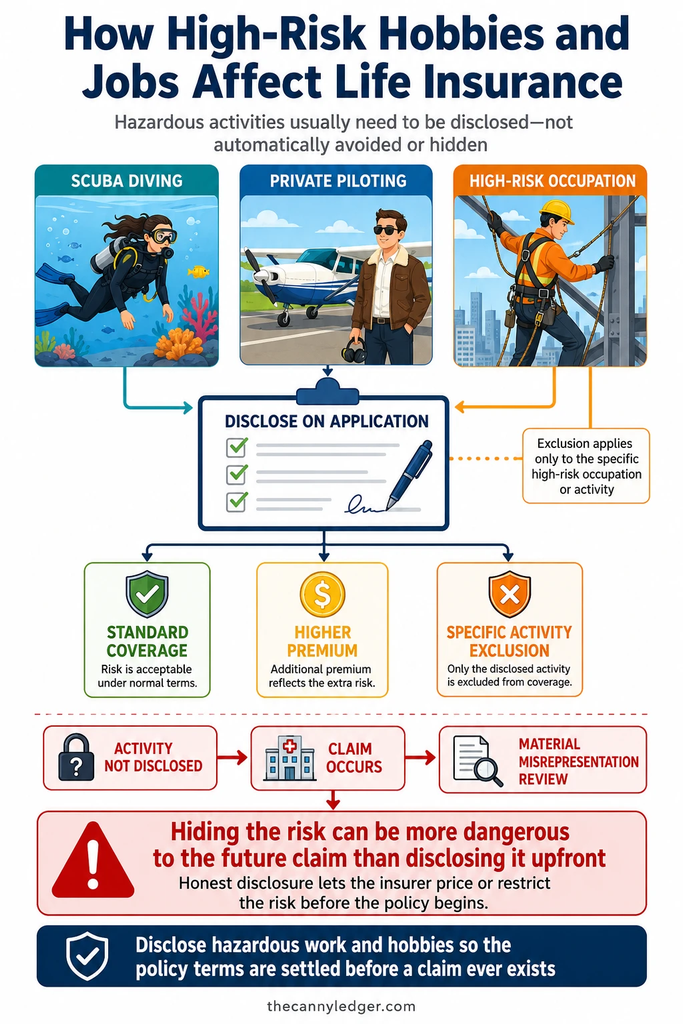
Scuba diving, private piloting, or a physically dangerous occupation don’t automatically exclude someone from coverage, but they do need to be disclosed honestly on the application rather than left out. Failing to mention a genuinely hazardous hobby or job, then dying in connection with it, is where this overlaps with the material misrepresentation problem described above rather than being its own separate category of exclusion. Disclosed honestly, these factors typically show up as a modest premium increase or an added exclusion specific to that one activity, rather than a blanket refusal of coverage across the board.
What the Payout Can Actually Be Used For
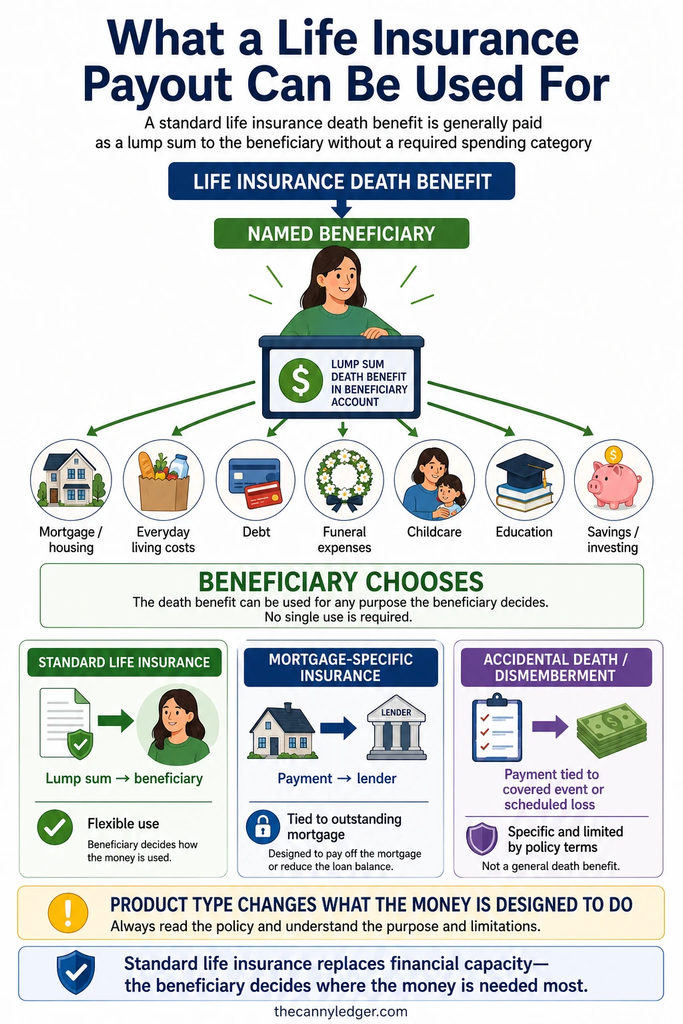
Once a standard life insurance claim is approved, the death benefit comes with no restrictions on how it gets spent, a point RBC Insurance makes directly in its own overview of what a policy actually pays for. This is worth stating explicitly because it isn’t true of every product that sounds similar. Mortgage-specific insurance pays the lender directly and only covers the outstanding mortgage balance, while accidental death and dismemberment coverage pays according to a fixed schedule tied to the specific type of loss. A standard term life insurance death benefit does neither. It’s paid as a lump sum directly to whoever is named as beneficiary, with no requirement to spend it on funeral costs, debt, or anything else specifically, which is exactly why sizing the coverage correctly in the first place matters more than most people realize, since nothing forces the money toward any particular use afterward.
The Exclusion Almost Nobody Thinks to Ask About
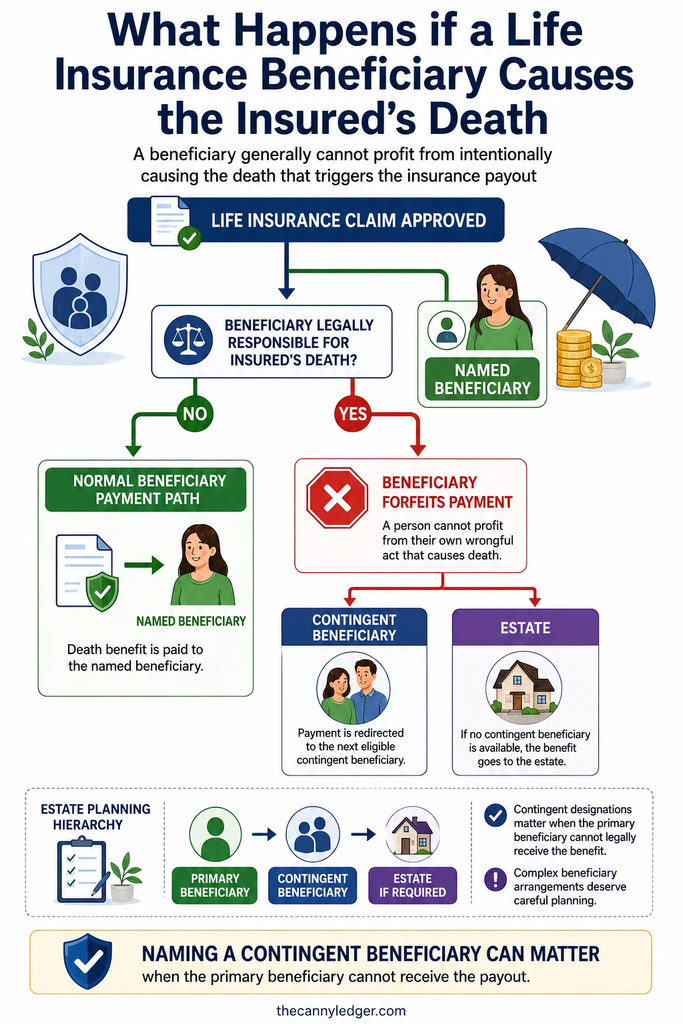
One scenario rarely comes up in general coverage explanations but is worth knowing regardless. If a named beneficiary is found responsible for causing the insured person’s death, that beneficiary generally forfeits their right to the payout, which then typically passes to a contingent beneficiary or the estate instead. This isn’t a written clause insurers advertise, it reflects a broader legal principle that a person shouldn’t profit from causing the harm that triggers a payout, but it’s a real and consistently applied outcome worth being aware of, particularly for anyone structuring beneficiary designations in a complicated family situation.
What This Actually Means When You’re Deciding on Coverage
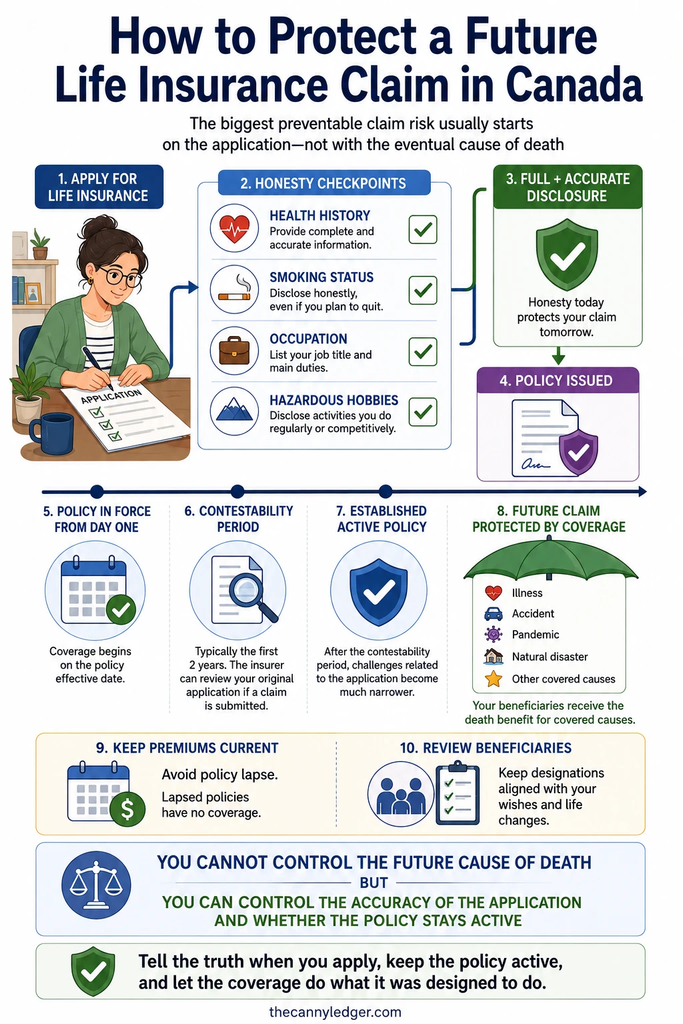
The practical takeaway is that the coverage itself is broader than most people assume going in, and the real risk to a claim sits almost entirely in the honesty of the original application rather than in what eventually causes death. Disclose health history, smoking status, occupation, and any genuinely hazardous hobbies completely and accurately at the time of applying, since that single step does more to protect a future claim than anything else covered here. And once a policy has cleared its contestability period, understand that the promise behind it is close to unconditional, which is worth remembering the next time a real crisis, whether personal or something as large as a pandemic, raises the question of whether coverage will actually hold.
Frequently Asked Questions
Does dying while intoxicated or under the influence of drugs void a life insurance claim? Not automatically. Unless the policy specifically excludes death connected to intoxication or illegal substance use, or the circumstances involve a broader misrepresentation issue, standard life insurance generally still pays out, though the specific facts of a claim can matter here more than with most other exclusions.
Is there a separate exclusion for suicide beyond what’s already covered under the contestability period? No, the suicide exclusion and the broader contestability period run on the same timeline in most policies, and a closer look at exactly how the suicide clause works covers the specific mechanics of that exclusion in more depth than fits here.
Does the death benefit get taxed differently based on what caused the death? No. The tax treatment of a life insurance death benefit is the same regardless of cause of death, remaining tax-free to a named beneficiary in every scenario described in this article.
How long after a claim is approved does the payout typically arrive? Timing depends on the insurer and how quickly a complete claim gets submitted, and understanding typical payout timelines separately helps set realistic expectations for a beneficiary managing a claim during an already difficult period.