
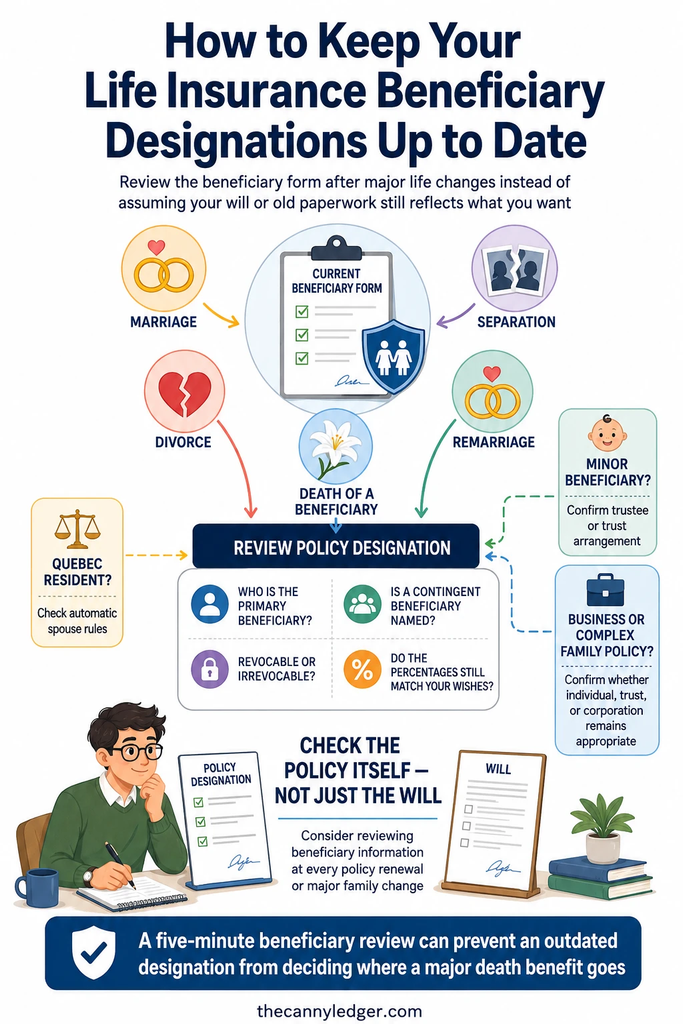
A will has no authority over who receives a life insurance death benefit, no matter how clearly it spells out someone’s wishes. The beneficiary form on file with the insurer is a separate legal contract that overrides anything written in a will, which means an ex-spouse named on a policy fifteen years ago, and never removed, still collects the full payout even if the will says otherwise and even if that person has been out of the picture for over a decade. This isn’t a loophole or an oversight in the system. It’s simply how the two documents work, and the gap between what people assume their will controls and what it actually controls is where most beneficiary mistakes happen.
- Revocable Versus Irrevocable, and Why the Distinction Actually Matters
- The Quebec Exception, Which Actually Has Two Parts
- Naming a Minor Comes With a Requirement Most People Skip
- The Divorce Mistake That Isn’t Actually a Loophole
- Primary and Contingent Beneficiaries, and Splitting a Payout
- Naming a Trust Instead of an Individual
- What Happens With No Beneficiary Named at All
- The Insurable Interest Requirement, Briefly
- Keeping This Current
- Frequently Asked Questions
A life insurance beneficiary is the person, trust, or entity named on the policy itself to receive the death benefit, and that designation is legally separate from a will, meaning the policy’s own beneficiary form, not the will, determines who actually gets paid. Beneficiaries can be revocable, changeable at any time without their knowledge, or irrevocable, requiring their written consent before any change, and the rules that govern both vary in one significant way for anyone living in Quebec.
Revocable Versus Irrevocable, and Why the Distinction Actually Matters
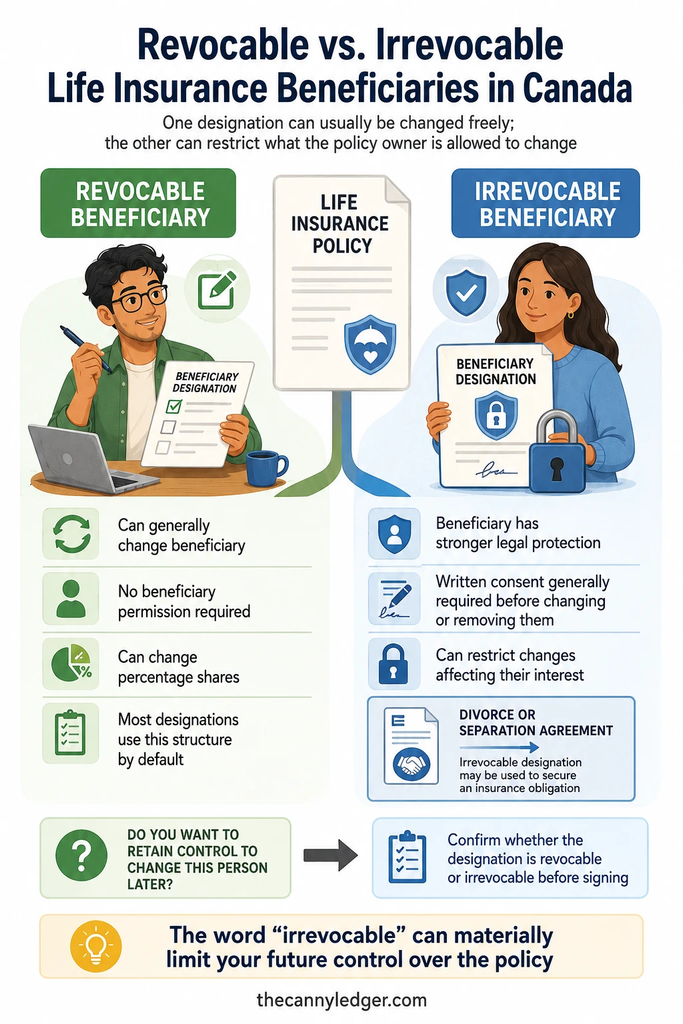
Most beneficiary designations in Canada are revocable by default, meaning the policy owner can change who’s named, or in what proportion, at any point without needing permission from the current beneficiary or even telling them it happened. An irrevocable designation flips that arrangement. Once someone is named irrevocably, the Financial Consumer Agency of Canada confirms that the policy owner needs that beneficiary’s written permission before making any change, including reducing their share or removing them entirely. Irrevocable designations show up most often in divorce settlements or separation agreements, where one spouse wants a guarantee that support obligations tied to a term policy or another type of coverage can’t quietly get undone later if the other party remarries or changes their mind.
The Quebec Exception, Which Actually Has Two Parts
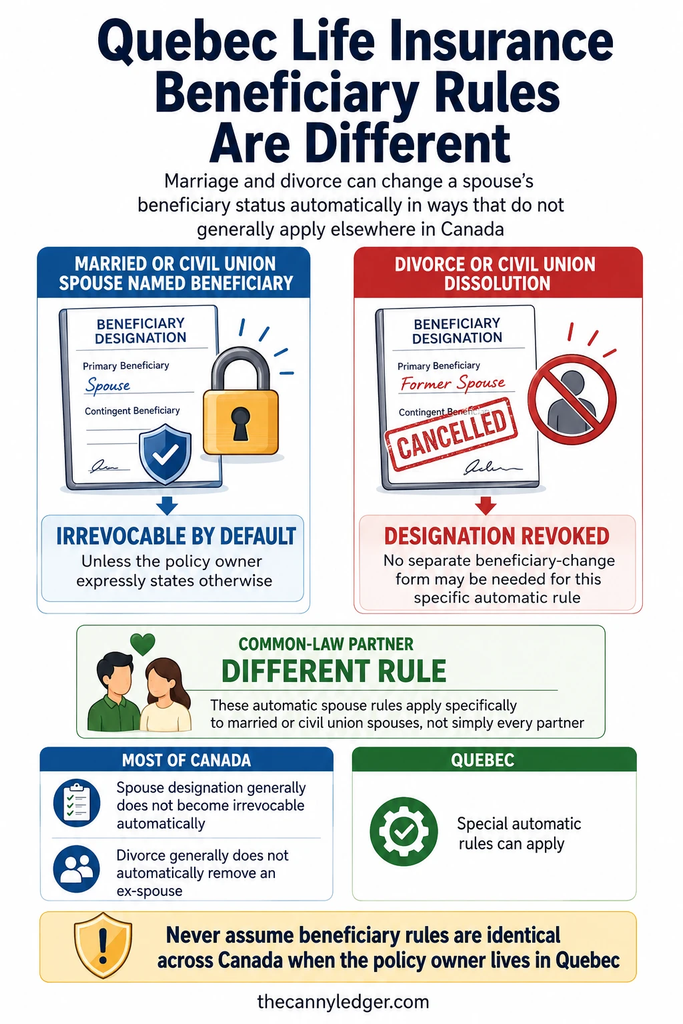
Quebec handles beneficiary designations differently from the rest of the country in ways that catch people off guard specifically because the assumption of uniform national rules doesn’t hold here. First, under the Civil Code of Quebec, naming a married or civil union spouse as beneficiary automatically makes that designation irrevocable unless the policy owner explicitly states otherwise in writing, a reversal of the default that applies everywhere else in Canada. Second, and working in the opposite direction, a divorce or the dissolution of a civil union in Quebec automatically cancels a spousal beneficiary designation, even without the policy owner doing anything to update the paperwork. Both rules only apply to a legally married or civil union spouse specifically, not to a common-law partner, and neither rule exists anywhere else in the country, which makes Quebec residents dealing with either marriage or divorce worth flagging as a genuinely different situation from the rest of Canada on this specific question.
Naming a Minor Comes With a Requirement Most People Skip
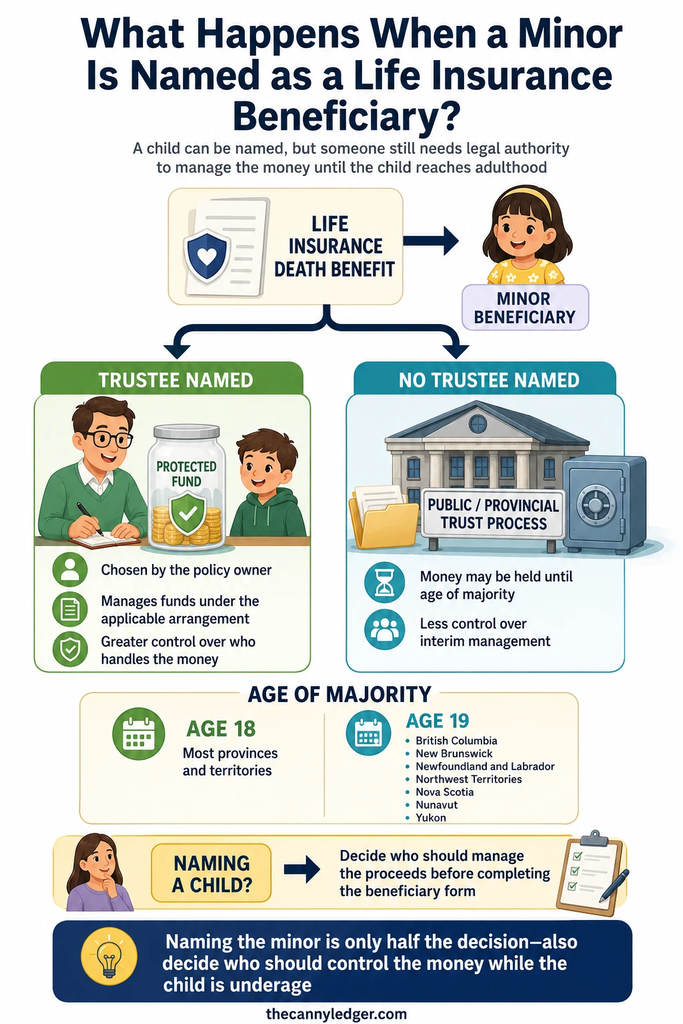
A minor can absolutely be named as a life insurance beneficiary, but the money can’t simply be handed to them the way it would to an adult. Without a trustee named specifically to manage the funds, the relevant province or territory will hold the death benefit in trust until the child reaches the age of majority, a process that adds delay and removes control over how the money gets used in the meantime, an outcome worth weighing against naming a trustee directly on a policy meant for a child from the start. The age of majority itself isn’t uniform either. Sun Life notes it’s 19 in British Columbia, New Brunswick, Newfoundland and Labrador, the Northwest Territories, Nova Scotia, Nunavut, and Yukon, and 18 everywhere else, which affects exactly how long a public trustee arrangement would need to hold funds if no private trustee had been named instead. Naming a specific trustee inside the policy, or setting up a formal trust for the purpose, keeps that control with someone the policy owner actually chose rather than defaulting to a government process.
The Divorce Mistake That Isn’t Actually a Loophole
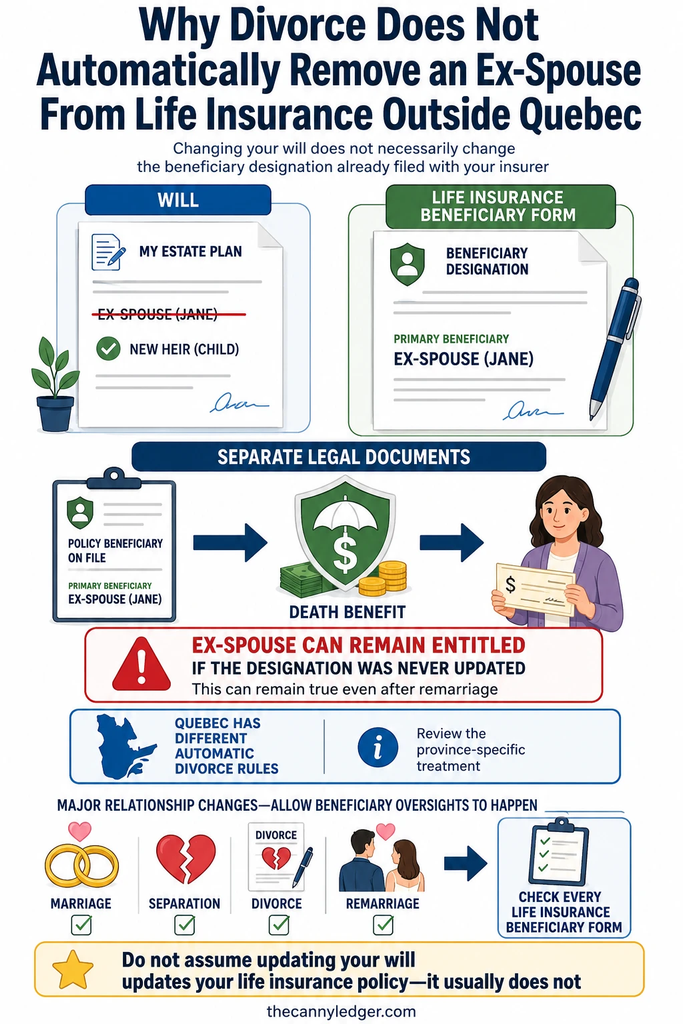
Outside Quebec, getting divorced does nothing to a beneficiary designation automatically. An ex-spouse named years before a separation remains the named beneficiary indefinitely unless the policy owner actively files a change with the insurer, and this is true even after a subsequent remarriage. It’s genuinely different from how wills often work in several provinces, where divorce can automatically revoke a gift to a former spouse written into the document, which is likely part of why so many people mistakenly assume the same automatic protection extends to insurance. It doesn’t. This is precisely the scenario that opened this article, and it’s worth treating any major relationship change, marriage, separation, divorce, remarriage, as an automatic trigger to check every existing policy’s beneficiary form specifically, not just the will.
Primary and Contingent Beneficiaries, and Splitting a Payout
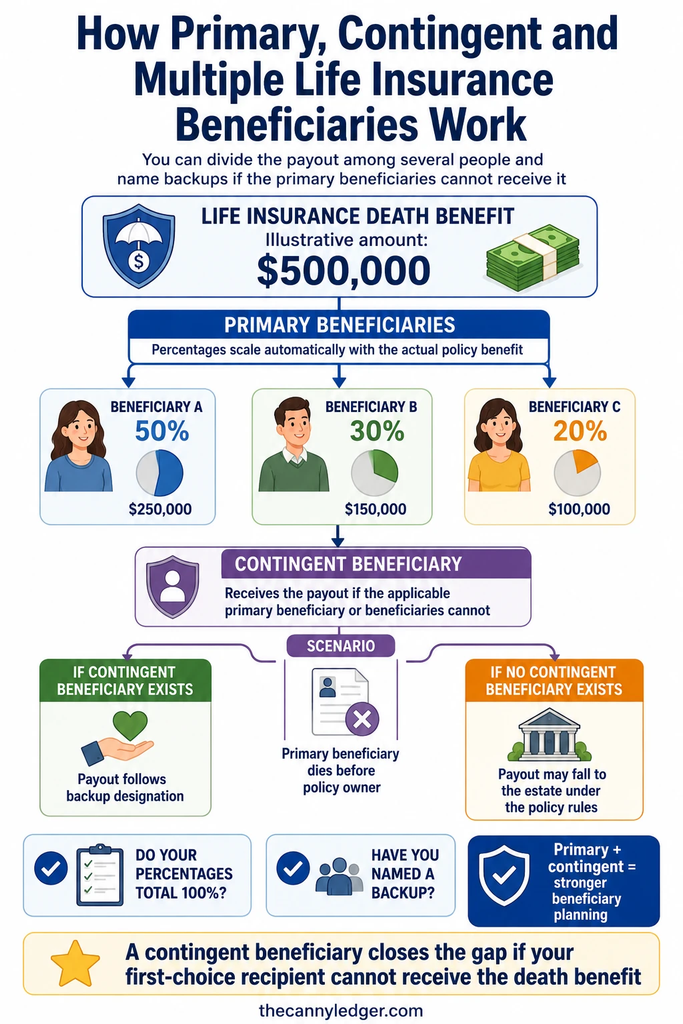
A policy can name more than one beneficiary and split the death benefit between them in whatever proportions the owner chooses, commonly by percentage rather than a fixed dollar amount so the split scales correctly regardless of how much the policy is worth at the time of a claim, a structure RBC Insurance describes in its own overview of how beneficiary designations work. Layering in a contingent beneficiary, someone who only receives anything if the primary beneficiary has also died, closes a gap that a lot of policies leave open by accident. Without a contingent beneficiary named, a primary beneficiary who predeceases the policy owner, even briefly, can send the payout to the estate by default rather than to whoever the policy owner would have actually chosen as a backup, adding a probate step that a five-minute contingent beneficiary designation would have avoided entirely.
Naming a Trust Instead of an Individual
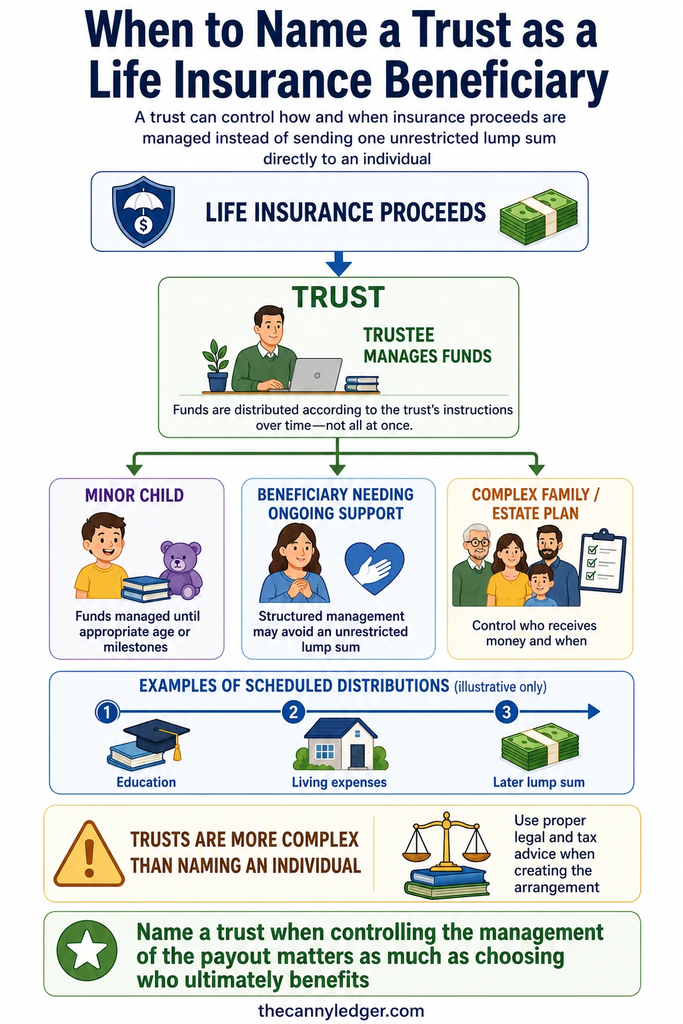
Rather than naming a person directly, a policy can name a trust as beneficiary, with a trustee responsible for managing and distributing the proceeds according to instructions the policy owner set up in advance. This shows up most often for minors, for a beneficiary with a disability or vulnerability that makes a lump sum risky to hand over directly, or for more complicated family situations, including a policy shared between two people insured jointly, where the policy owner wants the payout released on a schedule rather than all at once. It’s a more involved setup than a straightforward individual designation, and it’s worth doing with proper legal guidance rather than as a do-it-yourself addition to a standard beneficiary form, but for the right situation it solves a real problem that naming an individual outright simply can’t.
What Happens With No Beneficiary Named at All
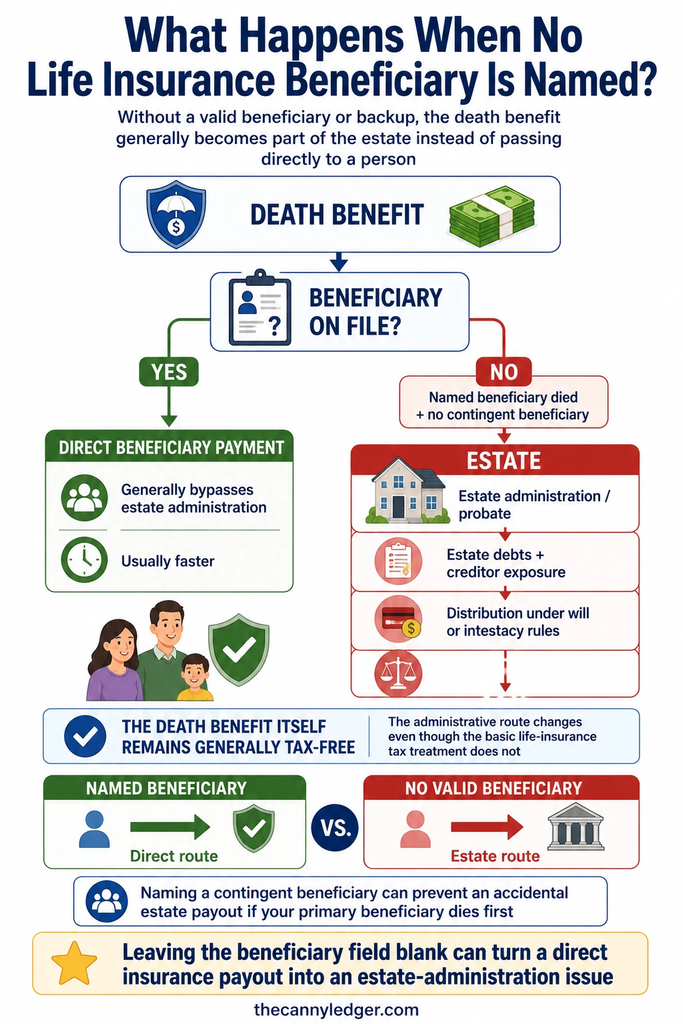
Leaving the beneficiary field blank, or naming a beneficiary who has already died with no contingent beneficiary in place, sends the death benefit to the deceased’s estate by default. From there, the payout becomes part of the probate process rather than bypassing it, which is exactly the outcome that naming an actual person is meant to avoid. The tax treatment of the payout itself doesn’t change based on this, a death benefit routed through the estate is still tax-free, but it does mean the money moves slower and becomes visible to the estate’s creditors and probate fees in a way it wouldn’t have if a specific person had simply been named from the start.
The Insurable Interest Requirement, Briefly
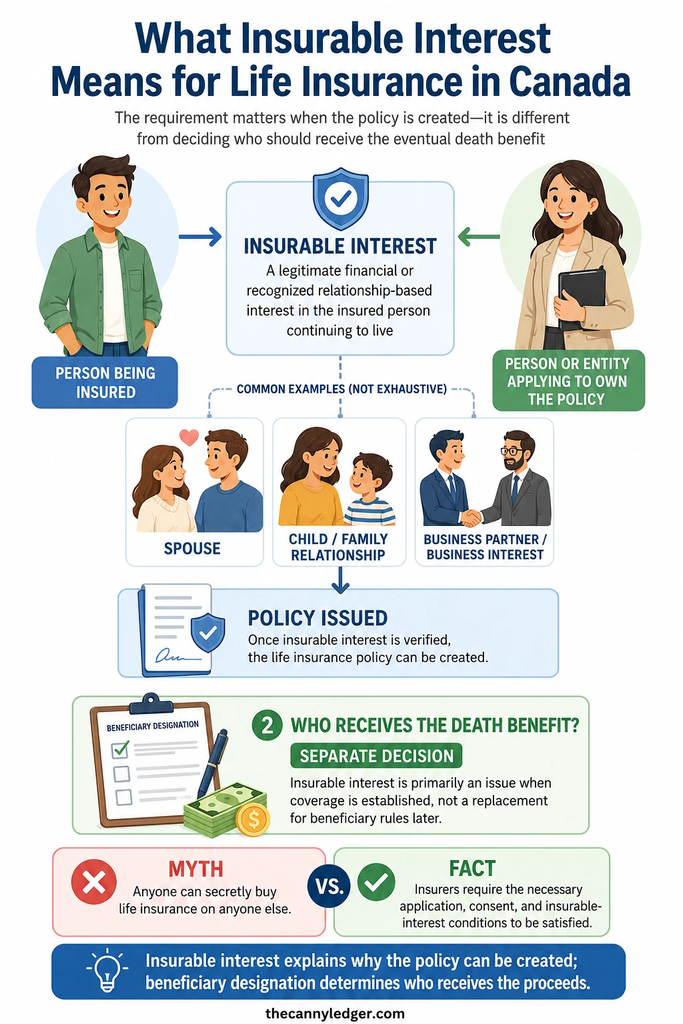
Before a policy can even be issued, most insurers require that whoever’s applying to be the policy owner has an insurable interest in the person being insured, essentially a real financial or emotional stake in that person continuing to live, such as a spouse, child, or business partner. This requirement exists at the application stage rather than affecting an already-issued policy’s beneficiary designation later, but it’s worth knowing about since it explains why a policy can’t simply be taken out on a random acquaintance and have the proceeds redirected to someone else entirely.
Keeping This Current
Pull up the actual beneficiary designation on every existing policy, not just the will, and check it against who the policy owner would genuinely want covered today rather than whoever was accurate at the time the policy was first purchased. Anyone in Quebec dealing with a recent marriage or divorce should confirm exactly how the automatic spousal rules apply to their specific policy, since the default here runs opposite to the rest of the country. And for a policy connected to a business or a more complex family structure, confirming whether an individual, a trust, or the corporation itself should actually be named is worth doing with an advisor before assuming the simplest option is automatically the right one.
Frequently Asked Questions
Can a beneficiary designation be changed without the insurer’s involvement, just by updating a will? No. The insurer’s own beneficiary form is what legally controls the payout, and a will alone, without a corresponding update filed directly with the insurance company, has no effect on which named beneficiary actually receives the death benefit.
Does naming a common-law partner in Quebec trigger the same automatic irrevocable rule as a married spouse? No. Quebec’s automatic irrevocable designation and the automatic cancellation on divorce both apply specifically to a legally married or civil union spouse, not to a common-law partner, who follows the standard revocable default unless the policy owner specifies otherwise.
How quickly does a payout to a named individual beneficiary typically move compared to one routed through an estate? Payouts to a named individual generally move faster once a claim is processed, since the money bypasses probate entirely, while proceeds paid to an estate wait on the broader estate administration process before reaching anyone.
Can a business partner be named as a life insurance beneficiary instead of a family member? Yes, provided the insurable interest requirement is met, and this is a common structure specifically for funding a business buy-sell arrangement rather than a personal income replacement need.