

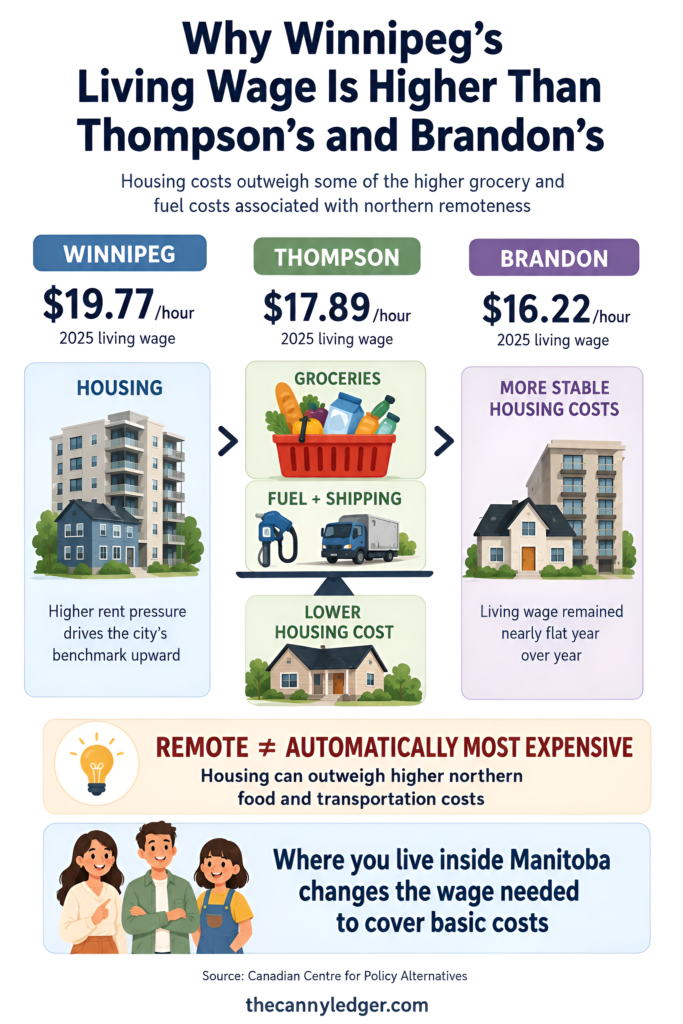
A worker in Thompson needs to earn $1.67 more an hour than a worker in Brandon just to cover the basics, despite both living under the exact same provincial minimum wage. The Canadian Centre for Policy Alternatives calculated Manitoba’s 2025 living wages at $19.77 an hour in Winnipeg, $17.89 in Thompson, and $16.22 in Brandon, three genuinely different numbers for three cities inside one province with one shared minimum wage floor. Manitoba’s cost of living isn’t one figure any more than Canada’s is, and the gap between its own cities is wide enough to matter a great deal depending on where you actually live.
- The Surprising Part Of The Provincial Comparison
- Manitoba’s Minimum Wage Doesn’t Move With Any Of This
- A Genuinely Fresh Tax Change Most Manitobans Haven’t Caught Up On Yet
- Manitoba’s Tax Structure Compared To Its Neighbours
- Winnipeg’s Place In The Broader Manitoba Picture
- What This Actually Means Depending On Where You Live
The Surprising Part Of The Provincial Comparison
This runs against most people’s assumptions going in. Thompson, a genuinely remote northern city roughly 760 kilometres north of Winnipeg, calculates out to a lower living wage than Winnipeg itself, not higher, despite the added cost of shipping goods that far north. Winnipeg’s higher figure comes down almost entirely to housing. The living wage methodology weighs local rent heavily, and Winnipeg’s rental market, while cheaper than most major Canadian cities, still runs meaningfully above what a smaller centre with far less housing demand pressure requires. Remoteness genuinely does drive up specific costs like groceries and fuel in the north, but it doesn’t automatically outweigh the sheer weight housing carries in a city the size of Winnipeg.
Brandon sits at the bottom of the three calculated cities, and its 2025 living wage held essentially flat year over year while Winnipeg’s climbed by a full dollar an hour. That stability reflects a housing market that simply hasn’t faced the same rent pressure Winnipeg has recently absorbed, even though Brandon and Winnipeg share a province, a minimum wage, and largely the same tax rules.
Manitoba’s Minimum Wage Doesn’t Move With Any Of This
None of these three living wage figures are legally binding on an employer the way minimum wage is. Manitoba’s minimum wage sits at $16.00 an hour today, rising to $16.40 on October 1, 2026, a single provincial number that applies identically whether an employee works in Winnipeg, Brandon, or Thompson. This annual adjustment is tied directly to Manitoba’s own inflation rate from the prior year, rounded up to the nearest five cents, rather than to any city-specific cost calculation the way the living wage figures are. That means a Thompson worker earning minimum wage falls $1.89 short of their city’s own calculated living wage, while a Brandon worker earning the same minimum wage sits only 22 cents below theirs, a genuinely different gap depending entirely on which city that worker happens to live in, even though the legal wage floor treats them identically.

A Genuinely Fresh Tax Change Most Manitobans Haven’t Caught Up On Yet
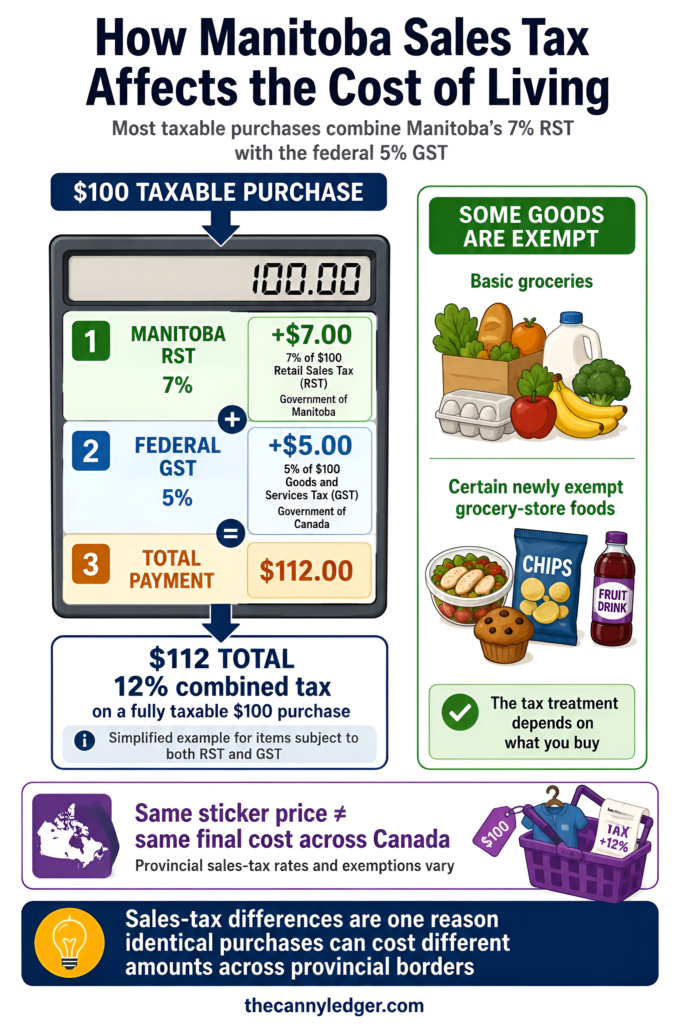
Something concrete and current actually works in the average Manitoban’s favour right now. Manitoba expanded its Retail Sales Tax exemption on groceries starting July 1, 2026, removing the 7 percent RST from prepared foods, snacks, baked goods, and many beverages sold at grocery stores, items like rotisserie chicken and chips that previously carried the tax even though basic groceries like bread and produce were already exempt. The provincial government estimates the change saves the average family roughly $100 a year, and it’s genuinely new enough that plenty of shoppers are still paying the old tax rate mentally even though it no longer applies at checkout. The exemption applies at grocery and larger convenience stores specifically, not at restaurants, bakeries, or bars, and smaller shops under 280 square metres that sell tobacco don’t qualify for the expanded relief either.

Manitoba’s Tax Structure Compared To Its Neighbours
Manitoba’s 7 percent Retail Sales Tax applies on top of the federal 5 percent GST, bringing the combined rate to 12 percent on most taxable goods and services. That’s genuinely a factor worth knowing if you’re comparing Manitoba’s overall cost structure against a neighbouring province, since sales tax rates and exemptions differ enough across provincial lines to meaningfully change what an identical purchase actually costs. Our dedicated breakdowns of GST in Winnipeg and PST in Winnipeg cover the full exemption list and how these two taxes stack on a typical purchase in more detail than fits here.
Winnipeg’s Place In The Broader Manitoba Picture
As the province’s largest city by a wide margin, Winnipeg carries the highest calculated living wage of the three cities, but it’s also where the overwhelming majority of the province’s jobs, services, and housing stock actually sit. Our dedicated coverage of average rent, grocery costs, and the broader living expenses picture specific to Winnipeg goes deeper into the city-level numbers than a province-wide comparison like this one can. If you’re weighing Winnipeg against a move elsewhere in Manitoba, comparing your own income or salary by profession against both the local living wage figure and the job market depth in a smaller centre matters just as much as the raw cost comparison itself, since a lower cost of living paired with fewer job opportunities in your specific field isn’t automatically the better trade.

What This Actually Means Depending On Where You Live
If you’re in Winnipeg, the province’s highest living wage figure reflects genuinely higher housing costs specifically, not a uniformly more expensive life across every category, and it’s worth checking your own mortgage payment or rent against that $19.77 benchmark to see where you actually stand. If you’re in Brandon or considering a move there, the flatter, lower living wage figure reflects real housing stability rather than a temporary dip, though it’s worth confirming that job availability in your specific field matches the smaller market before treating the lower cost as a straightforward win. And if you’re anywhere in the province earning close to minimum wage, comparing that $16.00 hourly rate against your specific city’s calculated living wage, not the provincial average, tells you the real size of the gap you’re actually working against, since Thompson, Brandon, and Winnipeg each tell a genuinely different version of that story.