

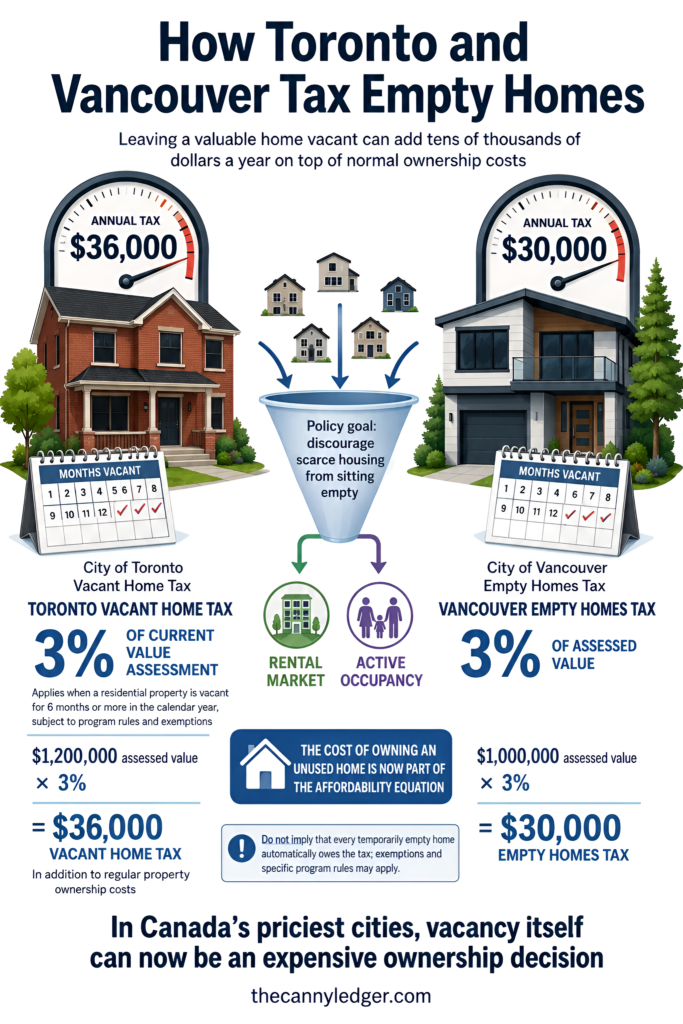
Leave a $1.2 million Toronto property empty for more than six months this year and the city bills you $36,000 in tax alone, on top of everything else that property already costs. That’s not a hypothetical penalty buried in fine print, it’s the actual math behind Toronto’s Vacant Home Tax, and it captures something the usual “most expensive city” ranking misses entirely. The story at the top of the Canadian housing market isn’t just how much these places cost. It’s how aggressively governments have started taxing people for simply owning property there and not using it.
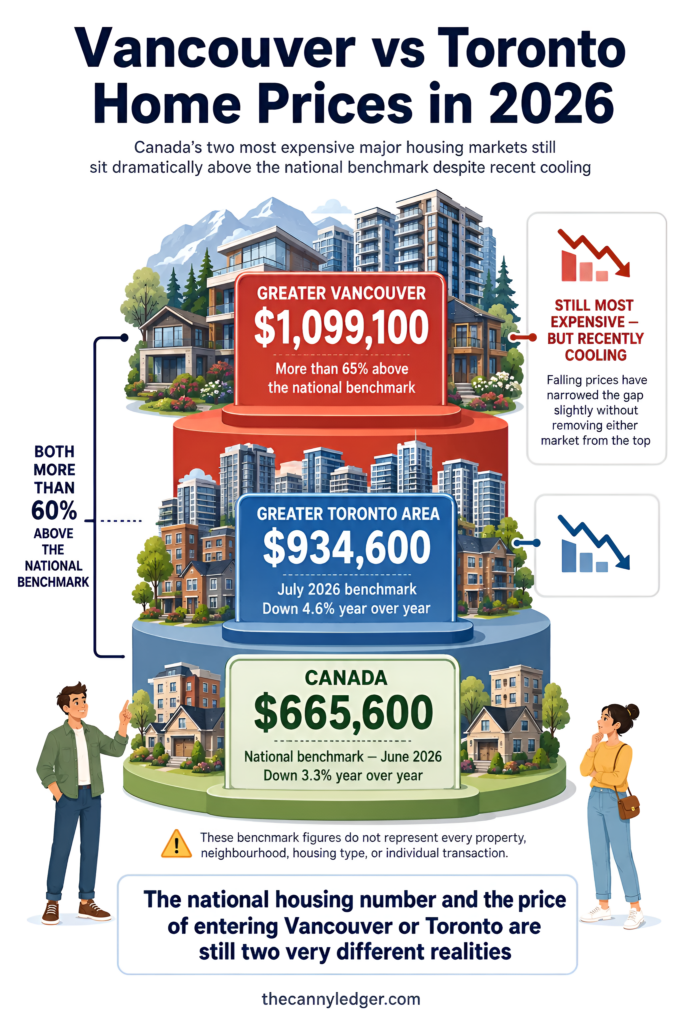
Vancouver and Toronto remain Canada’s most expensive cities to live in, with Greater Vancouver’s benchmark home price sitting at $1,099,100 and the Greater Toronto Area’s at $934,600 as of mid-2026, both more than 60% above the national benchmark of $665,600. What separates this pair from the rest of the country isn’t just the price tag anymore, it’s the layered stack of federal, provincial, and municipal taxes specifically built to make owning property there more expensive if you’re not actually living in it.
The Actual Numbers at the Top
Canada’s national benchmark home price sits at $665,600 as of June 2026, according to the Canadian Real Estate Association’s own monthly statistics, down 3.3% from the year before. Against that national figure, Greater Vancouver’s benchmark comes in at $1,099,100, more than 65% higher than the national number, while the Greater Toronto Area’s benchmark price sat at $934,600 as of July 2026, according to the Toronto Regional Real Estate Board’s own market data, down 4.6% from a year earlier despite still sitting well above every other major Canadian market.
Both cities have actually been cooling recently, which is worth sitting with directly rather than skipping past, and a fuller ranking of major Canadian cities shows just how much that trend has narrowed the gap with everywhere else. Vancouver and Toronto posting the sharpest year-over-year declines among Canada’s largest markets doesn’t change their position at the top of this list, it just means the gap between them and the country’s most affordable cities has been narrowing slightly rather than widening the way it did through most of the past decade.
Why Governments Started Taxing Empty Homes
This is the part of the expensive-city story that a plain price ranking never captures. Both Vancouver and Toronto now charge homeowners directly for leaving a residential property unoccupied, on top of regular property tax, and the mechanics of each program are worth understanding if you own or are considering owning in either city. According to WOWA’s own calculator built around the City of Toronto’s program, Toronto’s Vacant Home Tax now sits at 3% of a property’s Current Value Assessment, up from just 1% when the program launched in 2022, applying to any residential property left unoccupied for six months or more in a calendar year. On a property assessed at $1.2 million, that works out to $36,000 owed for the year, due in three instalments each fall.
Vancouver runs a nearly identical program under a different name. According to WOWA’s Vancouver-specific calculator, the city’s Empty Homes Tax has held at 3% of assessed value since a rate increase from the program’s original design, meaning a Vancouver property assessed at $1 million owes $30,000 for a year spent sitting vacant. Both programs exist for the identical stated reason, pushing empty units back into the rental or ownership market in cities where supply is scarce enough that a government is willing to charge tens of thousands of dollars a year to discourage a property from sitting empty.
The Foreign Buyer Ban, and Whether It’s Actually Working
Beyond taxing vacancy, the federal government has gone further and restricted who can buy at all, a policy that sits alongside CMHC’s broader mandate in Canadian housing policy. The Prohibition on the Purchase of Residential Property by Non-Canadians Act, first introduced in 2023, has been extended to January 1, 2027, blocking non-Canadians from buying residential property in census metropolitan areas like Toronto and Vancouver, with exemptions carved out for some international students, work permit holders, and property purchased for development.
Whether the ban has meaningfully changed prices in either city is actively disputed, and it’s worth knowing the counterargument rather than assuming the policy did what it set out to do. Statistics Canada data from 2022 put non-resident ownership at 3.8% of residential properties in Toronto and 6.4% in Vancouver, small enough that at least one real estate economist has publicly questioned whether the ban addresses a meaningful share of what’s actually driving prices, versus functioning mainly as a political signal that the government is taking the affordability crisis seriously.

British Columbia’s Extra Layer
Vancouver specifically sits under more overlapping taxation than anywhere else in the country, which is worth understanding if the city is anywhere on your radar as a buyer. Beyond the municipal Empty Homes Tax, British Columbia runs its own provincial Speculation and Vacancy Tax, which climbed to 3% for foreign owners as of the 2026 tax year, up from 2% previously, layered directly on top of the 20% Additional Property Transfer Tax the province already charges foreign buyers on the purchase price itself. A foreign buyer purchasing and then failing to occupy a Vancouver property could realistically be facing three separate taxes stacked on top of each other, provincial purchase tax, provincial vacancy tax, and municipal empty homes tax, none of which apply to a comparable purchase almost anywhere else in Canada.
That stacking is deliberate policy design rather than an accident of overlapping jurisdictions. Ontario has resisted building an equivalent provincial vacancy tax on top of Toronto’s municipal one, which means Vancouver currently carries a meaningfully heavier tax burden on non-resident and vacant ownership than Toronto does, despite the two cities usually appearing side by side on cost of living rankings as though they’re functionally interchangeable at the top of the list.

The Smaller Enclaves Hiding Inside the Big Number
A citywide benchmark price flattens out real variation that matters enormously if you’re actually looking at a specific neighbourhood rather than a metro-wide average. North Vancouver posted the highest rental market in the entire country in a recent national rent report, more expensive on a monthly basis than Vancouver’s own core, which is a detail a “Vancouver is expensive” headline number completely obscures. The same pattern shows up around Toronto, where suburbs like Oakville or specific pockets of the city itself routinely price well above the GTA-wide benchmark that gets reported as the headline number.
This matters practically because comparing your own target neighbourhood against a metro-wide average can leave you badly unprepared for what a specific address actually costs. A GTA benchmark of $934,600 is truly useful as a directional signal, but it’s an average pulled from suburbs, condos, and detached homes across dozens of distinct submarkets, some running well below that figure and some running well above it.

What This Actually Means If You’re Looking to Buy There
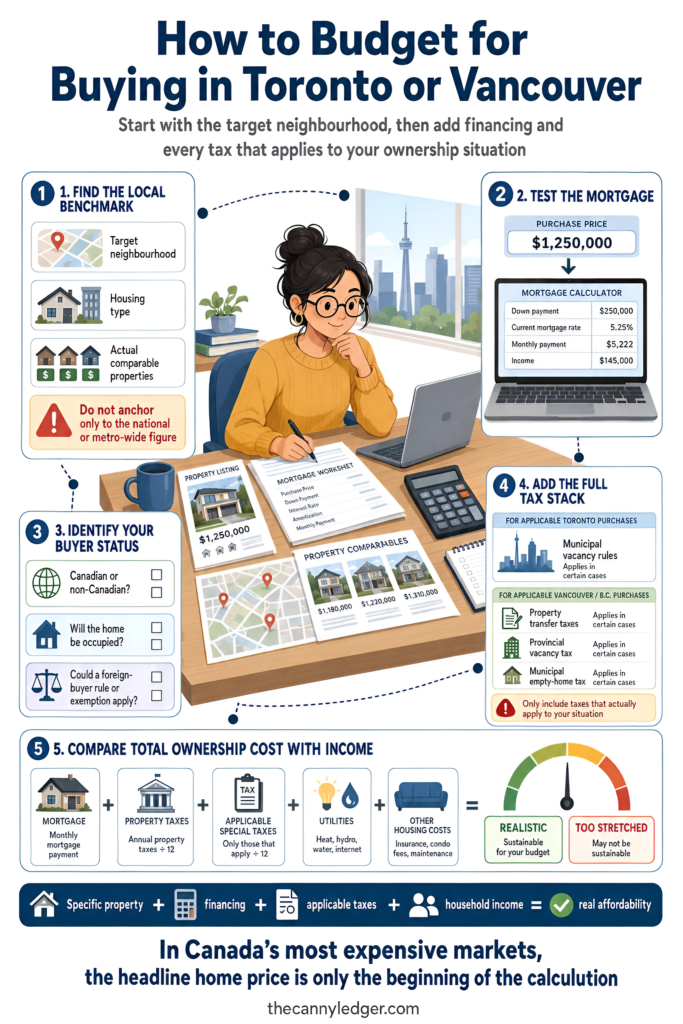
Check whether a specific neighbourhood you’re considering runs above or below the metro-wide benchmark before anchoring your own budget to the headline number, since the gap between a citywide average and a specific address can run into hundreds of thousands of dollars in either direction. If you’re a non-resident considering a purchase in either city, budget for the full stack of applicable taxes rather than just the purchase price itself, since British Columbia specifically layers provincial and municipal charges that can add tens of thousands of dollars to a single transaction, and compare that stack against current mortgage rates before assuming financing alone makes the purchase workable. And run your own numbers through a mortgage affordability calculator using the actual benchmark for your target neighbourhood, weighed against your own current income if you’re relocating from somewhere more affordable, rather than the national or even the metro-wide figure alone.
Questions Worth Sorting Out First
Are Vancouver and Toronto home prices actually falling right now? Yes, both cities posted year-over-year benchmark price declines as of mid-2026, though they remain the two most expensive major markets in the country by a wide margin even after those declines.
Does the federal foreign buyer ban apply to permanent residents? No. The ban specifically targets non-Canadians, meaning individuals who are neither citizens nor permanent residents. Permanent residents face no federal restriction under this specific law.
If I already own a vacant property in Toronto or Vancouver, can I avoid the tax by declaring it exempt? Only if a real exemption applies, such as the property undergoing major renovation or a change of ownership during the tax year. Exemptions are never automatic in either city’s program, and failing to file the required annual declaration results in being deemed vacant by default regardless of the property’s actual status.

