

The cheapest places to live in this country almost never show up in the headlines. Toronto and Vancouver dominate every cost of living conversation, but a detached home in Portage la Prairie, Manitoba currently sells for less than a used car costs in some parts of the country to insure for a decade. That gap between what gets talked about and what actually costs the least is the whole reason a list like this one is worth building carefully rather than just repeating the same six major cities everyone already knows are expensive.
- Cheapest for Renters Isn’t the Same List as Cheapest for Owners
- The Actual Cheapest Places to Buy
- The Actual Cheapest Places to Rent
- What Actually Makes These Places Cost Less
- The Manitoba Cluster Worth Knowing About
- The Honest Tradeoffs Nobody Puts on the Ranking
- What to Actually Do With This List
- Questions That Come Up Before a Move
The cheapest places to live in Canada right now include small cities like Portage la Prairie, Manitoba and Timmins, Ontario for home ownership, alongside smaller Quebec centres like Drummondville and Sherbrooke for renters. Canada’s national benchmark home price sits at $665,600 as of June 2026, while several of these smaller cities offer detached homes for under $320,000. None of them get discussed nearly as often as Winnipeg or Halifax, let alone Toronto, despite offering a much lower cost of entry into either owning or renting.
Cheapest for Renters Isn’t the Same List as Cheapest for Owners
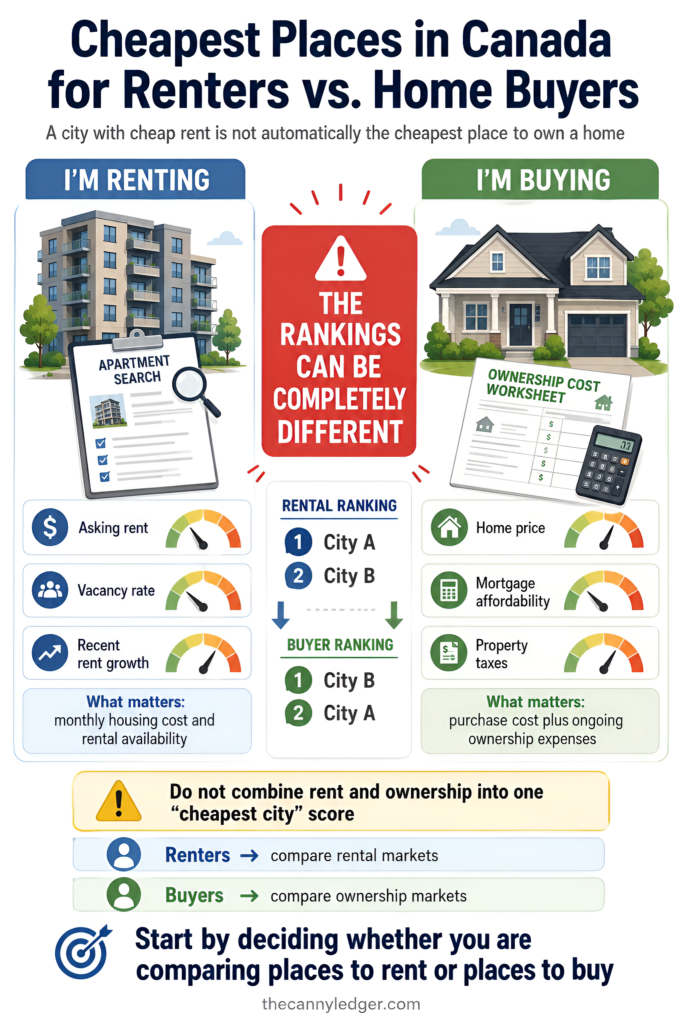
This distinction matters more than most cost of living rankings acknowledge, and conflating the two produces a misleading list. A city can be a terrible rental market and a fantastic place to buy, or the reverse, depending entirely on local supply, who’s building, and whether the local economy skews toward long-term residents or a transient rental population. Treating “cheapest place to live” as one single ranking hides that split entirely.
Renters care about asking rent, vacancy rates, and how fast a market is moving. Buyers care about benchmark home prices, mortgage qualification against local incomes, and property tax rates that vary meaningfully by municipality even within the same province. A place that ranks near the bottom for rent can sit in the middle of the pack for home prices, and the reverse happens constantly too, which is exactly why this list treats the two questions separately rather than blending them into one number that satisfies neither audience well.
The Actual Cheapest Places to Buy
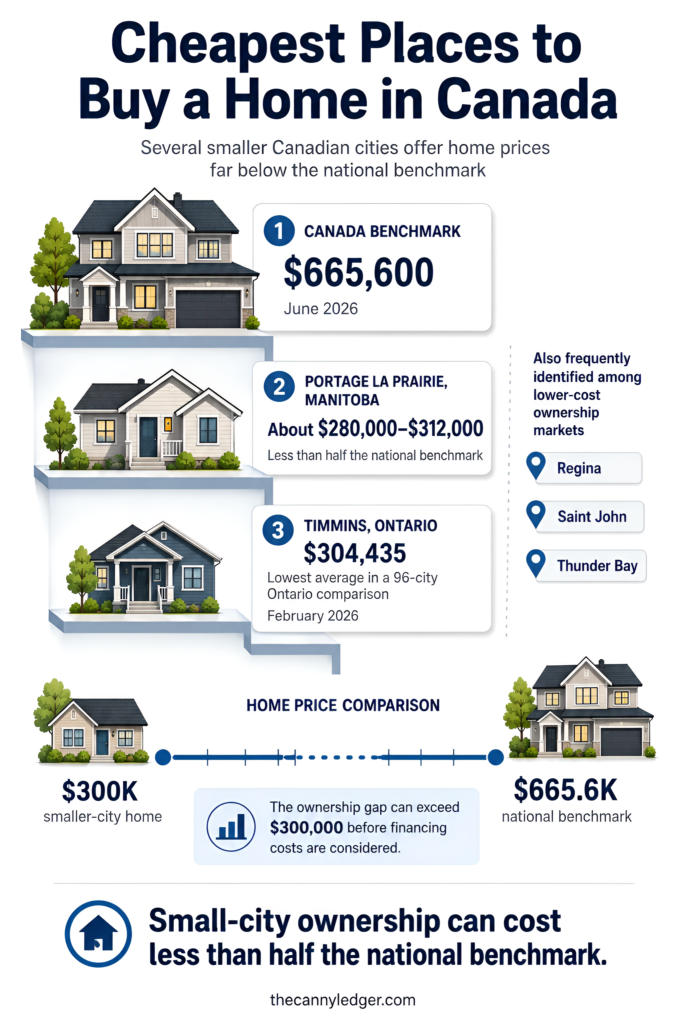
Canada’s national benchmark home price sits at $665,600 as of June 2026, according to the Canadian Real Estate Association’s own monthly statistics, down 3.3% from a year earlier. Against that backdrop, a handful of smaller cities offer a real, different entry point. According to REMAX’s own network data, Portage la Prairie, Manitoba currently has average home prices between $280,000 and $312,000, less than half the national benchmark, with the same source naming Regina, Saint John, and Thunder Bay as consistently offering lower average prices than major urban centres.
Ontario tells a similar story once you look past the cities everyone already assumes are expensive. Zolo’s analysis of 96 Ontario cities found Timmins, a city of about 29,000 people in the province’s northeast, had the lowest average home price of every city analyzed at $304,435 as of February 2026, against a provincial average north of $800,000. That’s not a rounding difference against Ontario’s own number, it’s less than 40% of what the province averages, inside the same set of provincial borders.
The Actual Cheapest Places to Rent
Rental affordability tells a different story than home prices, concentrated heavily in Quebec’s smaller cities rather than the Prairies. According to Statistics Canada’s own quarterly rent statistics, Drummondville and Sherbrooke posted the lowest average asking rents for a two-bedroom apartment among all tracked census metropolitan areas, at $1,200 and $1,250 respectively as of the most recent comparable data. Both cities also saw the steepest rent growth of any market StatCan tracks over the preceding six years, Drummondville’s rent doubled over that stretch, which is worth knowing if you’re chasing today’s low number without checking the trend line behind it.
That combination, currently cheap but rising faster than almost anywhere else, is exactly the kind of nuance a static ranking misses. A city sitting at the bottom of this year’s list isn’t guaranteed to stay there, and the places with the most room to climb are often the same ones currently pulling people in specifically because they’re cheap.

What Actually Makes These Places Cost Less
None of this affordability shows up by accident, and understanding why matters before assuming any of these cities is a straightforward swap for wherever you live now. Smaller job markets are the most consistent factor across almost every city on this list. Portage la Prairie, Timmins, and similarly sized centres simply don’t have the depth of employment options that Winnipeg, let alone Toronto, offers across finance, tech, or specialized healthcare roles, which is a direct part of why housing costs less there in the first place. Distance from a major metropolitan area compounds this, since commuting into a bigger job market isn’t a realistic option the way it can be from a suburb of Ottawa or Calgary.
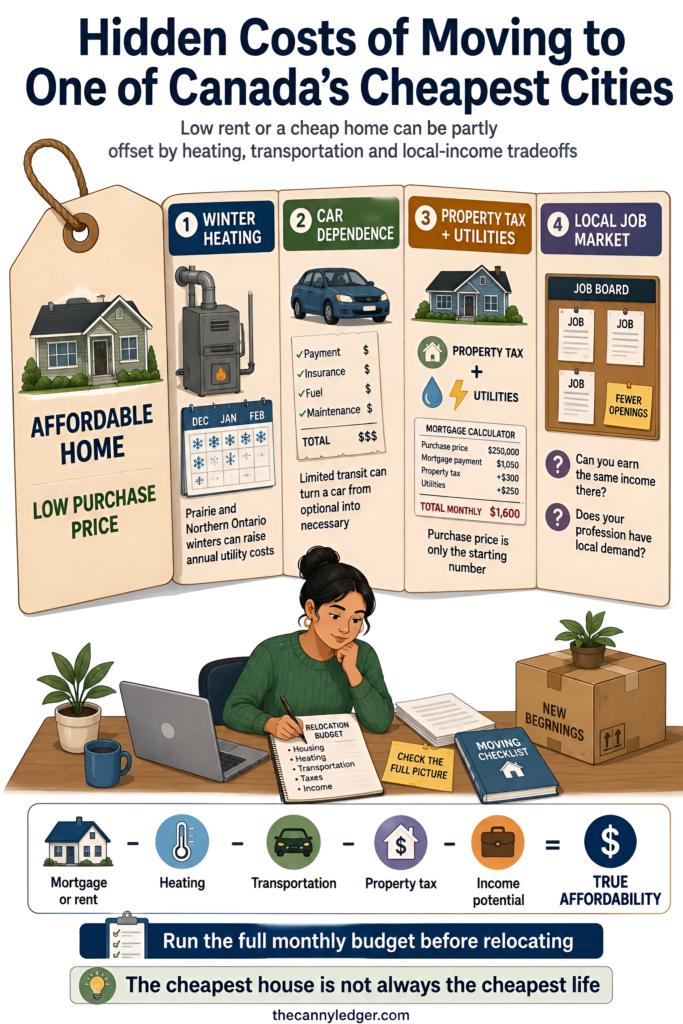
Climate and geography play a role too, particularly across the Prairies and Northern Ontario, where winter heating costs run higher for a longer stretch of the year than in milder parts of the country. A lower purchase price or rent doesn’t automatically mean a lower total cost of living once utilities, and often the practical need for a vehicle in a place with limited transit, get factored into the comparison.

The Manitoba Cluster Worth Knowing About
Manitoba shows up disproportionately often on lists like this one, and Portage la Prairie isn’t an isolated example within the province. Smaller Manitoba centres consistently undercut both the national benchmark and Winnipeg’s own housing market, which makes the province worth a closer look for anyone specifically prioritizing home ownership cost above everything else. That said, a smaller Manitoba town and Winnipeg itself aren’t interchangeable, since Winnipeg’s own housing market still offers meaningfully more in employment diversity, services, and amenities than a town a fraction of its size, even while sitting well below Toronto or Vancouver itself.
Anyone drawn specifically to Manitoba for the affordability numbers should weigh a smaller centre against Winnipeg’s own more affordable neighbourhoods before assuming a full rural or small-town move is the only way to capture that savings, since the city itself already undercuts most major Canadian markets without requiring a move away from urban amenities entirely.

The Honest Tradeoffs Nobody Puts on the Ranking
A lower price tag is real, but it isn’t free of consequences, and pretending otherwise does a disservice to anyone actually considering a move based on a list like this one. Higher heating costs in a Prairie or Northern Ontario winter can claw back a meaningful chunk of the savings from a lower purchase price over a full year, something worth checking directly against your own heating cost expectations rather than assuming the sticker price tells the whole story. A smaller city’s transit system, where one exists at all, rarely matches what’s available in a major centre, which can quietly convert a housing savings into a car payment and insurance bill instead.
None of this means the tradeoff isn’t worth it for a lot of people. It means the actual math has to include more than the headline home price or rent figure to mean anything, and a mortgage calculator built around a smaller city’s real property tax rate and utility costs gives a far more honest picture than the purchase price alone.
What to Actually Do With This List
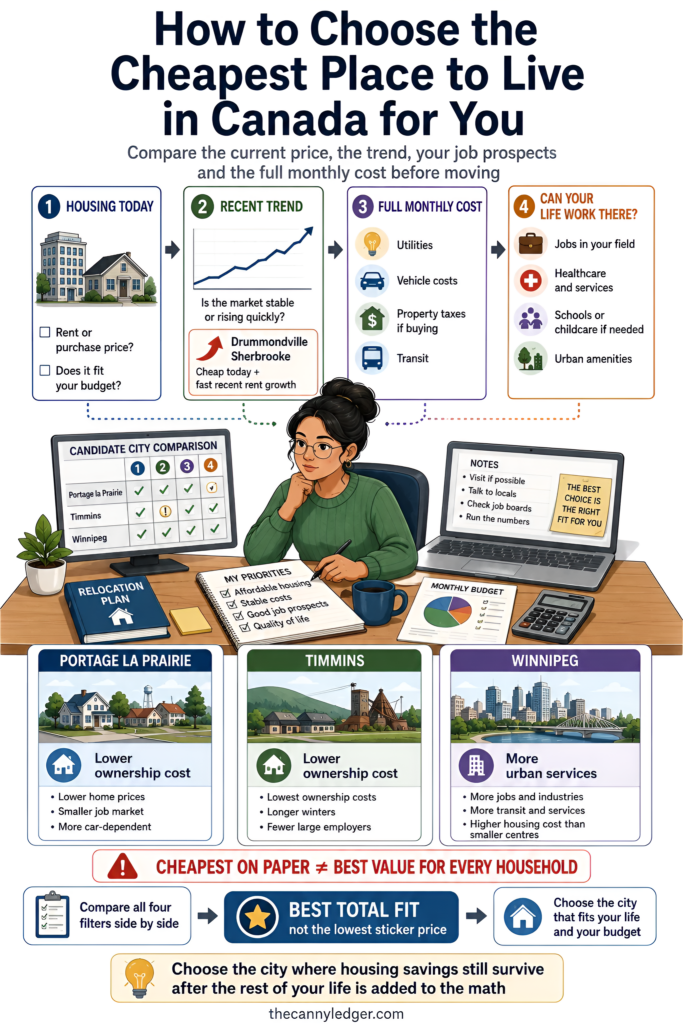
Check the specific city’s own recent trend, not just this year’s snapshot, since Drummondville and Sherbrooke prove a cheap city today can be a fast-rising one within a few years. If a smaller Manitoba or Ontario town looks appealing purely on price, run the full picture, heating, a vehicle if transit isn’t realistic there, and the local job market for your specific field, before treating the home price alone as the deciding number. And if you’re weighing Winnipeg itself against something smaller and cheaper still, remember the comparison isn’t just dollars, it’s whether the smaller city’s job market and services actually support the life you’re trying to build there.
Questions That Come Up Before a Move
Is the cheapest place to live in Canada always the best financial choice? Not necessarily. A lower housing cost paired with a thinner local job market can leave someone worse off overall if it means lower wages or fewer opportunities in their specific field, which is exactly why housing cost alone shouldn’t drive a relocation decision on its own.
Do these smaller cities have the same mortgage qualification rules as major cities? Yes, the federal mortgage stress test and standard lending rules apply identically regardless of city size, though a lower purchase price in a smaller centre generally makes qualifying easier in practice since the required income to support the mortgage is correspondingly lower.
Are rents in these cheap cities likely to stay low? Not reliably. Drummondville and Sherbrooke both show that a city’s cheapest-in-the-country status can coincide with the fastest rent growth in the country at the same time, so checking the trend alongside the current number matters more in these markets than in already-expensive ones where the ceiling is closer to being reached.