
Most people getting serious about debt make the same mistake in the same order. They pick a strategy first, avalanche or snowball, consolidation or a credit counsellor, before they’ve actually written down every single thing they owe with the real numbers attached. That’s backwards, and it’s the reason so many debt payoff plans stall out within a few months, not because the strategy was wrong, but because it was built on a rough guess instead of an honest accounting.
- Step One, Get an Honest, Complete List
- Step Two, Call Your Lender Before You Call Anyone Else
- Step Three, Pick a Payoff Method That Matches How You Actually Behave
- Step Four, Know the Point Where a DIY Plan Isn’t Enough Anymore
- Step Five, Build a Small Buffer While You’re Still Paying
- Step Six, Protect the Progress You’re Actually Making
- Where to Start Today
- Questions Worth Sorting Out Along the Way
Getting out of debt in Canada follows a specific, sequential order that matters more than which particular strategy you eventually choose. Start with a complete, accurate list of every debt, contact your lenders directly before assuming you need outside help, pick a payoff method that matches your own behaviour rather than the math alone, and know the specific point at which a do-it-yourself plan stops being enough. Skipping ahead in that sequence, jumping straight to a debt consolidation loan without first knowing your real numbers, for instance, is exactly why so many plans don’t survive contact with the first unexpected expense.
Step One, Get an Honest, Complete List
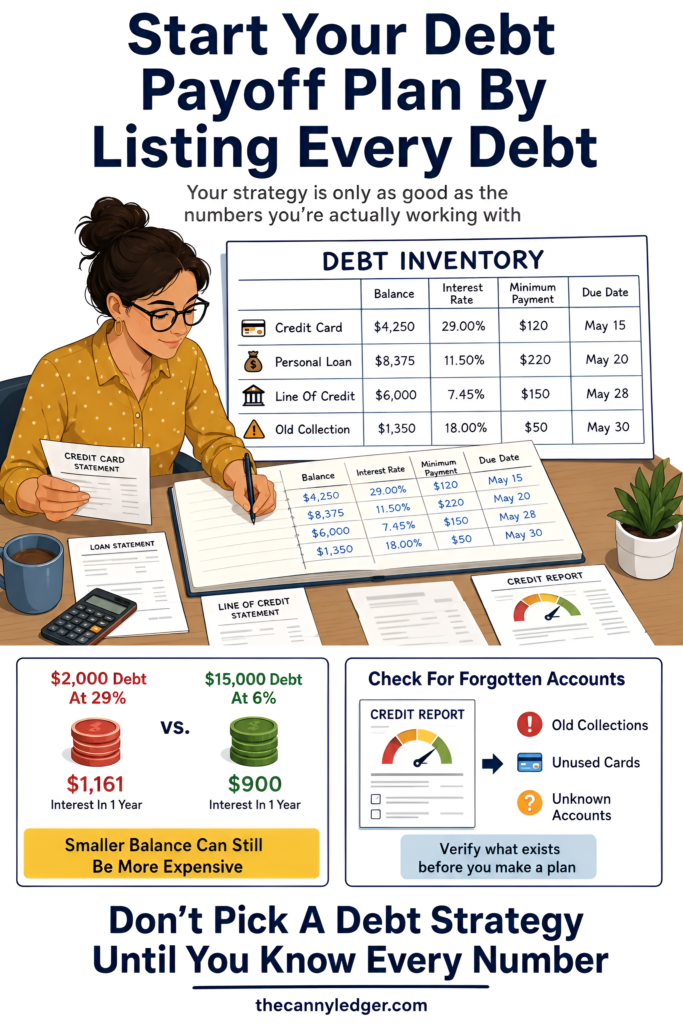
This sounds obvious and gets skipped constantly. Write down every single debt you have, the actual current balance, the interest rate, the minimum payment, and the due date, not a rounded estimate from memory. Pull an actual credit report if you’re not confident you remember every account, since forgotten accounts, old collections, or a card you stopped using years ago but never closed can all still be quietly accruing interest or damaging your credit picture in the background.
This list is also where you’ll first notice which debts are actually costing you the most, and it often isn’t the one with the biggest balance. A $2,000 balance at 29% interest can cost more per month in pure interest than a $15,000 balance at 6%, which is exactly the kind of detail a rough mental estimate misses entirely and a written list makes obvious immediately.
Step Two, Call Your Lender Before You Call Anyone Else
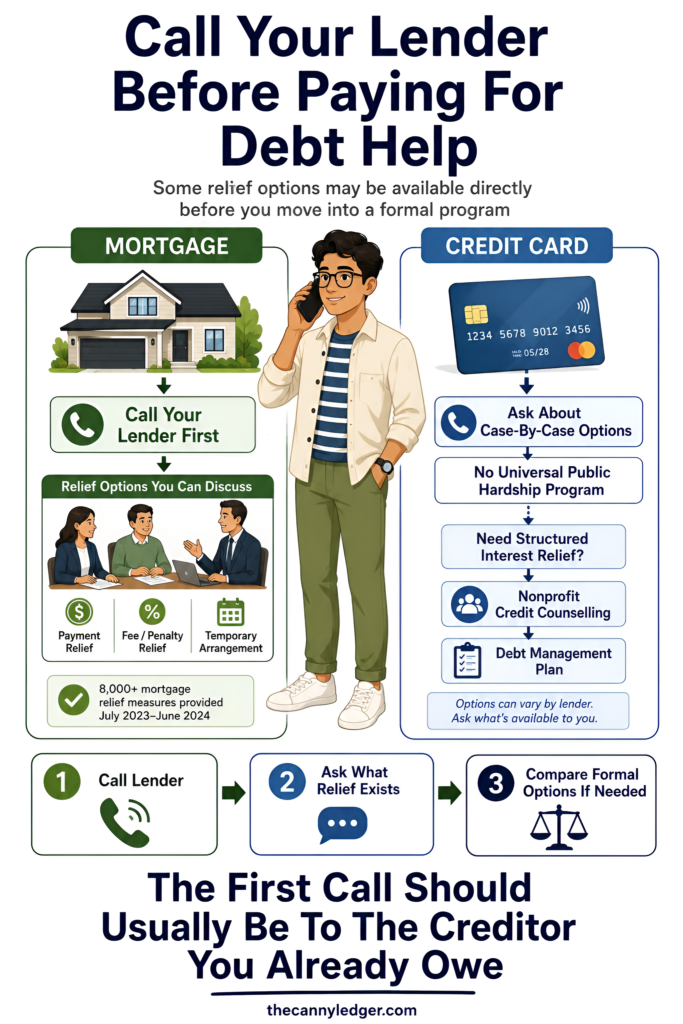
This is the step most guides skip past entirely, and it’s worth doing before assuming you need a credit counsellor, a consolidation loan, or any formal program at all. Canadian lenders handle hardship requests differently depending on what kind of debt you’re dealing with, and knowing the difference changes where you should actually start.
For a mortgage specifically, contacting your federally regulated lender directly is the correct first move, not a last resort. According to the Financial Consumer Agency of Canada’s own December 2024 report, federally regulated financial institutions provided more than 8,000 mortgage relief measures between July 2023 and June 2024 alone, saving affected homeowners over $4 million in penalties and fees they would otherwise have owed. FCAC’s own guideline on this specific topic requires these institutions to proactively work with mortgage holders showing signs of financial difficulty, which means asking directly for relief on a mortgage specifically has real, documented odds of success.
Credit cards work differently in Canada, and it’s worth knowing this before assuming a formal hardship program exists the way it might elsewhere. According to a Canadian financial hardship resource covering this specific gap, most Canadian credit card issuers don’t run a publicly advertised hardship program, though special, case-by-case payment arrangements are still sometimes available if you call and explain your situation directly. The more established Canadian path for reduced interest specifically runs through a nonprofit credit counselling agency and a formal debt management plan, covered in full detail against its main alternative elsewhere on this site, rather than an informal arrangement negotiated card by card on your own.
Step Three, Pick a Payoff Method That Matches How You Actually Behave
Once you know exactly what you owe, the next decision is how to attack it, and this is truly a personal choice rather than a purely mathematical one. Directing extra payments toward your highest interest rate debt first saves the most money overall, while targeting your smallest balance first builds momentum faster through the psychological win of closing an account entirely. The actual mechanics behind both approaches, along with a real worked example of how compounding interest changes the calculation, are covered step by step in a dedicated breakdown of the math itself, worth running your own numbers through directly rather than picking a method based on gut feeling alone.
Whichever method you choose, the honest answer to which one is better depends entirely on whether you’re more at risk of losing motivation or more focused purely on minimizing total cost. Neither answer is wrong, and switching from one method to the other partway through doesn’t undo any progress you’ve already made.

Step Four, Know the Point Where a DIY Plan Isn’t Enough Anymore
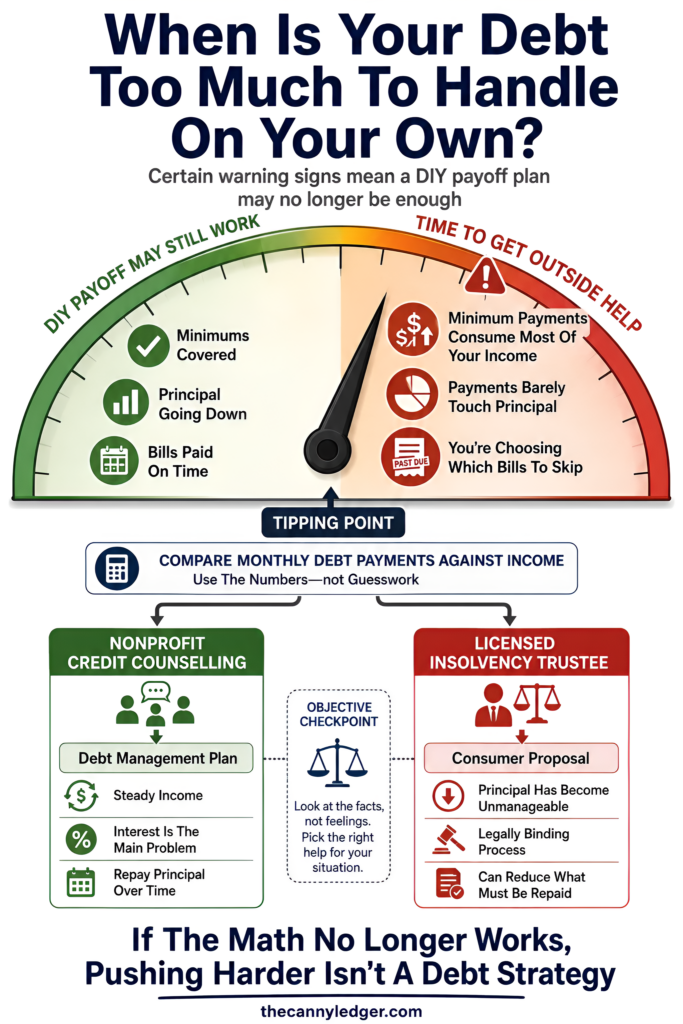
There’s a real, identifiable line between debt that a disciplined payoff plan can handle on its own and debt that’s grown past the point where extra effort alone will fix it. If your minimum payments alone consume most of your monthly income, if you’re only able to cover interest without touching principal, or if you’re already juggling which bills to skip each month, that’s the signal to bring in outside help rather than push harder on a plan that’s structurally not working. Checking how your total monthly debt payments compare against your income using the same ratios lenders actually use gives you an objective marker rather than a gut feeling about whether you’ve crossed that line.
From there, the specific path depends on your situation. A nonprofit credit counselling agency and a debt management plan suit someone with steady income who’s mainly being crushed by interest rather than the principal itself. A formal, legally binding consumer proposal through a Licensed Insolvency Trustee is the stronger option once the principal itself has become unmanageable, since it’s the only path among the common options that actually forces creditors to accept reduced terms rather than simply hoping they agree.
Step Five, Build a Small Buffer While You’re Still Paying
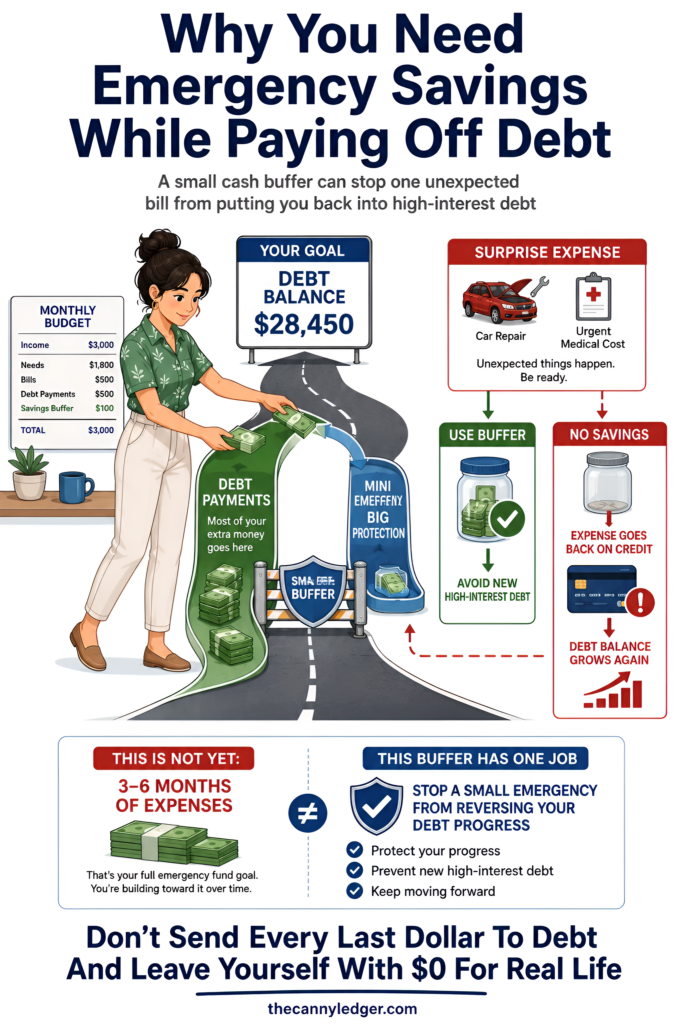
This runs against the instinct to throw every spare dollar at debt, and it’s worth doing anyway. According to Credit Canada’s own guidance on getting out of debt, Mike Bergeron, the organization’s Counselling and Client Services Manager, points out that without any savings buffer at all, unexpected expenses routinely force people straight back onto credit, undoing months of payoff progress in a single transaction. Even a modest $500 to $1,000 set aside specifically for real emergencies, a car repair, an urgent medical cost, can be the difference between a temporary setback and starting the entire payoff process over from scratch.
This isn’t an argument for building three to six months of expenses before touching debt at all, that broader emergency fund goal comes later. It’s a narrow, specific buffer meant to do one job, keep a single unplanned expense from becoming new high-interest debt while you’re actively working through what you already owe.
Step Six, Protect the Progress You’re Actually Making
Debt that’s already gone to collections runs under a different set of rules than debt you’re still paying directly, and it’s worth knowing your actual rights there rather than assuming a collector’s tone reflects the real legal situation. Every province regulates what a collector can and can’t do, covered in detail elsewhere on this site, including hard limits on contact frequency and a clear statute of limitations that varies by where you live. Knowing those rules changes how much pressure a collection call should actually put on you versus how much it’s designed to.
If debt has touched a relationship specifically, whether through a joint account with a spouse or a shared obligation you’re now managing alone, the rules governing who’s actually liable work differently than most people assume, and getting that distinction right before making a payment you don’t legally owe protects the progress you’ve already made.

Where to Start Today
Start today with the list from step one, not a mental estimate, an actual written accounting of every debt with its real numbers attached, since every step after that depends on getting this one right first. Make the phone call in step two before assuming you need a formal program, since a direct conversation with a lender costs nothing and, for a mortgage specifically, has real documented odds of producing relief. And revisit your own numbers periodically rather than setting a plan once and forgetting it, since your situation, and the broader context of what other Canadians are carrying, both shift over time in ways worth checking against your own progress.

Questions Worth Sorting Out Along the Way
Should I close a credit card once I’ve paid it off, or keep it open? Keeping an old account open, even unused, generally helps your credit utilization and the length of your credit history, though this needs to be weighed against the temptation to run the balance back up. There’s no universal right answer, it depends on your own discipline with that specific account.
Does paying off debt faster always mean paying less interest overall? Almost always, since interest accrues on whatever balance remains, but the specific savings depend on which payoff method you use and how consistently you stick with it, which is exactly why step three matters as much as it does.
Is it worth pausing retirement contributions to pay off debt faster? This depends heavily on the interest rate you’re paying versus what you’d otherwise earn, and on whether an employer match is involved, since walking away from a matched contribution often costs more than the interest you’d save. It’s an individual calculation rather than a rule that applies the same way to everyone.