


Manitoba Public Insurance (MPI) is a non-profit provincial Crown corporation that has provided compulsory basic automobile insurance, known as Autopac, since November 1, 1971, and also administers driver licensing and vehicle registration for the entire province. Manitoba is one of only three Canadian provinces, alongside British Columbia and Saskatchewan, where government-run public insurance is mandatory rather than optional, meaning every Manitoba driver’s basic coverage comes from the same single source regardless of who they’d otherwise choose.
- Why You Can’t Choose Your Insurance Company
- Why Manitoba Has Public Auto Insurance in the First Place
- MPI Also Handles Your Driver’s Licence and Vehicle Registration
- Basic Coverage vs Extension Coverage: What’s the Difference
- What “No-Fault” Insurance Actually Means
- What Changed on April 1, 2026
- Who Decides How Much You Pay
- Where to Go for MPI Services
- Common Questions About Manitoba Public Insurance
Why You Can’t Choose Your Insurance Company
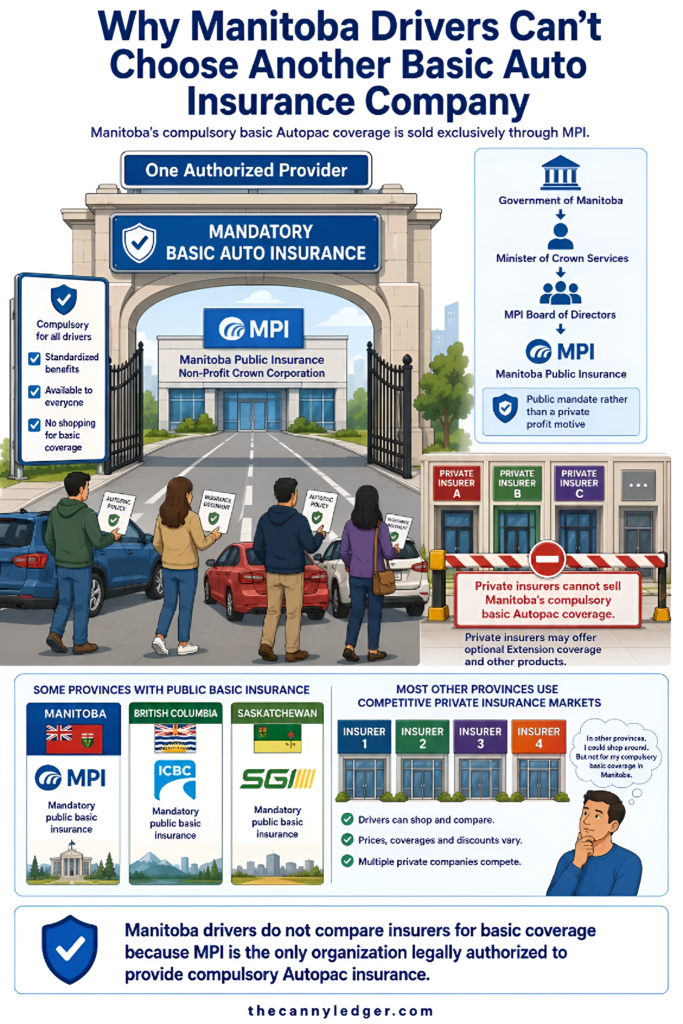
MPI isn’t a private insurance company competing for customers the way an insurer in Ontario or Alberta would be. It’s a non-profit Crown corporation, owned by the Government of Manitoba and accountable to the Minister of Crown Services through its own Board of Directors, meaning it operates with a public mandate rather than a profit motive driving its basic pricing decisions. This structure puts Manitoba in a small club: only British Columbia’s ICBC and Saskatchewan’s SGI run comparable public auto insurance monopolies elsewhere in Canada, while every other province leaves basic coverage to a competitive private market. For a Manitoba driver, this means the familiar experience of comparing quotes across several companies simply doesn’t apply to the mandatory portion of a policy, since there’s only one entity legally authorized to sell it.
Why Manitoba Has Public Auto Insurance in the First Place
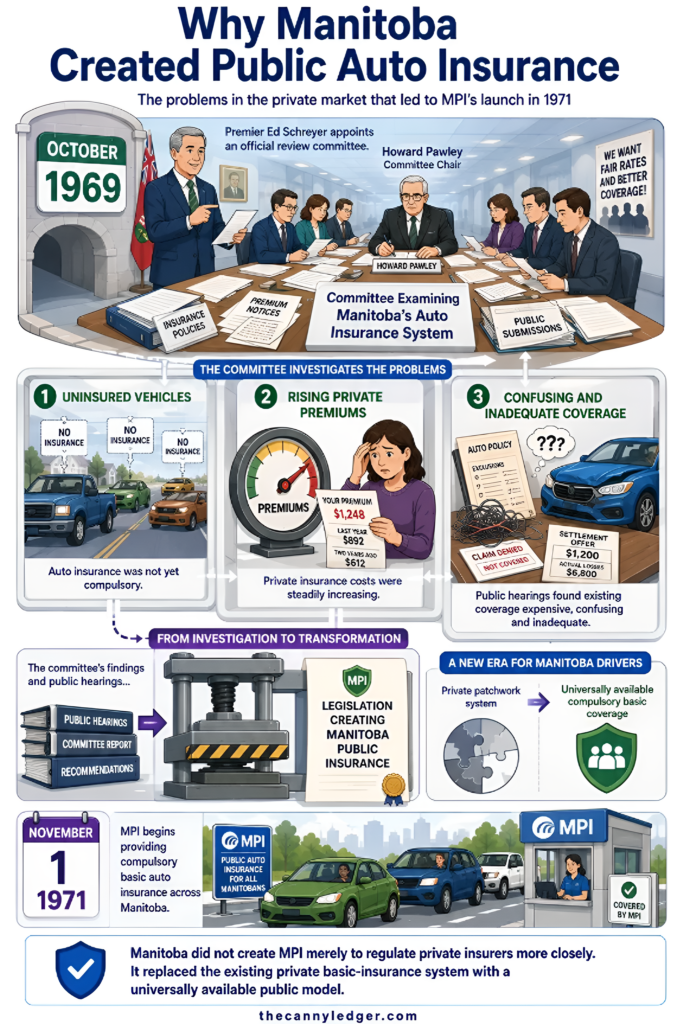
The system dates back further than most people assume. In October 1969, Premier Ed Schreyer struck a committee, chaired by Howard Pawley, the minister then responsible for auto insurance, to examine how Manitoba’s private insurance market was actually serving drivers. What the committee found wasn’t reassuring: auto insurance wasn’t even mandatory at the time, leaving a real population of uninsured vehicles on the road, and private insurers were charging steadily rising premiums for coverage that extensive public hearings ultimately judged inadequate, confusing, and expensive. That finding led directly to legislation creating Manitoba Public Insurance, which began providing universally available, compulsory basic coverage on November 1, 1971, replacing the patchwork private system entirely rather than simply regulating it more heavily.
MPI Also Handles Your Driver’s Licence and Vehicle Registration
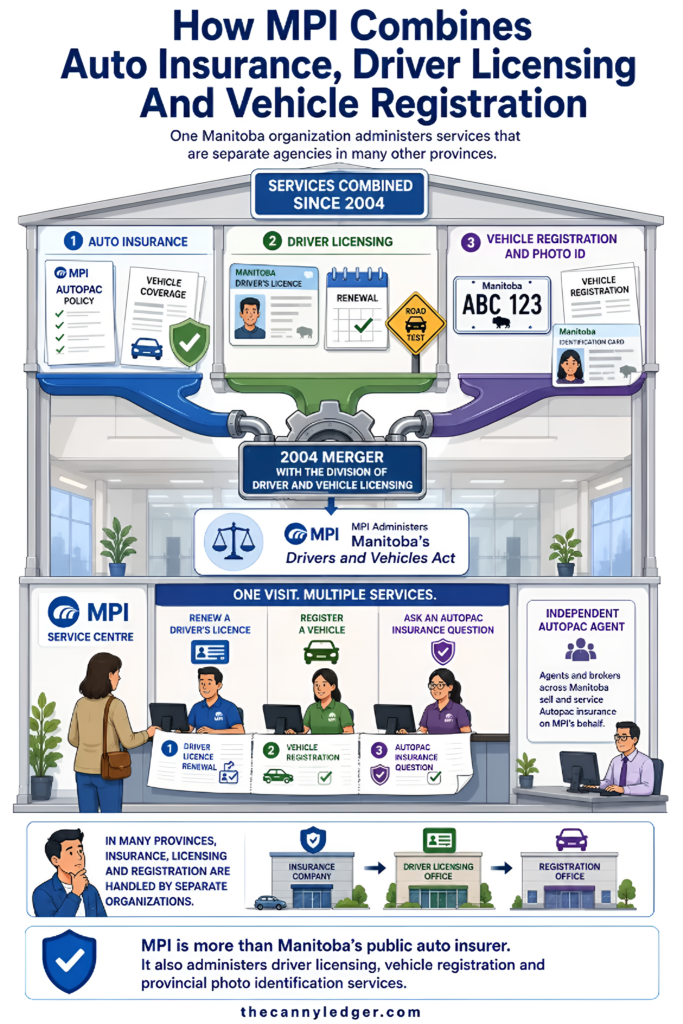
A detail that surprises people moving to Manitoba from almost anywhere else: MPI isn’t only an insurance provider. Since 2004, when the province’s Division of Driver and Vehicle Licensing merged into the corporation, MPI has been directly responsible for administering Manitoba’s Drivers and Vehicles Act, which means driver licensing, vehicle registration, and photo identification cards all run through the same organization that handles auto insurance. In most other provinces, these functions sit with entirely separate government departments or agencies. In Manitoba, a single trip to an Autopac agent or MPI service centre can handle a licence renewal, a vehicle registration, and an insurance question all at once, a genuine convenience once you understand the system, but a confusing overlap for anyone expecting these to be three separate government interactions the way they’d be almost anywhere else in the country.
Basic Coverage vs Extension Coverage: What’s the Difference
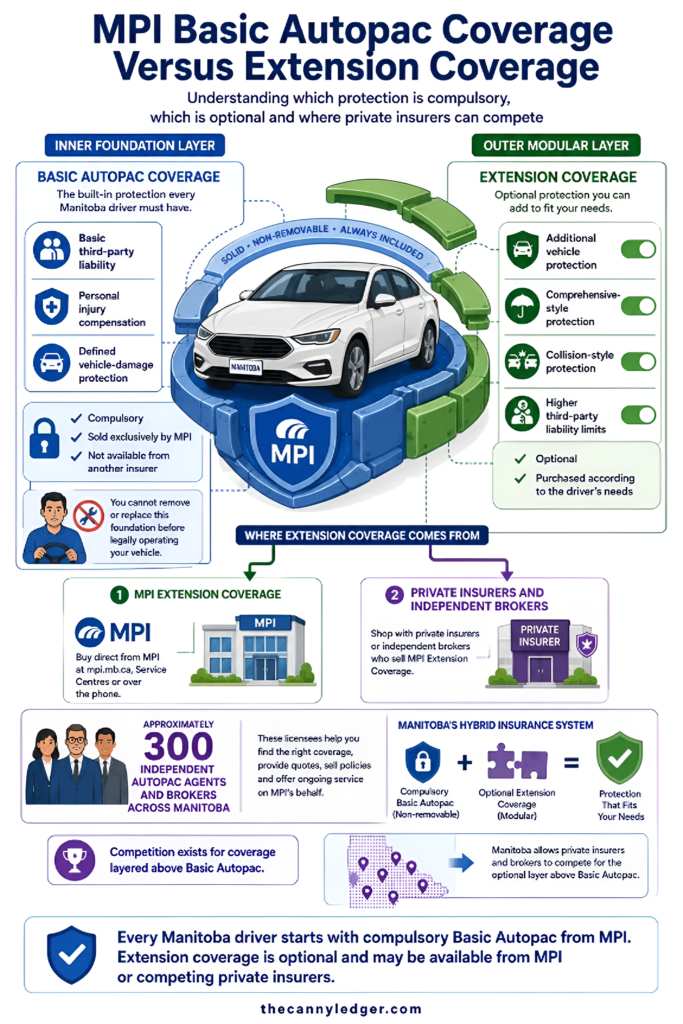
This is the single most important structural concept to understand about how Manitoba insurance actually works. Basic Autopac coverage, third-party liability, injury compensation, and a defined level of vehicle damage protection, is compulsory, sold exclusively through MPI, and not available anywhere else at any price. Extension coverage, additional protection layered on top of the basic policy, comprehensive and collision-style add-ons, and enhanced liability limits, is optional, and here Manitoba actually does allow some competition: extension coverage can be purchased either directly through MPI or through private insurers and independent brokers, of which roughly 300 operate across the province selling and servicing Autopac policies on MPI’s behalf. This hybrid structure, a hard public monopoly on the mandatory portion paired with a genuinely competitive market for everything layered on top, is exactly what makes Manitoba’s system different from BC’s ICBC or Saskatchewan’s SGI, both of which run closer to a fully public model across nearly all coverage types.
What “No-Fault” Insurance Actually Means
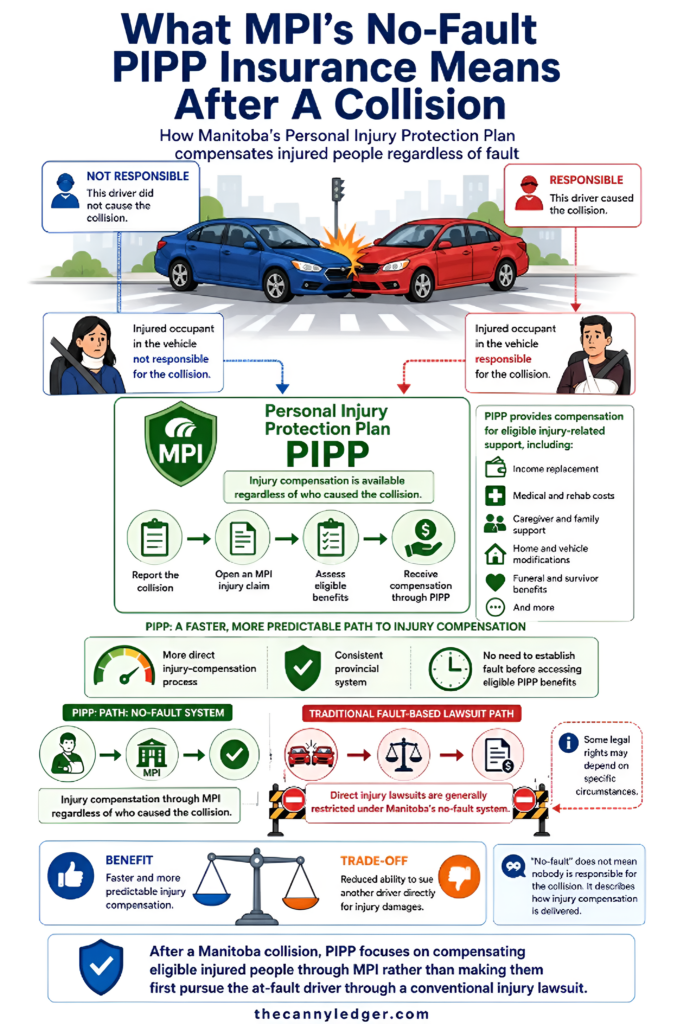
Manitoba’s basic Autopac coverage operates on a no-fault injury system called the Personal Injury Protection Plan (PIPP). In practice, this means MPI compensates you for injuries sustained in a collision regardless of who was actually at fault, rather than requiring an injured driver to pursue the other party’s insurer through a fault-based claims process the way most of Canada handles it. The tradeoff for this faster, more predictable injury compensation is a general restriction on suing another driver directly for injury damages outside the PIPP system in most circumstances, a structural feature that shapes how a Manitoba collision claim actually unfolds from the moment it’s reported.
What Changed on April 1, 2026
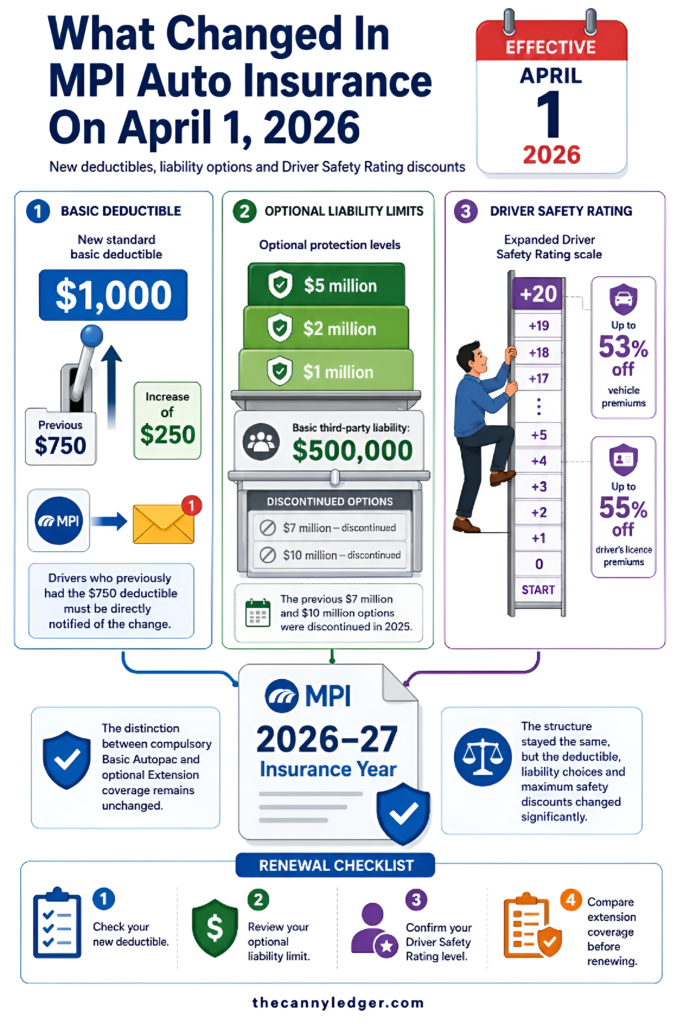
This is the most significant restructuring MPI’s basic and extension products have seen in years, and it’s worth understanding in full rather than discovering piecemeal at renewal time. The standard basic deductible rose from $750 to $1,000 effective with the 2026-27 insurance year, a change the Manitoba Public Utilities Board approved as part of a broader rate order, meaning anyone with the previous $750 deductible needs to be directly notified of the shift by MPI. Alongside the deductible increase, the corporation’s optional liability coverage tiers were restructured: MPI now offers $1 million, $2 million, or $5 million optional third-party liability limits on top of the basic $500,000, having discontinued the previous $7 million and $10 million options in 2025. The Driver Safety Rating scale, the system that rewards a clean driving record with lower premiums over time, was also expanded, now extending up to +20, unlocking discounts reported as high as 53 percent off vehicle premiums and 55 percent off driver’s licence premiums for drivers who reach that top tier. None of this changes the fundamental structure of Basic versus Extension coverage, but it meaningfully changes the numbers behind both.
Who Decides How Much You Pay
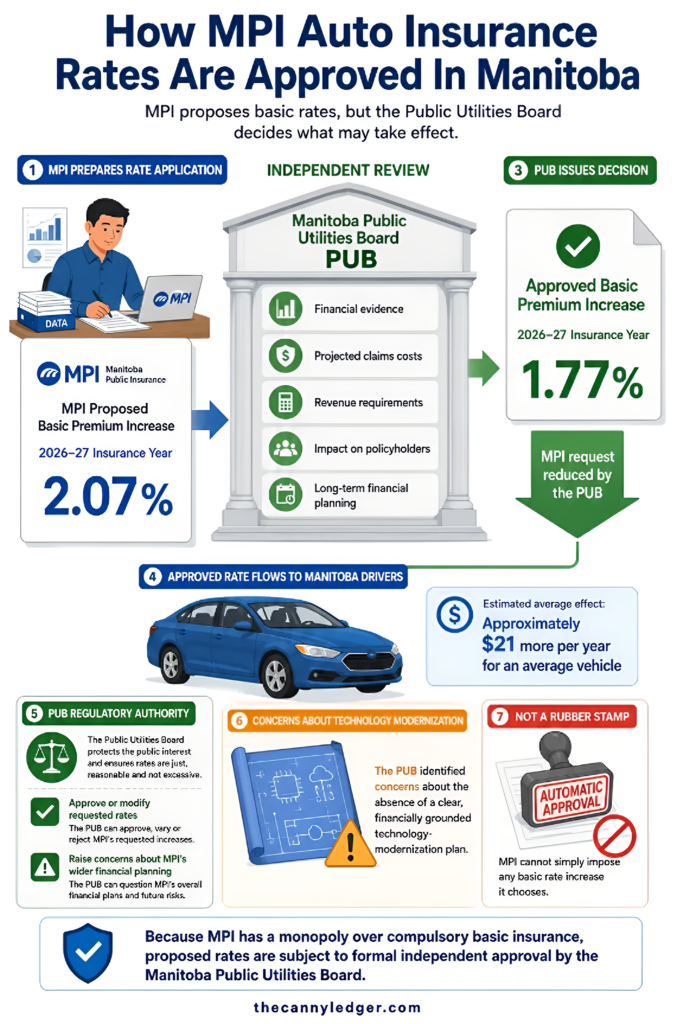
Because MPI is a monopoly rather than a competitive market, rate increases don’t happen through ordinary business pricing decisions, they go through formal regulatory approval by the Manitoba Public Utilities Board (PUB), an independent body reviewing MPI’s requested rates before anything takes effect. For the 2026-27 insurance year, MPI requested a 2.07 percent overall increase to basic premiums, and the PUB approved a smaller 1.77 percent increase instead, working out to roughly $21 more per year for an average vehicle. The PUB’s order also flagged ongoing concerns about MPI lacking a clear, financially grounded technology modernization plan, a reminder that this regulatory relationship isn’t a rubber stamp, the board has real authority to push back on both the size of a requested increase and the corporation’s broader financial planning.
Where to Go for MPI Services
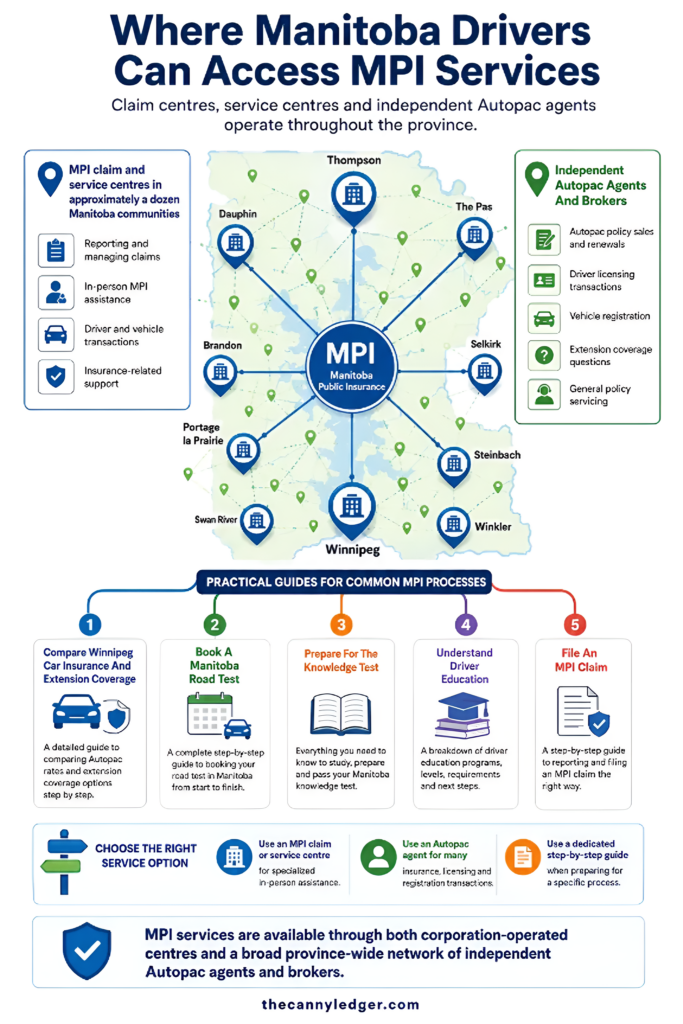
MPI operates claim and service centres in a dozen communities across Manitoba, supplemented by the wider network of independent Autopac agents and brokers who handle policy sales, licensing transactions, and extension coverage questions on the corporation’s behalf. For the practical, step-by-step side of actually using these services, comparing Winnipeg car insurance rates, booking a road test, preparing for the knowledge test and driver’s education, and filing a claim are each covered in their own dedicated guide, since each process has enough specific detail to warrant a full walkthrough on its own rather than a summary here.
Common Questions About Manitoba Public Insurance
Can I buy my basic auto insurance from a private company instead of MPI? No. Basic Autopac coverage is a legal monopoly held by MPI, there’s no private alternative for the compulsory portion of a Manitoba auto policy, regardless of driving record, vehicle type, or personal preference. Only the optional extension coverage layered on top allows any choice between MPI and private insurers.
Does MPI cover every type of vehicle in Manitoba? Not universally. Certain vehicle types fall outside standard Autopac coverage entirely, semi-trailers, for instance, carry no coverage at all through the standard program, and some higher-risk vehicles may need special risk coverage arranged separately through MPI or another insurer rather than a standard policy.
Is MPI the same as Manitoba’s driver’s licence and vehicle registration office? Functionally, yes, since MPI has administered Manitoba’s Drivers and Vehicles Act since 2004. A single MPI service centre or Autopac agent handles licensing, registration, and insurance together, rather than these being separate government offices the way they are in most other provinces.
Understanding MPI’s structure, one mandatory public insurer for basic coverage, a genuinely competitive market for everything layered on top, and a regulator reviewing every rate change before it takes effect, explains almost everything unusual about how Manitoba car insurance actually works compared to the rest of the country. The specific mechanics of getting licensed, insured, and on the road are covered in depth across the rest of this series, but this underlying structure is what shapes every one of those processes.