

For the 2025 and 2026 tax years, Manitoba taxes income at 10.8 percent up to $47,000, 12.75 percent from $47,000 to $100,000, and 17.4 percent above that, with a Basic Personal Amount of $15,780, both frozen and identical across both years. Federal rates and thresholds, by contrast, continue to rise with inflation each year, and the 2025 tax year deadline to file is April 30, 2026, or June 15, 2026 for anyone self-employed.
- How Manitoba’s Three Tax Brackets Actually Work
- The Basic Personal Amount, and the Freeze That’s Quietly Raising Bills
- How Federal and Provincial Tax Stack Together
- The High-Income Clawback Nobody Expects
- Deadlines That Actually Matter
- Where Real Savings Come From: RRSP and TFSA Room
- Manitoba-Specific Credits Worth Knowing
- Getting Help Filing, Free or Paid
- Common Questions About Manitoba Income Tax
How Manitoba’s Three Tax Brackets Actually Work
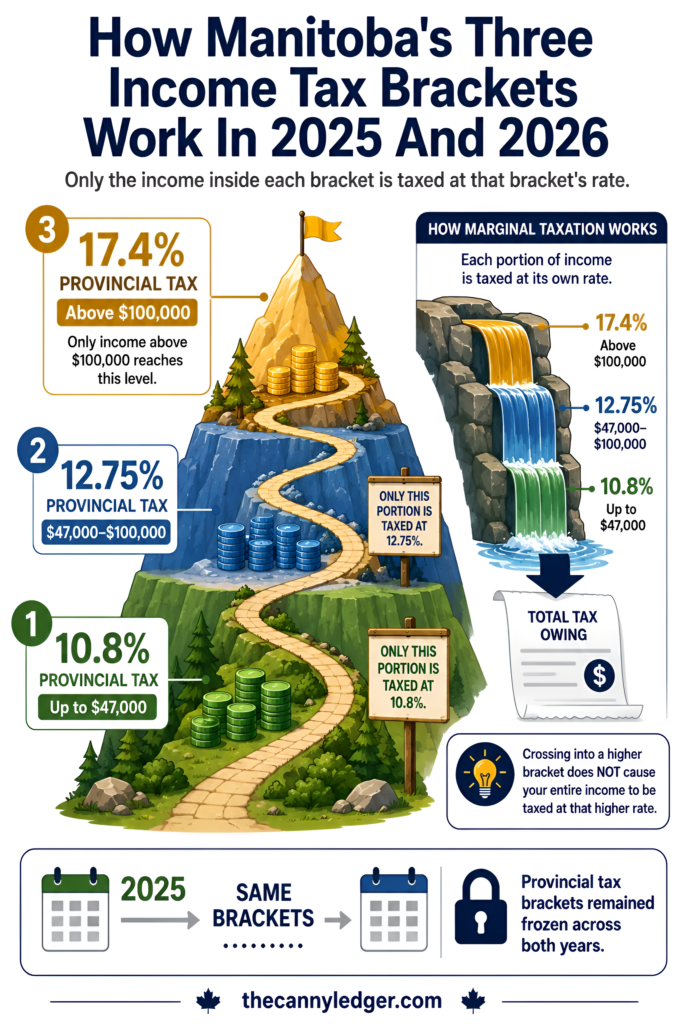
Manitoba runs a straightforward three-bracket system, and unlike a lot of provinces, it’s stayed at exactly three brackets for years rather than adding more at higher income levels. The first $47,000 of taxable income is taxed at 10.8 percent, the portion from $47,000 to $100,000 at 12.75 percent, and anything above $100,000 at 17.4 percent. These are marginal rates, meaning only the income within each specific bracket gets taxed at that bracket’s rate, not your entire income once you cross a threshold, a distinction that trips up a lot of people who assume crossing into a higher bracket means their whole income suddenly gets taxed at the higher rate.
What makes this specific two-year period unusual is that these numbers are identical for both 2025 and 2026. Manitoba’s government confirmed that the Basic Personal Amount and bracket thresholds would remain frozen at 2024 levels rather than being indexed to inflation as they normally would be, a policy choice that stands out against the federal government’s continued annual indexing over the same period.
The Basic Personal Amount, and the Freeze That’s Quietly Raising Bills

Manitoba’s Basic Personal Amount, the portion of income every resident can earn tax-free before provincial tax starts applying at all, sits at $15,780 for both 2025 and 2026. Normally this number rises a little each year to keep pace with inflation, which means a frozen BPA combined with rising wages creates what’s known as bracket creep, more of a person’s income effectively becomes taxable each year even though the real, inflation-adjusted value of their earnings hasn’t necessarily grown at all.
Run a real example: someone earning $99,000 in 2025 who gets a standard 3 percent cost-of-living raise moves to $101,970 in 2026. Had Manitoba’s top bracket threshold risen with inflation the way it normally would, roughly to $102,000, that raise would have stayed entirely within the 12.75 percent bracket. Because the threshold stayed frozen at $100,000, $1,970 of that raise instead falls into the 17.4 percent bracket, a jump of nearly 4.65 percentage points on that specific slice of income purely because the bracket line didn’t move. It’s a modest dollar amount in any single year, but it compounds the longer the freeze continues, and it’s exactly the kind of quiet tax increase that never shows up as a headline rate hike.
How Federal and Provincial Tax Stack Together
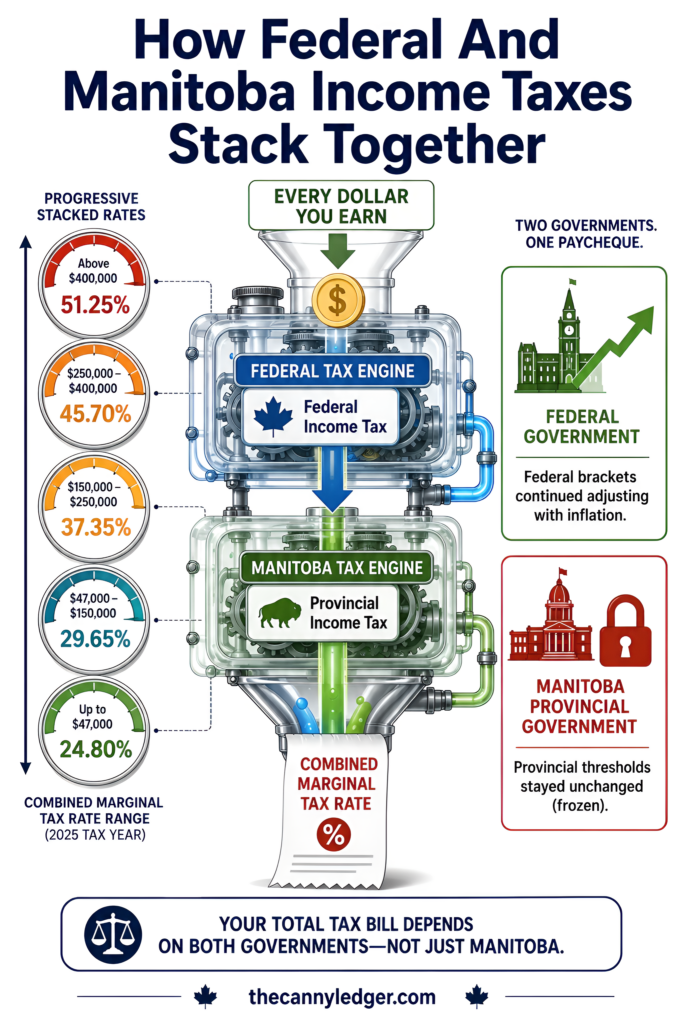
Every dollar of taxable income gets hit twice, once by federal tax and once by Manitoba’s provincial tax, and the two combine into a single marginal rate at each income level. For 2026, the combined federal and Manitoba marginal rate on ordinary income starts at 24.80 percent on the first $47,000, climbs through several steps as income rises, and reaches a combined top marginal rate of 51.25 percent on income between $258,482 and $400,000, before settling to 50.40 percent above $400,000 due to how the federal Basic Personal Amount enhancement phases out at high income levels. The federal side of this equation moved in the taxpayer’s favour for 2026 specifically: the bottom federal bracket rate dropped a full percentage point, from 14.5 percent to 14 percent, while Manitoba’s rates stayed exactly where they were.
This combined-rate structure is also why a Manitoba resident’s total tax bill depends on both governments’ decisions in a given year, not just the province’s. A federal rate cut can offset some of the effect of Manitoba’s frozen brackets, but it doesn’t erase it, since the bracket-creep effect described above happens entirely within Manitoba’s own unchanged thresholds regardless of what Ottawa does with its own rates.
The High-Income Clawback Nobody Expects
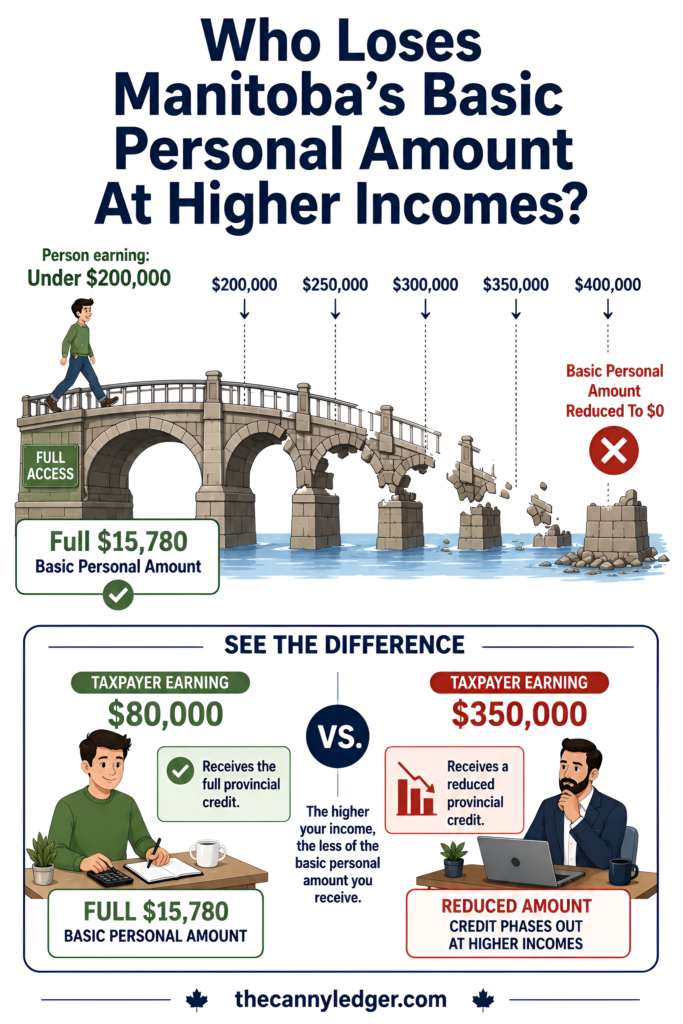
Manitoba’s Basic Personal Amount isn’t actually flat for every income level, something that catches higher earners off guard. The full $15,780 BPA is only available to taxpayers with net income under $200,000. Above that threshold, the credit gradually shrinks, reaching zero entirely once net income hits $400,000. This phase-out, planned as part of the 2024 Budget and now in effect for 2025 and subsequent years, means someone earning $350,000 doesn’t get the same tax-free personal amount as someone earning $80,000, even though both are technically entitled to “the” Basic Personal Amount on paper. Combined with a similar federal clawback on the enhanced federal personal amount for high earners, this is part of why the combined marginal rate table above shows the rate climbing even within Manitoba’s own top bracket rather than staying flat at 50.4 percent straight through.
Deadlines That Actually Matter

The core filing deadline for most Manitobans is April 30, 2026, for the 2025 tax year, the same date CRA applies nationally regardless of province. Anyone self-employed, or with a spouse or common-law partner who is, gets an extended filing deadline of June 15, 2026, though it’s worth knowing that any balance owing is still due by April 30 even with the extended filing window, interest starts accruing on unpaid amounts from May 1 regardless of when the return itself actually gets filed.
A separate, easy-to-miss deadline applies to RRSP contributions: to have a contribution count toward the 2025 tax year and reduce that year’s taxable income, it needs to be made by March 2, 2026, the first 60 days of the new calendar year. Contributions made after that date still count, just toward the 2026 tax year instead, claimed when filing in early 2027 rather than in the return being filed now.
Where Real Savings Come From: RRSP and TFSA Room
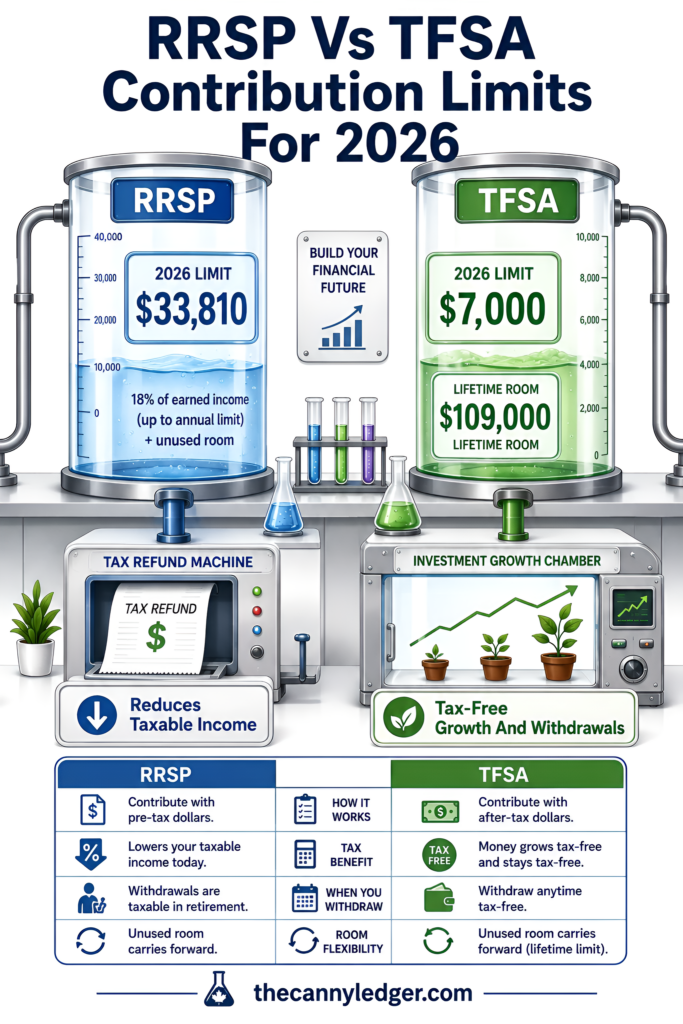
For 2026, the RRSP contribution limit rose to $33,810, up from $32,490 in 2025, calculated as 18 percent of the previous year’s earned income up to that annual cap, plus any unused room carried forward from prior years. The TFSA annual contribution limit for 2026 holds at $7,000, unchanged from 2025, bringing total lifetime contribution room for anyone who’s been eligible and never contributed since the TFSA’s 2009 introduction to $109,000. Unlike RRSP contributions, TFSA contributions don’t reduce taxable income in the year they’re made, the benefit comes from tax-free growth and withdrawals later, which makes the two accounts useful for different purposes rather than interchangeable options for the same tax problem.
Manitoba-Specific Credits Worth Knowing
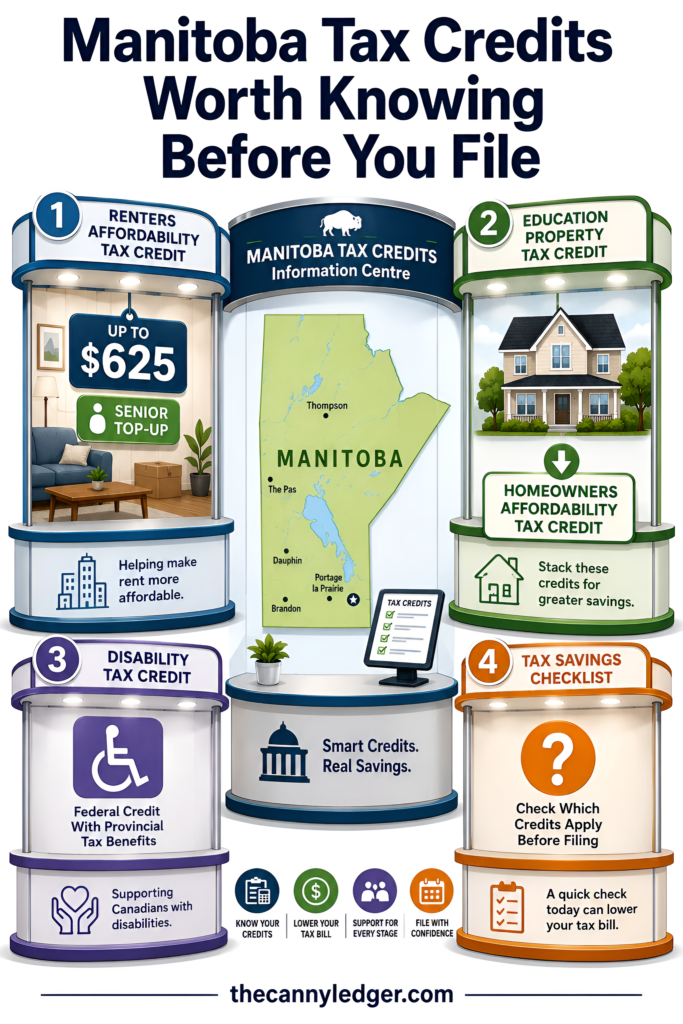
Beyond the core bracket and BPA math, several Manitoba-specific credits change what a resident actually owes, each significant enough to warrant its own deeper look rather than a passing mention here. The Renters Affordability Tax Credit provides up to $625 for the 2026 tax year for eligible renters, with an additional top-up for senior renters specifically. Homeowners have a separate credit structure entirely, covered in full in Manitoba’s Education Property Tax Credit guide, which walks through how that credit now interacts with the newer Homeowners Affordability Tax Credit. Manitobans living with a disability, or supporting a dependant who does, should also check eligibility for the Disability Tax Credit, a federal credit with real provincial implications that’s worth applying for well before tax season rather than scrambling at filing time.
Getting Help Filing, Free or Paid
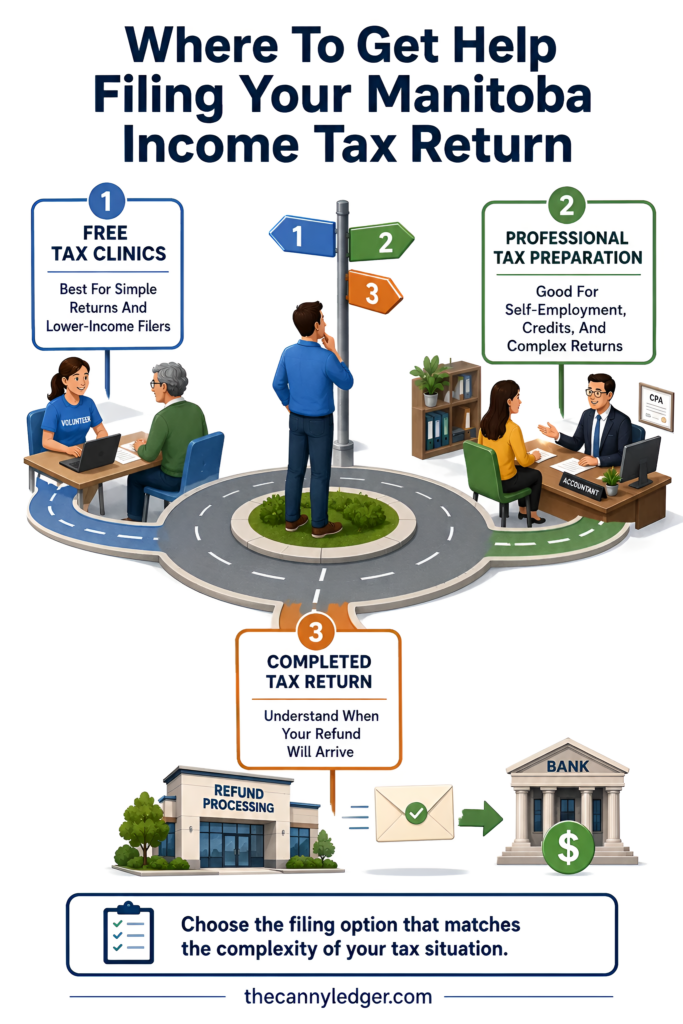
Not every Manitoban needs, or can afford, a professional accountant to file a straightforward return, and there’s real help available at both ends of the budget spectrum. Lower-income filers and anyone with a simple tax situation can use Winnipeg’s free tax clinics rather than paying for a service that a volunteer preparer can handle just as accurately. For anyone with a more complex return, self-employment income, multiple credits, or a first-time filing situation, that’s still worth professional help without breaking the budget, affordable tax preparation options in Winnipeg covers what’s actually available locally. And once a return is filed, understanding how Winnipeg tax refunds actually get processed and paid out helps set realistic expectations for when that money actually shows up rather than guessing.
Common Questions About Manitoba Income Tax
Does the bracket freeze mean Manitoba raised taxes for 2025 and 2026? Not directly, no rate went up and no new bracket was added. But freezing the thresholds while incomes rise with inflation produces the same practical effect as a tax increase for anyone whose income growth pushes them across a threshold that would otherwise have moved with them, which is why it’s sometimes described as a stealth increase rather than a formal one.
If I live in Winnipeg specifically, do I pay any additional municipal income tax on top of provincial and federal? No. Winnipeg, like other Manitoba municipalities, doesn’t levy its own separate income tax, unlike property tax, which is collected at the municipal level. Income tax in Manitoba is strictly a two-layer system, federal and provincial, regardless of which city or town you live in within the province.
Will Manitoba’s bracket freeze continue past 2026? That depends entirely on future provincial budgets, and it isn’t something that can be confirmed in advance. The freeze was explicitly announced for 2025 and subsequent years as of the 2025 Budget, but provincial governments can and do change this kind of policy in a future budget, so it’s worth checking each year’s budget announcement rather than assuming the freeze is permanent.
Whichever bracket your income actually falls into, the math worth doing every year isn’t just “what’s my rate,” it’s checking whether Manitoba’s frozen thresholds and BPA are quietly taxing more of a raise than they used to, and confirming which credits, from the renters’ credit to the Disability Tax Credit, actually apply to your specific situation before you file.