

Ask a condo owner in Winnipeg to describe their unit’s “standard unit description” and most will have no idea what you’re talking about, despite the fact that this one document, buried somewhere in their condo corporation’s paperwork, is what actually decides whether their kitchen renovation gets covered after a fire or whether they’re paying for it entirely out of pocket. Condo insurance in Winnipeg doesn’t work the way most people assume, and the confusion almost always traces back to this exact gap: owners think the corporation’s master policy protects everything inside their walls, and it doesn’t.
- The Document That Actually Decides What’s Covered
- What the Master Policy Covers, and Stops Covering
- What Your Own Condo Policy Needs to Cover
- The Deductible Chargeback Most Owners Don’t See Coming
- What It Actually Costs
- Condo Insurance vs. Tenant Insurance vs. Home Insurance
- How to Actually Find Out What You’re Responsible For
- What to Actually Do Next
Condo insurance in Manitoba is a separate policy from your condo corporation’s master policy, and it covers your personal belongings, upgrades you’ve made to your unit, personal liability, and your potential share of the corporation’s insurance deductible. The corporation’s own policy covers the building’s structure and common areas, not what’s inside your unit or what you’d owe if something goes wrong.
The rest of this covers exactly where that line sits in Manitoba, what document actually draws it, and what you’re on the hook for if you don’t have your own policy filling the gap.
The Document That Actually Decides What’s Covered
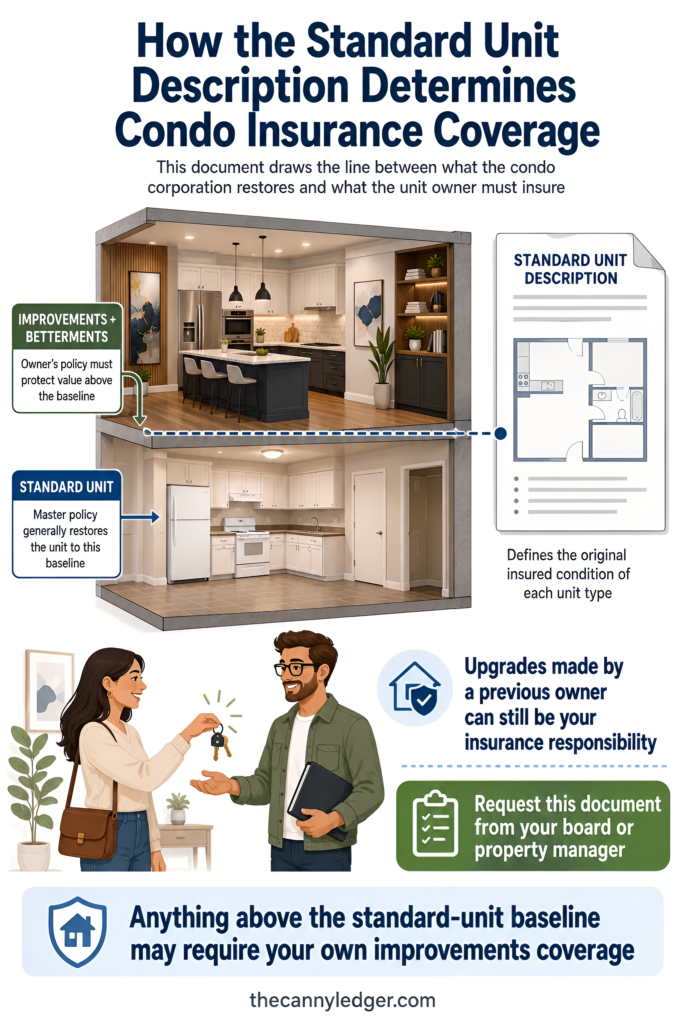
Manitoba’s Condominium Act requires every condominium corporation’s declaration to include something called a standard unit description for each type of unit in the building. This description sets a baseline, essentially defining what a “standard” unit looks like when it was originally built, and it exists specifically to determine two things: who’s responsible for repairing improvements after damage, and who’s responsible for insuring them.
Anything beyond that baseline, upgraded flooring, a renovated kitchen, custom cabinetry, built-in shelving, counts as an improvement or betterment to the unit. The condo corporation’s master policy generally insures the unit back to that original standard unit condition. Everything above and beyond it is the owner’s responsibility to insure themselves. If you bought a unit from a previous owner who’d already renovated it, or if you’ve done any upgrades yourself since moving in, there’s a real chance a meaningful part of your unit’s actual value sits outside what the master policy would ever pay to replace.
Most owners never ask their board for a copy of this description. It’s worth requesting directly, since it’s the single clearest way to know exactly where your corporation’s coverage stops and your own policy needs to start.
What the Master Policy Covers, and Stops Covering
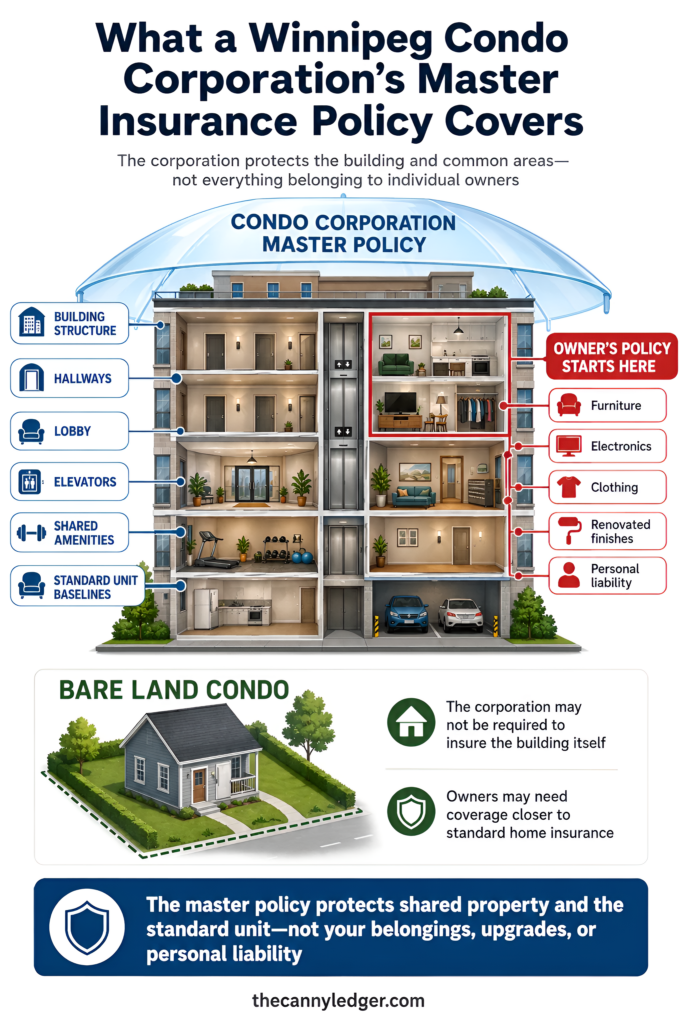
Manitoba’s Condominium Act obligates every condominium corporation to maintain property insurance, on its own behalf and on behalf of all unit owners, covering damage to the units and common elements caused by major perils or any other perils specified in the corporation’s declaration or bylaws. This is a legal requirement, not an optional courtesy the board extends to owners.
In practice, this master policy covers the building’s structure, the common areas like hallways, lobbies, elevators, and shared amenities, and the units themselves back to that standard unit baseline described above. What it does not cover is anything personal to you: your furniture, electronics, clothing, and other belongings sitting inside the unit, your personal liability if someone gets hurt inside your suite, and any improvements beyond the standard unit description.
One exception worth knowing if you’re shopping for a condo specifically: bare land condominium units, meaning units defined only by boundary lines on a plan without reference to any building or structure, are explicitly excluded from the corporation’s mandatory insurance obligation under Manitoba’s Act. If you own or are considering a bare land unit, you’re responsible for insuring the structure yourself, closer to a standard home insurance policy in Winnipeg than to typical condo coverage.
What Your Own Condo Policy Needs to Cover
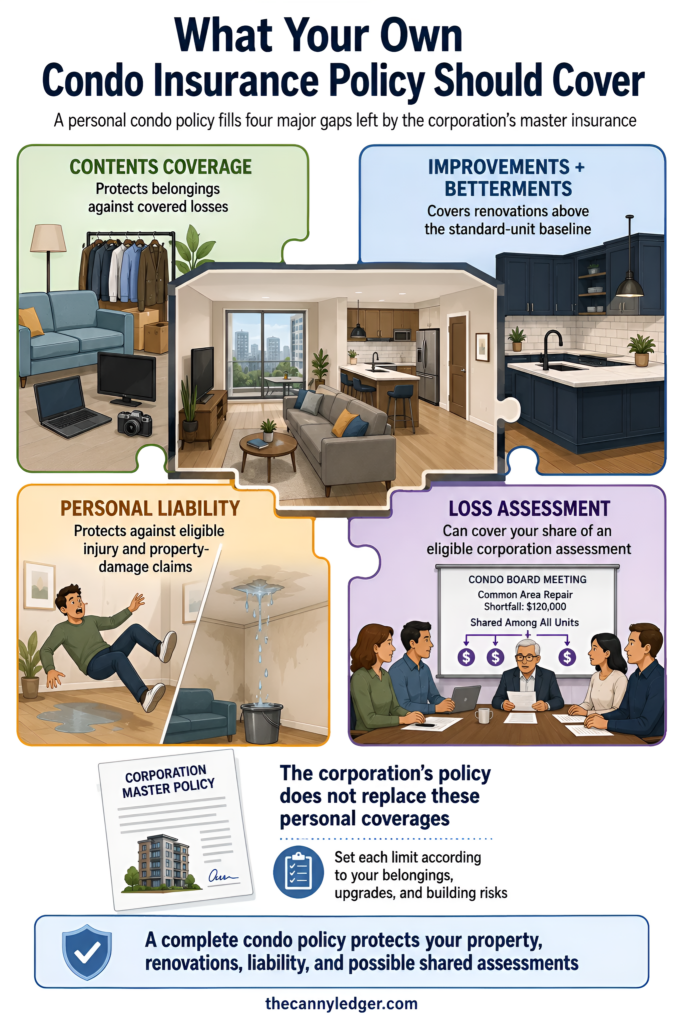
A proper condo insurance policy in Manitoba fills every gap the master policy leaves open, and it typically bundles together several distinct types of coverage rather than being one simple product.
Contents coverage protects your personal belongings against covered perils like fire, theft, and water damage, the same core function tenant insurance serves for renters. Improvements and betterments coverage insures everything you’ve added beyond the standard unit description, which matters enormously if you’ve renovated or bought a previously upgraded unit. Personal liability coverage protects you if you’re found responsible for injuring someone or damaging property, whether that’s a guest slipping in your unit or a leak from your suite damaging the unit below you.
Loss assessment coverage is the piece unique to condo living. If the corporation faces a large claim in the common areas and its insurance or reserve fund doesn’t fully cover the cost, the board can issue a special assessment charging each unit owner a share of the shortfall. Loss assessment coverage in your own policy picks up that bill instead of leaving you to pay it directly out of pocket.
The Deductible Chargeback Most Owners Don’t See Coming
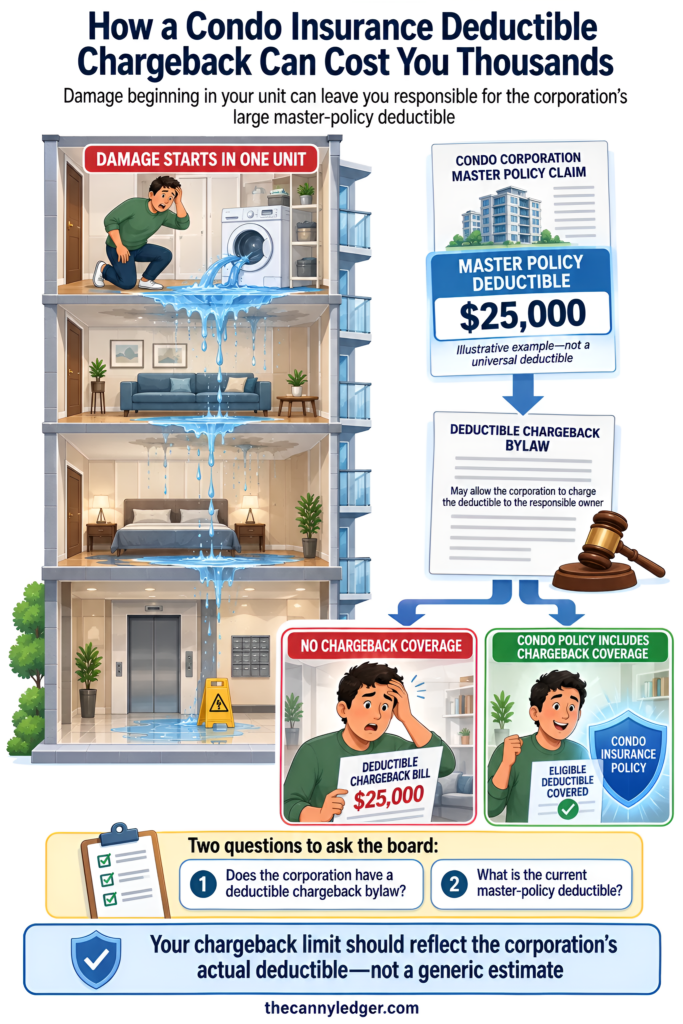
This is the part of condo ownership that catches the most people off guard, and it’s directly tied to how condo corporations manage their own insurance costs. Because corporations pay premiums that get passed on to owners through condo fees, boards face constant pressure to keep those premiums low, and one common way to do that is accepting a much higher deductible on the master policy than an individual homeowner would ever carry, sometimes reaching tens of thousands of dollars.
When a claim originates from damage inside a specific unit, such as a washing machine hose failure that floods multiple suites below, Manitoba’s Condominium Act permits condo corporations to pass bylaws allowing them to charge that deductible back to the unit owner responsible, rather than spreading the cost across every owner as a shared expense. If your corporation has such a bylaw in place and a plumbing failure in your unit triggers a $25,000 deductible on the master policy, you could be the one holding that bill unless your own condo insurance policy specifically includes deductible chargeback coverage to absorb it.
This is worth asking your board about directly: whether a deductible chargeback bylaw exists, and what the master policy’s actual deductible amount currently sits at. Both numbers directly shape how much chargeback protection you should be carrying in your own policy.
What It Actually Costs
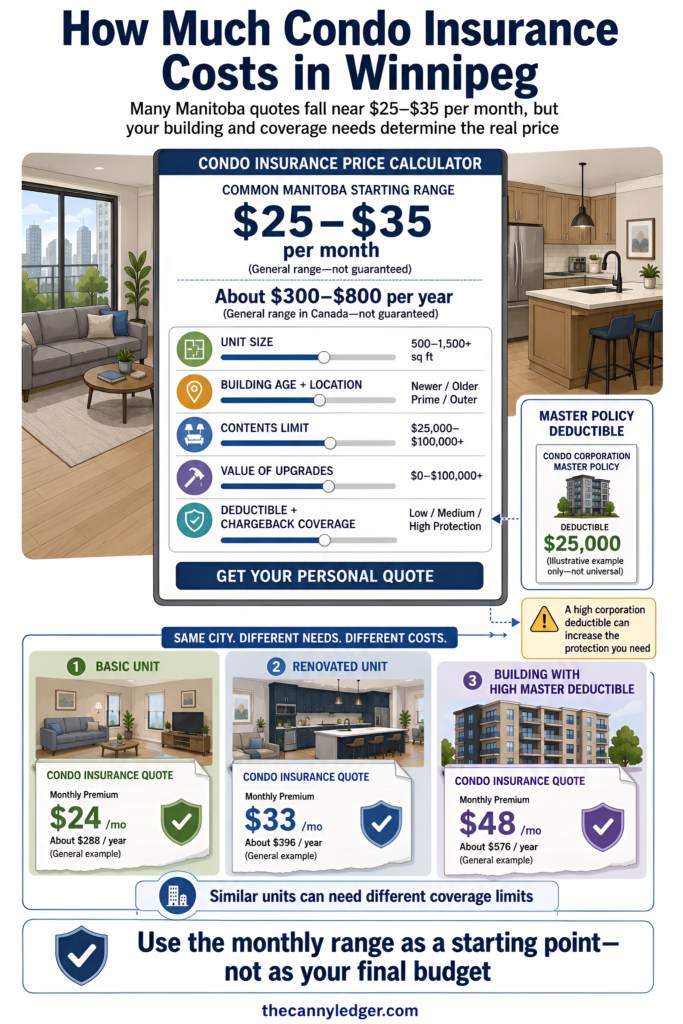
Condo insurance runs meaningfully cheaper than a full home insurance policy, which makes sense given how much less it actually needs to cover. Across Canada, condo owners typically pay somewhere between $300 and $800 a year, with the exact number driven by your unit’s size, age, location, coverage limits, and deductible choice. Manitoba brokers commonly quote condo insurance in the range of $25 to $35 a month, which lands toward the lower-to-middle end of that national range rather than at the expensive end where cities like Toronto and Vancouver tend to sit.
Treat any of these figures as a starting point for a conversation with a broker rather than a number to budget around exactly, since your specific unit, your corporation’s deductible amount, and how much improvements and betterments coverage you actually need will move your real quote up or down from these broad ranges.
Condo Insurance vs. Tenant Insurance vs. Home Insurance
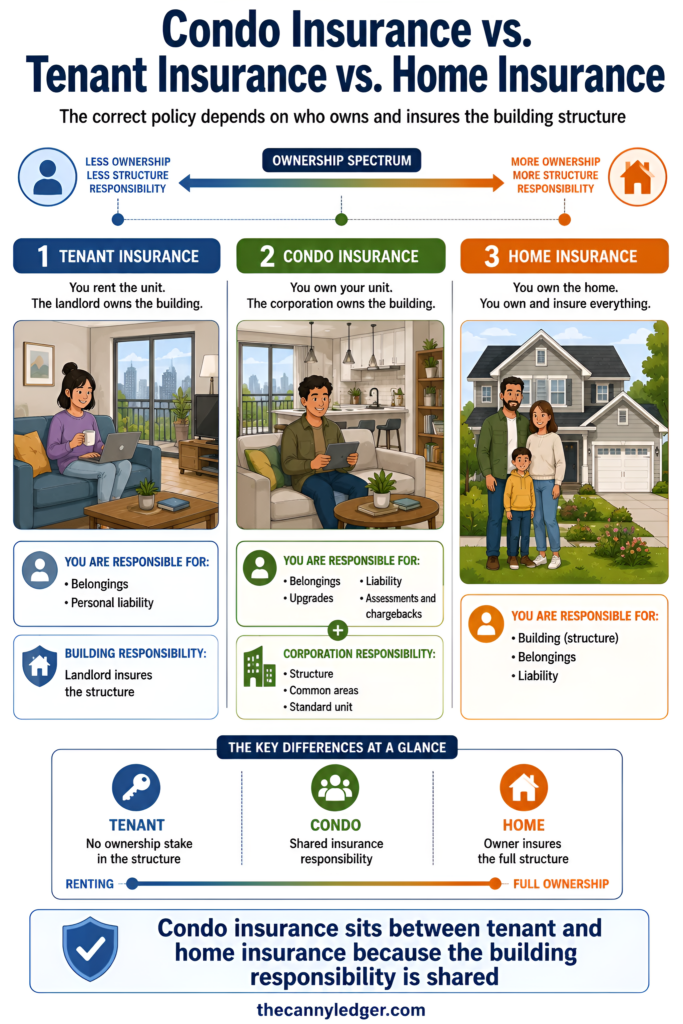
The confusion between these three products is understandable, since all three protect personal belongings and liability, but each sits in a different ownership structure.
Tenant insurance in Winnipeg covers a renter’s belongings and liability with no ownership stake in the property at all, since the landlord’s own insurance handles the building. Condo insurance sits in the middle: you own your unit, but a corporation owns and insures the building’s structure and common areas through a shared master policy, leaving you responsible for your contents, improvements, and liability. Full home insurance in Winnipeg covers everything, since a detached homeowner has no corporation or landlord sharing any part of the structural insurance responsibility.
That middle position is exactly why condo insurance costs less than home insurance but more than tenant insurance in most cases. You’re insuring less than a full house, but more than a renter with no stake in the structure at all.
How to Actually Find Out What You’re Responsible For
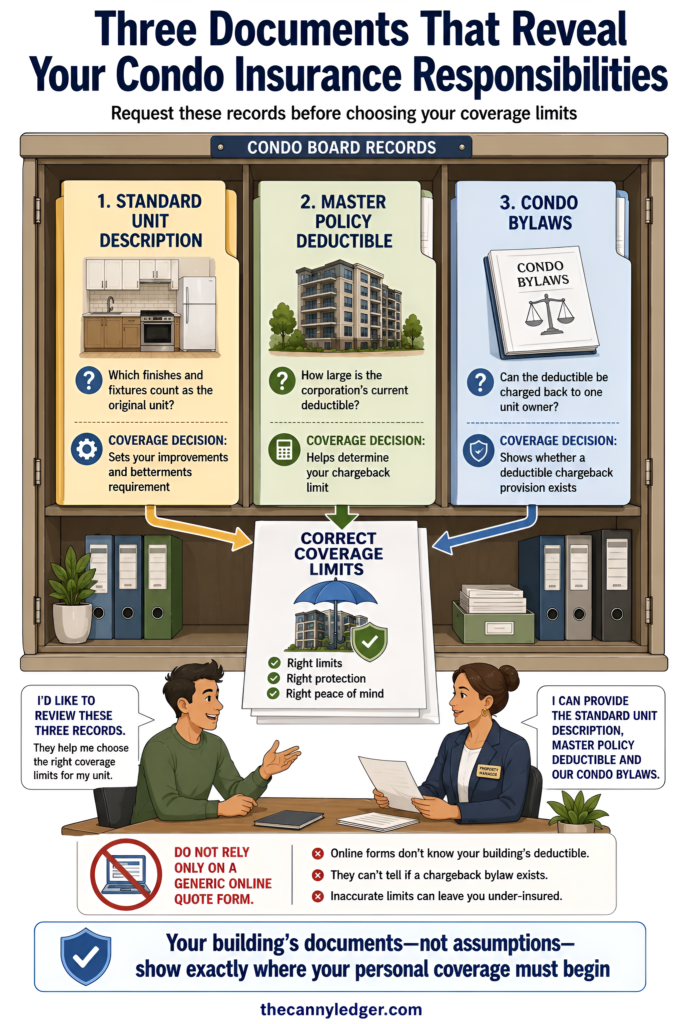
Three specific documents will tell you exactly where your coverage gap sits, and it’s worth requesting all three from your condo board or property manager before you finalize a policy.
Ask for the corporation’s standard unit description, which defines the baseline your improvements coverage needs to protect above. Ask for the current deductible amount on the corporation’s master policy, since that number directly determines how much chargeback protection makes sense in your own policy. And ask whether the corporation’s bylaws include a deductible chargeback provision at all, since not every corporation has adopted one, and the answer changes how urgently you need that specific coverage.
What to Actually Do Next
Request your condo corporation’s standard unit description and current master policy deductible amount before you shop for a policy, not after, since both numbers directly shape what coverage limits actually make sense for your unit. If you’ve made any upgrades to your suite since moving in, whether that’s flooring, cabinetry, or anything else beyond what came standard, get those improvements appraised or at minimum documented with receipts, since that’s exactly the value a standard policy might miss without betterments coverage specifically added.
From there, a conversation with one of Winnipeg’s local insurance brokers who actually works with condo policies regularly will get you a quote that reflects your specific building’s deductible and bylaws rather than a generic estimate, and knowing what to look for when choosing a broker is worth a read first if this is your first time buying condo coverage.