

Ask five different salary websites what the “average salary in Winnipeg” is and you’ll get five different numbers, ranging from the high $40,000s to the low $60,000s depending on the source. None of them is exactly wrong, but all of them are close to useless for the actual question most people asking have in mind, which is “what does my specific job, or the job I’m considering, actually pay here.” A single blended citywide average mixes a first-year retail associate with a specialist physician into one meaningless midpoint. The genuinely useful number is occupation-specific, and the best public source for it in Canada is the federal government’s own Job Bank wage data, which reports a low, median, and high figure by region for hundreds of individual occupations. This guide walks through what that data actually shows across Winnipeg’s major sectors, and just as importantly, how to read the spread rather than fixating on a single midpoint number.
- Why the spread matters more than the median
- Healthcare: wide range, real shortage-driven leverage
- Skilled trades: the widest spread on this entire list
- Technology: strong median, real demand
- Transportation and logistics
- Education
- Office, administrative, and retail roles
- How these numbers compare to what it actually costs to live here
- What actually moves you from the low end to the high end
- If you’re weighing a career move or a new start in the city
- The bottom line
Why the spread matters more than the median
Job Bank’s regional wage reports break every occupation into three figures: a low end, typically reflecting entry-level or newly certified workers, a median representing the typical experienced worker, and a high end representing senior, specialized, or high-demand roles within that same occupation. The gap between low and high tells you something the median alone can’t: how much room a given career has to grow within the same job title, versus how much of your future earning potential depends on switching roles entirely once you’ve hit that occupation’s ceiling. A trade with a wide low-to-high spread rewards experience and certification heavily within the same job; a profession with a narrow spread means most of your earning growth over a career will come from promotions into different titles rather than simply getting better at the same one.

Healthcare: wide range, real shortage-driven leverage
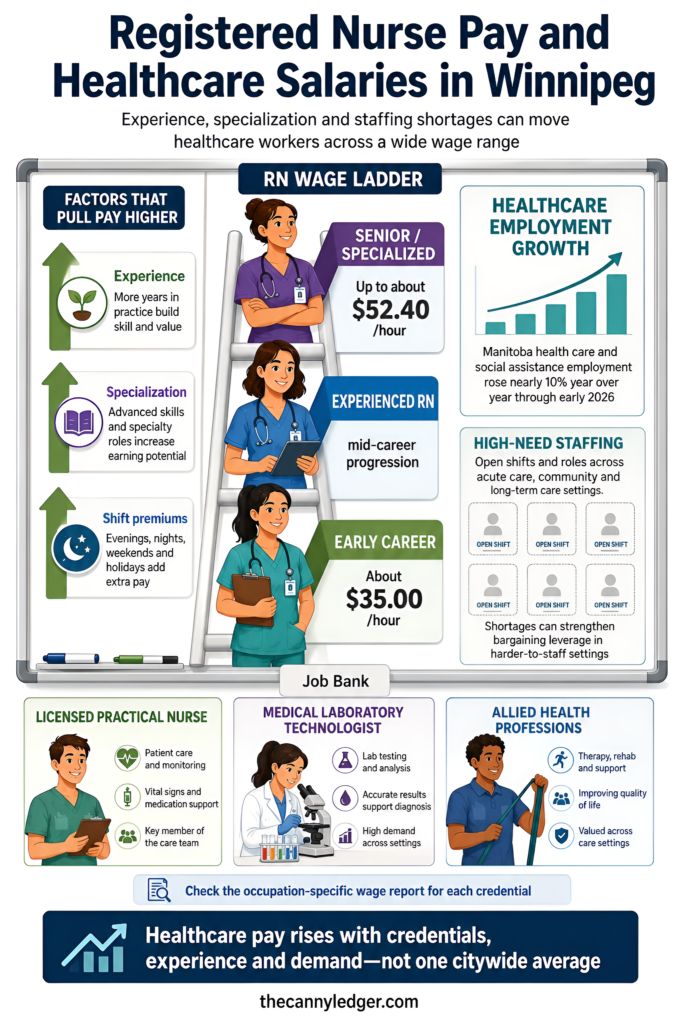
Registered nurses in the Winnipeg Region currently earn between roughly $35.00 and $52.40 an hour according to Job Bank’s most recent wage data, a spread wide enough that experience, specialization, and shift premiums genuinely move the number. This sits within a broader context worth knowing: Manitoba’s health care and social assistance sector saw employment rise nearly 10 percent year over year through early 2026, with nursing shortages described as severe enough in some rural areas that emergency departments have reported vacancy rates as high as 50 percent. That kind of shortage tends to translate into real negotiating leverage for nurses willing to work in higher-need settings or take on additional shifts, on top of the base wage range itself.
Other regulated health professions, licensed practical nurses, medical laboratory technologists, and various allied health roles, generally sit below RN wages but above the citywide median, and each carries its own specific Job Bank wage report worth checking directly if you’re weighing a specific credential or specialization within the broader healthcare field.
Skilled trades: the widest spread on this entire list
Electricians in the Winnipeg Region show one of the widest wage spreads of any occupation tracked, running from roughly $17.50 to $46.00 an hour. That enormous gap reflects the structure of the trade itself: the low end captures apprentices in their first year or two, while the high end reflects fully certified Red Seal journeypersons, often in specialized commercial or industrial work. This pattern holds broadly across the skilled trades: general construction supervisors in the region earn between roughly $29.00 and $45.67 an hour, with the spread again driven heavily by whether a worker is early in their supervisory career or running large, complex projects.
The practical takeaway for anyone considering a trade is that the entry-level wage tells you almost nothing about where the career actually lands. Red Seal certification specifically is worth treating as the single biggest lever in this category, since it’s the credential that moves a worker from the lower half of these ranges toward the upper half, and it’s worth researching the apprenticeship and certification pathway directly rather than judging a trade’s earning potential by what a first-year apprentice makes.

Technology: strong median, real demand
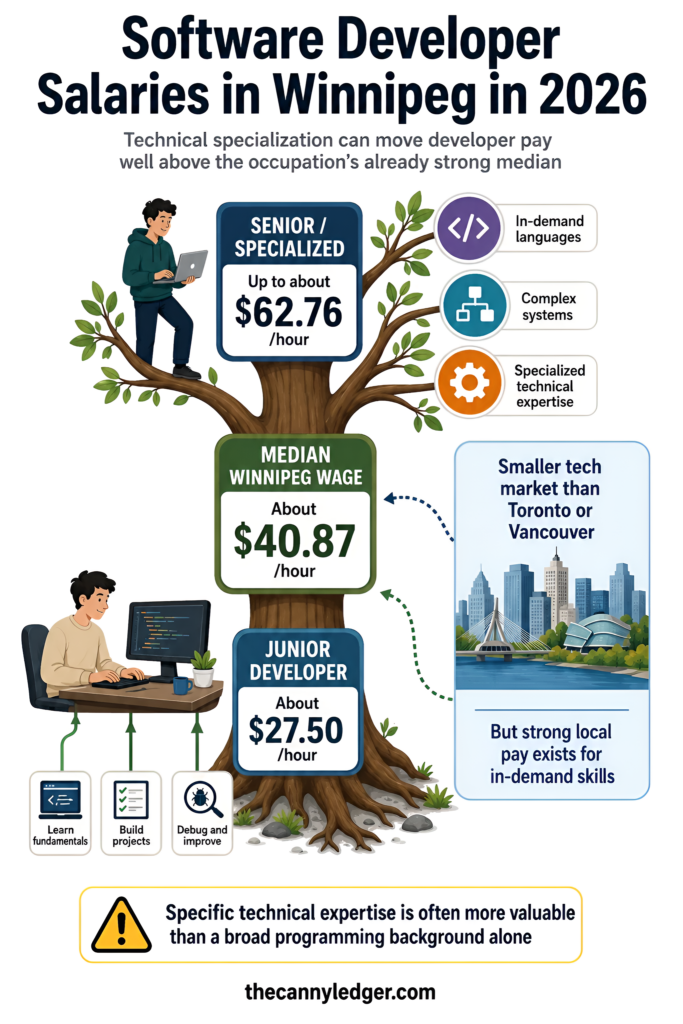
Software developers and programmers in the Winnipeg Region earn a median of roughly $40.87 an hour according to Job Bank data, with a range running from about $27.50 at the low end to $62.76 at the high end, a spread that reflects the real difference between junior developers and senior specialists in high-demand languages or systems. Winnipeg’s tech sector is smaller than Toronto’s or Vancouver’s in absolute terms, but the wage data suggests genuinely competitive compensation for the roles that do exist here, particularly for anyone with in-demand specific technical skills rather than a general programming background alone.
Transportation and logistics
Driving and logistics roles show real variation depending on the specific vehicle class and cargo involved. Local and specialized driving roles, tow truck operation being one tracked example, run from roughly $16.67 to $34.00 an hour in the Winnipeg Region, while long-haul and specialized commercial trucking, which carries its own separate wage classification, generally commands more than local delivery driving specifically because of the licensing, time away from home, and cargo value involved. Winnipeg’s position as a genuine transportation and logistics hub for the Prairies means this sector employs a meaningful share of the city’s workforce, and it’s worth checking the specific wage report for your exact role, since “driver” as a category covers a genuinely wide range of licensing requirements and pay.

Education
Elementary and secondary teaching salaries in Manitoba are set largely through provincial and divisional collective agreements rather than the open-market wage bands that apply to most other occupations on this list, which makes Job Bank’s general wage data a less precise fit for this specific profession. Broader salary survey data puts an experienced elementary teacher’s compensation in Winnipeg somewhere in the $60,000s annually, with earlier-career teachers starting meaningfully lower and compensation climbing over time based on years of service and additional qualifications under most school division grid systems. If teaching is a career you’re specifically researching, checking the salary grid published directly by the school division you’re interested in will give you a far more precise number than any general salary aggregator.

Office, administrative, and retail roles
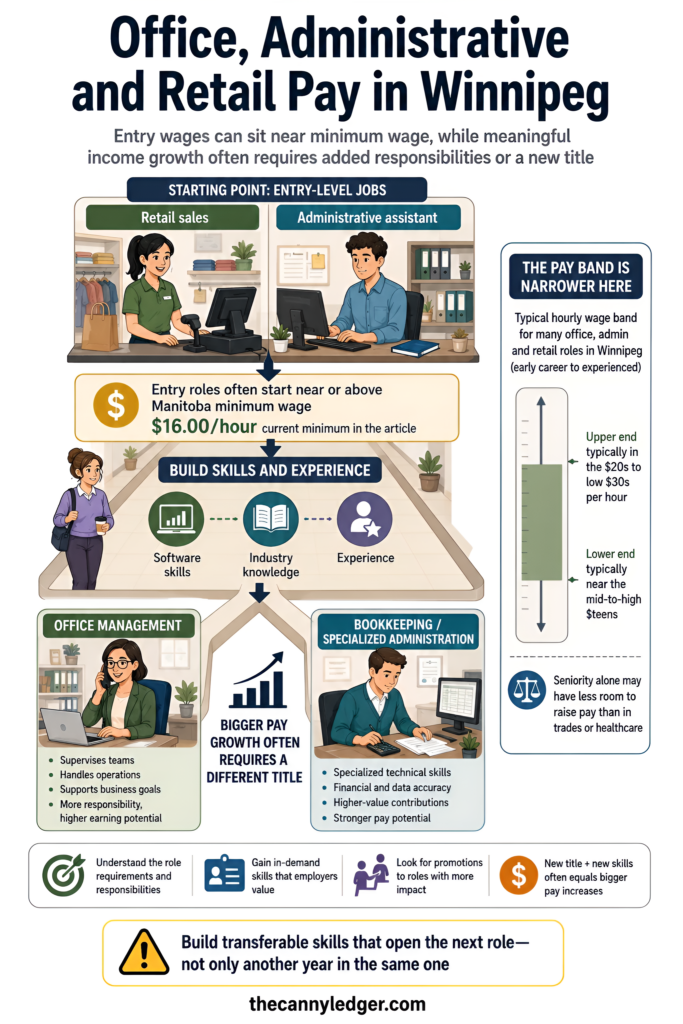
These roles, covering everything from administrative assistants to retail sales positions, sit closer to the lower end of Winnipeg’s overall wage spectrum, with entry-level positions often starting near or just above Manitoba’s current minimum wage of $16.00 an hour, discussed in more depth in our minimum wage in Winnipeg guide. Experience, specific software or industry knowledge, and roles carrying more responsibility, office management or bookkeeping functions layered onto an administrative role, for example, push wages up from that floor, but this category generally shows a narrower low-to-high spread than the trades or healthcare, meaning career growth here more often comes from moving into a different job title entirely rather than simply gaining seniority within the same one.
How these numbers compare to what it actually costs to live here
A wage figure only means something in context, and it’s worth reading any of the numbers above alongside a realistic sense of what they actually need to cover. Our living expenses in Winnipeg guide builds out full monthly budgets for a single person, a couple, and a family of four using current housing, utility, grocery, and transportation costs, and it’s worth running your specific occupation’s wage range against those budgets directly rather than assuming a given salary is comfortable in the abstract. Our average income in Winnipeg guide covers the broader citywide income picture this occupation-specific data feeds into, and our Manitoba and Winnipeg personal income tax guide is worth reading before assuming a gross wage figure translates directly into take-home pay, since the gap between the two matters considerably once you’re budgeting against real monthly numbers.

What actually moves you from the low end to the high end
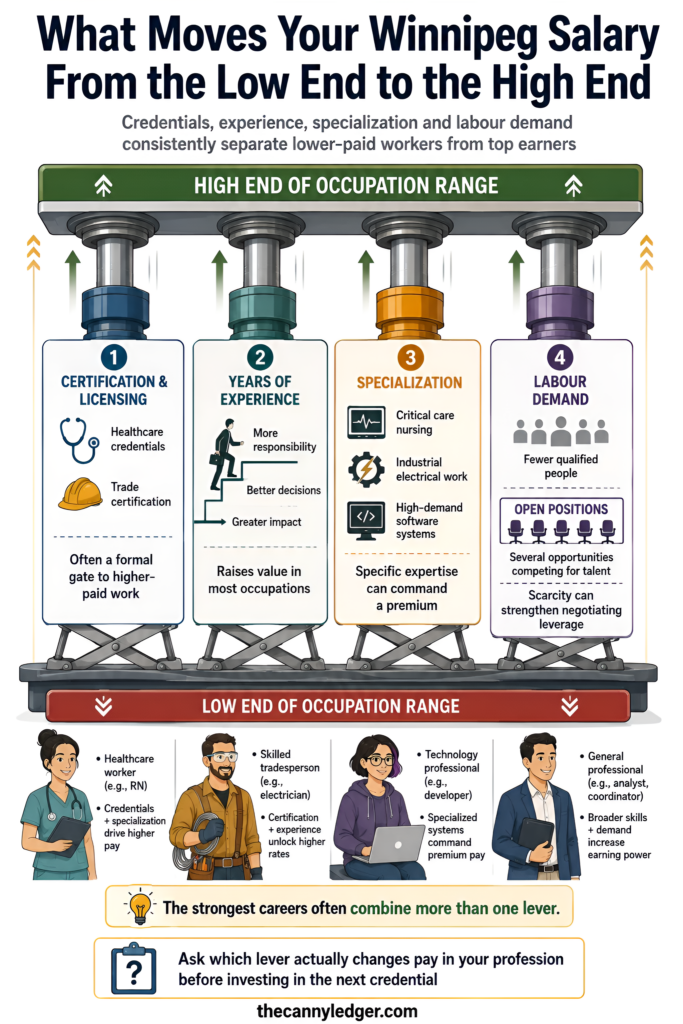
Across nearly every occupation covered here, a handful of factors consistently explain the gap between the bottom and top of a given wage band. Certification and licensing matter enormously in regulated fields, healthcare and the trades especially, where a specific credential is often the literal gatekeeper between one wage tier and the next. Years of experience matter almost everywhere, though the rate at which experience translates into higher pay varies considerably by field. Specialization within a broader occupation, a nurse with a critical care certification, an electrician qualified for industrial work, a developer with expertise in a specific in-demand system, consistently commands more than a generalist in the same base occupation. And in high-demand areas specifically, healthcare being the clearest current example given Manitoba’s documented nursing shortages, straightforward market scarcity gives workers real negotiating leverage that a wage band alone doesn’t fully capture.
If you’re weighing a career move or a new start in the city
If you’re newer to the Winnipeg job market entirely, whether relocating from elsewhere in Canada or arriving from another country, our career counselling for newcomers in Winnipeg and jobs for new immigrants in Winnipeg guides cover resources specifically built to help translate outside experience and credentials into a clear sense of where you’d land on the wage bands described above. And if you’re a student or early in your career weighing part-time work against your studies, our part-time jobs in Winnipeg guide covers what that segment of the market typically pays, generally at the lower end of the ranges discussed here but worth knowing precisely before you commit your schedule to a specific role.

The bottom line
Skip the single blended “average salary” number the next time you’re researching pay in Winnipeg, and go straight to the occupation-specific wage data instead. The spread between low and high within your specific field tells you more about your realistic earning trajectory than any citywide average ever could, and pairing that number honestly against the actual cost of living covered in our companion budget guide is what turns a wage figure from an abstract statistic into something you can actually plan a life around.