

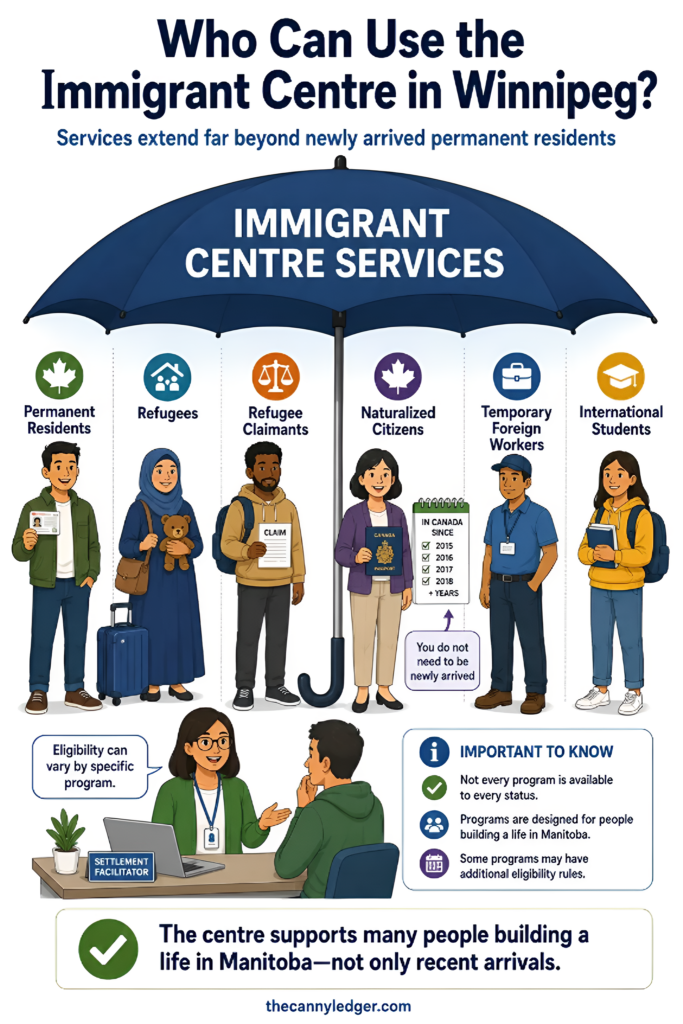
The name suggests a place for people who just got off a plane, and that assumption keeps a lot of longer-settled Manitobans from ever walking through the door. The Immigrant Centre serves naturalized citizens who’ve been in Canada for years just as readily as someone who landed last month, along with refugees, refugee claimants, temporary foreign workers, permanent residents, and international students. Scope is the thing most people get wrong about this organization, not eligibility.
- Who Actually Qualifies as a Client
- How to Actually Register as a Client
- Settlement Services: The First Stop for Almost Everything
- Employment Services: Built for Entry-Level Work and Beginner English
- The Classes Worth Knowing About Beyond Employment Help
- Nutrition Services Nobody Expects From a Settlement Agency
- The Language Bank Handles Document Problems Most People Don’t Expect
- The Neighbourhood Program If You’re Outside Downtown
- Hours, Location, and What to Bring
- Common Questions
- One Organization, a Lot More Than Its Name Suggests
The Immigrant Centre in Winnipeg offers free settlement, employment, nutrition, English language, and document services to newcomers of nearly every immigration category, with no fee attached to any of it. Its main office sits at 100 Adelaide Street, and services range from one-on-one orientation appointments to citizenship test preparation, cooking classes, and certified document translation.
Who Actually Qualifies as a Client
Eligibility here is broader than the organization’s name implies. Permanent residents, refugees, refugee claimants, and naturalized citizens all qualify, and so do temporary foreign workers and international students in some program areas, particularly employment services. The one meaningful line is around long-term settlement status rather than how recently someone arrived, since services are built for the ongoing work of building a life in Manitoba, not a one-time welcome. If you’re unsure whether your specific status qualifies for a given service, that’s exactly the kind of question a Settlement Facilitator answers directly rather than something you need to guess at from a website.
How to Actually Register as a Client
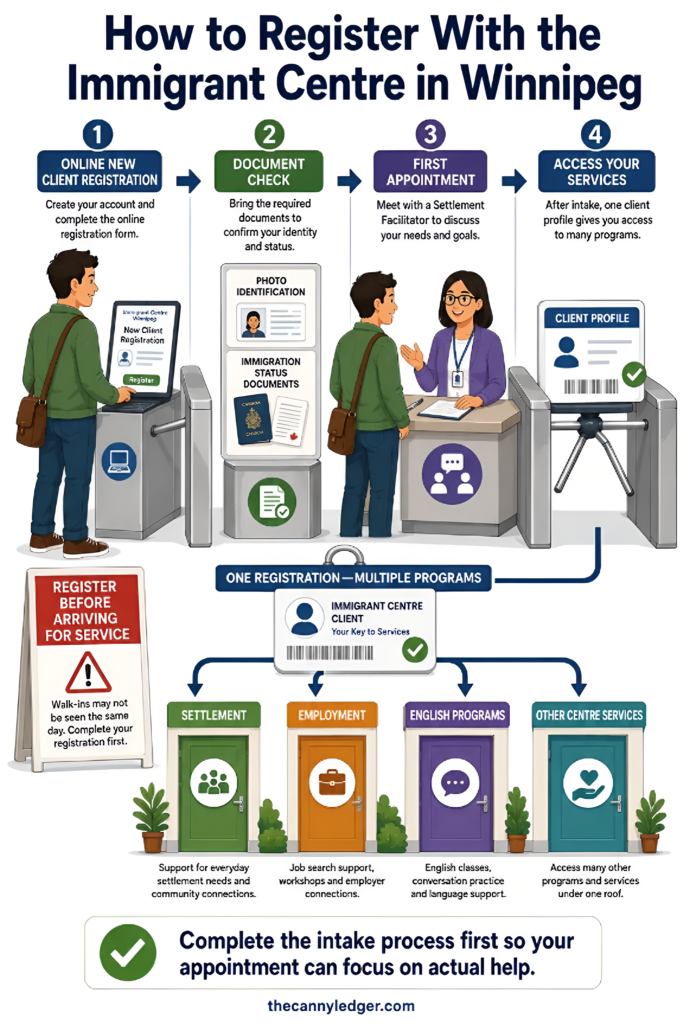
Registration happens through the centre’s own intake process rather than a drop-in first visit, so it’s worth doing before you show up expecting immediate service. New clients register online, and the centre’s site lists what documents to bring for that first appointment, generally identification and anything related to your immigration status. Once registered, you’re not locked into a single service either. A client working with a Settlement Facilitator on housing questions can just as easily book into the Access English Centre or the employment program without a separate application process for each.
Settlement Services: The First Stop for Almost Everything
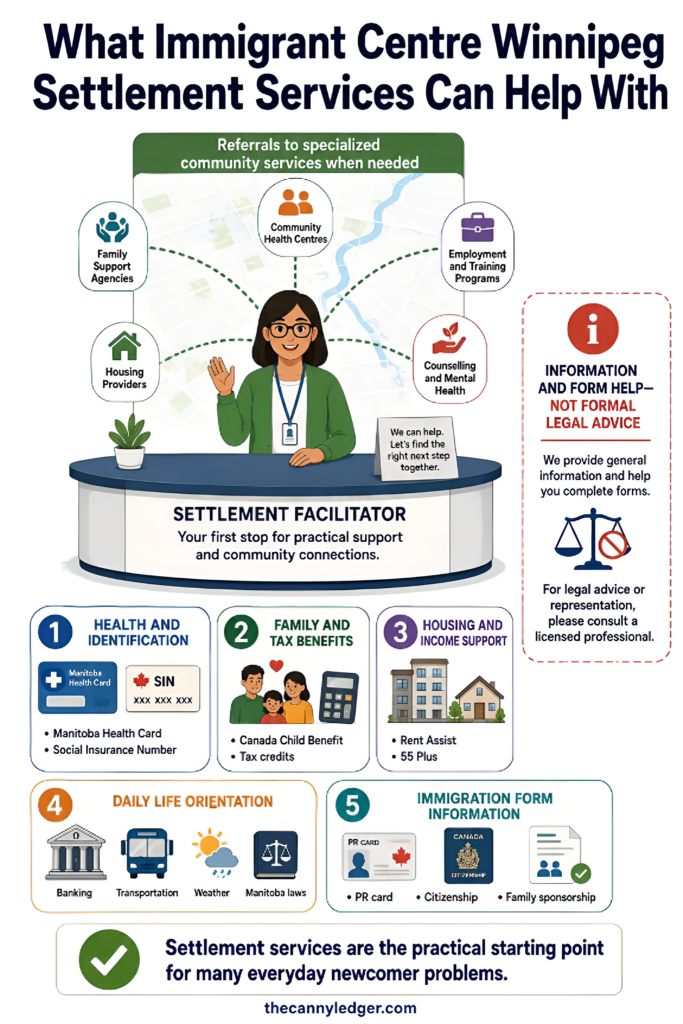
This is the broadest program at the centre, and for most newcomers it’s the sensible entry point before anything more specialized. A Settlement Facilitator covers first-steps orientation on health, housing, transportation, banking, weather, and Manitoba law, but the more practical value often shows up in form help: Social Insurance Number applications, the Manitoba Health Card, the Canada Child Benefit and related tax credits, and provincial benefits including Rent Assist and the 55 Plus program. If you’re specifically trying to understand whether you qualify for that rent benefit, our own breakdown of how to qualify for Rent Assist in Manitoba goes deeper into the income thresholds than a settlement appointment alone will cover.
Settlement Facilitators also provide information, not formal legal advice, on immigration applications themselves: permanent resident card renewals or replacements, family sponsorship applications, and Canadian citizenship applications. That distinction matters. It’s genuine, useful orientation on what a form requires, not a substitute for a lawyer on a contested or complicated file. Our guide to free and low-cost immigration help in Winnipeg covers where that legal-advice line sits and who to call when a situation crosses it.
Beyond direct help, the centre maintains referral relationships with more than twenty partner organizations across Manitoba covering children and youth programming, family and crisis counselling, trauma support, refugee-specific programs, and settlement and employment services in other parts of the province. A Settlement Facilitator’s job includes knowing which of those twenty-plus partners actually fits your specific situation, which is a genuinely useful thing to have someone else sort out rather than researching cold.
Employment Services: Built for Entry-Level Work and Beginner English
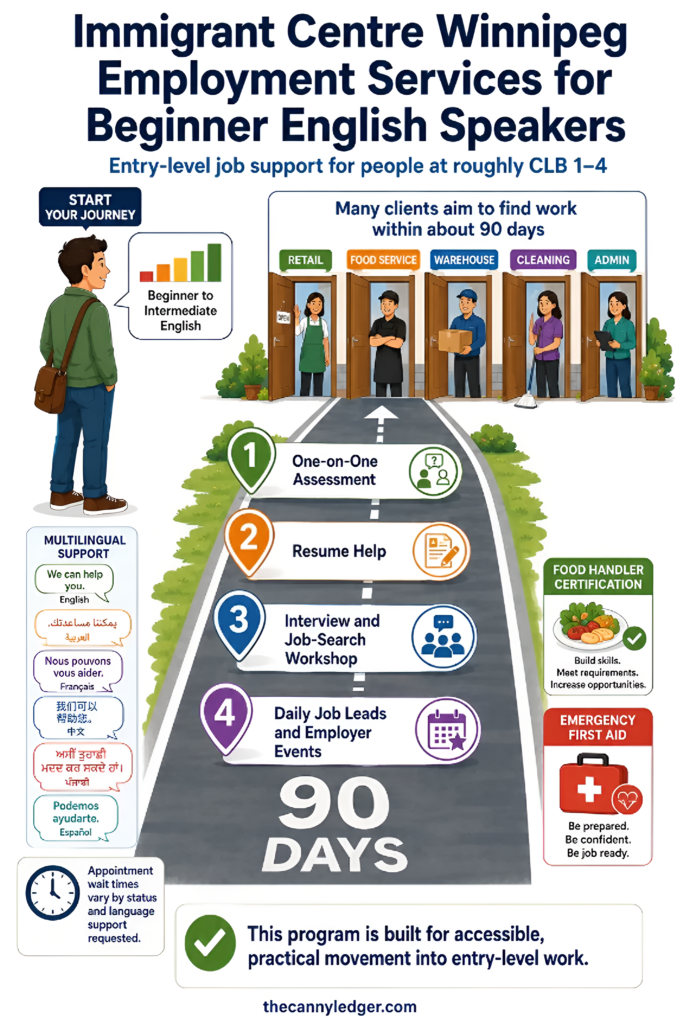
The employment program occupies a distinct niche within Winnipeg’s newcomer job-search landscape. It specializes in assisting people with beginner to intermediate English, roughly CLB 1 through 4 on the Canadian Language Benchmark scale, who need entry-level work sooner rather than a lengthy credential recognition process. Coaching happens in plain English and in translation across more than a dozen languages common among newcomers, including Arabic, Somali, Tigrigna, Spanish, and Ukrainian.
Current appointment wait times run a week or less for most permanent residents, two to three weeks for permanent residents specifically requesting a Tigrigna or Amharic-speaking facilitator, and one to three weeks for non-permanent residents including open work permit holders and refugee claimants. Most clients land entry-level work within 90 days of that first appointment. Services include a one-on-one assessment with resume help, half-day workshops on job search and interview prep, daily job lead emails, and weekly employer events. Extras like food handler certification and emergency first aid training are also available, both common requirements for entry-level service jobs. If your field is more specialized or you’re trying to get back into professional work you did before immigrating, our guide to career counselling for newcomers in Winnipeg covers organizations built specifically for that instead, and jobs for new immigrants in Winnipeg walks through the broader job-search landscape beyond any single agency.
The Classes Worth Knowing About Beyond Employment Help
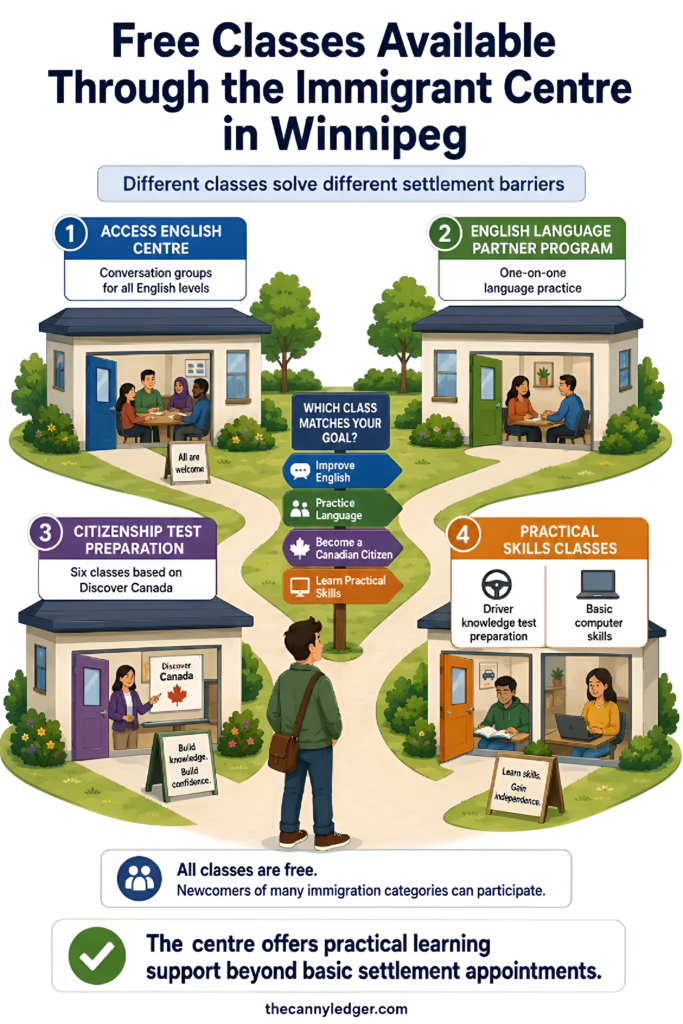
A separate program area covers classes, presentations, and workshops, and it’s worth treating as its own destination rather than an afterthought to settlement or employment services. The Access English Centre runs free conversation groups facilitated by trained volunteers, open to English learners of any level with no restriction based on immigration status, at various times through the week. A separate English Language Partner Program pairs learners with a tutor one-on-one rather than in a group setting. Our broader roundups of free English classes for immigrants in Winnipeg and free courses for new immigrants in Winnipeg cover where these sit alongside other language options across the city.
Citizenship test preparation runs as a six-class course covering the material in the Discover Canada study guide that Immigration, Refugees and Citizenship Canada sends applicants directly, and it’s open to anyone who has already applied for citizenship and wants structured help getting ready for the test. Driver’s education knowledge test preparation covers the written portion of Manitoba’s driver’s licence exam specifically, a genuinely practical offering given how many newcomers need to navigate MPI’s licensing process within their first few months. Computer training rounds out the list, covering basic skills like internet use and common office software for anyone who didn’t grow up with regular computer access.
Nutrition Services Nobody Expects From a Settlement Agency
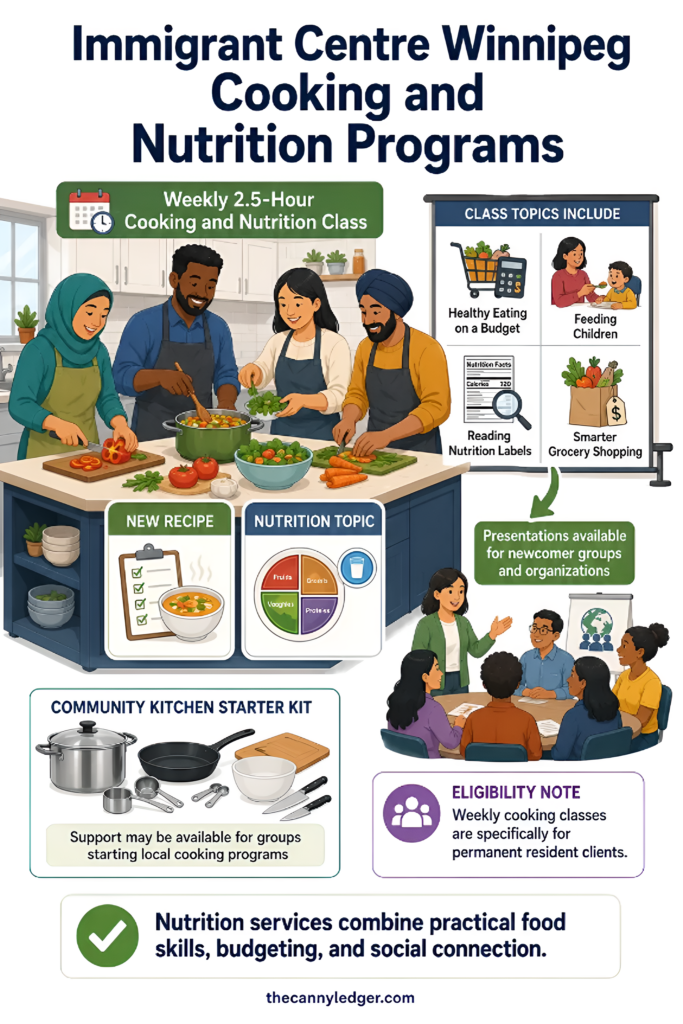
This is the program most newcomers don’t know exists until someone mentions it. Cooking and nutrition classes run as a 2.5-hour weekly session, open specifically to permanent resident clients, covering a new recipe and a nutrition topic each week alongside a chance to meet people from other cultural backgrounds going through the same adjustment. Separately, nutrition presentations are available to any newcomer group, an English class, an ethnic community organization, a support group, on topics like healthy eating on a budget, feeding children, reading nutrition labels, and grocery shopping strategies. A group interested in starting its own ongoing cooking and nutrition class in their area can also partner with the centre for support and resources rather than starting from scratch.
The Language Bank Handles Document Problems Most People Don’t Expect
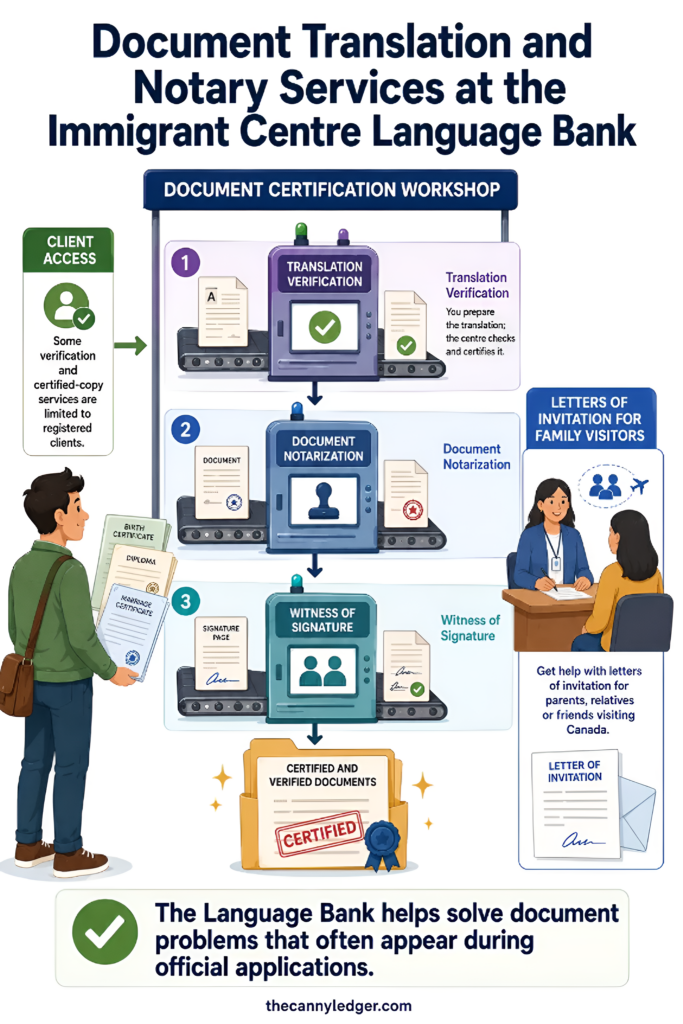
Translation and document verification is one of those needs that blindsides newcomers precisely because it rarely comes up until a specific bureaucratic wall appears. The Language Bank handles translation verification, meaning you translate a document yourself and the centre checks, certifies, and notarizes that translation, along with straightforward document notarization and witness-of-signature services. It also provides letters of invitation to visit, useful for family members applying to visit Canada, though verification and certified-copy services here are limited to registered Immigrant Centre clients rather than open to the general public.
The Neighbourhood Program If You’re Outside Downtown
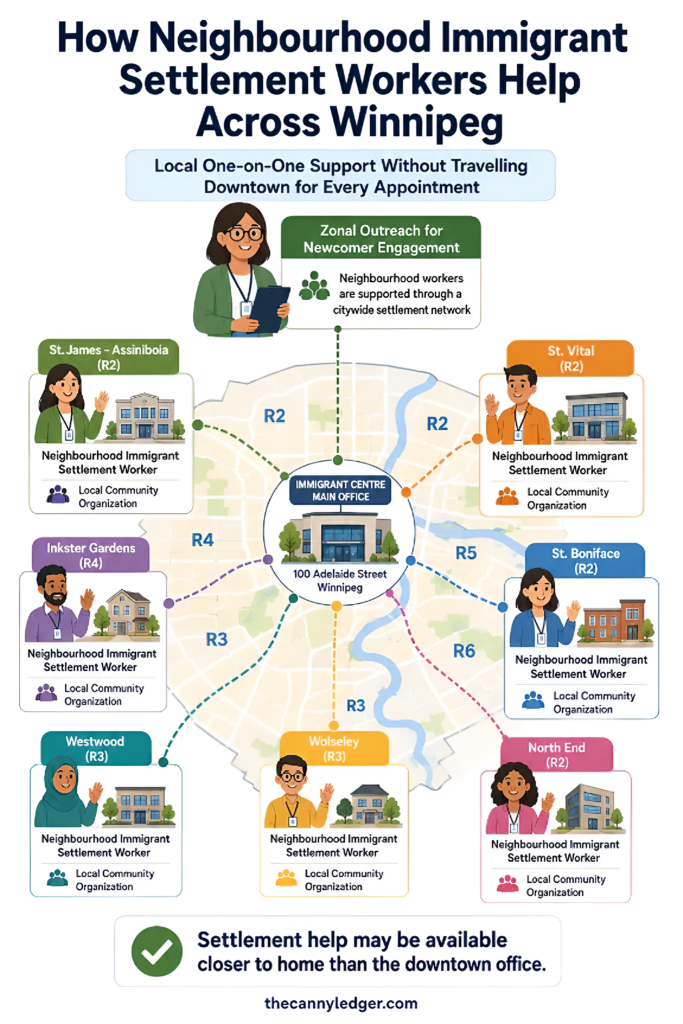
Not every newcomer lives close enough to Adelaide Street to make regular in-person visits practical, and the centre’s Zonal Outreach for Newcomer Engagement structure addresses exactly that gap. A Neighbourhood Immigrant Settlement Worker Coordinator mentors and supports roughly two dozen Neighbourhood Immigrant Settlement Workers placed across different postal code zones in Winnipeg, each connected to a local community organization. Someone settling in St. Vital, St. Boniface, or another zone outside the downtown core can generally find one-on-one settlement support through their neighbourhood worker without needing to travel downtown for every appointment. Our broader directory of new immigrant services in Winnipeg covers other zone-specific and community-specific organizations worth knowing about alongside this one.
Hours, Location, and What to Bring
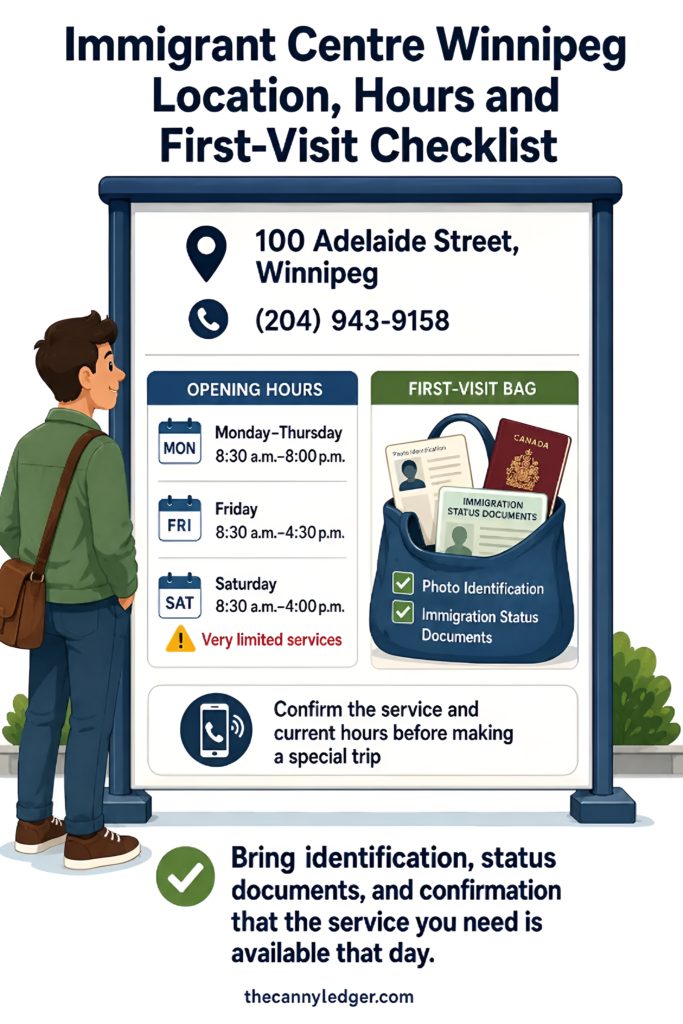
The main office is at 100 Adelaide Street, Winnipeg, phone (204) 943-9158. Front desk hours run Monday through Thursday from 8:30 a.m. to 8:00 p.m., Friday from 8:30 a.m. to 4:30 p.m., and Saturday from 8:30 a.m. to 4:00 p.m. with very limited services available on Saturdays specifically. These hours and any given day’s service availability can shift, so it’s worth confirming directly before making a special trip, particularly for a Saturday visit. For a first appointment, bring photo identification and whatever documentation you have related to your immigration status.
Common Questions
Do I need to be a client for every service, or can I just show up to the Access English Centre? Conversation groups through the Access English Centre are open without registration as a formal client first, but most other services, including settlement appointments and employment support, do require registering through the centre’s intake process.
Is there a cost for any of these services? No. Everything covered here runs free of charge to eligible newcomers, funded through government and community partnerships rather than client fees.
What if I don’t live in Winnipeg? The main office serves Winnipeg directly, but the Zonal Outreach network connects to community organizations elsewhere in Manitoba, and the centre’s settlement referral network extends services and information beyond the city itself.
One Organization, a Lot More Than Its Name Suggests
Most people who eventually use two or three services here started out only knowing about one, usually settlement orientation or employment help, and discovered the rest by word of mouth rather than by reading through the organization’s full service list up front. Given how much of this runs free regardless of how long you’ve been in Manitoba, the actual cost of not knowing about the nutrition classes, the citizenship test course, or the Language Bank isn’t financial, it’s just time spent solving a problem alone that a Settlement Facilitator could have pointed you toward in a single conversation.

