

A dividend that looks modest on paper can quietly push your net income high enough to trigger the Old Age Security clawback, even though the actual cash you received was far smaller. The 2026 OAS recovery threshold sits at $95,323, above which every dollar of net income triggers a 15 cent repayment, and the gross-up mechanic covered below is exactly what can push a modest cash dividend past that line even when the real money received falls well short of it. That happens because of how Canadian dividend tax works outside a registered account, a mechanic called the gross-up, which inflates the dividend for tax purposes before any credit gets applied back. Inside a TFSA, none of that machinery exists at all, the dividend simply arrives, stays, and never touches your tax return in the first place.
- How Dividend Tax Actually Works Outside A TFSA
- Why None Of This Machinery Applies Inside A TFSA
- What The Difference Actually Looks Like In Real Numbers
- The One Place This Protection Doesn’t Reach
- Does Reinvesting Dividends Use Up Contribution Room
- What Actually Fits Well In A TFSA For This Purpose
- Common Questions About Dividend Taxation And The TFSA
How Dividend Tax Actually Works Outside A TFSA
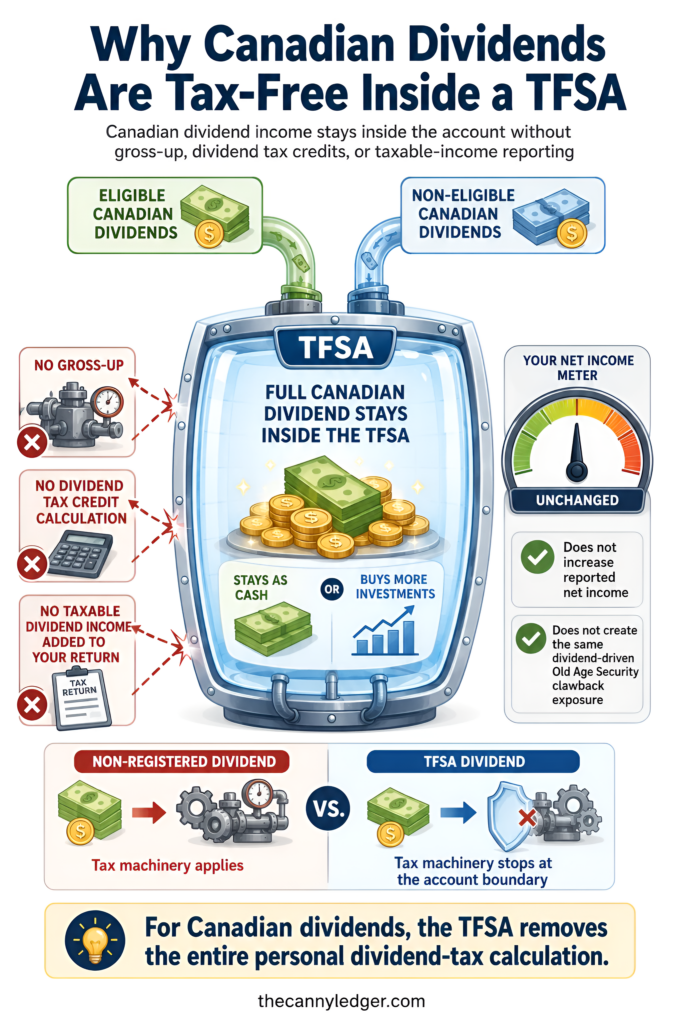
Canadian dividends get taxed through a gross-up and credit system built to avoid taxing the same corporate profit twice, once inside the company and again in your hands. Eligible dividends, generally the ones paid by public Canadian corporations, get grossed up by 38 percent before being added to your taxable income, with a federal dividend tax credit of 15.0198 percent applied back against that grossed-up amount. Non-eligible dividends, typically paid by Canadian-controlled private corporations that benefited from the small business tax rate, follow a lighter version of the same mechanic, a 15 percent gross-up against a smaller 9.0301 percent federal credit. Both credits get reported directly on line 40425 of a personal tax return, alongside a separate provincial credit that varies by where you live.
The gross-up is exactly what creates the OAS clawback trap from the opening. Since the inflated, grossed-up figure counts toward your net income for benefit calculations, not the smaller actual dividend you received, a dividend income stream that looks perfectly reasonable in cash terms can push your reported net income past a clawback threshold you’d otherwise be nowhere near.

Why None Of This Machinery Applies Inside A TFSA
A TFSA sidesteps the entire gross-up and credit system by removing the need for it entirely. Dividends earned inside the account, whether eligible or non-eligible, arrive at their full cash value with nothing added to your taxable income and no T5 slip generated for the CRA to track. There’s no gross-up to inflate your reported net income, no dividend tax credit to calculate, and consequently no exposure to the clawback mechanic that catches dividend income sitting in a non-registered account. The entire apparatus that exists specifically to make dividend taxation fair outside a TFSA simply has nothing to apply to once the dividend lands inside one.
What The Difference Actually Looks Like In Real Numbers
Take a $5,000 eligible dividend earned by someone in Ontario’s top marginal tax bracket. Outside a TFSA, that dividend grosses up to $6,900, and after applying the federal credit and Ontario’s own provincial dividend tax credit, the net tax owed comes to roughly $1,269, an effective rate close to 25 percent on the original dividend amount, leaving about $3,731 after tax. The identical $5,000 dividend earned inside a TFSA keeps its full value, no gross-up, no credit calculation, no tax owed at all. That gap, over a thousand dollars on a single $5,000 dividend at this income level, is the concrete size of what the TFSA wrapper is actually worth to a dividend investor in the top bracket, and it scales directly with both your dividend income and your marginal rate.

The One Place This Protection Doesn’t Reach
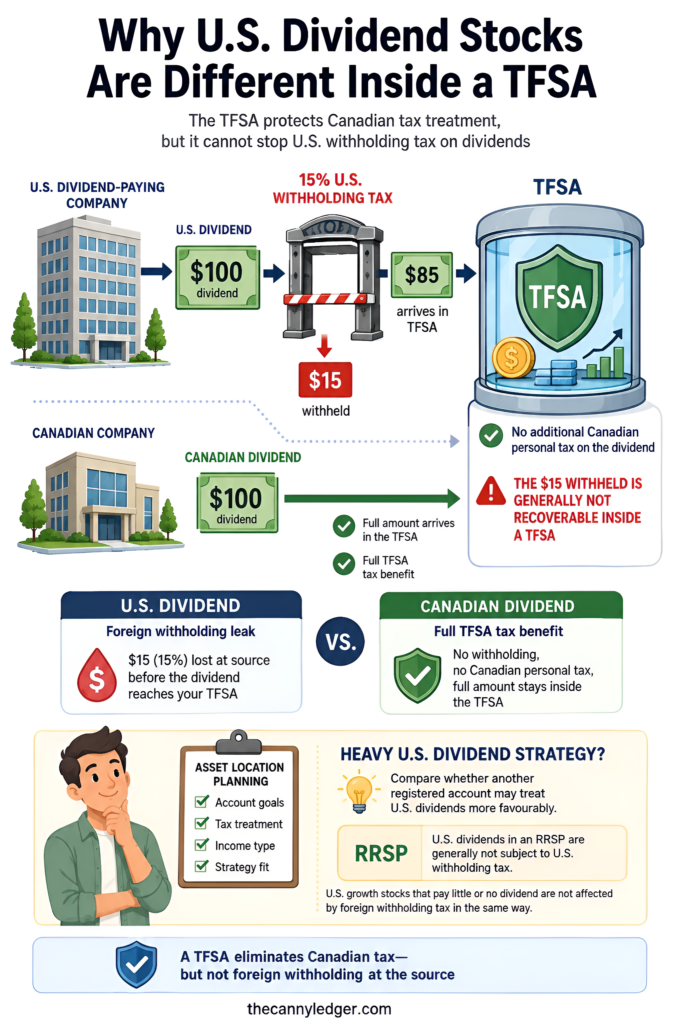
US dividend stocks are the genuine exception to everything covered above. The United States withholds 15 percent tax on dividends paid into a TFSA, and unlike the domestic dividend system, that withholding isn’t offset by any Canadian credit and can’t be recovered the way it can in a non-registered account. Our full breakdown of TFSA tax traps and our dedicated guide to holding US stocks in a TFSA both cover this specific gap in more depth, but the short version matters here too, Canadian dividend payers get the full benefit described above, while heavy US dividend exposure inside a TFSA quietly loses a slice of that benefit to a foreign government that a TFSA can’t shield you from.
Does Reinvesting Dividends Use Up Contribution Room
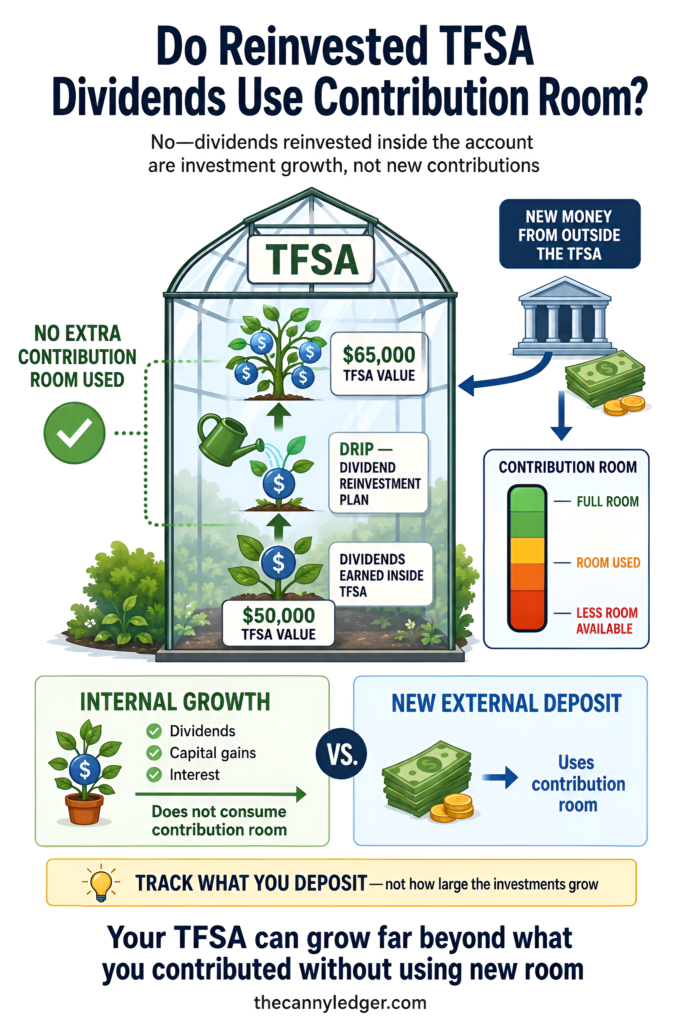
A dividend reinvestment plan, where cash dividends automatically buy more shares of the same stock inside your TFSA, doesn’t consume any new contribution room, and this trips people up more often than it should. Growth inside a TFSA from reinvested dividends, capital gains, or interest is treated as internal growth of the account, not a fresh contribution, so an account that grows from $50,000 to $65,000 purely through reinvested dividends hasn’t used any additional room in the process. Contribution room only gets consumed by money you actually deposit from outside the account, a distinction worth being clear on before assuming reinvested growth is somehow eating into the room you’re tracking.
What Actually Fits Well In A TFSA For This Purpose
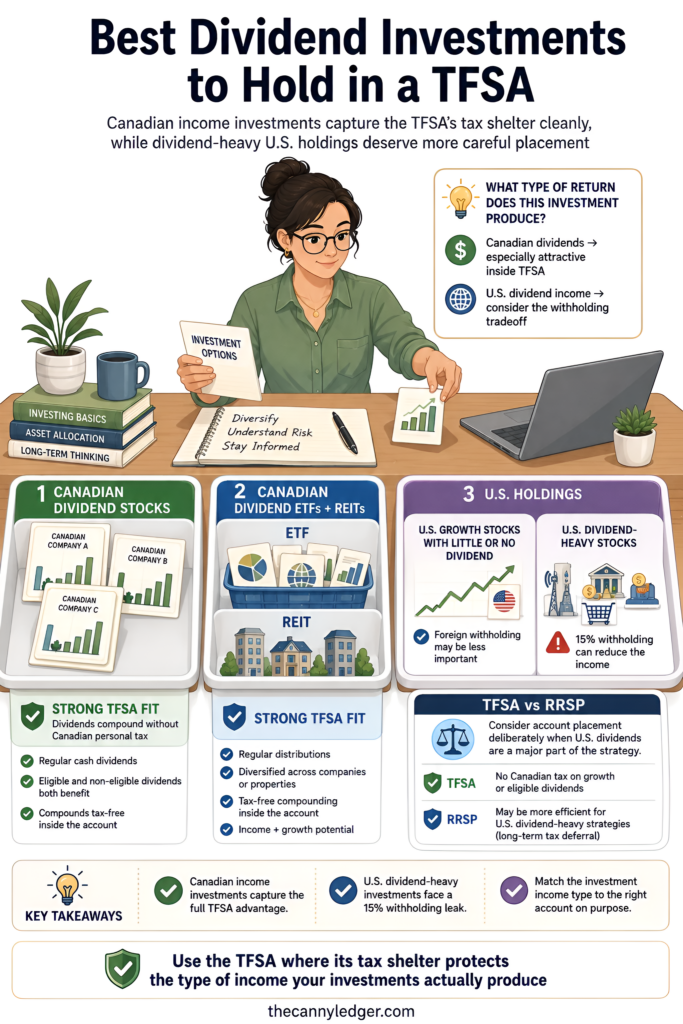
Canadian dividend-paying stocks and ETFs suit a TFSA especially well given everything above, since they capture the full tax-free benefit without the US withholding leak. Real estate investment trusts and other Canadian income-focused holdings that distribute cash regularly fit the same logic, letting the full distribution compound inside the account without any of it being diverted to tax along the way. If growth-focused US holdings are also part of your strategy, weighing where each type of asset sits, Canadian dividend payers inside the TFSA, US growth stocks with little or no dividend also inside the TFSA, and US dividend-heavy holdings potentially better suited to a different account type, is worth thinking through deliberately rather than defaulting to whatever’s easiest to buy. Our comparison of TFSA against RRSP covers how this same dividend and withholding logic plays out differently once retirement accounts enter the picture, since the RRSP’s treaty exemption on US dividends flips this specific tradeoff entirely.
Common Questions About Dividend Taxation And The TFSA
Does the type of Canadian dividend, eligible or non-eligible, matter at all once it’s inside a TFSA? No, since neither type generates any tax inside the account, the distinction that matters so much outside a TFSA becomes completely irrelevant once the dividend is earned within one.
Do I still need to report TFSA dividend income anywhere on my tax return? No, since the TFSA issuer doesn’t generate a T5 slip for dividends earned inside the account, and there’s nothing to report because no tax liability exists in the first place.
If I hold a Canadian dividend ETF that includes some US stocks, does the US withholding apply to the whole fund? Only to the portion of the fund’s income actually sourced from US dividend payers, so a Canadian-focused fund with minimal US exposure faces a proportionally smaller version of that withholding than a fund weighted heavily toward US dividend payers would.