

Fareed Ahamed opened a Tax-Free Savings Account and ended up with a real tax bill anyway, one large enough that the dispute went all the way to the Federal Court of Appeal. Ahamed, a Vancouver-based investment advisor, traded penny stocks frequently enough inside his TFSA that the Tax Court of Canada ruled his gains counted as business income rather than tax-free investment growth, a decision the Federal Court of Appeal upheld in 2024. The account’s name promises something the law doesn’t actually guarantee unconditionally, and understanding exactly where that guarantee breaks down is the difference between a TFSA that behaves the way its name suggests and one that quietly turns into a taxable trust.
The Day Trading Trap That Actually Made It To Court
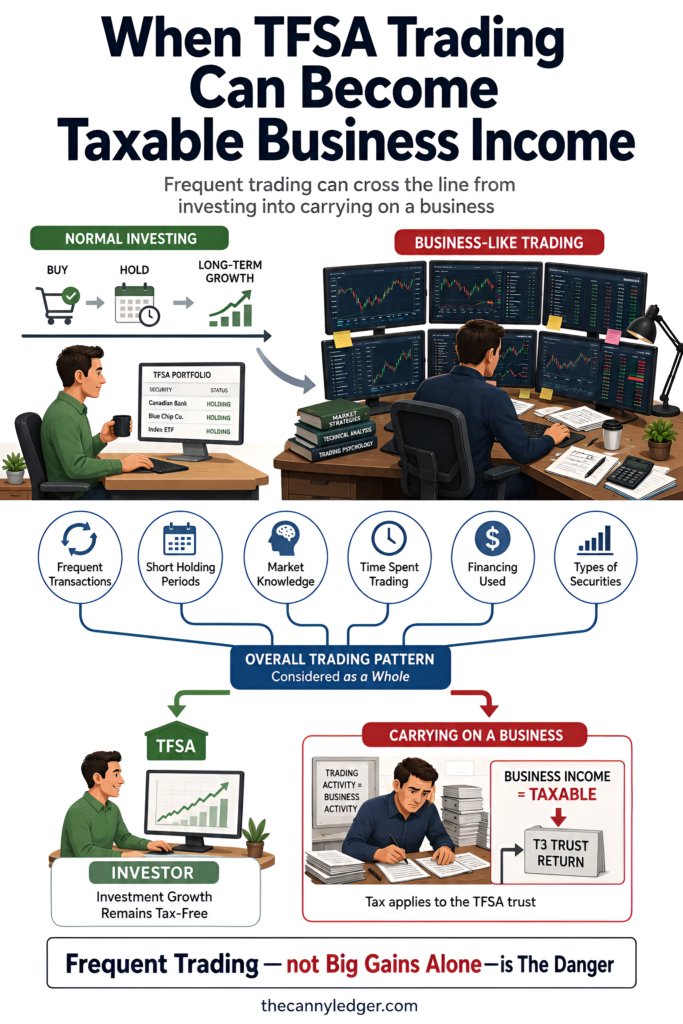
The single biggest way a TFSA loses its tax-free status is frequent trading that starts looking like a business rather than personal investing. The CRA and the courts apply what’s known as the six-factor test, originally developed under interpretation bulletin IT-479R and later applied directly to TFSA trading activity, weighing the frequency of transactions, how briefly securities were held before selling, the trader’s market knowledge, time spent on the activity, whether the trading was financed, and the type of securities involved. Ahamed’s case checked enough of those boxes, frequent penny stock trades on the TSX Venture Exchange, held briefly, by someone with genuine market expertise, that the Tax Court found he was carrying on a business inside an account never meant to hold one.
The financial consequence is severe specifically because of how the tax gets applied once a TFSA crosses this line. Business income inside a TFSA is fully taxable, not eligible for the 50 percent inclusion rate that applies to ordinary capital gains, and it gets taxed at the top federal marginal rate plus the relevant provincial rate on top, a genuinely different tax bill than what the same gains would generate as a normal capital gain outside a TFSA. There’s a technical wrinkle worth knowing too, the tax doesn’t land on you personally in the usual sense, it lands on the TFSA trust itself, which becomes legally required to file its own T3 trust return once the CRA reclassifies the activity this way.
None of this means occasional trading or holding volatile individual stocks puts your TFSA at risk. Long-term holders who buy and hold, even concentrated in a handful of stocks that grow enormously over years, remain firmly inside the tax-free zone the account was actually designed for. The line sits specifically at frequency and pattern, not simply at risk level or account size, a distinction our full guide to TFSA day trading rules covers in more depth.
The Non-Resident Contribution Trap
Moving abroad creates a genuinely different tax trap that catches people who assume their TFSA just keeps working the same way once they leave Canada. Any contribution made to a TFSA while you’re a non-resident of Canada is taxed at 1 percent per month for as long as that contribution stays in the account, continuing until you withdraw the full amount or regain Canadian residency, whichever happens first, and withdrawing only part of the contribution doesn’t reduce the tax owed at all, the entire non-resident contribution has to come out. You also stop accumulating new contribution room for any calendar year spent entirely as a non-resident, which means someone who keeps contributing out of habit after moving abroad can end up facing both the non-resident penalty and a separate overcontribution penalty stacked on top of each other if that contribution also exceeds their existing room.

Overcontributing And The Re-Contribution Timing Trap
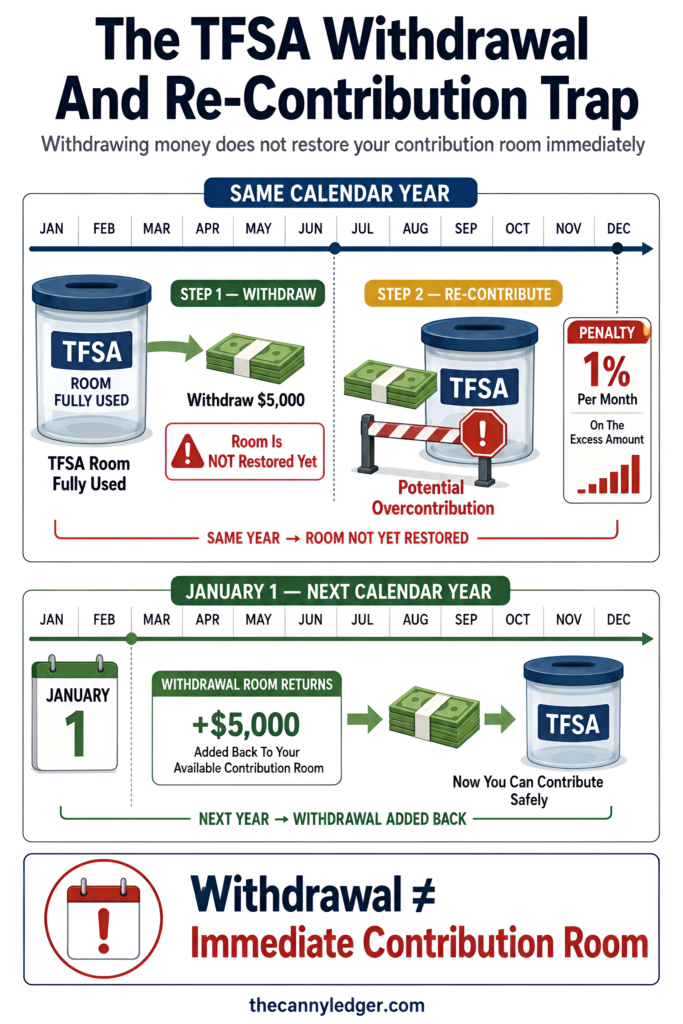
The most common TFSA mistake by far has nothing to do with residency or trading strategy. Contributing more than your available room triggers a 1 percent monthly penalty on the excess amount, and that penalty keeps applying every month until the excess is either withdrawn or absorbed by new room in a future year. The version of this mistake that catches people who genuinely know the rules is timing, not ignorance. Withdrawing money from a TFSA doesn’t restore that room immediately, it only gets added back on January 1 of the following calendar year, so re-contributing the same amount later in the same year, if your room was already fully used, creates a genuine overcontribution even though you’re technically just putting your own money back, exactly the kind of trap covered in our full breakdown of TFSA withdrawal rules.
The US Dividend Trap Most Investors Never Notice
Holding US stocks inside a TFSA creates a quieter, ongoing cost rather than a single dramatic penalty. The United States withholds 15 percent tax on dividends paid to a TFSA, and unlike an RRSP, which is specifically exempted from that withholding under the Canada-US tax treaty, a TFSA gets no such exemption and that withheld tax simply can’t be recovered. It’s a genuinely different structural outcome for what looks like the same kind of investment choice, and it’s exactly why growth-focused US stocks that pay little or no dividend, along with Canadian dividend payers, tend to fit a TFSA better than US dividend-heavy holdings do, a point covered in more detail in our guide to holding US stocks in a TFSA. Our comparison of TFSA against RRSP covers this specific difference alongside the other structural gaps between the two accounts.

What Stays Completely Safe
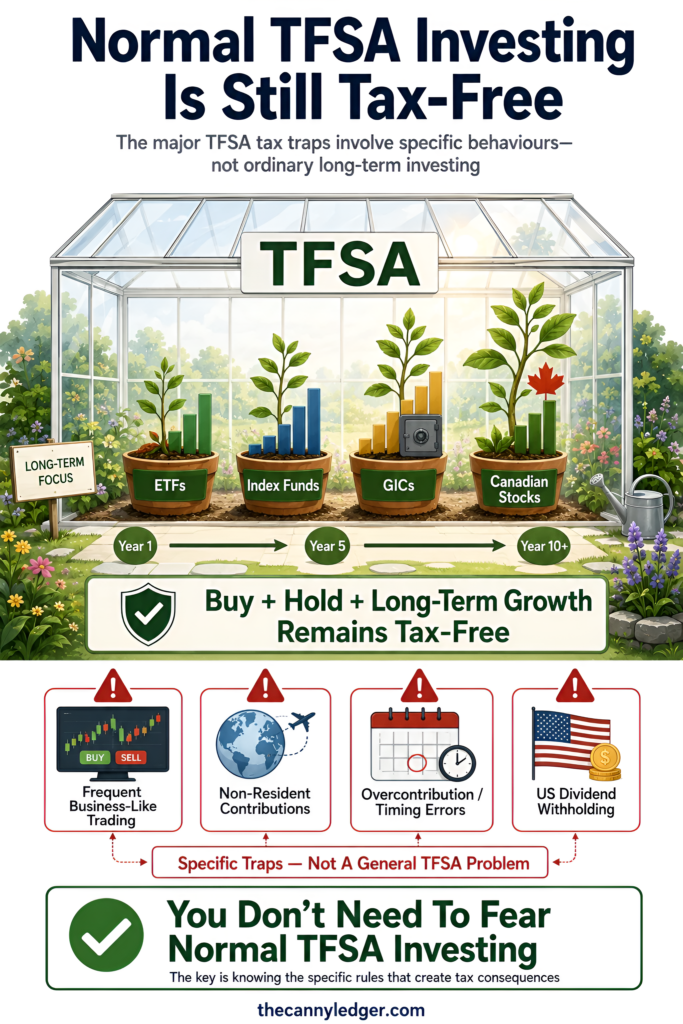
None of this makes the TFSA a risky account to hold in any ordinary sense, and it’s worth ending on that note directly rather than leaving the impression that tax traps lurk around every investment decision. Buying and holding ETFs, index funds, GICs, and individual Canadian stocks for the long term, the way the overwhelming majority of TFSA holders actually use the account, carries none of the risk covered here. The traps above are specific, identifiable patterns, frequent trading, non-resident contributions, timing mistakes on withdrawals, and heavy US dividend exposure, not a general hazard attached to the account itself.
Keeping Your Own TFSA Clear Of These Traps
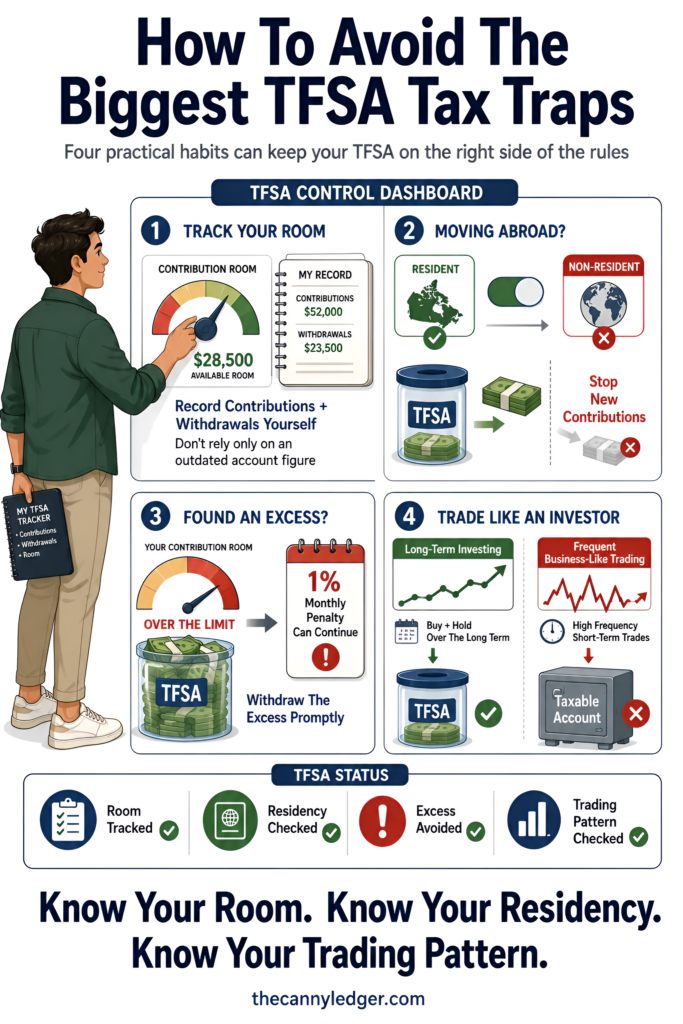
Track your actual contribution room yourself rather than relying only on the CRA’s My Account figure, since that number reflects institution reporting as of the prior December and won’t show contributions or withdrawals made so far this year, or use our contribution room checking guide for the full process. If you’re planning a move abroad, stop contributing the moment your residency status changes rather than assuming a grace period exists, and if you’ve already made a contribution that turned out to be excess, withdraw it as soon as you catch the mistake, since the penalty clock keeps running for every month it stays in the account. And if you’re an active trader who genuinely enjoys frequent buying and selling, consider whether that activity belongs in a taxable account instead, since a TFSA reclassified as a business isn’t just inconvenient, it’s a materially worse tax outcome than simply paying capital gains tax would have been in the first place.
What The Ahamed Case Actually Settles
Why does the tax bill land on the TFSA trust itself rather than on Ahamed personally? Section 146.2(6) of the Income Tax Act specifically makes the TFSA trust the taxable person once business income gets found inside it, which is why the account has to file its own T3 return rather than the penalty simply showing up on the holder’s regular tax filing.
Why doesn’t an RRSP face the same US dividend withholding problem a TFSA does? The Canada-US tax treaty specifically names retirement accounts like the RRSP as exempt from that 15 percent withholding, a carve-out negotiated decades ago that the treaty’s drafters never extended to the TFSA, since the account didn’t exist yet when that exemption was written.
Why doesn’t withdrawing only part of a non-resident contribution reduce the penalty at all? The CRA treats the entire non-resident contribution as a single taxable event rather than a divisible balance, so the 1 percent monthly tax keeps applying to the full original amount until every dollar of it is gone, not just whatever fraction happens to remain.