

One of Canada’s largest life insurers runs its national headquarters out of a 21-storey tower in downtown Winnipeg, and most Winnipeggers walk past it without knowing Wawanesa Life is headquartered right here rather than in Toronto or Montreal like most of the industry. That local detail aside, the actual decision most people in this city face isn’t which company to buy from, it’s a much more fundamental question: term or whole life, and the two products are different enough that picking wrong can mean paying five to fifteen times more than necessary, or having coverage disappear right when a family needs it most.
- What Term Life Insurance Actually Is
- What Whole Life Insurance Actually Is
- The Real Cost Gap, With Real Numbers
- Term vs Whole Life at a Glance
- When Term Makes More Sense
- When Whole Life Makes More Sense
- The Tax Angle Nobody Explains Well
- Where to Actually Buy This in Winnipeg
- Good Stuff and Bad Stuff, Both Products
- Common Questions
- Getting an Actual Quote Is the Only Way to Know for Sure
Term life insurance covers you for a fixed period, typically 10 to 30 years, at a much lower premium, while whole life insurance covers you permanently and builds cash value, at a premium that runs roughly 5 to 15 times higher for the same death benefit. For most Winnipeg families whose main goal is replacing income during working years or paying off a mortgage, term is the more efficient choice. Whole life earns its higher cost in specific estate planning and permanent-need situations.
What Term Life Insurance Actually Is
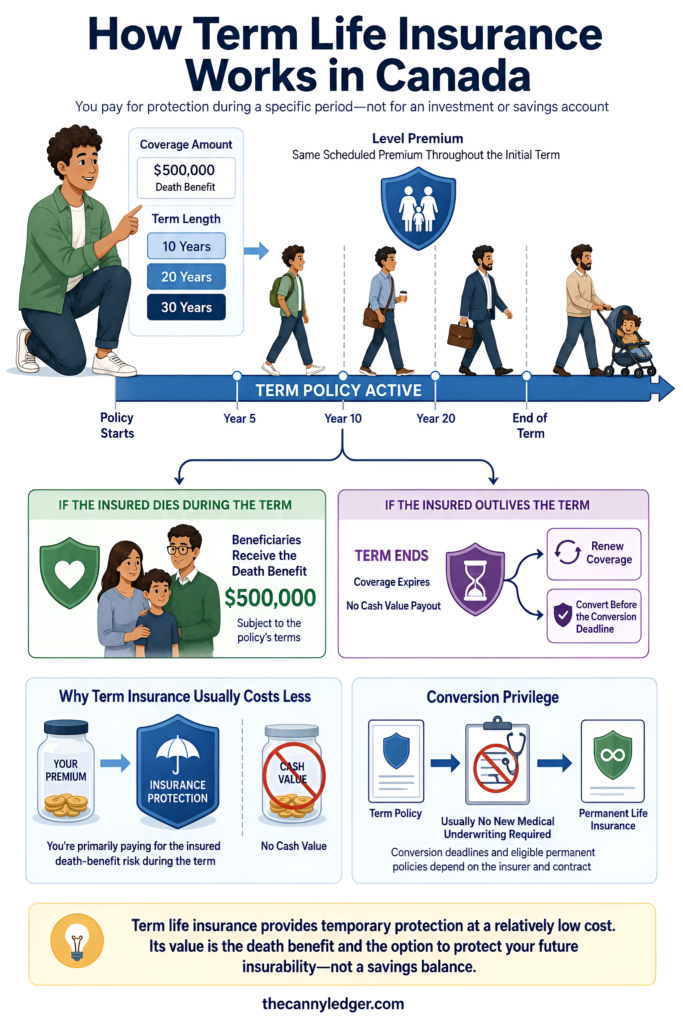
Term life insurance is about as close to pure insurance as this industry gets. You pick a coverage amount and a term length, commonly 10, 20, or 30 years, and you pay a level premium for that entire term. If you die during the term, your beneficiaries receive the full death benefit. If the term ends and you’re still alive, the policy simply expires, with nothing paid out and nothing owed, unless you renew it or convert it to a permanent policy before the term runs out. There’s no cash value building anywhere inside a term policy, which is exactly why it costs so much less than permanent coverage. You’re paying purely for the risk the insurer is taking on, not funding a savings component alongside it.
Most term policies in Canada come with a conversion privilege, letting you switch some or all of the coverage to a permanent policy later without a new medical exam, typically up to a certain age limit set by the insurer, often somewhere in the low seventies. This matters more than it sounds like it should, since health can change unpredictably, and having the option to convert without requalifying medically is a real hedge against becoming uninsurable later while your term coverage is still active.
What Whole Life Insurance Actually Is
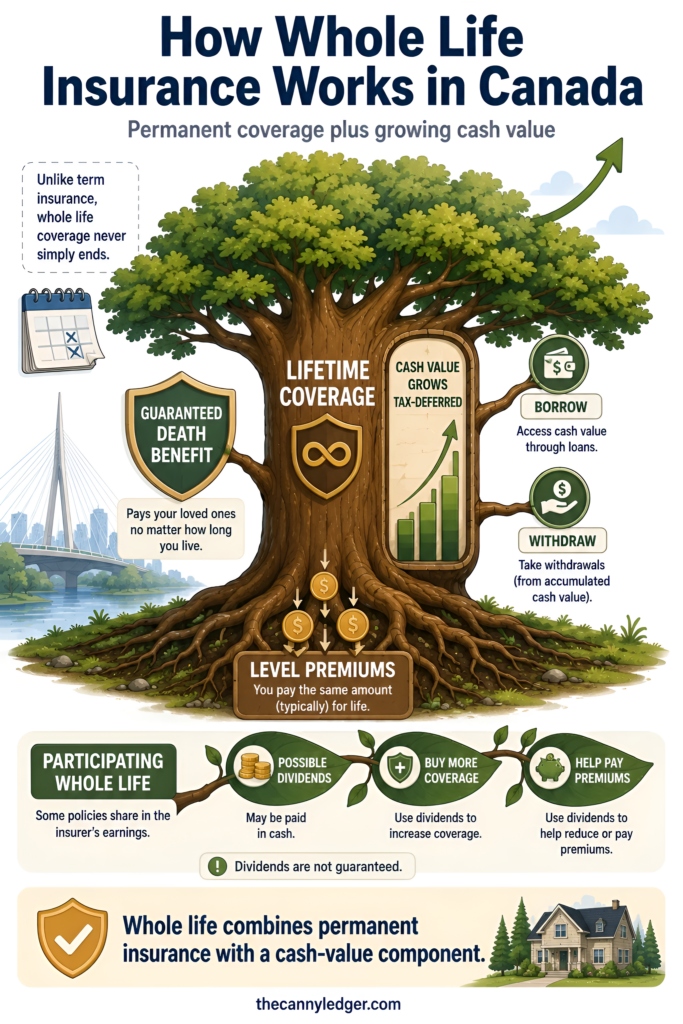
Whole life insurance works on an entirely different structure. Coverage lasts your entire life as long as premiums keep getting paid, the death benefit is guaranteed, and the premium itself is typically level for life rather than increasing with age the way renewing term coverage would. A portion of every premium payment goes into a cash value account that grows on a tax-deferred basis inside the policy, and depending on the specific product, you may be able to borrow against that cash value, withdraw from it, or use it to help cover premiums later in life.
Participating whole life policies, offered by insurers including Manulife, Sun Life, and Canada Life, add another layer on top of the base guarantee: annual dividends based on the insurer’s financial performance, which policyholders can typically use to buy additional paid-up insurance, take as cash, or apply toward future premiums. These dividends aren’t guaranteed the way the base death benefit is, but participating whole life products from Canada’s major insurers have paid dividends consistently for over a century, which is part of why permanent insurance appeals to people thinking in multi-generational terms rather than just their own working years.
The Real Cost Gap, With Real Numbers
Abstract talk about term being “cheaper” undersells just how large the actual gap is. For a healthy 35-year-old non-smoker buying $500,000 of coverage, a 20-year term policy typically runs somewhere in the range of $28 to $45 a month across Canada’s major insurers. The equivalent whole life policy for that same person and same coverage amount runs closer to $260 to $600 a month, depending on the insurer and whether the policy is participating or non-participating. That’s not a modest premium bump, it’s routinely 8 to 15 times the monthly cost for identical death benefit protection.
What that gap means in practice matters more than the raw numbers. A Winnipeg household choosing term over whole life for that same $500,000 in coverage could be saving $300 or more every month, money that, invested consistently over the same 20-year term, would in most realistic scenarios grow to significantly more than the whole life policy’s cash value ever would, precisely because term frees up so much more capital to put to work elsewhere. This is the core argument behind the “buy term and invest the difference” strategy that shows up constantly in Canadian personal finance circles, and it holds up reasonably well for people with the discipline to actually invest that difference rather than simply spending it.

Term vs Whole Life at a Glance
| Term Life | Whole Life | |
|---|---|---|
| Coverage length | Fixed term, typically 10 to 30 years | Lifetime, as long as premiums are paid |
| Monthly cost (age 35, $500K) | Roughly $28 to $45 | Roughly $260 to $600 |
| Cash value | None | Grows tax-deferred inside the policy |
| Premium stability | Level for the term, rises sharply if renewed after expiry | Level for life on most products |
| Dividends | Not applicable | Possible with participating policies |
| Best fit | Income replacement, mortgage protection, temporary needs | Estate planning, permanent dependents, lifelong needs |
When Term Makes More Sense
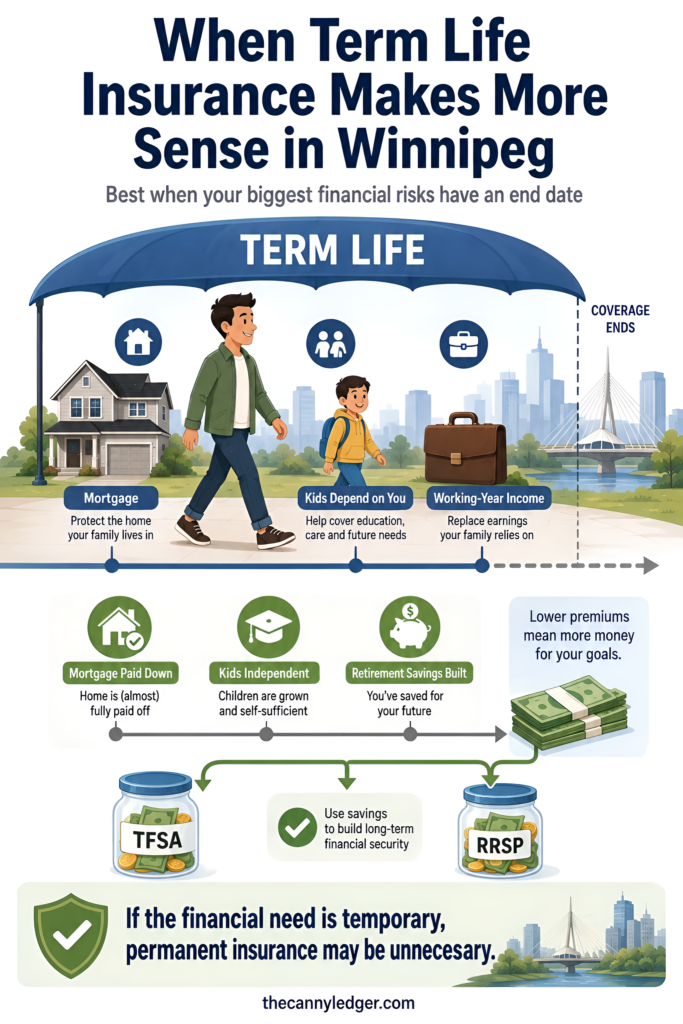
Term life fits the large majority of Winnipeg households whose actual insurance need has a natural end date, even if that end date is decades away rather than a fixed number. A parent covering the years until kids are financially independent, a homeowner wanting the mortgage cleared if something happens to them, or someone whose main financial risk is losing their income during their working years, all of these are genuinely temporary needs, and paying a fraction of whole life’s cost to cover exactly that window, then letting the policy lapse once the need has passed, is the more efficient use of money for most families. The savings from choosing term over whole life aren’t trivial either, they’re often substantial enough to fund a TFSA or RRSP contribution every single month for the length of the term, which compounds into real money by the time that term actually ends.
When Whole Life Makes More Sense
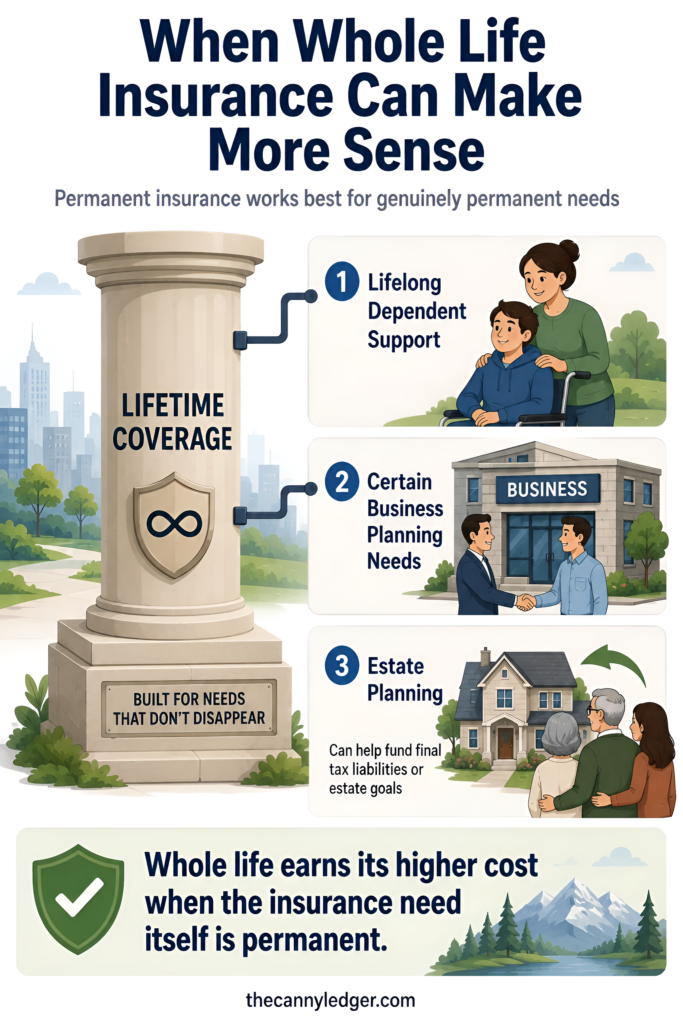
Whole life earns its cost in narrower situations, but they’re real ones. Someone with a dependent who will need lifelong financial support, an adult child with a significant disability, for instance, doesn’t have a “term” to their caregiving need, and permanent coverage matches that permanence in a way a policy that expires simply can’t. Business owners sometimes use whole life for buy-sell agreements or key-person coverage where the need genuinely doesn’t have a natural expiry date either. And for high-net-worth estate planning specifically, the guaranteed, tax-advantaged death benefit can be a deliberate tool for covering final tax liabilities or equalizing an estate between heirs, a use case where the cash value growth and dividend history of a well-established participating policy actually matters, rather than being an expensive feature nobody needed.
The Tax Angle Nobody Explains Well
Here’s the detail that gets glossed over constantly: life insurance death benefits paid to a named beneficiary are tax-free in Canada under the Income Tax Act, regardless of whether the underlying policy was term or whole life. Your beneficiary doesn’t report the payout as income and doesn’t pay tax on it, full stop, for either product type. Where people get confused is with whole life’s cash value specifically. Growth inside that cash value account is tax-deferred while it stays in the policy, but if you withdraw or surrender funds beyond what’s called the policy’s adjusted cost basis, that excess portion is taxed as income, and the insurer issues a T5 slip for it. Term life has no cash value at all, so this entire complication simply doesn’t apply to it, one more reason term is the structurally simpler product of the two.
One more detail worth knowing: naming an actual person or organization as your beneficiary, rather than defaulting to your estate, means the payout bypasses probate entirely and reaches them faster and without probate fees eating into it, a difference that applies identically whether you’ve chosen term or whole life.

Where to Actually Buy This in Winnipeg
Winnipeg has genuine local roots in this industry, not just branch offices of companies headquartered elsewhere. Wawanesa Life, a subsidiary of the Wawanesa Mutual Insurance Company founded in the Village of Wawanesa, Manitoba in 1896, runs its head office operations from downtown Winnipeg and offers both term and permanent life products through independent brokers across the country. Beyond Wawanesa, the national insurers most commonly sold through Winnipeg brokers, Manulife, Sun Life, Canada Life, Empire Life, and iA Financial Group, all offer both term and whole life products, and rates and underwriting can vary meaningfully enough between them that comparing quotes across at least two or three insurers before committing is worth the extra half hour it takes.
Working with an independent broker, rather than going directly to a single insurer’s captive sales team, generally gets you access to multiple companies’ rates in one conversation, since Manitoba-licensed brokers aren’t tied to selling just one insurer’s products the way a captive agent is. For anyone who’s also comparing this decision against other insurance priorities on a tight household budget, our guide to health and dental insurance in Winnipeg and our coverage of disability and critical illness insurance in Winnipeg cover two other categories worth weighing alongside life insurance rather than in isolation, since a household’s total insurance budget usually has to stretch across more than one type of coverage at once.

Good Stuff and Bad Stuff, Both Products
Term life, good stuff: Dramatically lower monthly cost for the same coverage amount, straightforward to understand with no cash value complexity to track, conversion privileges protect against becoming uninsurable later.
Term life, bad stuff: Coverage disappears at the end of the term with nothing paid out if you outlive it, renewing after the original term expires can mean a sharp premium jump since the renewal rate reflects your older age.
Whole life, good stuff: Coverage never expires as long as premiums are paid, cash value grows tax-deferred and can be accessed during your lifetime, participating policies from major insurers have a long, consistent dividend track record.
Whole life, bad stuff: Premiums run 5 to 15 times higher than equivalent term coverage, cash value growth in the early years is typically modest since a larger share of early premiums covers the cost of insurance and fees, withdrawing beyond the adjusted cost basis triggers taxable income.
Common Questions
Can I have both term and whole life insurance at the same time? Yes, and many financial advisors specifically recommend “layering,” a smaller permanent policy for lifelong needs like final expenses, combined with a larger term policy covering the years of highest financial responsibility like a mortgage or dependent children.
Does Manitoba have different life insurance rules than other provinces? Life insurance products themselves are largely standardized nationally, since federally regulated insurers sell the same core products across provinces, though provincial rules can affect things like probate treatment and insurable interest requirements in specific situations.
What happens if I stop paying premiums on a whole life policy after several years? Depending on how much cash value has accumulated, you may be able to use the policy’s cash value to keep it in force on a reduced basis, convert it to a smaller fully paid-up policy, or surrender it for its cash value, rather than simply losing everything the way a lapsed term policy would.
Getting an Actual Quote Is the Only Way to Know for Sure
Every number in this article is a benchmark, not your personal rate, since age, health, smoking status, and the specific insurer all move the real figure meaningfully in either direction. The genuinely useful next step is getting quotes for both term and a comparable whole life policy from at least two insurers or an independent Manitoba-licensed broker, so the decision is based on your actual numbers rather than a general comparison like this one. If you’re building out a household’s full insurance picture rather than just life coverage, our Winnipeg car insurance rates and calculator covers another major recurring cost worth budgeting alongside whatever you land on here.