
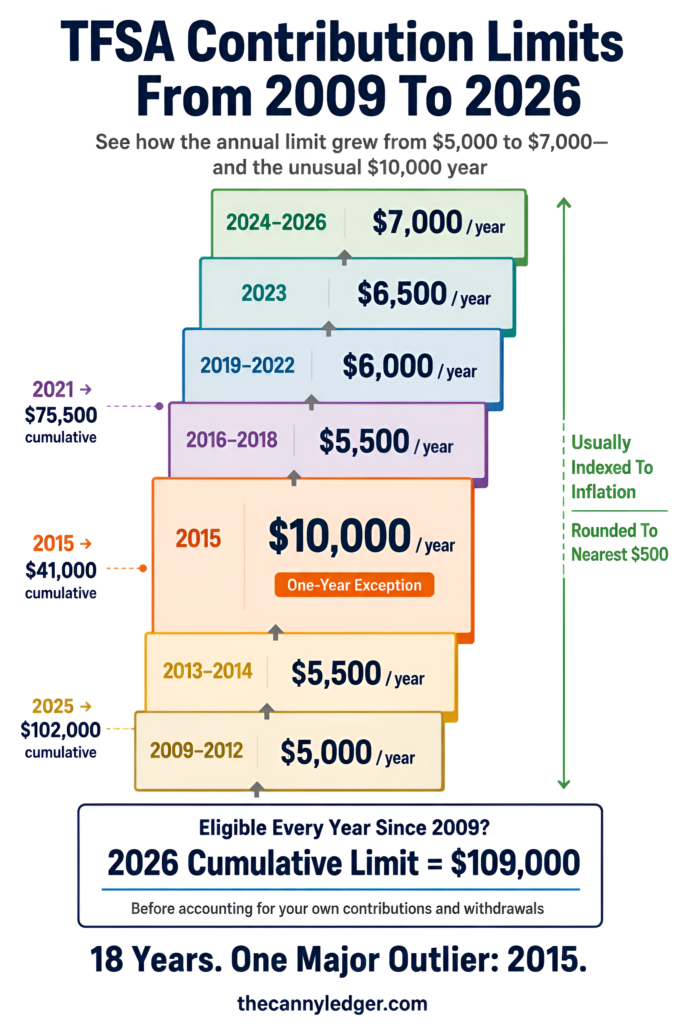
One year in this table doesn’t belong, and it’s the one people usually get wrong first. Every other year in TFSA history moved by $500 or stayed flat. 2015 jumped from $5,500 straight to $10,000, an increase of nearly double, before dropping right back to $5,500 the following January. That wasn’t a data entry error or an inflation quirk, it was a federal election-year budget decision that got reversed by the next government within a single calendar year, and it’s still the single strangest line in an otherwise fairly predictable eighteen-year history.
The TFSA annual contribution limit has moved eight times since the account launched in 2009, from an original $5,000 up to $7,000 for 2026, with the sharpest single change being a jump to $10,000 in 2015 that was rolled back to $5,500 the very next year. Someone eligible since 2009 who has never contributed has $109,000 in cumulative room as of 2026, built by adding every one of those annual figures together. The year-by-year detail behind that total, and the political story behind its one outlier year, explains a lot about why the limit looks the way it does today.
Every Year, Side by Side
The annual limit started at $5,000 in 2009 and held there through 2012, before moving to $5,500 for 2013 and 2014. It then jumped to $10,000 for 2015 alone, dropped to $5,500 for 2016 through 2018, rose to $6,000 for 2019 through 2022, increased to $6,500 for 2023, and has sat at $7,000 for 2024, 2025, and 2026. Adding each of those figures in sequence for someone eligible in every year produces a running cumulative total of $41,000 through 2015, $75,500 through 2021, $102,000 through 2025, and the full $109,000 that applies now in 2026.
Every increase past the account’s first few years follows the same formula, indexed to inflation and rounded to the nearest $500, which is why the limit tends to hold flat for a stretch and then jump by a clean $500 all at once rather than drifting up gradually. The full mechanics of how that formula actually calculates your own personal room, rather than just the headline annual figure, and how the CRA actually tracks that number over time are both covered separately, since this piece focuses on the historical progression rather than the calculation itself.
The Year That Doesn’t Fit the Pattern
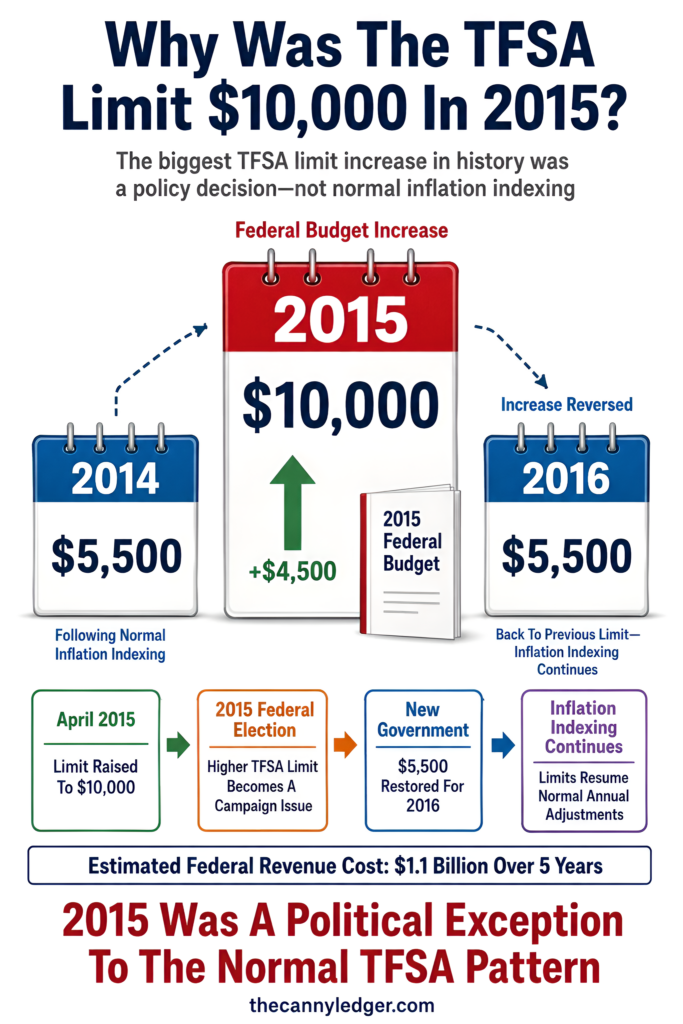
This is worth understanding properly rather than treating as a footnote, since it’s a real piece of Canadian tax policy history rather than a rounding anomaly. According to CBC News reporting from the 2015 federal budget, then-Finance Minister Joe Oliver raised the annual TFSA limit from $5,500 to $10,000 effective immediately, a move the government’s own estimates projected would cost $1.1 billion in foregone federal tax revenue over the following five years. The change landed months before a federal election, and became a real campaign issue that year.
The Liberal Party, then in opposition under Justin Trudeau, campaigned specifically on reversing the increase, arguing the higher limit disproportionately benefited wealthier Canadians who could actually afford to contribute that much in a single year. After winning that election, the new government confirmed the rollback in reporting from the Globe and Mail, dropping the limit back to $5,500 for 2016 and restoring the inflation-indexed formula that determines the annual figure to this day.
Nobody Actually Lost the Room They’d Already Earned
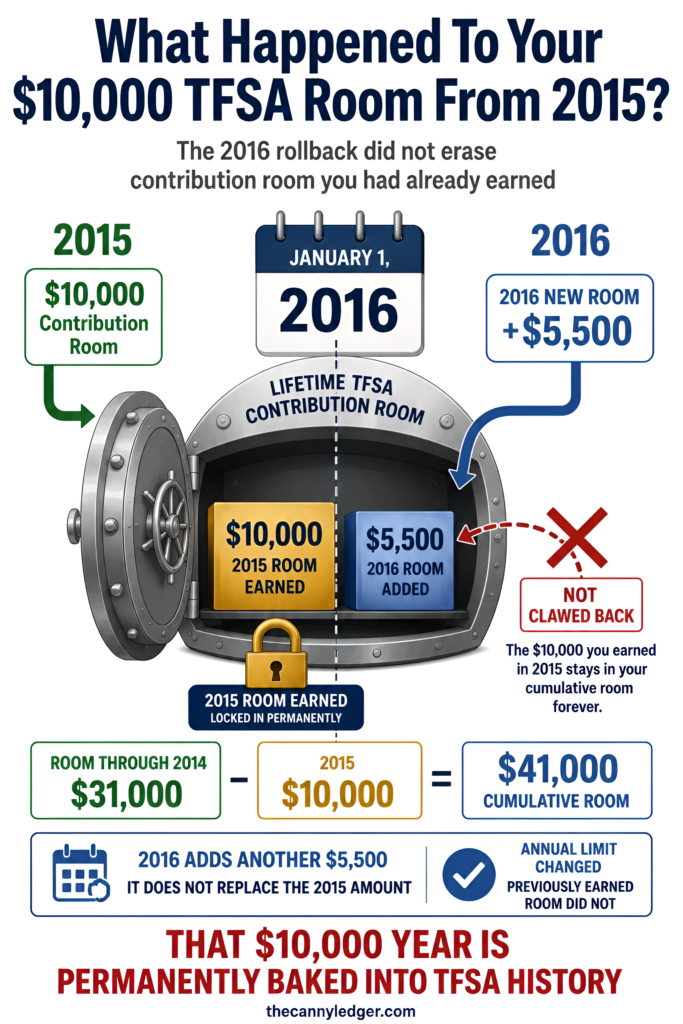
This is the detail that matters most for anyone who was eligible during that specific window, and it’s worth stating plainly since the rollback sounds worse than it actually was for existing room. According to CBC News’ own coverage of the 2016 rollback, the $10,000 in room generated specifically during 2015 stayed permanently part of anyone’s cumulative total, it was never clawed back or reduced after the fact. Only the going-forward annual figure changed starting January 1, 2016, which means the political reversal affected future contribution limits, not room that had already legitimately accumulated the year before.
That distinction is exactly why the cumulative totals in the table above still show a real, permanent jump at 2015 even though the following year’s limit dropped right back down. The $10,000 figure is baked into everyone’s lifetime total exactly the same way every other year’s contribution is, regardless of how short-lived that specific annual rate turned out to be.
The Debate Never Fully Went Away
This isn’t purely historical trivia either, since the TFSA limit has resurfaced as a live political question more recently. According to CBC News reporting on a 2025 policy proposal, Conservative leader Pierre Poilievre proposed adding an additional $5,000 in TFSA contribution room specifically tied to investments in Canadian companies, on top of the existing indexed limit. Whether or not that specific proposal ever becomes policy, it’s a reminder that the annual dollar figure covered in this article isn’t a fixed constant, it’s a number that’s changed through real political decisions before and remains something future governments could adjust again.

Adding Up Your Own Years
Add up your own eligible years directly using the table above rather than assuming the full $109,000 applies to you automatically, particularly if you turned 18 sometime after 2009 or became a Canadian resident partway through the account’s history. If your own eligibility window includes 2015 specifically, remember that year contributed $10,000 to your lifetime total permanently, not the $5,500 every surrounding year contributed, a detail easy to miss if you’re adding the figures from memory rather than checking the actual historical table, and one worth getting right before it turns into an overcontribution mistake in either direction. And keep in mind that the current $7,000 figure, unchanged since 2024, isn’t guaranteed to stay flat or even keep rising the same way every year going forward, since the account’s own history shows the limit has moved through political decisions before, not just inflation indexing alone.

A Few Questions This History Raises
Why did the limit stay at $7,000 for three consecutive years, 2024 through 2026, after moving almost every year before that? The indexed formula only produces a new $500 increment once cumulative inflation pushes the calculation past that threshold, so a period of more moderate inflation naturally produces a longer stretch at the same dollar figure before the next jump triggers.
Does the TFSA limit ever apply differently by province the way some other programs do? No, the annual dollar limit itself is federal and identical across every province and territory, though provincial age of majority rules can affect when someone is actually able to open the account, separately from how much room they’re accumulating.
Is there any indication the government plans to change the indexing formula itself again? Nothing has been confirmed as of 2026, and any change to the underlying formula, rather than a single year’s dollar figure, would represent a bigger structural shift than anything in the account’s history since the 2016 rollback restored indexing.