

Most people who overcontribute assume the penalty is simply the cost of the mistake, full stop, pay it and move on. That’s not actually how the CRA treats this. The agency’s own published policy allows it to waive or cancel the tax entirely when the overcontribution happened through a reasonable error and the person moved quickly to fix it, a real escape hatch that most overcontribution content skips past in favour of just explaining the penalty rate itself.
A TFSA excess amount is taxed at 1% per month, calculated on the highest excess balance sitting in the account during that month, for every month the overcontribution continues. Fixing it requires withdrawing the excess as soon as it’s discovered, then filing Form RC243 with the CRA by June 30 of the following year to report and pay whatever tax accrued. What most people don’t realize is that the CRA can waive that tax afterward under specific, published criteria, which makes the filing and waiver request just as important as the withdrawal itself.
How the Penalty Actually Builds
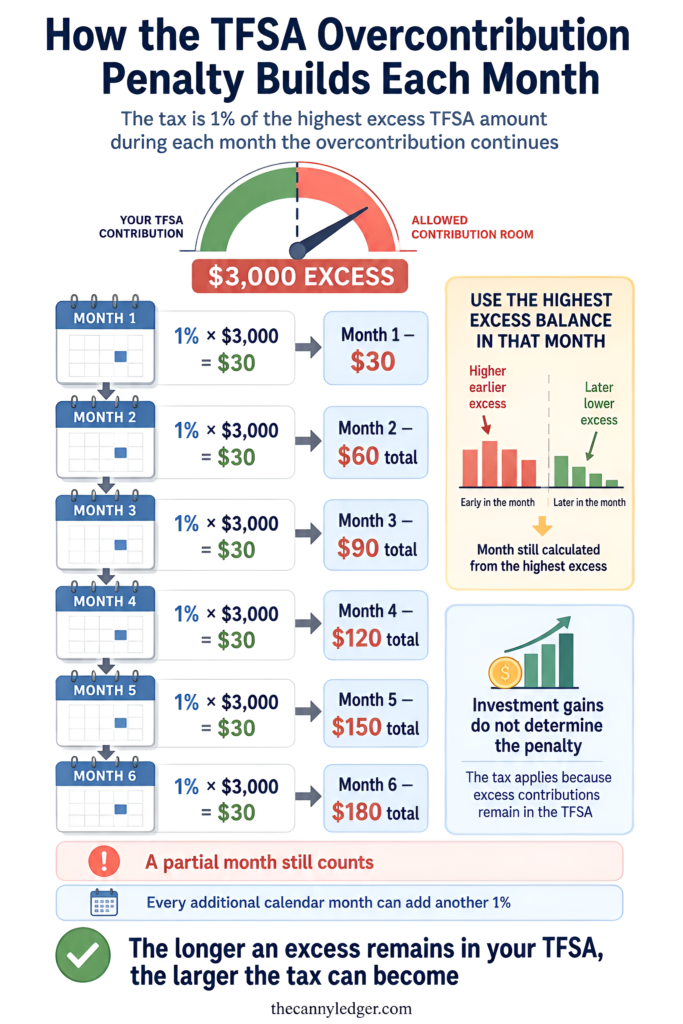
The 1% monthly rate applies to whatever the highest excess balance was during that specific month, not an average, and not the original overcontribution amount if you’ve partially corrected it partway through. A $3,000 excess sitting untouched for six months generates $180 in tax across that period, and the clock keeps running for every full or partial month the excess remains, regardless of whether the money earned any investment return at all. The specific mechanic that most often triggers this, withdrawing from a TFSA and re-contributing in the same calendar year before the room actually comes back, is covered in full detail elsewhere on this site, since it’s the single most common way people end up in this situation without realizing it.
Fix It First, File Second
The moment you discover an overcontribution, the first move is withdrawing the excess amount directly, since every additional month it sits in the account adds another 1% to the tax owed. This isn’t a situation where waiting to sort out the paperwork first actually helps, the tax calculation runs on calendar months regardless of when you eventually file anything with the CRA, so speed actually reduces the total cost in a way that careful planning afterward can’t undo.
Withdrawing the excess doesn’t erase the tax already accrued for the months it was there, it simply stops the clock going forward. That distinction matters for anyone assuming a quick correction wipes the slate clean entirely, it stops new charges from accumulating, but it doesn’t retroactively cancel what already built up before the withdrawal happened.

The RC243 Return, What Actually Has to Be Filed
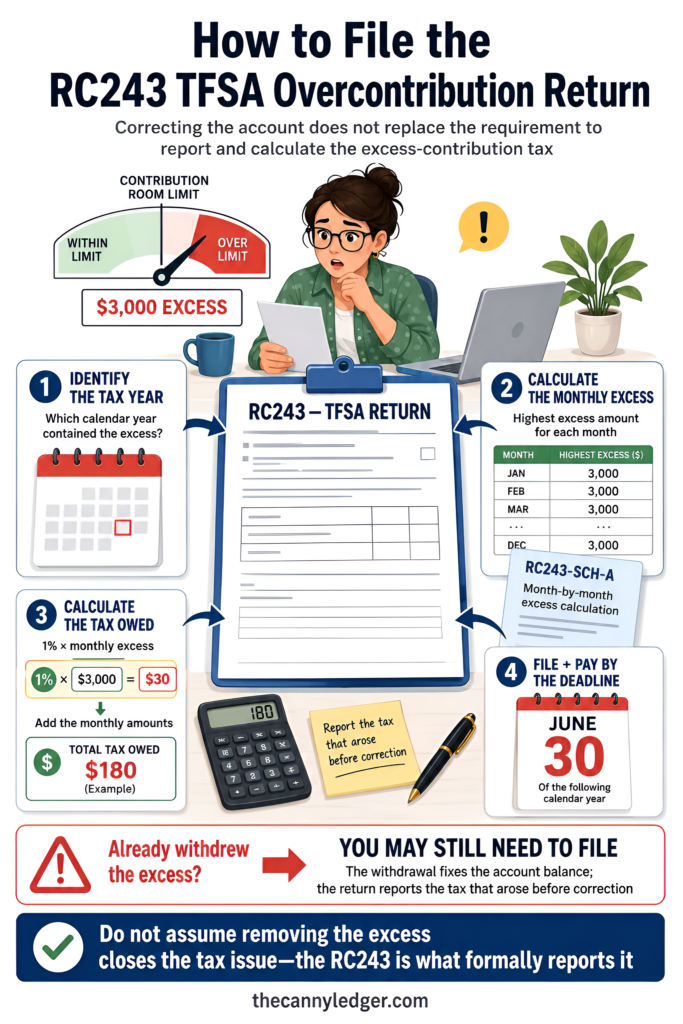
According to the Canada Revenue Agency’s own guidance on paying tax on a TFSA, anyone with taxable amounts in a TFSA must complete and file Form RC243, the TFSA Return, by June 30 of the calendar year following the year the tax applies. Depending on the specific situation, the RC243-SCH-A schedule may also need to be completed, which breaks the excess amount down month by month to calculate the total tax owed rather than treating the whole period as a single flat calculation.
This isn’t an optional step even if you’ve already withdrawn the excess and assume the problem is resolved. The return is what actually calculates and formalizes what’s owed, and skipping it doesn’t make the underlying tax liability disappear, it just means the CRA eventually catches the discrepancy on its own, typically with less goodwill toward the situation than if you’d filed and explained it proactively.
Requesting a Waiver, and What the CRA Actually Looks At
This is the part of the process most people don’t know exists, and it’s worth taking seriously rather than assuming the penalty is fixed and non-negotiable. According to the CRA’s own published policy, the agency may waive or cancel all or part of the tax on a TFSA if it determines doing so is fair, based on three specific factors, whether the tax arose because of a reasonable error, the extent to which the same transaction also triggered another tax under the Income Tax Act, and how much of the excess was actually withdrawn to correct the mistake.
That third factor is exactly why acting quickly matters beyond just minimizing the monthly charge itself, a fast, complete withdrawal demonstrably strengthens a waiver request, while leaving an excess sitting in the account for months before addressing it undermines the argument that the error was actually accidental. This isn’t a new or untested policy either, when the TFSA program first launched in 2009, the government explicitly extended filing deadlines and waived first-year taxes specifically for people who had a reasonable misunderstanding of the brand-new contribution rules, a real precedent for how the CRA has actually applied this discretion in practice rather than just a theoretical option buried in policy language.

What Actually Triggers This Most Often
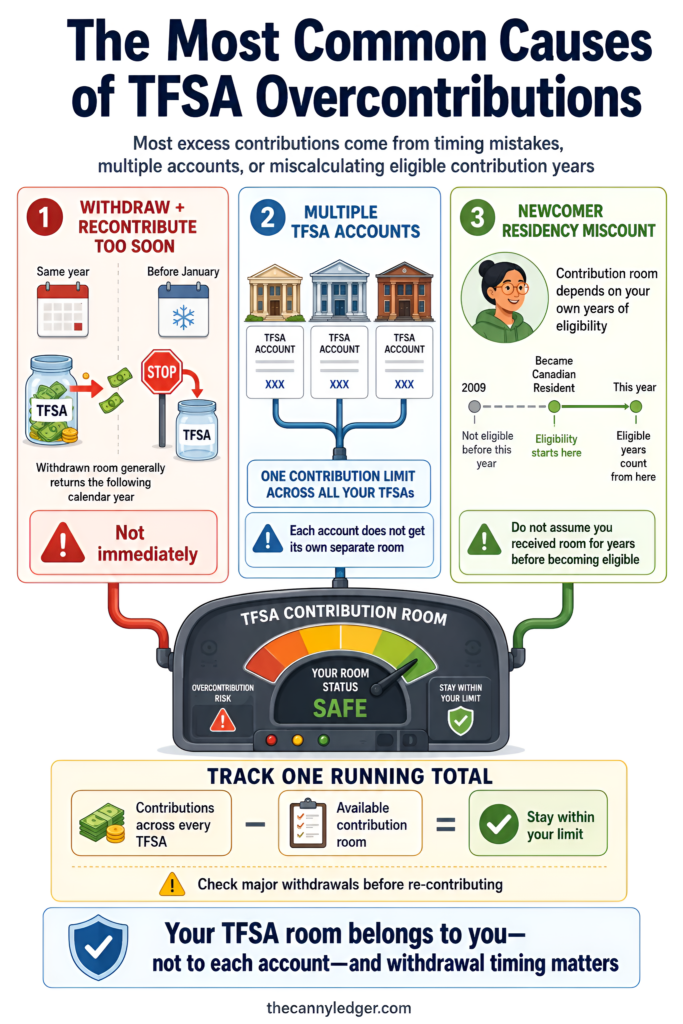
A handful of specific situations account for most overcontribution cases, and recognizing them ahead of time is the cheapest way to avoid the whole process entirely. Withdrawing and re-contributing within the same calendar year, before the room actually returns the following January, is the single most common cause. Holding TFSAs at more than one institution and losing track of a combined running total across all of them is another frequent trigger, since your contribution room is a single lifetime figure shared across every account you hold, not a separate allowance per institution. Newcomers to Canada miscalculating their eligible years based on the account’s full history rather than their own actual residency timeline is a third recurring pattern worth checking against directly if you became a Canadian resident sometime after 2009.
Acting Before It Compounds Further
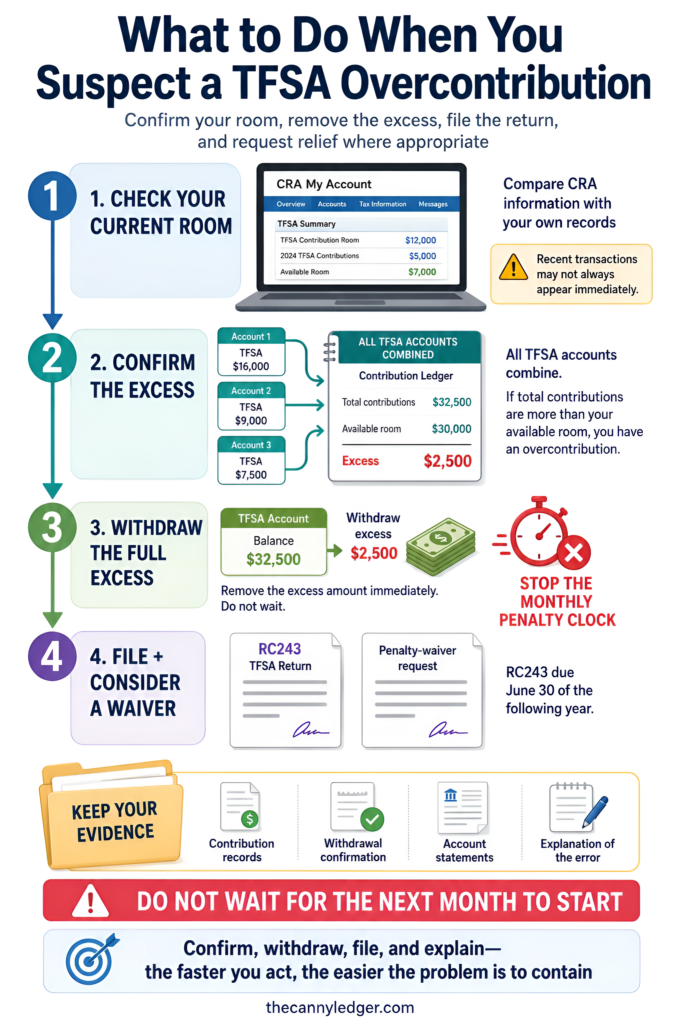
Check your real, current contribution room directly in CRA My Account the moment you suspect an overcontribution, rather than relying on your own running total from memory, since even a well-intentioned personal tally can miss a transfer or a second account. Withdraw the full excess amount immediately once confirmed, since every month of delay adds directly to what you owe before any waiver request even enters the picture. And file the RC243 return by the June 30 deadline regardless of whether you’re also requesting a waiver, since the return itself is what formally establishes and calculates the tax, not something you can safely skip just because you’ve already fixed the underlying balance.
Questions Worth Sorting Out Before You File
Do I need an accountant to file Form RC243? Not necessarily, the form and its schedule are designed for individual taxpayers to complete themselves, though anyone with a truly complicated situation, multiple institutions or overlapping tax years, may find professional help worthwhile given how easy the calculation is to get wrong.
If the CRA denies my waiver request, can I appeal? Yes, if you disagree with a TFSA notice of assessment after a waiver request is denied, the CRA’s own process allows for that decision to be formally disputed, similar to disputing any other tax assessment.
Does an overcontribution show up anywhere on my regular T1 tax return? No, TFSA excess amount tax is calculated and reported entirely through Form RC243, completely separate from your regular annual income tax return, which is exactly why it’s easy for someone to overlook filing it if they’re only thinking about their usual spring tax filing.