

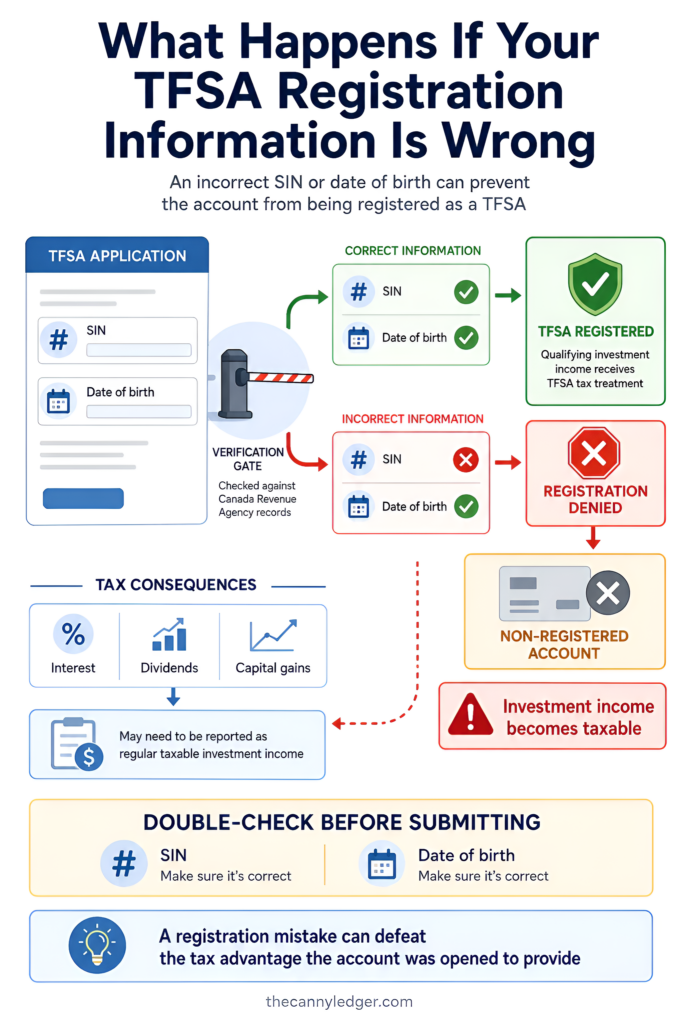
Get your Social Insurance Number wrong on a TFSA application, or leave it off entirely, and the account itself can end up not actually registered as a TFSA at all. That’s a bigger consequence than a rejected form and a resubmission. According to the CRA’s own guide, any income earned inside an account that never properly registered has to be reported as regular taxable income, which quietly defeats the entire point of opening one in the first place.
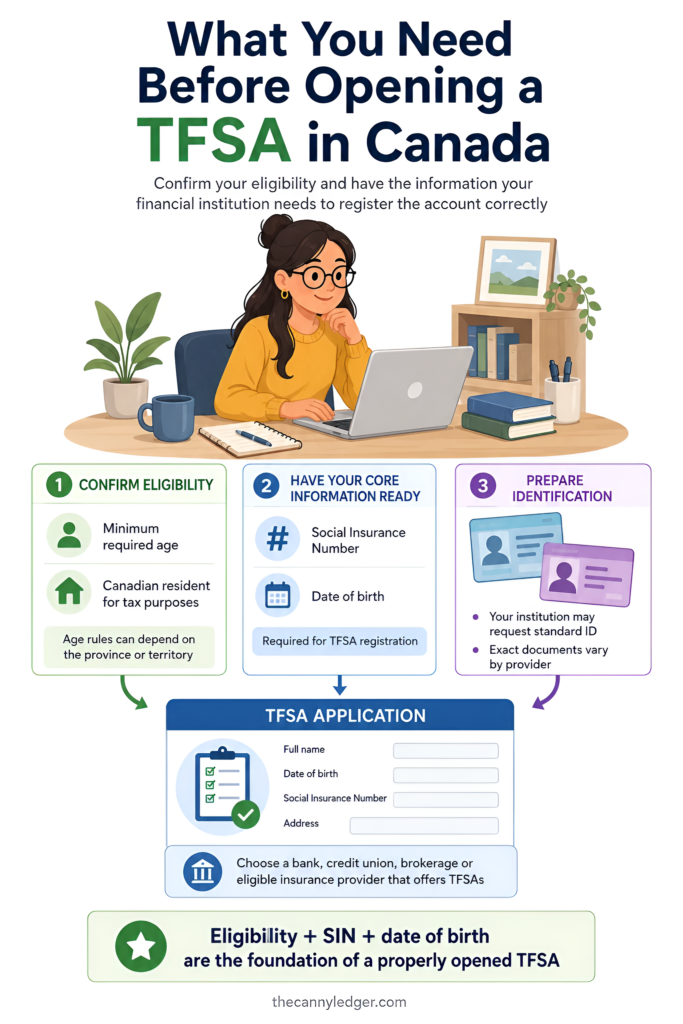
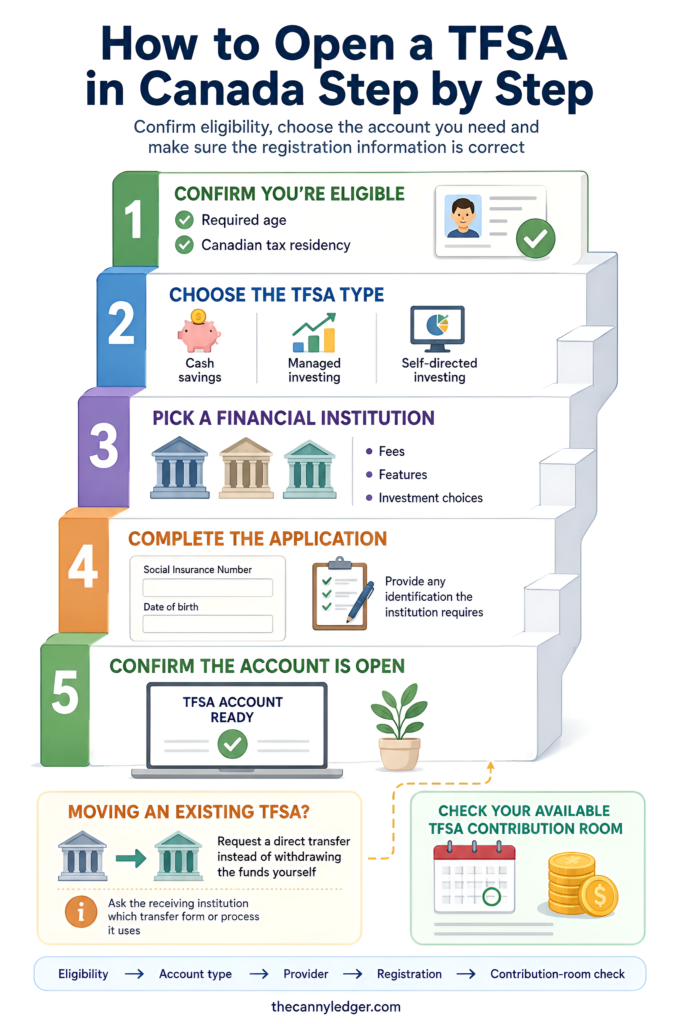
Opening a TFSA requires two things at minimum, contacting a financial institution, credit union, or insurance company that offers them, and providing your Social Insurance Number and date of birth so the issuer can register the account correctly with the CRA. Everything else, choosing an institution, deciding what to hold inside it, and moving money from an existing account if you already have one, builds on that basic registration step actually being done right the first time.
What You Actually Need Before You Start
You need to be at least 18 years old, or 19 in provinces where that’s the legal age of majority, and a Canadian resident for tax purposes, both requirements covered in full detail on the mechanics of the account itself. Beyond eligibility, the practical requirement is straightforward, your Social Insurance Number and date of birth, which the issuer uses specifically to register your account correctly with the CRA as a qualifying TFSA arrangement rather than just an ordinary savings or investment account.
Most institutions will also ask for standard identification during account opening, similar to what you’d provide opening any bank account, though the specific documents requested vary by institution rather than being fixed by any single federal requirement.
What Happens If the Information Is Wrong or Missing
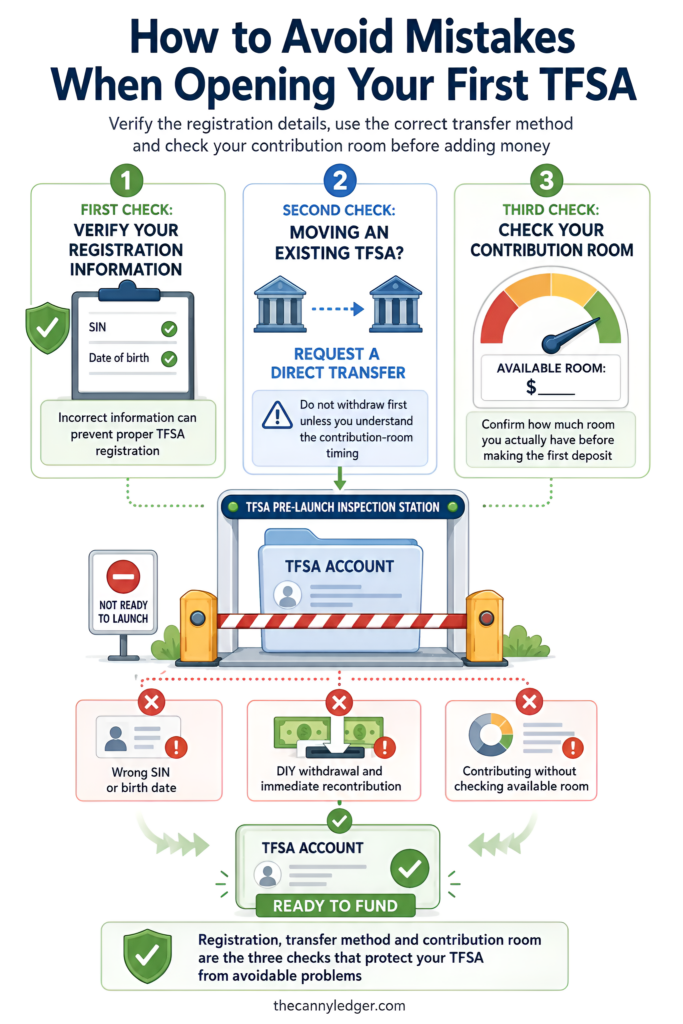
This is worth taking seriously rather than treating as a minor administrative step. According to the Canada Revenue Agency’s own TFSA guide for individuals, if you don’t provide your SIN and date of birth, or provide incorrect information, the registration of your TFSA can be denied outright. An account that never actually registers as a TFSA doesn’t carry the tax-free treatment the whole product is built around, any income it earns has to be reported on your regular income tax return exactly as though the money had been sitting in an ordinary non-registered account the entire time.
That’s a meaningfully worse outcome than a simple delay, since it means the tax-free growth someone believed they were accumulating never actually existed in the eyes of the CRA. Double-checking that your SIN and date of birth are entered correctly at the moment of opening is a small step that protects against a mistake with real financial consequences down the line.
Choosing Where to Open It
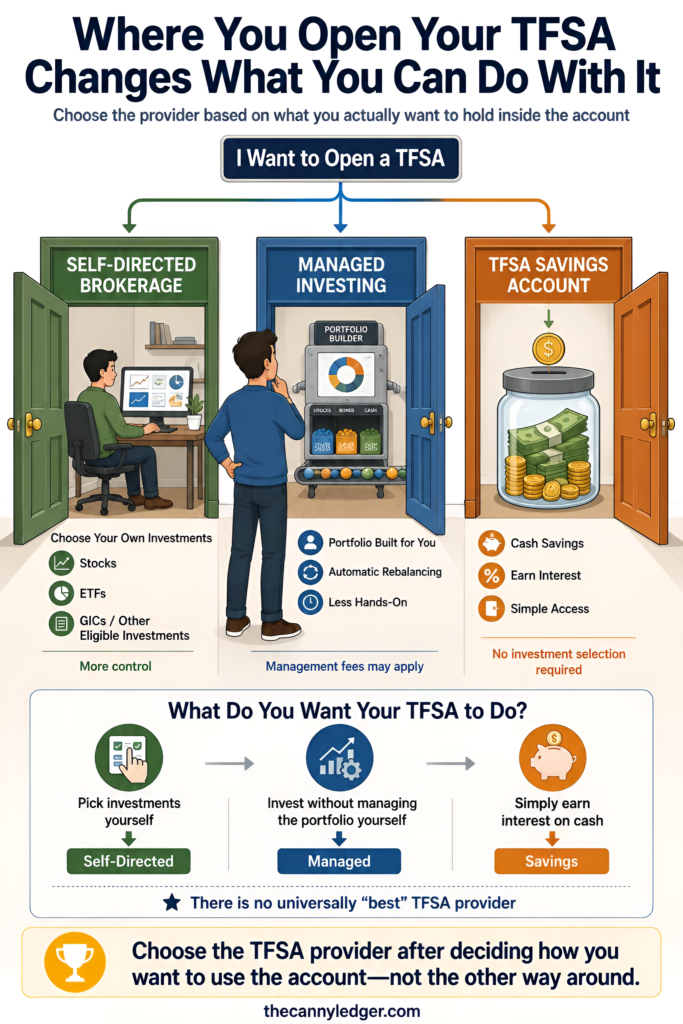
The institution you choose determines what kind of account you’re actually opening, a self-directed brokerage for picking your own investments, a managed platform that builds a portfolio for you, or a straightforward cash savings account. A detailed comparison of the major Canadian options across each of those categories is covered separately, since the right choice depends entirely on how you plan to use the account rather than any single institution being universally best.
Whichever type you land on, opening a TFSA for the first time is usually the simpler of two possible situations. The more involved scenario is moving an existing TFSA from one institution to another, which is worth understanding as its own distinct process before assuming it works the same way as opening a fresh account.
Opening Fresh Versus Moving an Existing Account
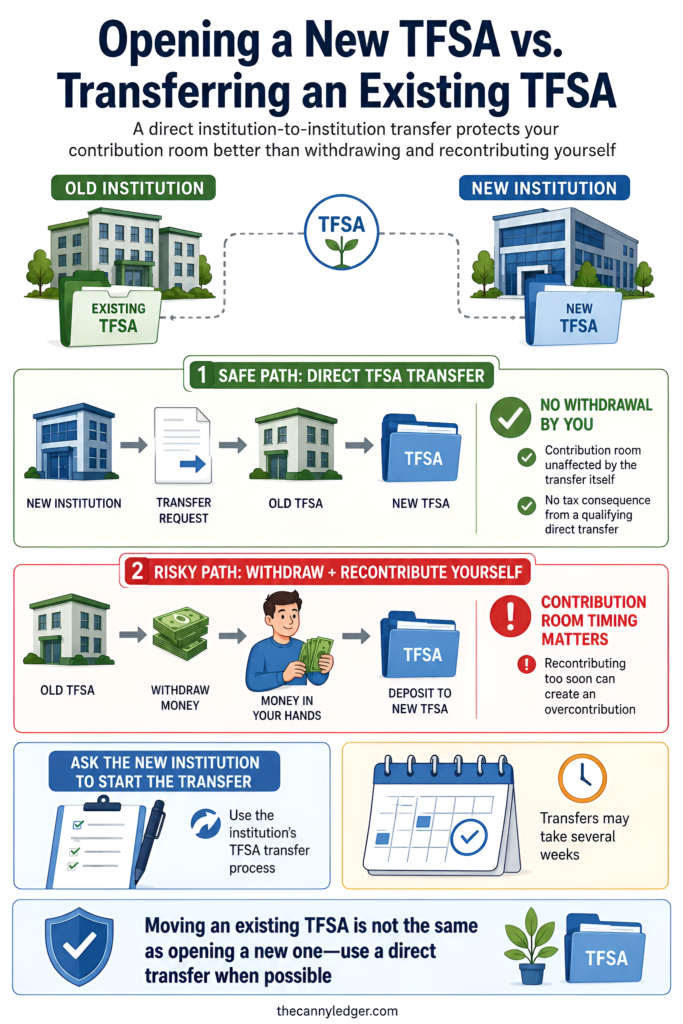
Someone who already has a TFSA somewhere and wants to move it needs to pay attention to method, since the way that transfer happens has real tax consequences attached, and getting it wrong is a real common mistake. According to the same CRA guide’s own section on qualifying transfers, a properly executed direct transfer between your issuer and a new institution carries no tax consequences at all, and your contribution room stays completely unaffected. Withdrawing the money yourself and then contributing it to a new TFSA on your own, instead of requesting a direct transfer, is treated entirely differently, that withdrawal and re-contribution can trigger the same overcontribution risk covered in detail elsewhere on this site if you haven’t accounted for the room timing correctly.
In practice, a direct transfer means asking your new institution to request the funds directly from your old one, usually through a transfer request form specific to that institution, sometimes still referred to informally as a T2033-style form even though the official T2033 form is technically built for RRSP-type accounts rather than TFSAs specifically. Documentation from Tangerine’s own direct transfer process states that a transfer typically takes two to six weeks to complete, timing worth factoring in if you’re planning around a specific deadline rather than assuming it happens instantly.
The Actual Steps, In Order
Confirm your own eligibility first, your age and residency status, since this determines whether you can open an account at all right now. Choose the account type that matches how you actually intend to use it, then pick a specific institution within that category based on the fees and features that matter most to your situation. Contact that institution directly, either online or in person depending on what they offer, and provide your SIN and date of birth accurately, along with whatever identification they require.
A first-time TFSA opening is essentially the whole process described above, the account becomes usable once the institution confirms the registration. Moving an existing TFSA rather than starting fresh works differently, request a direct transfer specifically, rather than withdrawing the funds yourself, and confirm with the receiving institution which form they use for that transfer before doing anything else with the existing account.
Getting the First Step Right
Verify your SIN and date of birth are entered correctly before finalizing any TFSA application, since that single detail is what determines whether the account actually registers as tax-free in the first place. If you’re moving money between institutions rather than opening your first account, insist on a direct transfer specifically and confirm the receiving institution’s process before touching the existing account yourself. And once the account is open, checking your actual available contribution room before making a first contribution protects against starting off with an overcontribution on day one, a mistake that’s entirely avoidable with one extra check.
A Few Practical Questions
Can I open a TFSA online, or does it require an in-person visit? Most institutions, particularly discount brokerages and digital banks, allow TFSA accounts to be opened entirely online, though some traditional banks and credit unions may still prefer or require an in-person appointment depending on their own process.
Do I need to have my full contribution room calculated before opening the account? No, opening the account itself doesn’t require knowing your exact room in advance, though you should confirm your available room before making an actual contribution, since the account can sit open and empty indefinitely without any consequence.
Is there any cost to opening a TFSA itself, separate from investment fees? Generally no, most institutions don’t charge a fee simply to open a TFSA, though ongoing account fees, trading commissions, or management fees may apply depending on the specific institution and account type you choose.