

Your Manitoba Health card gets you a doctor’s visit and a hospital stay at no cost, and that’s essentially where its coverage stops. It won’t touch a dentist’s bill, a pair of glasses, or the vast majority of prescriptions you’d pick up at a pharmacy counter, and a lot of Manitobans only discover the size of that gap the first time they’re standing at the till with a prescription that costs more than they expected. Closing that gap involves stacking a few different programs and plans together rather than finding one single option that covers everything, and knowing which pieces exist matters more than most people realize until they actually need one.
- What Manitoba Health Actually Covers, and the Big Gap Behind It
- Manitoba Pharmacare Closes Part of the Drug Gap
- The Canadian Dental Care Plan Is the Newest, Biggest Shift for Dental
- Manitoba Blue Cross Now Sells Plans Built to Pair With CDCP
- What a Full Blue Choice Plan Actually Covers
- The Conversion Plan Safety Net If You Lose Group Coverage
- Employer Group Benefits vs Buying Your Own Plan
- Putting Together Your Own Coverage Stack
- Common Questions
- Check Your Eligibility Before You Buy Anything
Health and dental insurance options in Winnipeg include Manitoba Pharmacare for income-based prescription drug assistance, the federal Canadian Dental Care Plan for dental coverage based on family income, employer group benefits where available, and private plans through Manitoba Blue Cross for everything from prescription drugs to paramedical services. Most Winnipeggers end up combining two or three of these rather than relying on just one.
What Manitoba Health Actually Covers, and the Big Gap Behind It
Manitoba Health pays for physician visits, hospital stays, and medically necessary procedures performed in hospital, which is the core of what most people picture when they think of Canadian healthcare. What it doesn’t cover is the part of healthcare people actually spend money on regularly: prescription drugs taken outside a hospital setting, routine dental care, vision exams for most adults, and paramedical services like physiotherapy, massage therapy, or psychology, none of which fall under Manitoba Health’s insured services. Eye exams get covered only for residents under 19 or 65 and older, or at any age when medically warranted by a specific condition, and dental coverage under the public plan is limited to in-hospital dental surgery rather than anything a general dentist provides in a regular office visit.
This gap isn’t a Manitoba-specific oversight, it reflects how Canadian provincial health plans were designed from the start, built around hospital and physician care specifically rather than the broader range of health expenses a household actually faces. Understanding that distinction is the first real step toward building coverage that actually protects your budget rather than assuming a health card alone has you covered.

Manitoba Pharmacare Closes Part of the Drug Gap
For prescription drugs specifically, Manitoba runs its own income-based assistance program called Pharmacare, and it’s worth understanding exactly how the math works rather than assuming it’s either free or irrelevant to your situation. Every Manitoban eligible for Manitoba Health coverage who doesn’t already have prescription coverage through another federal or provincial program qualifies, and the program calculates an annual deductible based on your adjusted family income, ranging from 2 to 5 percent of that income, with a minimum deductible of $100 and no maximum. Once you’ve paid that deductible amount out of pocket over the course of the year, Pharmacare covers 100 percent of eligible prescription costs for the rest of the benefit year.
The income figure used isn’t your current income either, it’s based on Canada Revenue Agency data from two years prior, so your 2026/2027 Pharmacare benefit year deductible is calculated from your 2024 tax return. Our Manitoba and Winnipeg personal income tax guide covers how that same Notice of Assessment feeds into several other income-tested programs beyond Pharmacare specifically. If your income has genuinely dropped by more than 10 percent since that filing, you can request an adjustment using a Projected Income Worksheet rather than being stuck paying a deductible sized for an income you no longer earn. For households whose prescription costs are high relative to their monthly income specifically, Manitoba also runs a Deductible Instalment Payment Program that lets you pay your annual Pharmacare deductible in interest-free monthly instalments folded directly into your Manitoba Hydro bill, a genuinely useful detail most people never hear about until they specifically ask.

The Canadian Dental Care Plan Is the Newest, Biggest Shift for Dental
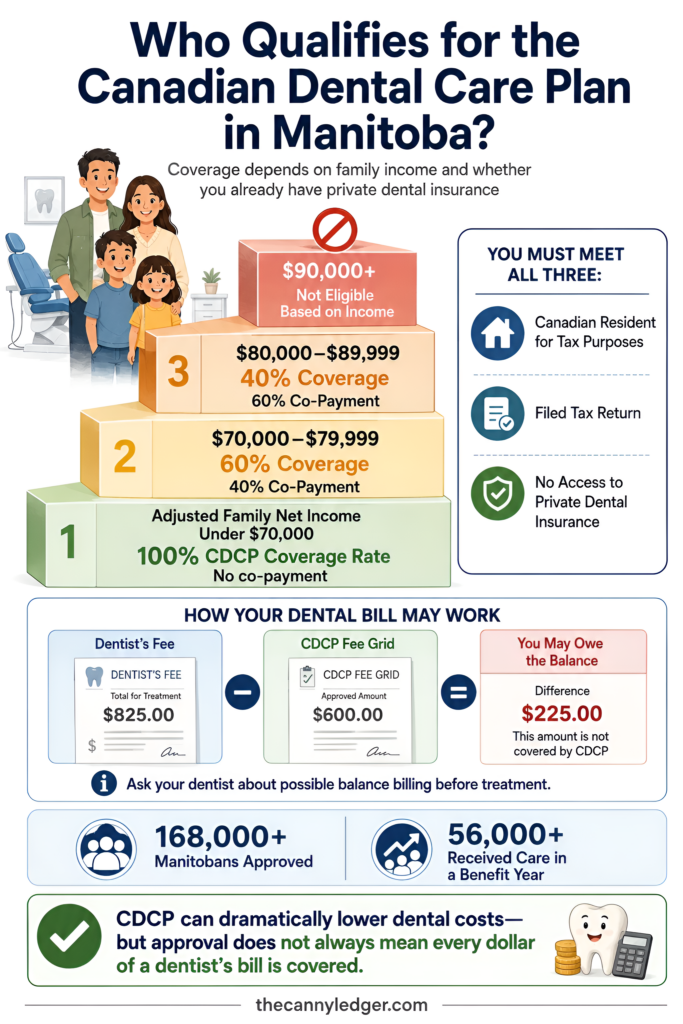
Dental coverage for Manitobans changed more in the last two years than in the previous few decades combined, with the federal government’s Canadian Dental Care Plan rolling out income-tested coverage to millions of Canadians who previously had no dental insurance at all. To qualify, your adjusted family net income needs to sit under $90,000, you need to be a Canadian resident for tax purposes with a filed tax return, and critically, you can’t already have access to private dental insurance through an employer, a pension, or a personal policy. Coverage scales with income rather than being all-or-nothing: families under roughly $70,000 in adjusted net income get the plan’s full coverage with no co-payment, those between $70,000 and $79,999 get 60 percent coverage with a 40 percent co-payment, and those between $80,000 and $89,999 get 40 percent coverage with a 60 percent co-payment.
The scale of this program’s actual reach in Manitoba is genuinely significant. As of the federal government’s most recent published statistics, more than 168,000 Manitobans have had applications approved under the CDCP, with over 56,000 having already received care under the plan in a single benefit year. One detail worth knowing before booking anything: the CDCP reimburses based on its own published fee grid, not necessarily what your specific dentist charges, so a dentist billing above that grid can leave you responsible for the difference even with approved coverage, a form of balance billing worth asking about directly at your dental office before treatment starts.
Manitoba Blue Cross Now Sells Plans Built to Pair With CDCP
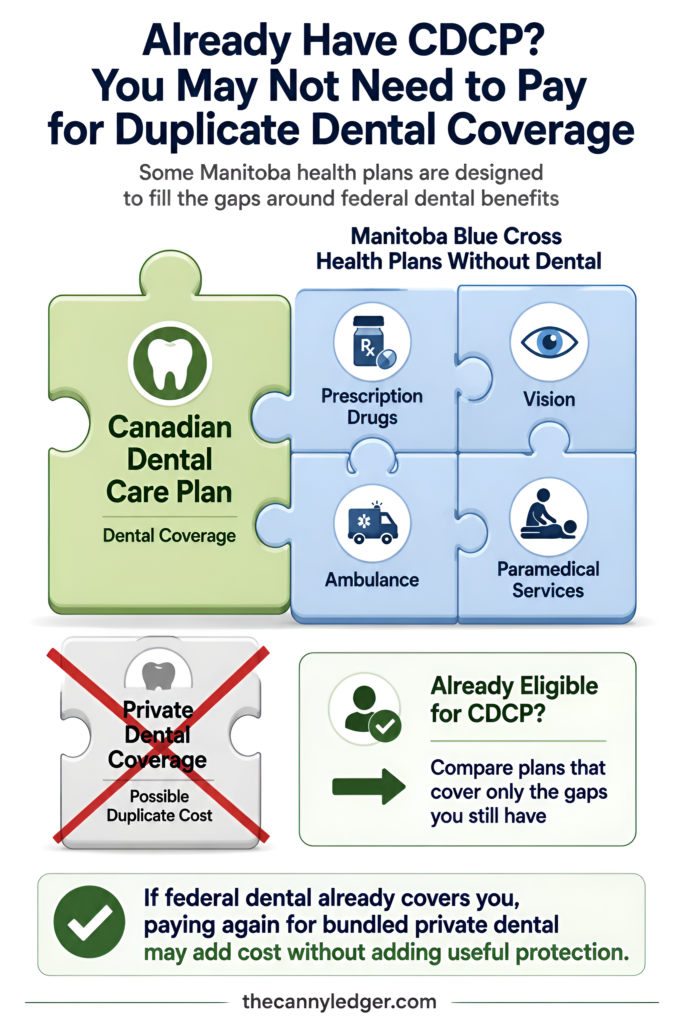
Here’s a detail that genuinely surprised even people already familiar with Manitoba Blue Cross: the insurer specifically created two new health benefit plans with no dental coverage built in, precisely so Manitobans who qualify for the federal CDCP can get robust coverage for prescription drugs, vision, ambulance, and paramedical services without paying for dental coverage they no longer need because the federal government is already providing it. Manitoba Blue Cross’s own president described this directly as a deliberate response to the dental plan’s rollout, rather than a coincidental gap in their existing lineup. For anyone qualifying for CDCP specifically, this is worth asking about directly, since paying for duplicate private dental coverage on top of a federal benefit you already qualify for is money spent for no additional protection.
What a Full Blue Choice Plan Actually Covers
For Manitobans who don’t qualify for CDCP, or who want dental coverage bundled with everything else in one plan, Manitoba Blue Cross’s Blue Choice lineup runs across three tiers. Plan A covers the basics, prescription drugs at 70 percent, standard dental checkups, cleanings, fillings, and extractions at 70 percent up to $300 a year, and ambulance service. Plan B adds higher coverage maximums and vision benefits on top of everything in Plan A, and Plan C, the most comprehensive tier, adds coverage for services like massage therapy, osteopathy, clinical psychology, and orthodontic treatment that the lower tiers don’t touch at all. Manitoba Blue Cross describes itself as the province’s largest provider of this kind of cost-effective coverage, aimed specifically at people who are self-employed, working part-time, or otherwise without workplace benefits to fall back on.

The Conversion Plan Safety Net If You Lose Group Coverage
One detail worth knowing before it becomes urgent: if you’re about to lose group benefits through a job change, layoff, or retirement, Manitoba Blue Cross offers a Conversion Plan specifically designed to bridge that gap without interruption. Approval is guaranteed, the waiting period for dental and vision benefits gets waived entirely, and there’s no medical questionnaire required, meaning pre-existing conditions are covered from day one rather than excluded the way they typically would be on a standard individual application. This matters enormously for anyone managing an ongoing health condition who’s worried about a coverage gap between leaving one job’s benefits and either finding new employer coverage or getting approved for a standard individual plan, since a standard application’s medical questionnaire can result in exclusions or higher premiums that the Conversion Plan simply doesn’t apply.

Employer Group Benefits vs Buying Your Own Plan
If you have access to group benefits through an employer, that’s almost always the more cost-effective starting point compared to an individual plan, since employers typically subsidize a meaningful share of the premium and group plans generally don’t require the same medical underwriting an individual application does. Where this gets more complicated is for gig workers, self-employed Winnipeggers, part-time employees without benefits, and newcomers who haven’t yet landed a job with a benefits package, all of whom are left choosing between going without extended coverage entirely, applying for CDCP if they qualify on income, or buying an individual plan directly. For anyone in that situation, our guides to term vs whole life insurance in Winnipeg and disability and critical illness insurance in Winnipeg cover two other categories worth building into a full insurance picture alongside health and dental coverage specifically, since these tend to get overlooked until an actual health scare makes the gap obvious.

Putting Together Your Own Coverage Stack
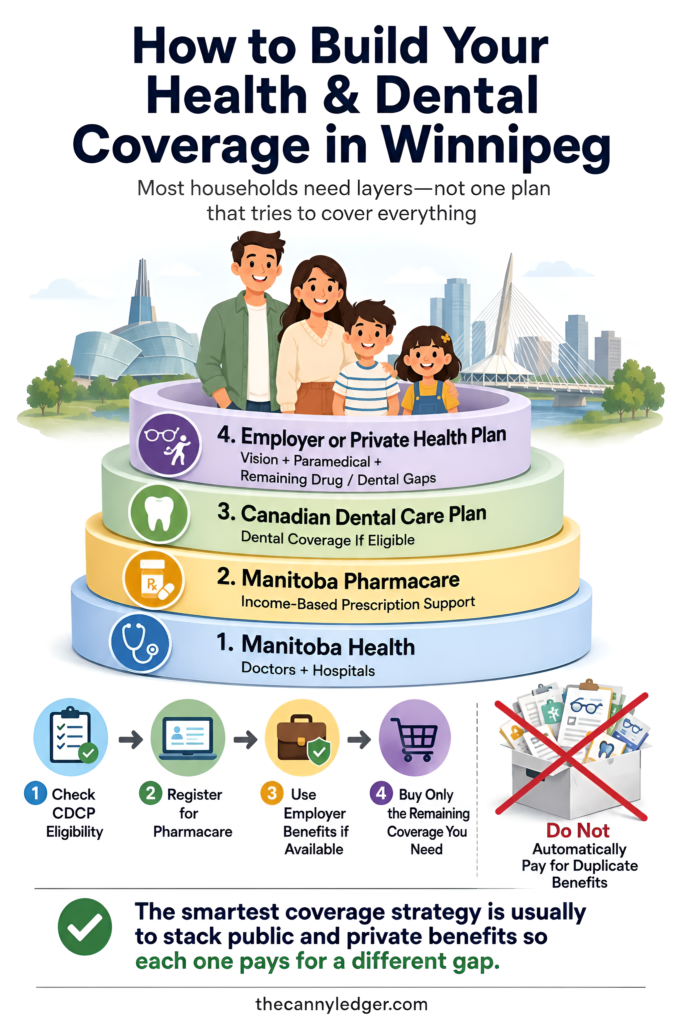
The realistic approach for most Winnipeggers without employer benefits is layering rather than picking one single plan to solve everything. Check your CDCP eligibility first, since it’s free federal coverage and the income threshold catches more households than people assume. Register for Pharmacare regardless of your income level, since the deductible scales down for lower incomes and there’s no reason to pay full price for prescriptions if you qualify for assistance on any portion of the cost. From there, fill whatever remains, vision, paramedical services, or dental if CDCP doesn’t apply to your income bracket, with either an employer plan if one becomes available or an individual Blue Choice plan sized to what you can actually use.
Common Questions
Can I have both CDCP and Manitoba Pharmacare at the same time? Yes, these cover different things entirely, CDCP handles dental and Pharmacare handles prescription drugs, so qualifying for one doesn’t affect your eligibility for the other.
Does having a Manitoba Blue Cross plan disqualify me from CDCP? It depends specifically on whether your Blue Cross plan includes dental coverage. If it does, that existing dental coverage makes you ineligible for CDCP, which is exactly why Manitoba Blue Cross now offers plans specifically without dental coverage for people who want to keep their CDCP eligibility intact.
What happens if my income changes and I no longer qualify for CDCP? Your eligibility gets reassessed based on your most recently filed tax return each benefit year, so a significant income increase could shift you into a lower coverage tier or out of eligibility entirely, and it’s worth having a private plan ready to pick up dental coverage if that happens rather than discovering the gap at your next dental appointment.
Check Your Eligibility Before You Buy Anything
Before paying for any private plan, confirm your CDCP eligibility and register for Pharmacare first, since both are income-based programs that can cover a meaningful share of your health costs at little or no cost to you, and paying for private coverage that duplicates a benefit you already qualify for is money that could go toward the gaps those programs genuinely don’t fill.