

GST in Winnipeg is charged at a flat 5 percent federal rate on most goods and services, calculated independently from Manitoba’s separate 7 percent Retail Sales Tax. The GST/HST credit that used to help offset this for lower-income households was replaced by the Canada Groceries and Essentials Benefit (CGEB) starting July 2026, paying 25 percent more than the old credit under the same eligibility rules.
- The 5% Federal Rate, and What Zero-Rated vs Exempt Actually Means
- The GST/HST Credit Is Gone, Replaced by the CGEB
- How to Calculate GST on Any Winnipeg Purchase
- Buying a New Home: Two Different GST Rebates Now Exist
- Running a Small Business: When You Actually Need to Charge GST
- What This Guide Doesn’t Cover
- Common Questions About GST in Winnipeg
The 5% Federal Rate, and What Zero-Rated vs Exempt Actually Means
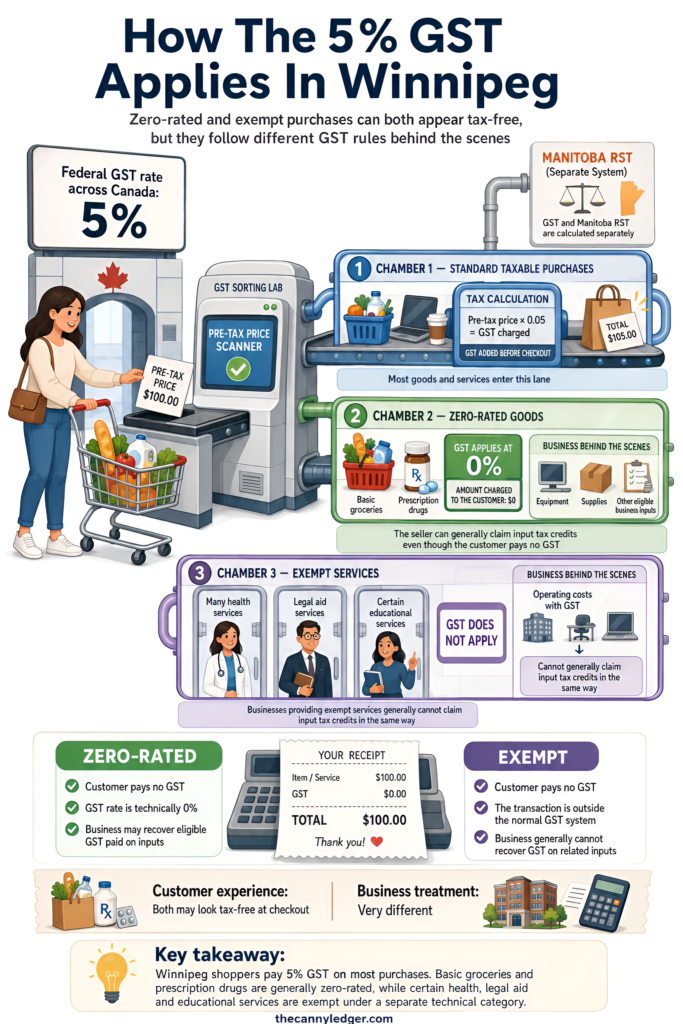
GST applies at 5 percent nationwide, Manitoba included, and it’s calculated on top of the pre-tax price of most goods and services, separately from whatever provincial sales tax also applies. What trips people up is that “not taxed” isn’t a single category. Some goods are zero-rated, meaning GST applies at a rate of 0 percent, basic groceries and prescription drugs are the clearest Manitoba examples, while others are fully exempt, a different technical status that mostly applies to specific services like many health, legal aid, and educational services. The practical difference matters more to businesses than shoppers: a business selling zero-rated goods can still claim back the GST it paid on its own supplies and equipment through input tax credits, while a business providing exempt services generally can’t, which can quietly affect pricing even on something that looks tax-free at the register either way.
The GST/HST Credit Is Gone, Replaced by the CGEB

This is the single biggest GST-related change most Manitobans will notice this year. The Canada Groceries and Essentials Benefit officially replaced the GST/HST credit starting July 2026, under legislation that received Royal Assent in February 2026. The eligibility rules, income thresholds, and quarterly payment structure carried over unchanged from the old credit, but payment amounts rose by 25 percent, a boost the federal government has committed to maintaining through 2031. Before the switch took effect, eligible Canadians received a one-time transition top-up on June 5, 2026, worth 50 percent of their 2025-26 GST/HST credit entitlement, meant to bridge the gap before the first enhanced quarterly CGEB payment arrived July 3, 2026. Under the new structure, a single individual can receive up to $679 a year, up from the old credit’s $533 maximum, while a couple can receive up to $890, with an additional amount per eligible child under 19.
Nothing about how you access this changed. There’s still no separate application required, filing an annual tax return is what determines eligibility automatically, exactly as it worked under the old GST/HST credit name. If you’ve been receiving quarterly payments and your situation hasn’t changed, you’re very likely receiving the CGEB now under that new name, whether or not your bank statement or CRA account has fully caught up with the terminology yet.
How to Calculate GST on Any Winnipeg Purchase
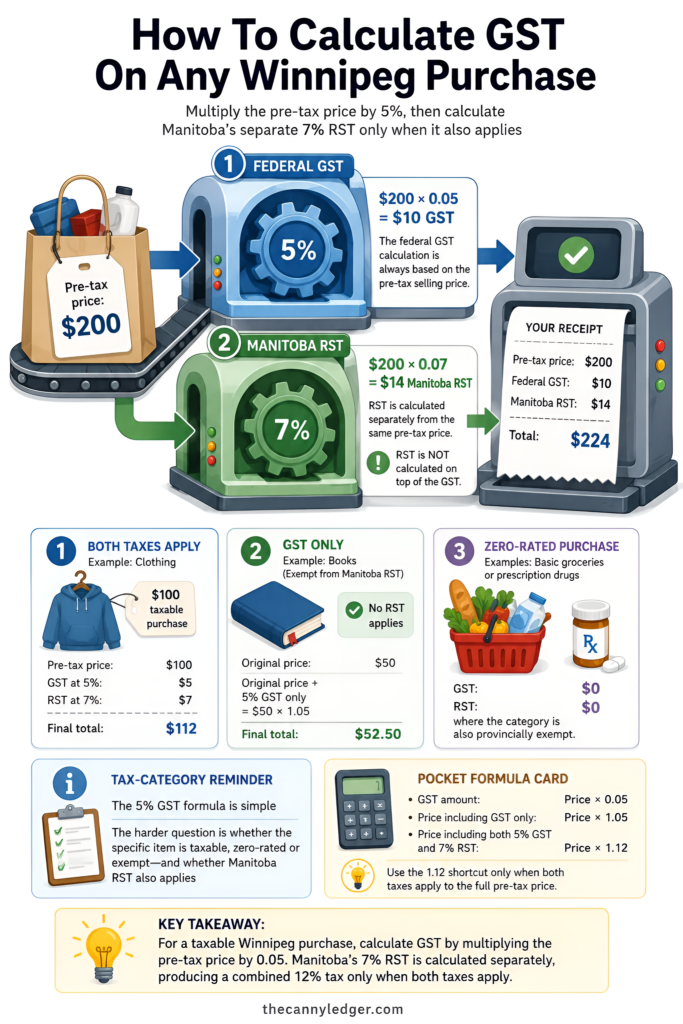
The math itself hasn’t changed even though the benefit around it has. Take the pre-tax price of anything taxable, multiply by 0.05, and that’s the GST owed, entirely separate from whatever Manitoba’s 7 percent RST adds on top for goods and services that aren’t RST-exempt. A $200 non-grocery purchase in Winnipeg owes $10 in GST specifically, plus $14 in RST if the item is RST-taxable, for a combined $224 total, though the full breakdown of what does and doesn’t carry RST varies by category in ways GST generally doesn’t, since GST’s exemption list is far shorter and more consistent nationwide.
Buying a New Home: Two Different GST Rebates Now Exist

This is genuinely useful for anyone building or buying new in Winnipeg, and it’s changed significantly enough recently that older information floating online is now outdated. The long-standing GST New Housing Rebate returns 36 percent of the GST paid on a new or substantially renovated home, up to a maximum of $6,300, available to any buyer regardless of whether it’s a first purchase, but the rebate shrinks on a sliding scale between $350,000 and $450,000 in purchase price and disappears entirely above $450,000. Given Winnipeg’s home prices sit well below that ceiling for most new builds, this older rebate remains genuinely useful for a lot of local buyers even without qualifying as a first-time purchaser.
A separate, much larger First-Time Home Buyers’ GST/HST Rebate applies specifically to qualifying first-time buyers, and it’s a dramatically bigger benefit: it eliminates the GST entirely on a new home valued up to $1 million, and reduces GST on a sliding scale for homes priced between $1 million and $1.5 million. This applies to purchase and sale agreements entered into after May 26, 2025 and before 2031, covering the vast majority of new construction anywhere in Winnipeg given local price points. Manitoba doesn’t run a parallel provincial rebate on the RST portion the way some HST provinces do on their provincial tax, so this federal rebate, in either its general or first-time-buyer form, is the only new-housing sales tax relief available locally.
Running a Small Business: When You Actually Need to Charge GST
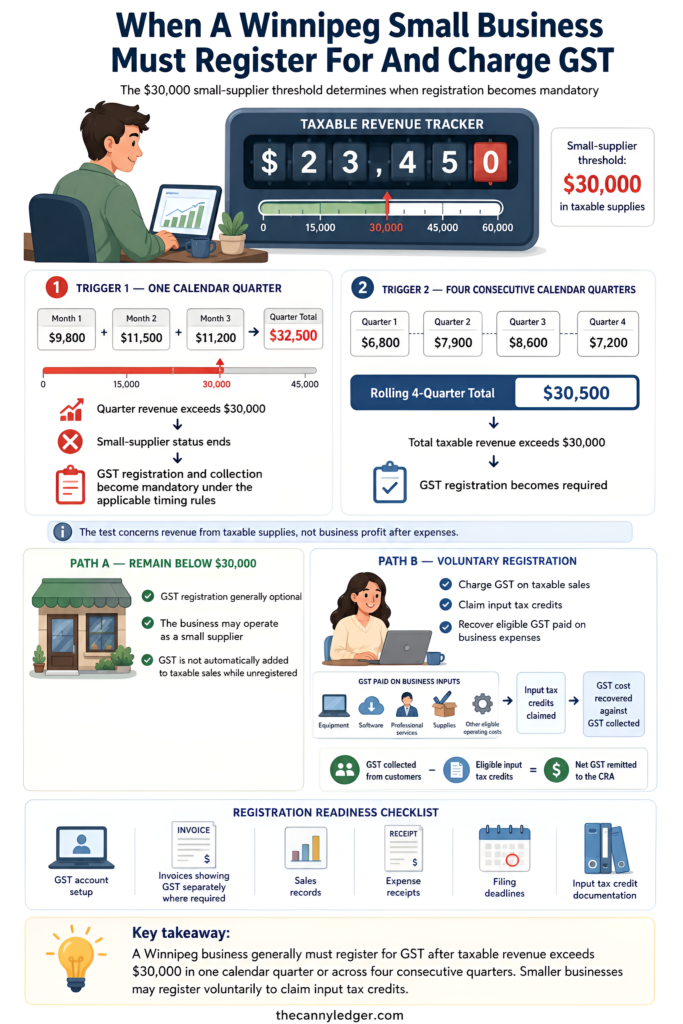
Anyone operating a small business or working as a sole proprietor in Winnipeg needs to register for and start charging GST once total revenue from taxable supplies crosses $30,000 in a single calendar quarter or over four consecutive quarters, the small supplier threshold that applies nationwide. Below that threshold, registration is optional, and plenty of small operators voluntarily register anyway specifically to claim input tax credits on their own business expenses, since a registered business can recover the GST it pays on supplies, equipment, and services used to generate its taxable income, effectively making a lot of GST paid on business inputs a wash rather than a real cost.
What This Guide Doesn’t Cover

Manitoba’s own Retail Sales Tax runs on entirely separate rules, exemptions, and a different administering government than GST does, and the full breakdown of what’s taxed under RST specifically is covered on its own rather than folded into this federal-tax-focused guide. For the combined shopping-level view of both taxes together, Winnipeg sales tax for shoppers walks through real receipts and common categories where the two taxes actually diverge.
Common Questions About GST in Winnipeg
Do I need to do anything to switch from getting the GST/HST credit to the CGEB? No. The transition happened automatically for everyone who was already receiving the GST/HST credit, based on the same tax return and eligibility criteria the CRA was already using. Continue filing your annual return as usual, and the CRA handles the rest.
Is the CGEB taxable income I need to report? No. Like the GST/HST credit before it, the Canada Groceries and Essentials Benefit is a tax-free payment and doesn’t need to be reported as income on your tax return.
Can I get both the old GST New Housing Rebate and the new First-Time Home Buyers’ rebate on the same home? No, they aren’t meant to stack on the same purchase in that way, the first-time buyers’ rebate is specifically designed to supersede the older rebate’s cap for qualifying purchases, effectively replacing the smaller benefit with a much larger one rather than adding to it. Confirm with the builder or a tax professional which rebate actually applies to your specific purchase agreement and closing date.
Check which of the two housing rebates actually applies before assuming the older $6,300 cap is your only option if you’re a first-time buyer, and don’t be thrown off if your CRA account still shows old terminology for a payment that’s already transitioned to the new benefit. The underlying 5 percent rate hasn’t moved, but nearly everything wrapped around it has shifted meaningfully within the past year.

