



Searching for the Manitoba Education Property Tax Credit in 2026 means searching for something that no longer exists under that name. The credit that capped out at $350 for the 2023 and 2024 tax years was retired starting with the 2025 tax year, folded into a much larger replacement that most homeowners are now receiving automatically without necessarily realizing the program behind it changed entirely. Understanding what the old credit was is still useful context, but understanding what actually shows up on a 2026 property tax bill requires looking at what replaced it.
- What the Education Property Tax Credit Used to Be
- The Companion Program Most People Forgot: The School Tax Rebate
- Both Replaced by the Homeowners Affordability Tax Credit
- The $285,000 Threshold Worth Knowing
- If You Rent Instead of Own
- The Separate Credit That Never Went Away
- Farm Properties Are a Different Story
- How to Actually Claim the Right Credit Now
- Common Questions About Manitoba’s Property Tax Credits
The Education Property Tax Credit (EPTC) and the separate School Tax Rebate were both eliminated starting the 2025 tax year and replaced by the Homeowners Affordability Tax Credit (HATC), worth up to $1,600 for 2026 and rising to $1,700 for 2027, available only on a principal residence. Renters have their own separate, renamed credit, the Renters Affordability Tax Credit, while a distinct Seniors’ School Tax Rebate continues to exist alongside HATC for eligible older homeowners.
What the Education Property Tax Credit Used to Be
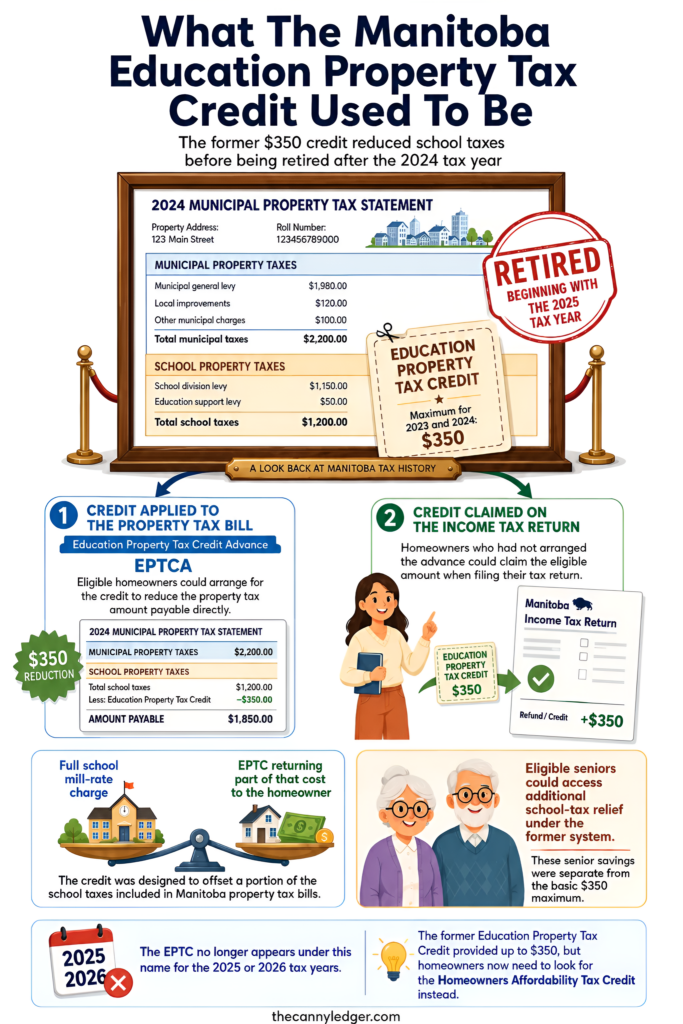
The old EPTC provided homeowners up to $350 in savings for the 2023 and 2024 tax years, applied either directly to a municipal property tax statement through something called the Education Property Tax Credit Advance (EPTCA), or claimed on an income tax return for anyone who hadn’t set up the advance. Seniors could access additional savings on top of the basic amount under the old structure. The credit existed specifically to offset a portion of the school taxes bundled into every Manitoba property tax bill, a way of returning some of that education-funding cost directly to homeowners rather than letting the full school mill rate hit every property equally regardless of income.
The Companion Program Most People Forgot: The School Tax Rebate

Running alongside the EPTC, and easy to conflate with it, was a separate program called the School Tax Rebate, which provided a 50 percent rebate on school taxes for residential and farm properties, and a 10 percent rebate for other property classes like commercial and industrial. These were two distinct programs showing up on the same 2024 property tax statement, the EPTCA reducing school taxes by up to $350, and the School Tax Rebate cutting a further half of whatever school tax remained for residential properties. Both got eliminated for most property types starting 2025, with one major exception: farm properties kept their 50 percent School Tax Rebate entirely intact, a distinction worth knowing if you own or are comparing notes with someone who owns farmland rather than a standard residential property.
Both Replaced by the Homeowners Affordability Tax Credit
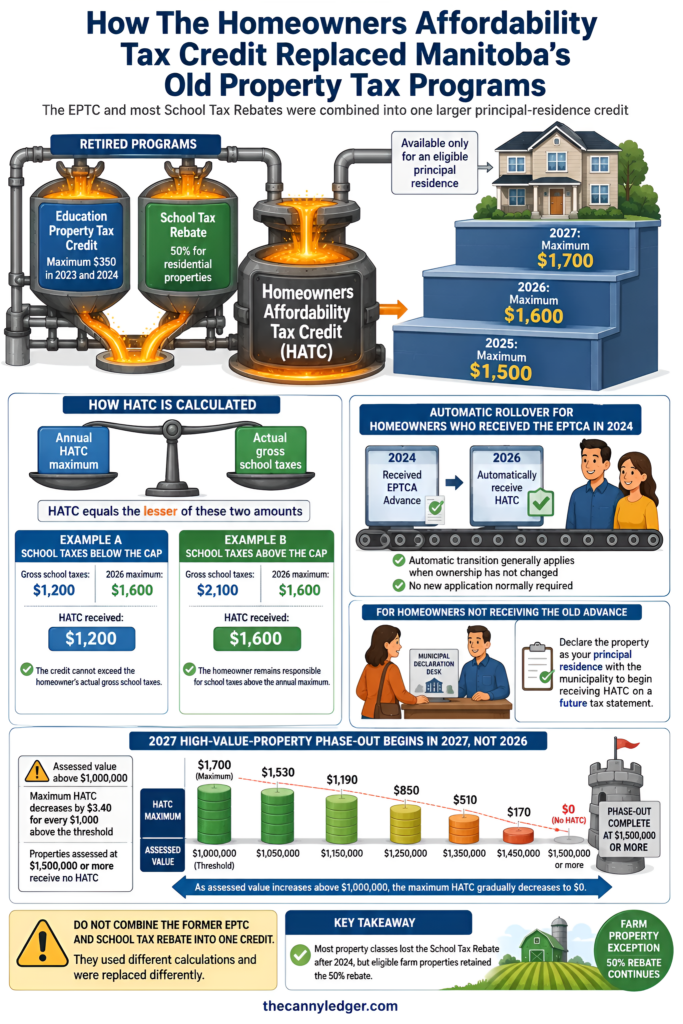
Manitoba’s government folded both retired programs into a single new credit. The Homeowners Affordability Tax Credit provided a maximum of $1,500 for the 2025 tax year, rising to $1,600 for 2026, with a further increase to $1,700 already confirmed for 2027. The credit equals the lesser of that year’s maximum or your actual gross school taxes, so a homeowner whose school tax bill is genuinely lower than the cap simply receives however much they actually owed, not a flat bonus beyond that. Starting in 2027, the credit also begins phasing out for higher-value properties: homes assessed over $1,000,000 see the maximum benefit reduced by $3.40 for every $1,000 of assessed value above that threshold, and properties assessed at $1,500,000 or more receive no HATC at all.
If you were receiving the old EPTCA on your 2024 property tax statement and your property’s ownership hasn’t changed since, the rollover to HATC happened automatically, no new application was needed. Anyone who wasn’t previously set up with the advance needs to declare their principal residence directly with their municipality to start receiving HATC applied to a future property tax statement, rather than waiting to claim it after the fact on an income tax return.
The $285,000 Threshold Worth Knowing
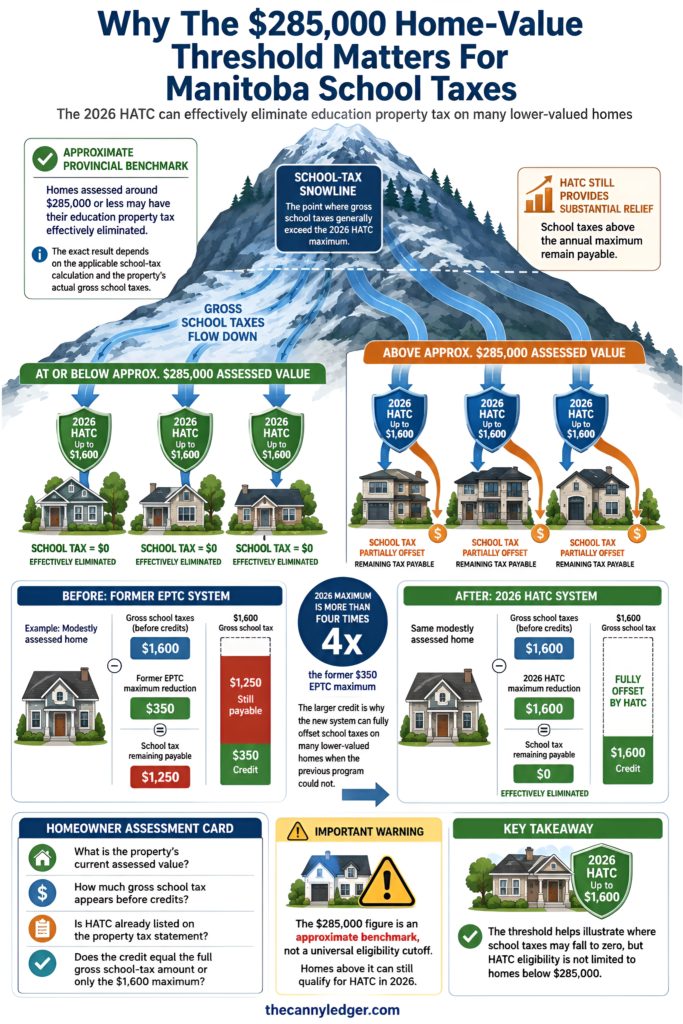
Manitoba’s own announcement of this change came with a specific, useful benchmark attached. Premier Wab Kinew’s government stated the new credit effectively eliminates education property tax entirely for homes assessed at approximately $285,000 or below, meaning a meaningful share of Winnipeg’s more modestly priced housing stock now owes essentially nothing in school tax once HATC applies, compared to the old $350 cap, which rarely covered a homeowner’s full school tax bill even on a lower-valued property. For homes assessed above that rough threshold, HATC still substantially reduces the school tax bill, just not down to zero, since the credit only covers up to its annual maximum rather than the full amount owed on a pricier home.
If You Rent Instead of Own

Homeowners aren’t the only ones affected by this round of changes, though renters saw their credit renamed rather than replaced outright. The old Renters Tax Credit was rebranded the Renters Affordability Tax Credit, with its maximum amount increased alongside the name change, up to $625 for the 2026 tax year, plus an additional top-up for senior renters specifically, up to $357. Unlike HATC, which applies directly to a property tax statement, the Renters Affordability Tax Credit gets claimed through an income tax return rather than showing up automatically on any bill, since renters don’t receive a municipal property tax statement of their own in the first place.
The Separate Credit That Never Went Away

Distinct from everything above, Manitoba’s Seniors’ School Tax Rebate continued unaffected through this entire round of changes. It provides up to $235, reduced by 1 percent of family net income over $40,000, available to eligible senior homeowners regardless of whether they’re also receiving HATC on the same property. This is genuinely a separate, stackable benefit rather than an alternative to choose between, a senior homeowner meeting both sets of eligibility rules can receive HATC on their property tax statement and separately claim the Seniors’ School Tax Rebate on their income tax return in the same year.
Farm Properties Are a Different Story

Worth stating plainly since it’s easy to overlook if you don’t own agricultural land: farm properties never lost their School Tax Rebate the way residential, commercial, and multi-residential properties did. That 50 percent rebate on school taxes continues for farm properties specifically, a carve-out the province maintained even while eliminating the equivalent rebate for every other property class. Anyone who owns both a farm property and a separate principal residence needs to track these as genuinely different credit situations rather than assuming one set of rules applies uniformly across everything they own.
How to Actually Claim the Right Credit Now

The practical path depends entirely on which category you fall into. Homeowners should first check whether HATC is already appearing on their current property tax statement, since anyone previously set up with the EPTCA should have rolled over automatically; if it isn’t showing up, declaring your principal residence directly with your municipality is the fix, and this needs to happen before that municipality’s own cutoff for the credit to apply to the current year’s bill rather than waiting until the following year. Renters need to actively claim the Renters Affordability Tax Credit on their annual income tax return using Manitoba’s provincial credit form, since nothing about it applies automatically the way HATC can. Eligible seniors should check both HATC and the Seniors’ School Tax Rebate separately rather than assuming one covers the other. For the full mechanics of how HATC actually reduces a specific property’s tax bill, including worked examples using current mill rates, Winnipeg’s property tax calculator walks through the complete math, and understanding your assessment covers how the underlying assessed value that HATC’s phase-out depends on actually gets determined.
Common Questions About Manitoba’s Property Tax Credits
Do I need to reapply for HATC every single year? Generally no, once your principal residence is properly declared and there’s no change in ownership, HATC continues to apply to your property tax statement automatically each year, the same way the old EPTCA rollover worked before the 2025 change.
What happens to HATC if I sell my home partway through the year? Ownership changes typically require the new owner to declare their own principal residence status with the municipality, since the credit is tied to who actually owns and lives in the property, not to the property itself independent of ownership. A sale generally means the credit doesn’t automatically continue for the new owner without a fresh declaration.
Can a rental property owner claim HATC on units they rent out? No. HATC applies exclusively to a homeowner’s own principal residence, not to rental properties, secondary residences, cottages, or commercial properties, regardless of how much school tax those other property types generate.
If you’ve been searching for the Education Property Tax Credit by its old name, the program you’re actually looking for now goes by Homeowners Affordability Tax Credit if you own, or Renters Affordability Tax Credit if you rent, and confirming which one is currently showing up on your own statement or return is worth doing directly rather than assuming last year’s paperwork still describes this year’s benefit correctly.