



Filing electronically with direct deposit set up is by far the fastest combination, with the CRA’s official standard targeting a Notice of Assessment within two weeks and the actual deposit landing within a few business days after that. Paper filing carries a 12-week official standard, and the CRA can also hold back all or part of a refund to cover certain outstanding federal, provincial, or territorial debts before anything reaches your account.
- The Official CRA Standard, and Why It Changed Recently
- What Actually Happens After You Click Submit
- The Single Biggest Lever: Direct Deposit
- Why Paper Filing Is Genuinely the Slowest Legal Option
- What Can Quietly Take Your Refund Before You See It
- Common Reasons a “Simple” Return Gets Stuck
- When “Fast” Isn’t Actually Fast: Adjustment Requests
- Checking Your Actual Status Right Now
- Common Questions About Tax Refunds in Winnipeg
The Official CRA Standard, and Why It Changed Recently

For the 2026-2027 service year, the CRA’s stated goal is to issue a Notice of Assessment within two weeks of receiving an on-time, electronically filed return, a target the agency aims to hit 95 percent of the time. Paper returns run on a considerably longer standard, 12 weeks, met only 85 percent of the time, and that 12-week figure itself was recently increased as part of this year’s service standard update, a quiet acknowledgment that paper processing has been taking longer than the CRA’s older targets assumed. Neither number describes when money actually lands in an account, both describe when the CRA finishes reviewing the return and issues its assessment, the refund itself follows afterward.
What Actually Happens After You Click Submit

Filing electronically doesn’t mean instant money, it means entering a faster, largely automated queue. The CRA’s systems validate an electronically filed return against the slips employers, banks, and other issuers have already reported, T4s, T5s, T3s, and similar documents, checking that the numbers match before assessing the return. Once that assessment is complete and the Notice of Assessment is issued, a refund tied to direct deposit typically arrives within a few business days, while a refund by mailed cheque adds the time for printing and postal delivery on top of that same processing period. The practical result: two people filing an identical, simple return on the same day can see genuinely different refund timing purely based on whether direct deposit was already set up.
The Single Biggest Lever: Direct Deposit
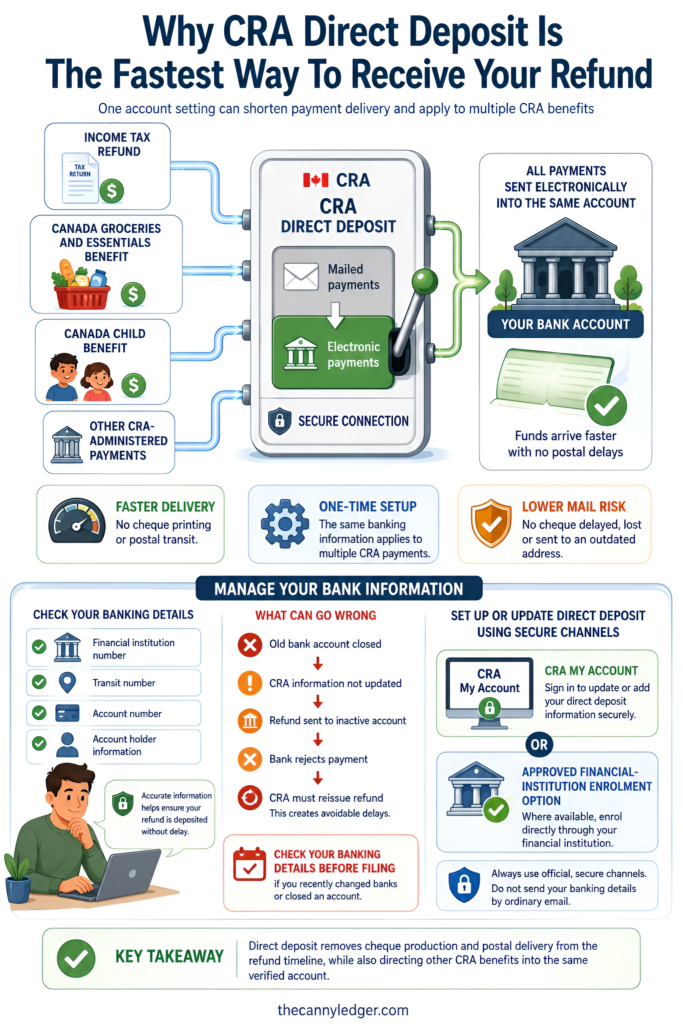
If there’s one change that consistently shortens the real-world wait more than anything else, it’s enrolling in direct deposit through CRA My Account rather than waiting for a mailed cheque. This isn’t a narrow, refund-only setting either, the same direct deposit information applies to every CRA benefit payment, the Canada Groceries and Essentials Benefit, the Canada Child Benefit, and any other CRA-administered payment a household receives, so setting it up once covers considerably more than a single tax season. For anyone who’s recently changed banks or closed an account without updating this information with the CRA, checking that the details on file are still accurate before filing is worth doing directly, since a refund sent to a closed account creates its own separate delay while the CRA reissues the payment.
Why Paper Filing Is Genuinely the Slowest Legal Option

Paper returns go through a fundamentally different process than electronic ones. Every paper return has to be physically opened, manually keyed into the CRA’s systems, and reviewed by a person checking the math and confirming slips before the same automated assessment process an electronic return receives automatically can even begin. That manual step is exactly why the standard sits at 12 weeks for paper versus 2 weeks electronically, and why peak filing season, the weeks immediately surrounding the April 30 deadline, tends to push actual paper processing toward the longer end of that window as CRA staff work through a much larger volume of physical returns all at once.
What Can Quietly Take Your Refund Before You See It
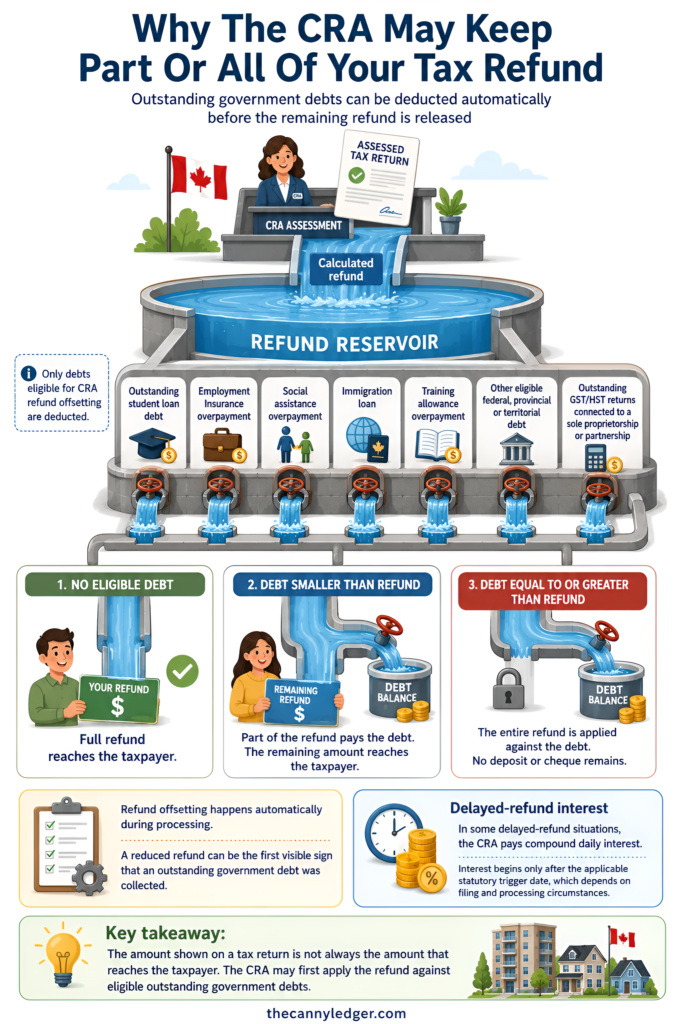
A refund isn’t guaranteed to arrive in full even once processing finishes. The CRA can apply all or part of a refund against certain outstanding debts before releasing whatever’s left, including federal, provincial, or territorial debts like student loans, EI or social assistance overpayments, immigration loans, and training allowance overpayments, along with any outstanding GST/HST returns owed by a sole proprietorship or partnership the filer operates. This offsetting happens automatically as part of processing, not as a separate notice sent in advance, so a smaller-than-expected refund is sometimes the first sign that an old debt got settled this way rather than an error in the return itself. On the other side of the ledger, the CRA does pay compound daily interest on a refund in certain situations, calculated from specific trigger dates depending on when the return was filed and processed.
Common Reasons a “Simple” Return Gets Stuck

A handful of specific issues account for most refund delays that aren’t simply about paper versus electronic filing. Slips that don’t match what an employer, bank, or other issuer already reported to the CRA trigger a manual review, so missing or mismatched T4, T5, or T3 information is one of the most common snags, even on an otherwise straightforward return. The CRA also randomly selects a percentage of returns for closer review each year regardless of how clean the return appears, and a first-time filer, particularly a newcomer to Canada, may face an identity verification step the CRA initiates through My Account, since there’s no prior filing history to automatically confirm identity against. An outstanding return from a previous tax year can also hold up the current year’s refund entirely until that earlier gap gets resolved, which is worth checking directly if a refund seems unusually delayed and there’s any uncertainty about whether every prior year was actually filed.
When “Fast” Isn’t Actually Fast: Adjustment Requests

If a return needs correcting after the fact, a missed deduction, an added slip, a claimed credit, the adjustment process runs on its own separate timeline, and this is where the biggest gap between official promise and lived experience shows up. The standard target is 2 weeks for an online adjustment request and 8 weeks for one submitted by mail, with the CRA’s own published standard allowing up to 20 weeks for genuinely complex adjustments. A federal service watchdog investigation found some Canadians were actually waiting as long as 47 weeks for these complex adjustment requests to process, more than double the CRA’s own stated ceiling. Anyone considering a significant adjustment, especially one covering multiple prior tax years at once, should budget for the possibility of a considerably longer wait than the official standard suggests, rather than assuming the published target reliably holds in every case.
Checking Your Actual Status Right Now
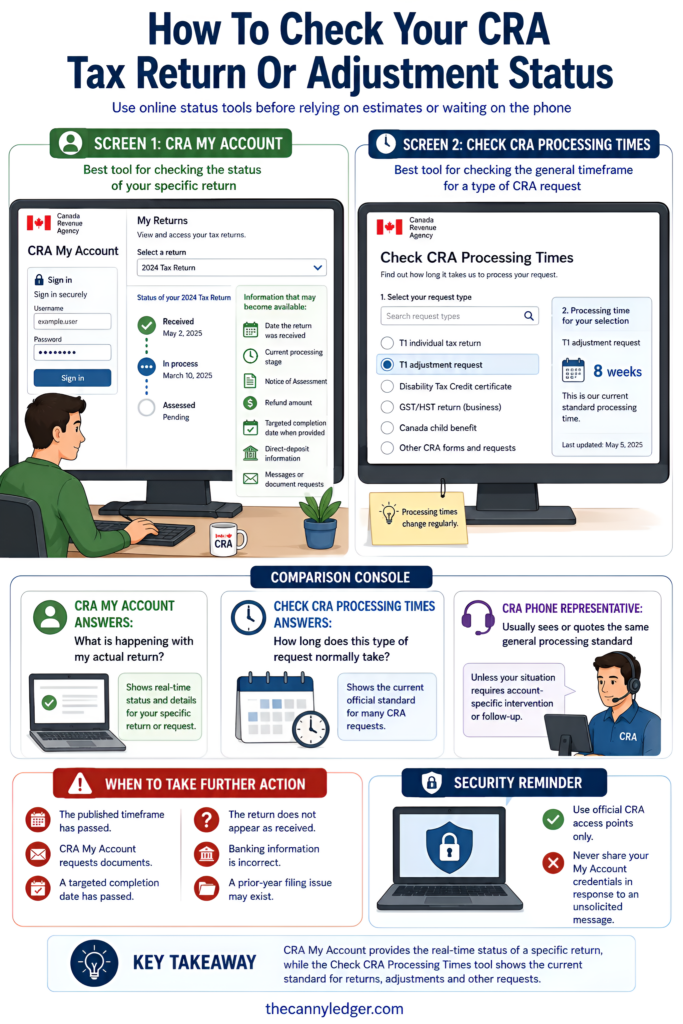
Rather than guessing, the CRA offers two direct tools worth using before assuming the worst. Signing into CRA My Account shows a specific return’s real-time status, received, in process, or assessed, along with a targeted completion date once available. Separately, the Check CRA Processing Times tool covers a wide range of specific request types beyond just a standard T1 return, including T1 adjustment requests, the Disability Tax Credit certificate, and several other common filings, giving the exact same standard timeframe a CRA phone representative would quote over the phone without needing to actually call in and wait on hold.
Common Questions About Tax Refunds in Winnipeg
Does filing through a tax preparer instead of myself speed up my refund? Not directly. A preparer, whether a free tax clinic or a paid service, still submits your return through the same electronic or paper channel the CRA processes at the same standard speed, regardless of who prepared it. The real speed advantage of using a preparer is reducing errors that could otherwise trigger a manual review, not any special fast-track treatment.
Can calling the CRA speed up my specific refund? No. CRA representatives can tell you the same standard processing time available through the Check CRA Processing Times tool, but there’s no mechanism to move an individual return ahead in the queue simply because someone called to ask about it.
If my refund is smaller than expected, does that always mean an error? Not necessarily. A smaller-than-expected refund can also mean the CRA applied part of it against an outstanding debt through offsetting, which happens silently as part of processing rather than through an advance warning, so it’s worth checking for that possibility before assuming your return was calculated incorrectly.
File electronically, confirm direct deposit details are current before submitting, and double-check every slip matches what’s already been reported to the CRA, since those three factors combined explain most of the real difference between a refund that arrives in two weeks and one that takes considerably longer. For anything beyond a standard return, understanding Manitoba’s income tax rules before filing catches more issues upfront than trying to fix them afterward through a slower adjustment request.

