

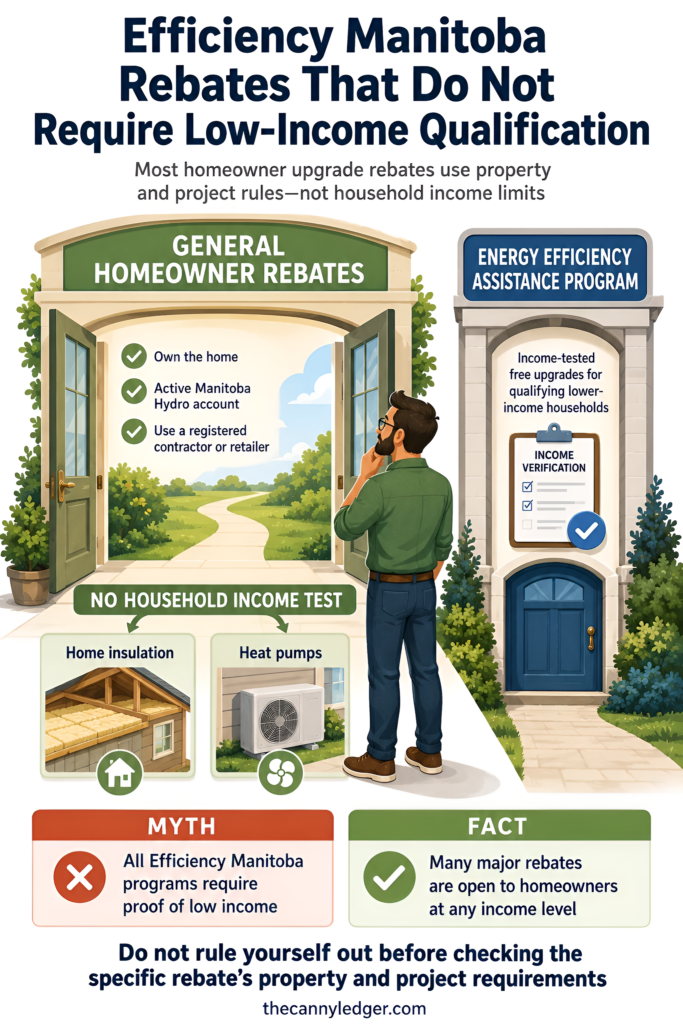
A lot of Manitoba homeowners assume Efficiency Manitoba’s rebates only exist for households that can prove a genuinely low income, and skip looking into the programs entirely because they figure they wouldn’t qualify. That assumption is wrong for most of what Efficiency Manitoba actually offers. The income-tested Energy Efficiency Assistance Program covers free upgrades specifically for lower-income households, but Efficiency Manitoba runs a separate, much broader set of rebate programs open to any homeowner with an active Manitoba Hydro account, regardless of what your household earns.
- These Rebates Don’t Require Proving Low Income
- The Home Insulation Rebate Program
- Heat Pump Rebates: Air Source and Ground Source
- A Separate Provincial Tax Credit for Geothermal
- Window, Door, and Thermostat Rebates
- Building New? There’s a Separate Program for That
- Manitoba’s Role in the Federal Oil to Heat Pump Program
- Solar and EV Incentives Round Out the Picture
- How to Actually Apply
- Common Questions
- Confirm Which Track Actually Fits Your Household
Efficiency Manitoba’s general rebate programs, covering home insulation, air source and ground source heat pumps, and new home construction, require only an active Manitoba Hydro account and, for most upgrade rebates, a home built before 1999, with no household income verification involved at all. Alongside these Manitoba-specific rebates, Manitoba is also the first province to sign a co-delivery agreement for the federal Canada Greener Homes Affordability Program in 2026, and remains an active partner in the separate federal Oil to Heat Pump Affordability program specifically targeting homes still heating with oil.
These Rebates Don’t Require Proving Low Income
The Home Insulation Rebate Program and the Heat Pump Program, Efficiency Manitoba’s two most commonly used general rebate offerings, both share a simple, universal eligibility structure rather than an income test. You need to own the home, hold an active Manitoba Hydro account, and use a contractor or retailer registered with Efficiency Manitoba to complete the work, with no requirement to submit an Income Tax Return or Notice of Assessment the way the separate income-tested assistance program requires. This distinction matters enormously for any Manitoba homeowner who assumed these rebates were out of reach simply because their household income sits above what a low-income program would require.
The Home Insulation Rebate Program
Efficiency Manitoba’s insulation rebate specifically targets homes built before 1999, reflecting the reality that older housing stock typically carries the biggest efficiency gains available from a straightforward insulation upgrade. Eligible project areas include attics, walls, and basements, with a minimum project size of 100 square feet per area and a requirement that the finished insulation meet both original and final R-value thresholds set by the program. Garages, sunrooms, porches, seasonal cottages, apartments, vacation rentals, and outbuildings don’t qualify, and neither does simply replacing existing insulation that’s already adequate, since the program is specifically designed to fund genuine efficiency improvements rather than routine maintenance or renovation work unrelated to actual energy performance.

Heat Pump Rebates: Air Source and Ground Source
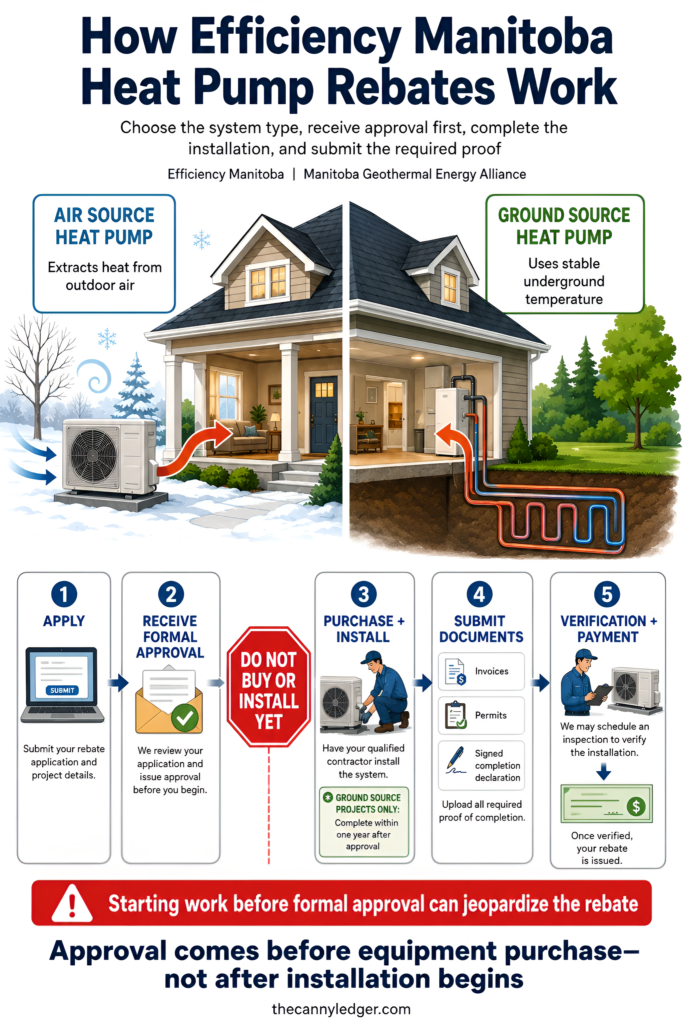
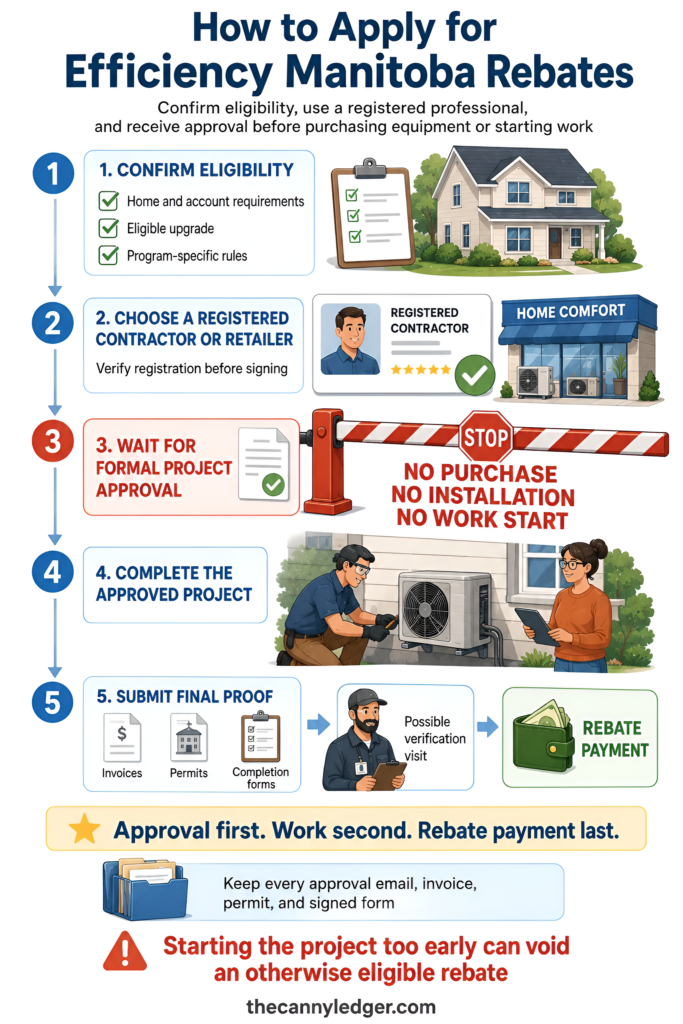
Efficiency Manitoba’s Heat Pump Program covers both air source heat pumps, which extract heat from outdoor air even in cold conditions, and ground source, or geothermal, heat pumps, which draw on the more stable underground temperature instead. For ground source systems specifically, the Manitoba Geothermal Energy Alliance describes the process as a formal approval stage first, where Efficiency Manitoba emails project approval before any purchase or installation begins, followed by a full year to actually complete the purchase and installation once approved. After installation, the homeowner and installer jointly sign a completion declaration and submit permits and invoices, and Efficiency Manitoba may schedule a post-installation verification visit before finally issuing the rebate payment. This structured, approval-first process matters practically, since starting work or purchasing equipment before receiving formal approval can jeopardize your eligibility for the rebate entirely.
A Separate Provincial Tax Credit for Geothermal
Beyond Efficiency Manitoba’s own rebate, the Manitoba government offers a distinct Green Energy Equipment Tax Credit worth 7.5 percent specifically for geothermal heat pump systems manufactured in Manitoba for use in the province. This tax credit operates entirely separately from Efficiency Manitoba’s rebate program, meaning a homeowner installing a Manitoba-manufactured geothermal system can potentially access both the Efficiency Manitoba rebate and this separate provincial tax credit for the same project, a genuinely valuable stacking opportunity worth confirming directly with both programs before finalizing an installation. Our guide to budgeting for a basement suite in Winnipeg touches on insulation and heating considerations specific to below-grade living space that these same rebate programs can genuinely help offset.

Window, Door, and Thermostat Rebates
Beyond the larger insulation and heat pump programs, Efficiency Manitoba’s broader Energy Efficiency Program also covers smaller-scale upgrades including windows and doors, smart thermostats, appliances, and pool pumps, each carrying its own specific eligibility criteria and rebate structure. These smaller upgrades tend to have a lower barrier to entry than a full insulation or heat pump project, making them a reasonable starting point for a homeowner wanting to test the rebate application process on a smaller scale before committing to a larger renovation project.

Building New? There’s a Separate Program for That
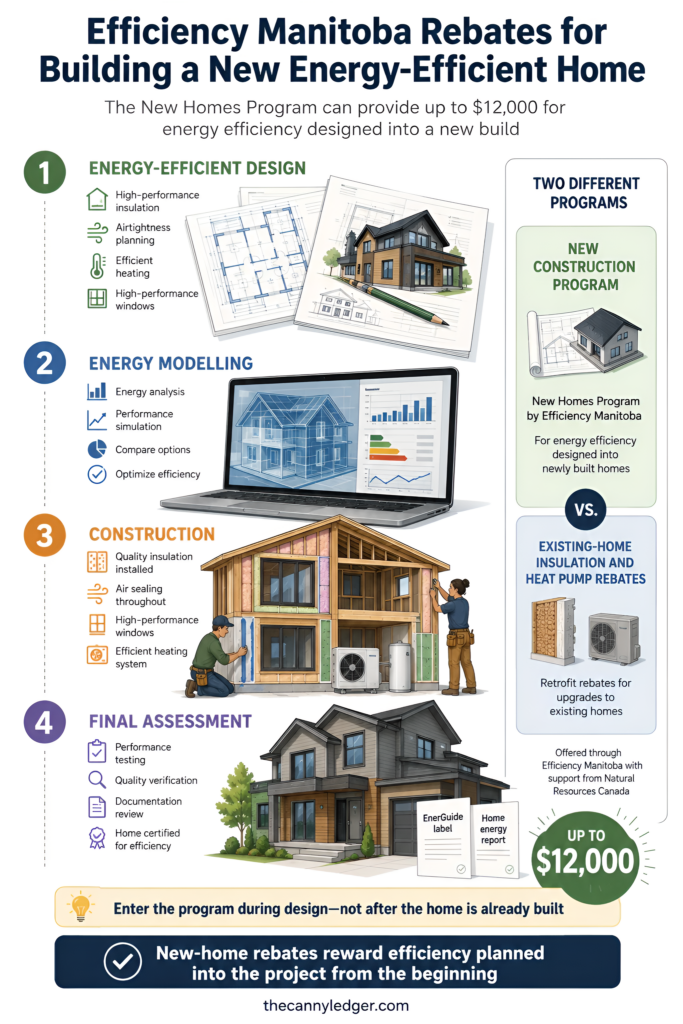
For anyone constructing a genuinely new home rather than upgrading an existing one, Efficiency Manitoba’s New Homes Program offers rebates up to $12,000 to help build to a certified energy-efficient standard, bundling design assistance, detailed energy modelling, and an official EnerGuide label and home energy report produced through Natural Resources Canada. This program addresses a completely different building stage than the insulation and heat pump rebates covered above, which are built around retrofitting existing housing stock rather than shaping a new build from the design phase forward.
Manitoba’s Role in the Federal Oil to Heat Pump Program
Beyond Efficiency Manitoba’s own provincial programs, Manitoba also partners directly with the federal government’s Oil to Heat Pump Affordability program, a $250 million initiative launched under the Canada Greener Homes Initiative specifically to help homes currently heating with oil transition to a cold-climate heat pump instead. Manitoba’s Minister of Environment and Climate Change has specifically framed this partnership around a goal of supporting 5,000 Manitoba families through the switch, with Efficiency Manitoba’s CEO describing the province’s role as making the transition to heat pumps as accessible as possible for eligible households. This program runs alongside, not instead of, Efficiency Manitoba’s own general heat pump rebate, meaning a home currently heating with oil specifically may have access to this additional federal-provincial layer of support beyond the standard provincial program.

Solar and EV Incentives Round Out the Picture
Manitoba also offers a solar rebate worth 50 cents per watt installed, up to a maximum of $5,000, for qualifying solar photovoltaic systems, alongside a separate $4,000 provincial rebate for new electric vehicles purchased through authorized dealers. Neither of these specific incentives runs directly through Efficiency Manitoba’s core rebate programs the way insulation and heat pump rebates do, but both represent genuinely related pieces of Manitoba’s broader push toward home and transportation electrification, worth knowing about if you’re already planning a larger efficiency-focused renovation and want to consider these adjacent opportunities at the same time.

How to Actually Apply
For insulation and heat pump projects specifically, the practical sequence starts with confirming your home’s eligibility, contacting a contractor or retailer already registered with Efficiency Manitoba, and waiting for formal project approval before any purchase or work begins, since starting early can void your eligibility entirely. Once your project is complete, your registered contractor typically helps finalize and submit the required documentation, invoices, and any applicable permits, with Efficiency Manitoba calculating your final rebate amount based on that submitted paperwork and, in some cases, a post-installation verification visit before payment goes out.
Common Questions
Can I use any contractor for an Efficiency Manitoba rebate project, or does it have to be a specific company? Your contractor or retailer needs to be registered with Efficiency Manitoba specifically, so confirming that registration status directly before hiring anyone for a rebate-eligible project is a necessary step, not an optional one.
Do these general rebates run out of funding partway through the year? Program budgets and availability can shift, so confirming current program status and funding availability directly with Efficiency Manitoba before starting a project protects you from assuming a rebate is available when it may have changed.
If my home was built after 1999, am I completely excluded from every rebate? Not necessarily, the pre-1999 requirement applies specifically to the insulation rebate program, while other offerings like heat pump rebates and the New Homes Program for new construction follow entirely different eligibility criteria not tied to a home’s original build year.
Confirm Which Track Actually Fits Your Household
Before assuming you don’t qualify for any Efficiency Manitoba support, confirm which specific track actually applies to your situation: the general rebate programs covered throughout this guide require no income verification at all, while a separate income-tested assistance program exists specifically for lower-income households seeking free rather than rebated upgrades. Contacting Efficiency Manitoba directly to confirm current program funding, eligibility specifics for your home’s age and heating system, and whether federal programs like the Oil to Heat Pump Affordability initiative might stack with a provincial rebate is the genuinely necessary next step before starting any project. Since several of these rebates and tax credits tie directly to your home’s characteristics, our guide to understanding your Winnipeg property tax assessment is also worth reviewing, since a major efficiency renovation can sometimes affect your property’s assessed value down the road.

