
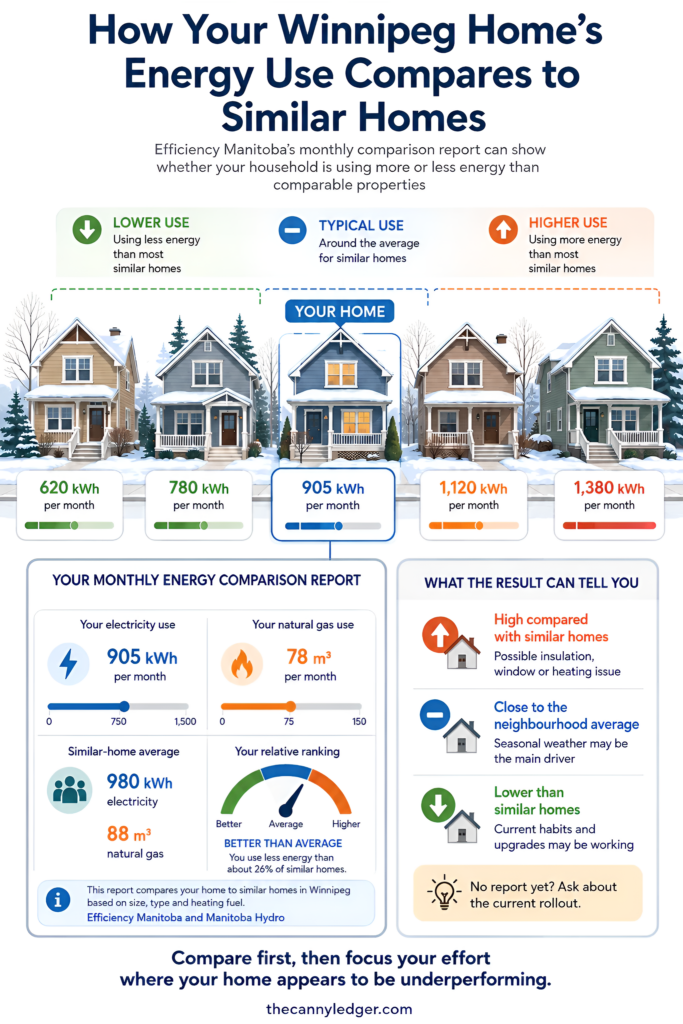
Lynn Campbell lives in a century-old Winnipeg home with a drafty front door, and yet her monthly energy report shows her electricity and natural gas costs running lower than most similar homes, including ones considered efficient. That report is a genuinely new thing: starting this year, Efficiency Manitoba began mailing roughly 100,000 Manitoba households a monthly comparison showing how their actual energy use stacks up against similar homes nearby, a direct response to how opaque a standard Hydro bill has always been about where your money is actually going and whether your household is doing better or worse than comparable homes.
- Efficiency Manitoba Is Now Telling You How You Compare to Your Neighbours
- The Thermostat Setback Rule That Actually Works
- A New Pilot Program Pays You to Shift Your Thermostat on Peak Days
- Insulation and Windows Still Matter More Than Any Single Habit Change
- Draft-Proofing Is the Cheapest Fix With the Fastest Payback
- Ceiling Fans and Airflow Tricks Most People Skip
- Standby Power and the Habits That Actually Add Up
- Smooth Out the Bill Itself With the Equal Payment Plan
- Common Questions
- Start With What’s Actually Costing You the Most
Lowering a Winnipeg hydro bill in winter comes down to a short list of genuinely high-impact changes: setting your thermostat back 3 degrees Celsius or more for at least eight hours a day can save up to 4 percent on heating costs, checking your home’s insulation and window condition addresses the single biggest driver of winter energy use, and enrolling in Manitoba Hydro’s Equal Payment Plan smooths out the seasonal spike into predictable monthly payments even when it doesn’t reduce your total annual cost.
Efficiency Manitoba Is Now Telling You How You Compare to Your Neighbours
Efficiency Manitoba’s new monthly report initiative directly addresses a problem researcher Ian Wilt described bluntly: a standard Hydro bill tells you the cost and compares it to your own previous months, but gives almost no sense of where costs are actually coming from or how your home stacks up against similar houses. The new comparison reports change that specifically, giving roughly 100,000 participating households a genuinely useful benchmark, seeing your own home ranked against comparable homes tells you immediately whether a high bill reflects your specific house’s condition or simply the season everyone’s dealing with. If your household hasn’t received one of these reports yet, checking directly with Efficiency Manitoba about the program’s current rollout status is worth doing, since seeing your own comparative standing is a more useful starting point for prioritizing changes than guessing blind.
The Thermostat Setback Rule That Actually Works
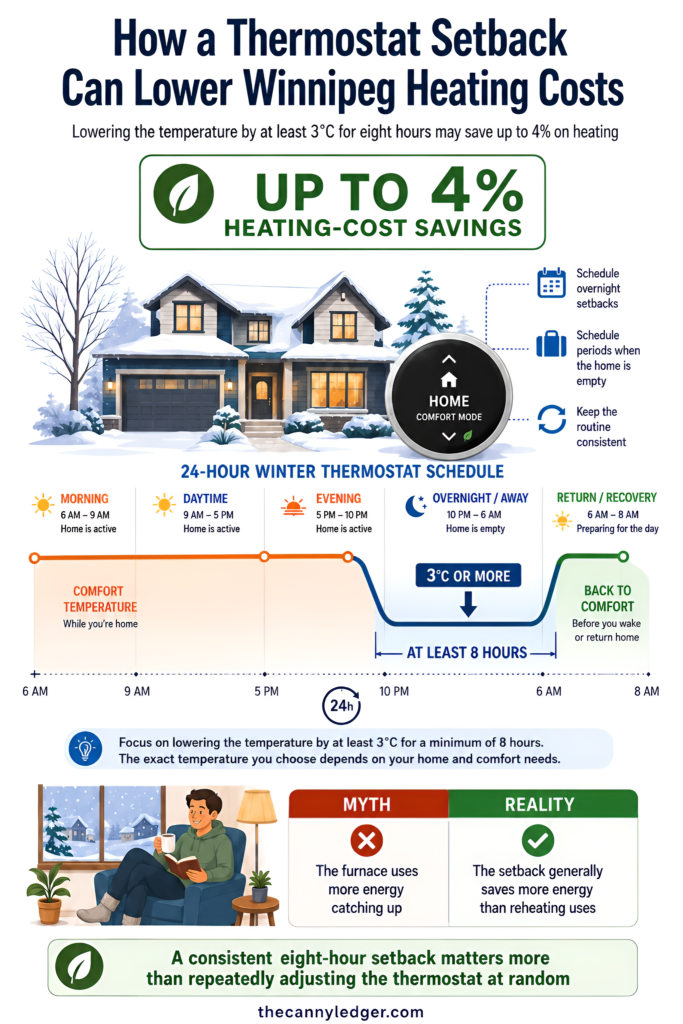
Manitoba Hydro’s own guidance is specific and direct: turning your thermostat down by 3 degrees Celsius or more for at least eight hours a day, whether overnight while you sleep or during the day while you’re away, saves up to 4 percent on heating costs. A furnace does need to run longer to bring a home back up to temperature after a setback period, but the total energy used in that recovery period is consistently less than what you save during the setback itself, a genuine engineering reality rather than a myth about furnaces working harder to catch up. A smart thermostat makes this genuinely easier to actually stick with consistently, since it can learn your household’s patterns and automatically execute the setback without you needing to remember it every single night.
A New Pilot Program Pays You to Shift Your Thermostat on Peak Days
Efficiency Manitoba is piloting a genuinely new incentive specifically for smart thermostat owners: starting this summer, 500 households enrolled in the pilot receive a rebate for shifting their thermostat by one to three degrees during the coldest and hottest peak-demand days of the year. This program is still in development according to Efficiency Manitoba’s own communications team, but it represents a meaningfully different approach than a flat rebate for owning a smart thermostat, instead paying households specifically for the behavior that actually reduces strain on the grid during the exact days that matter most. Worth watching for if you already own a qualifying smart thermostat, since Efficiency Manitoba separately offers a standard $50 rebate for ENERGY STAR certified smart thermostat purchases regardless of whether you participate in this specific peak-shifting pilot.

Insulation and Windows Still Matter More Than Any Single Habit Change
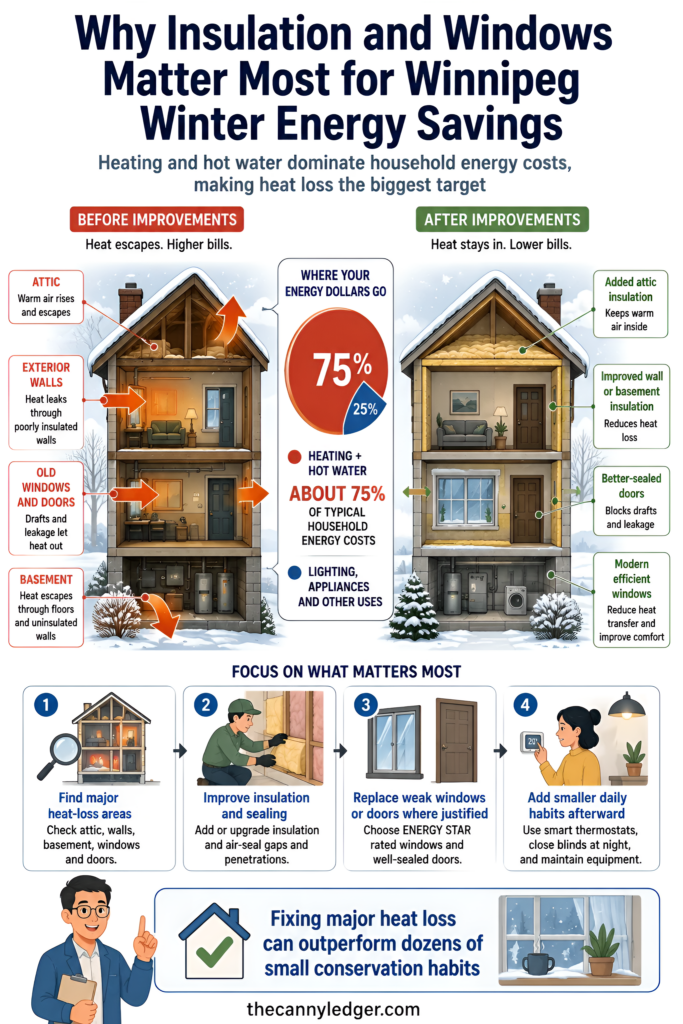
Efficiency Manitoba’s own communications team has been direct that heating and hot water together make up roughly 75 percent of a typical Manitoba household’s total energy cost, and insulation levels specifically in your attic, walls, and basement represent the single biggest lever for controlling that dominant cost driver. Proper windows and doors matter almost as much, with modern window technology capable of dramatically reducing heat loss compared to older, single-pane or poorly sealed windows common in Winnipeg’s older housing stock. No thermostat habit or behavioral change comes close to matching what a genuine insulation or window upgrade can do for a home that’s currently losing heat through poorly insulated walls or old windows, which is precisely why these structural fixes, not daily habits, represent the highest-impact winter savings available to most Winnipeg homeowners.
Draft-Proofing Is the Cheapest Fix With the Fastest Payback
Short of a full insulation or window replacement project, draft-proofing offers a genuinely fast, affordable way to keep heat inside where it belongs, sealing the gaps around doors, windows, and other openings where warm air quietly escapes and cold air seeps in. This is the kind of fix a homeowner can genuinely tackle over a weekend with basic weatherstripping and caulking materials, without needing to hire a contractor or wait for a larger rebate-eligible project to get approved. For renters specifically, draft-proofing remains one of the few winter energy-saving measures genuinely available without needing landlord approval for a larger structural change, since simple weatherstripping around a door or window doesn’t typically require permission the way a bigger renovation would. Our guide to budgeting for a basement suite in Winnipeg covers the specific insulation and heating challenges below-grade units face, a genuinely useful read if that’s the kind of unit you’re heating this winter.

Ceiling Fans and Airflow Tricks Most People Skip
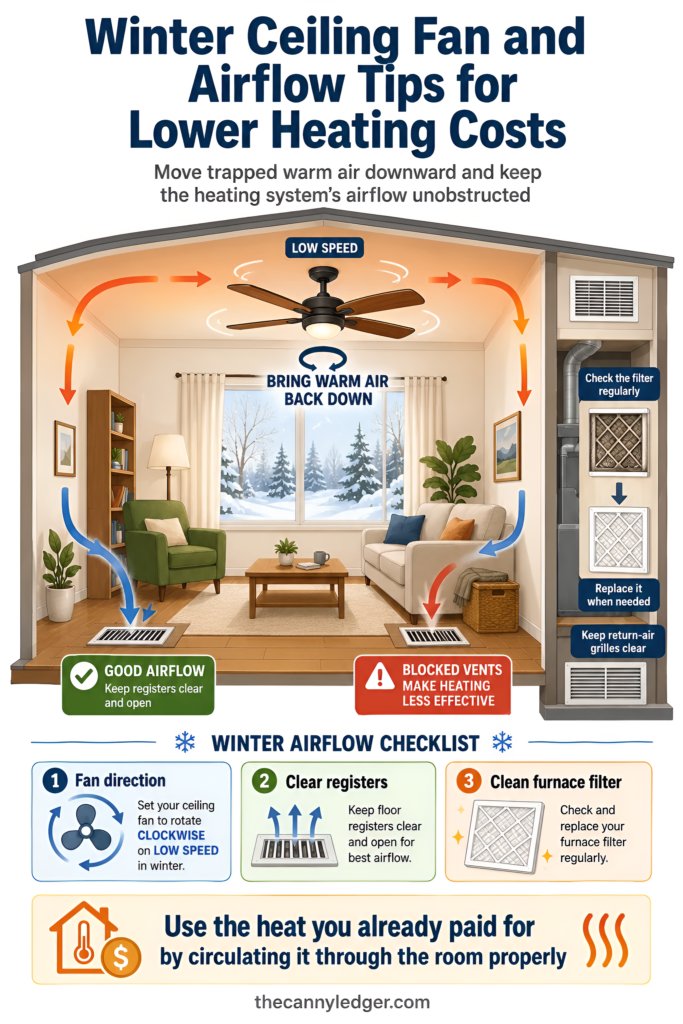
Running ceiling fans clockwise at a low speed during winter pushes warm air that naturally rises back down into the living space rather than letting it collect uselessly near the ceiling, a simple physics-based trick that costs nothing beyond the fan’s own minimal electricity use. Keeping air vents and registers genuinely unobstructed, not blocked by furniture, curtains, or stored items, also matters more than most homeowners realize, since blocked airflow forces a heating system to work harder to achieve the same actual room temperature. Regularly checking and replacing furnace filters rounds out this category of small, low-cost maintenance habits that collectively keep a heating system running at genuine efficiency rather than fighting against avoidable obstructions.
Standby Power and the Habits That Actually Add Up
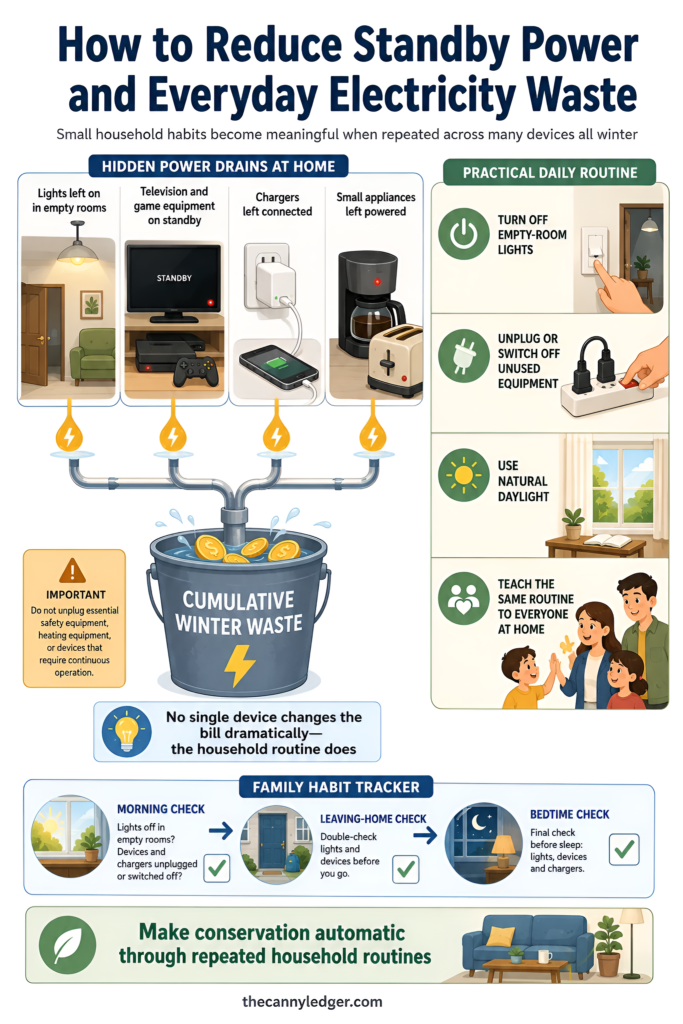
Never leaving lights on or appliances plugged in unnecessarily when you leave the house remains genuinely worth doing, even though any single device draws relatively little power on its own, since the combined effect across an entire household adds up meaningfully over a full winter. Taking advantage of natural daylight hours rather than defaulting to artificial lighting, and modelling these habits for kids in the household so conservation becomes a normal part of daily routine rather than a one-time effort, both compound over time in a way a single dramatic change wouldn’t.
Smooth Out the Bill Itself With the Equal Payment Plan
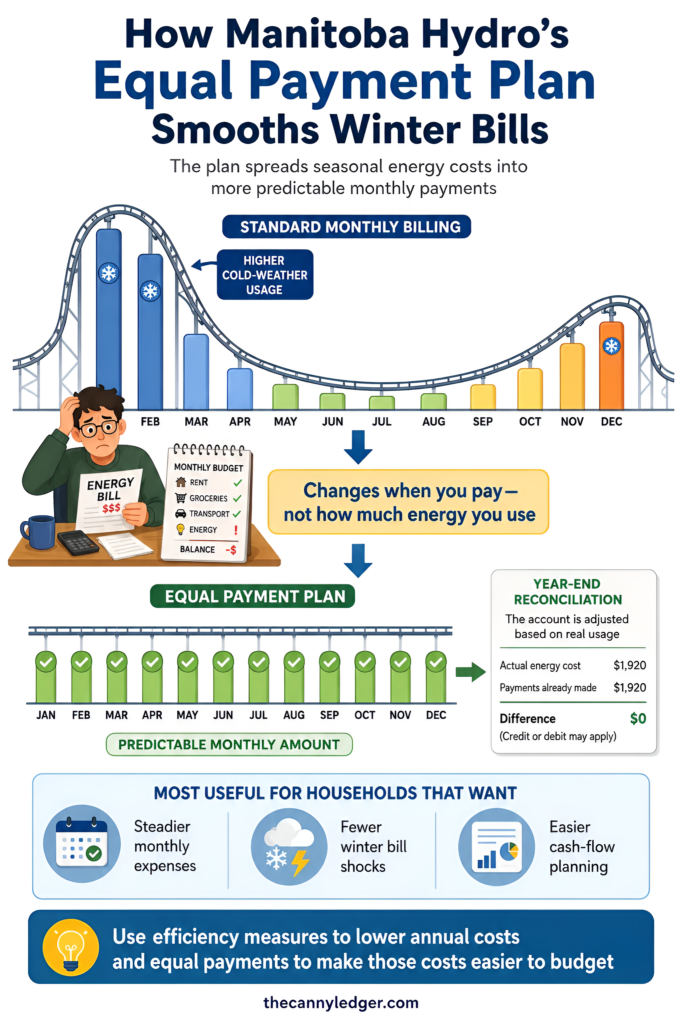
Even with every efficiency habit and upgrade covered above in place, Manitoba’s genuinely cold winters still mean higher energy consumption during the coldest months compared to summer, and Manitoba Hydro’s Equal Payment Plan exists specifically to smooth that seasonal swing into predictable, equal monthly payments rather than facing a dramatically higher bill every January and February. This doesn’t reduce your total annual energy cost, since Hydro reconciles your actual usage against your payments once a year, but the budgeting predictability genuinely matters for any household that finds a spiking winter bill harder to absorb than a flat monthly amount spread evenly across the full year. Our guide to all-utilities-included apartments in Winnipeg is worth checking if you’re a renter specifically weighing whether a unit with utilities bundled into rent might actually serve your household better than managing these seasonal swings directly yourself.
Common Questions
Does a smart thermostat actually pay for itself in a typical Winnipeg winter? For most households running consistent setback schedules already, the savings from a smart thermostat come mainly from consistency rather than a dramatically different setback amount, so the actual payback period depends heavily on whether you were already manually adjusting your thermostat regularly before switching to a smart model.
Is it actually more efficient to leave the heat running low all day than to set it back and reheat later? No, this is a genuine misconception. Manitoba Hydro’s own engineering guidance confirms that reheating a home after a setback period always uses less total energy than maintaining a constant higher temperature throughout that same period.
Should renters bother with any of these tips if they don’t pay their own heating bill directly? If heat is included in your rent, the direct financial benefit to you personally is limited, though draft-proofing and thermostat habits still improve comfort, and confirming exactly which utilities your specific lease includes is worth doing before assuming these tips don’t apply to your situation at all.
Start With What’s Actually Costing You the Most
Rather than adopting every tip in this guide at once, start by checking whether Efficiency Manitoba’s new comparison report program has reached your household yet, since seeing where your specific home actually ranks against similar homes tells you whether your priority should be a structural fix like insulation or windows, or simply more consistent habits like thermostat setbacks and draft-proofing. Whichever category your own home falls into, the biggest wins consistently come from addressing heating specifically, not the smaller appliance and lighting habits most winter energy-saving advice defaults to first.