


Canada’s Food Price Report projects a national family of four will spend somewhere between $16,800 and $17,600 on food in 2026, working out to roughly $1,400 to $1,467 a month before a single restaurant meal gets added on top. Manitoba, along with British Columbia and New Brunswick, is specifically forecast to see smaller price increases than that national trend in 2026, after running above average in 2025, according to the report’s own findings. For a Winnipeg household trying to figure out whether their own grocery bill is reasonable, that provincial detail matters more than the national headline number most coverage leads with.
- Manitoba Is Actually Forecast to See Smaller Increases in 2026
- What a Winnipeg Household Actually Spends by Size
- Why Groceries Are Zero-Rated for Tax and What That Actually Covers
- Which Categories Are Driving the 2026 Increase
- Why Winnipeg Ranks Among the Cheapest Cities to Buy Groceries
- The Real Range Behind Any “Average” Figure
- Practical Ways to Actually Track Your Own Number
- Common Questions
- Track Your Own Baseline Before Comparing to Anyone Else’s
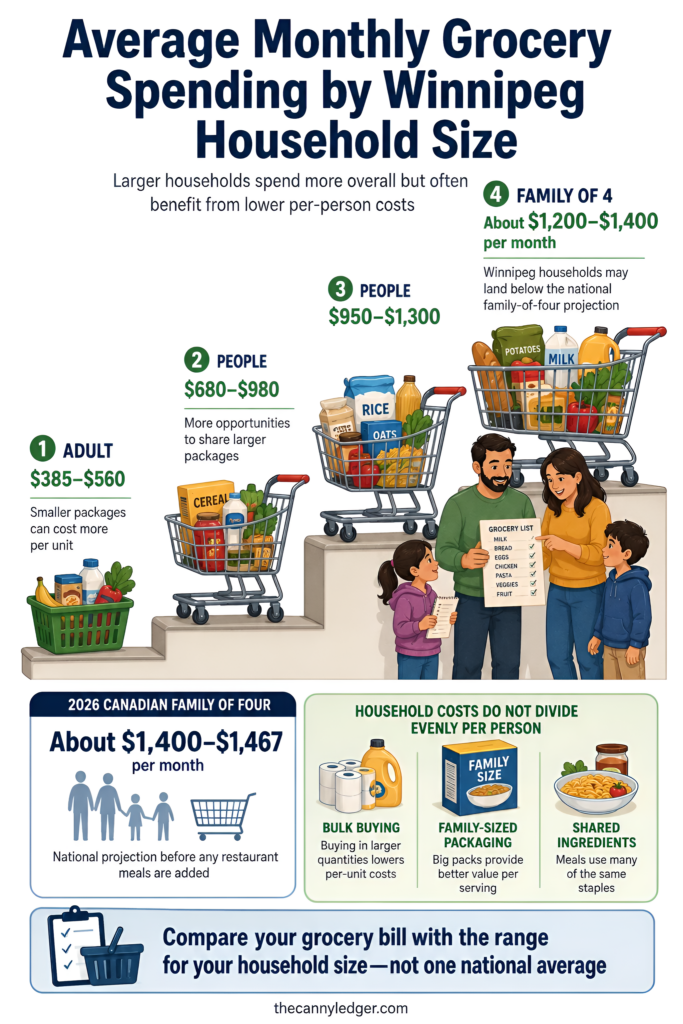
A Winnipeg household’s grocery spending varies enormously by size: a single adult eating mostly at home typically spends $385 to $560 a month, a couple lands somewhere between $680 and $980, a household of three runs $950 to $1,300, and a family of four sits close to or somewhat below the $1,400 national monthly average, reflecting Winnipeg’s position among Canada’s more affordable major grocery markets. Basic whole foods are taxed at 0 percent under GST rules across the country, meaning the bulk of a typical grocery run carries no sales tax at all, a detail that meaningfully affects the final total on your receipt compared to almost any other category of household spending.
Manitoba Is Actually Forecast to See Smaller Increases in 2026
Grocery inflation hit 4.7 percent year over year as of November 2025 nationally, a genuinely significant jump compounding on top of several previous years of elevated food price growth. Manitoba’s specific position within that national picture shifted for 2026: after running above the national average increase through 2025, the province is one of only three, alongside British Columbia and New Brunswick, forecast to fall below the national average price growth in 2026. This doesn’t mean Manitoba grocery prices are dropping, only that they’re expected to rise more slowly here than in most other parts of the country over the coming year, a genuinely useful distinction for anyone trying to gauge whether their own rising bill reflects something specific to their shopping habits or simply the broader national trend.

What a Winnipeg Household Actually Spends by Size
Household spending on groceries scales in a way that doesn’t divide evenly per person, since bulk buying and family-sized packaging become genuinely practical once a household grows past a single adult. A single adult shopping mostly for themselves typically spends $385 to $560 a month, often paying more per unit than larger households since most packaging and bulk discounts are designed around feeding more than one person. A couple typically spends $680 to $980 monthly, and a household of three, commonly two adults and one child, lands in the $950 to $1,300 range. For a family of four, the national projection sits close to $1,400 a month, though households in more affordable major cities, a category Winnipeg consistently falls into, often land closer to $1,200, meaningfully below that national midpoint.
Why Groceries Are Zero-Rated for Tax and What That Actually Covers
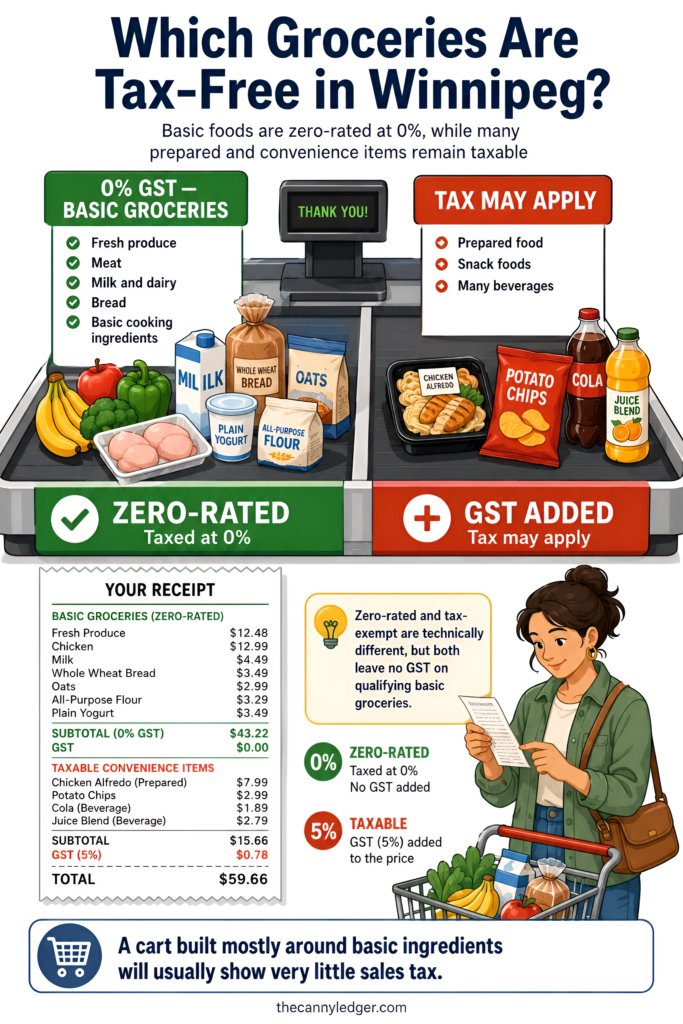
Basic groceries in Canada are zero-rated under GST and HST rules, meaning they’re taxed at 0 percent rather than being outright exempt, a small technical distinction that still results in essentially no sales tax showing up on most of a standard grocery bill. This zero-rating applies broadly to whole foods and basic ingredients, meat, produce, dairy, bread, and similar staples, while prepared foods, snacks, and many beverages remain taxable at the standard rate. In practice, a typical weekly shop built mostly around whole ingredients rather than processed convenience items will show very little tax on the final receipt, one of the more genuinely useful and under-recognized advantages Canadian grocery shoppers have over consumers in countries where food carries a standard sales tax rate straight through. Our guide to GST in Winnipeg covers this zero-rating alongside the broader federal sales tax structure in more depth.
Which Categories Are Driving the 2026 Increase
Within the 2026 Food Price Report’s category breakdown, meat is projected to see the largest jump of any category, rising 5 to 7 percent, with the widest range of uncertainty among all the food categories tracked. Bakery items, vegetables, and restaurant meals are also expected to climb noticeably, while fruit and seafood are forecast to see comparatively modest increases relative to the rest of the basket. This category-level detail matters for anyone trying to actually manage their own bill, since a household that already leans toward fruit, seafood, and home cooking over meat-heavy meals and restaurant spending is likely to see a smaller overall increase than the average projection suggests.

Why Winnipeg Ranks Among the Cheapest Cities to Buy Groceries
Winnipeg and Edmonton regularly rank among Canada’s most affordable major cities for groceries, a position driven by several compounding factors specific to the Prairies. Strong competition from warehouse-style retailers, including Costco and Real Canadian Wholesale Club, keeps downward pressure on prices across a wide range of categories. Proximity to Prairie agricultural production reduces transportation costs on many staples compared to cities relying more heavily on imported produce, particularly through the winter months. Lower commercial real estate costs in Winnipeg compared to cities like Vancouver or Toronto also feed through into lower overhead for grocery retailers, a cost saving that competition tends to pass at least partially along to shoppers rather than being fully absorbed as extra margin.

The Real Range Behind Any “Average” Figure
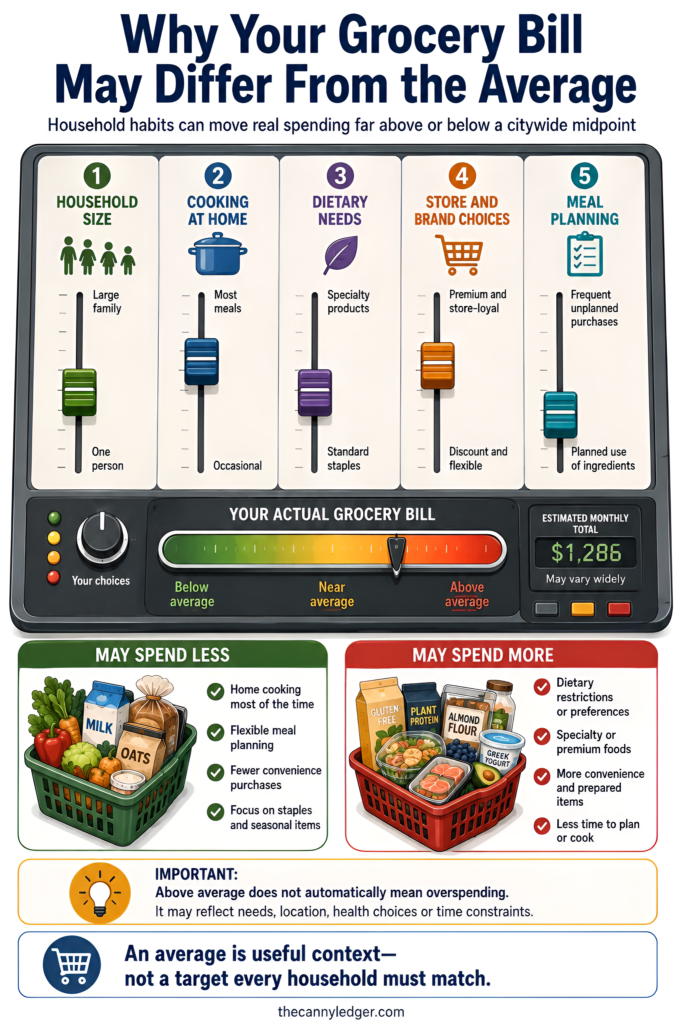
Every figure cited throughout this guide represents a midpoint or projected range rather than a number that applies precisely to any single household, since actual grocery spending depends heavily on dietary choices, how much cooking happens at home versus eating out, specific store loyalty, and genuine household-to-household variation in what gets bought each week. A family choosing to prioritize fresh produce and home-cooked meals over convenience foods and takeout will land meaningfully below these averages, while a household with specific dietary restrictions requiring specialty products, or simply less flexibility around meal planning, may run above them regardless of how carefully they shop.
Practical Ways to Actually Track Your Own Number
Rather than comparing your household against a national or even provincial average that may not reflect your specific circumstances, tracking your own actual monthly grocery spending over two or three months gives you a genuine personal baseline worth measuring future changes against. If your own number is running noticeably above the ranges described here for your household size, reviewing which specific categories, meat, bakery, and restaurant meals are the ones the 2026 report flags as rising fastest, is a reasonable starting point for figuring out where the gap is actually coming from. For households genuinely struggling to cover grocery costs, our guides to food banks in Winnipeg and how Winnipeg Harvest works cover real, available support options worth knowing about directly.

Common Questions
Does the zero-rating on groceries apply to everything I buy at a grocery store? No, it applies specifically to basic whole foods and ingredients, while prepared foods, snacks, and many beverages remain taxable, so a cart mixing staples with convenience items will show tax on only a portion of the total.
Why is Manitoba forecast to see smaller increases in 2026 specifically? The 2026 Food Price Report identifies Manitoba as one of a small group of provinces expected to fall below the national average increase after running above it in 2025, though the report doesn’t attribute this to any single specific local factor beyond the broader category-level pricing trends affecting the whole country.
Is Winnipeg’s grocery advantage likely to continue long-term? The underlying factors, warehouse retailer competition, proximity to Prairie agriculture, and lower commercial real estate costs, are structural rather than temporary, suggesting Winnipeg’s relative affordability compared to cities like Vancouver or Toronto is likely to persist even as national grocery prices continue climbing overall.
Track Your Own Baseline Before Comparing to Anyone Else’s
The single most useful step for any Winnipeg household isn’t memorizing the national or provincial averages covered here, it’s tracking your own actual spending for a couple of months to establish a real personal baseline, then checking that number against these ranges for genuine context rather than as a strict target to hit. A household spending meaningfully more than these figures for their size isn’t necessarily doing anything wrong, but it’s worth understanding specifically why before assuming the gap is simply “prices are high everywhere right now.”