- Two Private Companies, Not One System
- Why Your Two Reports Actually Don’t Match
- The Dispute Process Runs on Different Clocks
- Freeze and Lock Aren’t the Same Word for the Same Thing
- Quebec Gets an Escalation Path the Rest of Canada Doesn’t
- What Each One Actually Sells, Beyond Your Report
- What to Actually Check Right Now
- Follow-Up Questions People Ask
Equifax Canada and TransUnion Canada are competitors, not coworkers. That fact surprises a lot of people who assume the two bureaus are somehow coordinated branches of one national credit system, quietly comparing notes behind the scenes. They’re not. They’re two separate private companies that happen to occupy the same market, and that competitive, siloed structure is the actual reason your file at one can look meaningfully different from your file at the other, sometimes in ways that matter a great deal when a lender pulls just one.
Equifax Canada and TransUnion Canada are the two private companies that collect and report Canadian credit information, and neither is government run. They operate independently, use different scoring models, run dispute investigations on different timelines, and often hold different data on the same person, since lenders can choose to report to one, both, or neither bureau. Understanding them as separate businesses rather than one shared system changes how you should actually manage your credit file.
Two Private Companies, Not One System
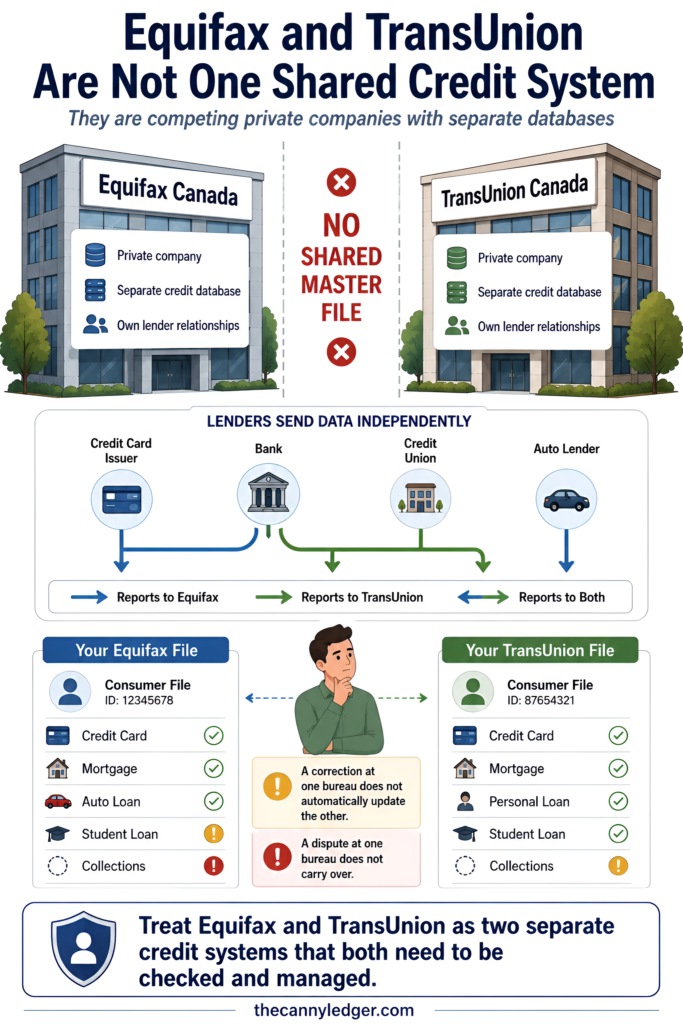
Neither bureau is a government agency, and neither answers to the other. Equifax Canada is the Canadian arm of Equifax, an American company headquartered in Atlanta, while TransUnion Canada is the Canadian arm of TransUnion, based in Chicago. Both operate in Canada under Canadian privacy and consumer protection law, but structurally they’re commercial competitors selling overlapping but distinct products to lenders, landlords, and employers, not two departments of the same organization quietly sharing a database.
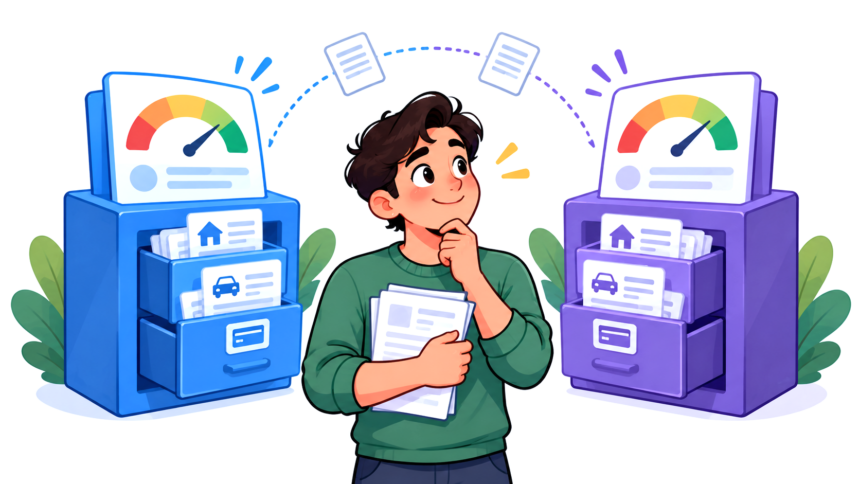
That competitive relationship explains a detail that trips a lot of people up the first time they notice it. A missed payment corrected at Equifax doesn’t automatically get corrected at TransUnion. A dispute resolved with one bureau has zero effect on the other. If you’ve only ever checked one, you’ve only ever seen half the actual picture a lender might be working from.
Why Your Two Reports Actually Don’t Match
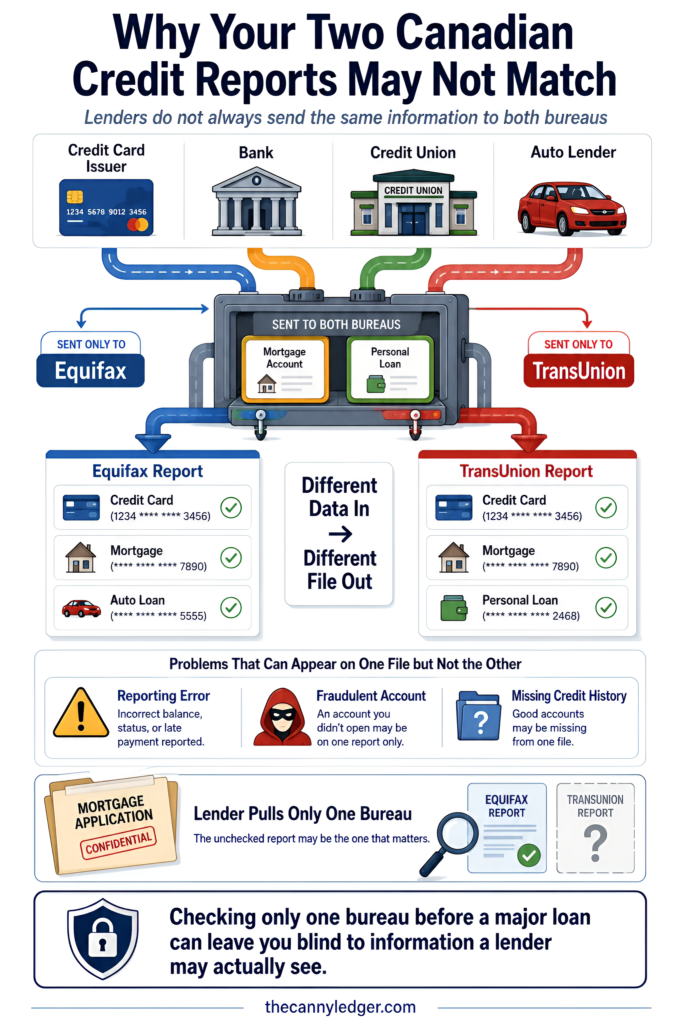
The core reason your Equifax file and your TransUnion file diverge isn’t a glitch, it’s baked into how the whole system works. Lenders choose which bureau or bureaus they report to, and plenty report to only one rather than both, whether it’s a national bank or a smaller credit union. A credit card from one issuer might show up cleanly on your Equifax file while barely registering on TransUnion’s, and a car loan from a different lender could run the exact opposite way. Neither bureau has a complete picture of your credit life on its own, because neither one is guaranteed to be receiving the same data everyone else sends.
This is the practical reason pulling only one report before a major application is a real risk, not just an abundance-of-caution suggestion. An error, a fraudulent account, or simply a thinner history sitting on the bureau you didn’t check is invisible until a lender who does pull that file flags it, at which point you’re finding out about a problem in the middle of a mortgage or car loan application rather than ahead of one.
The Dispute Process Runs on Different Clocks
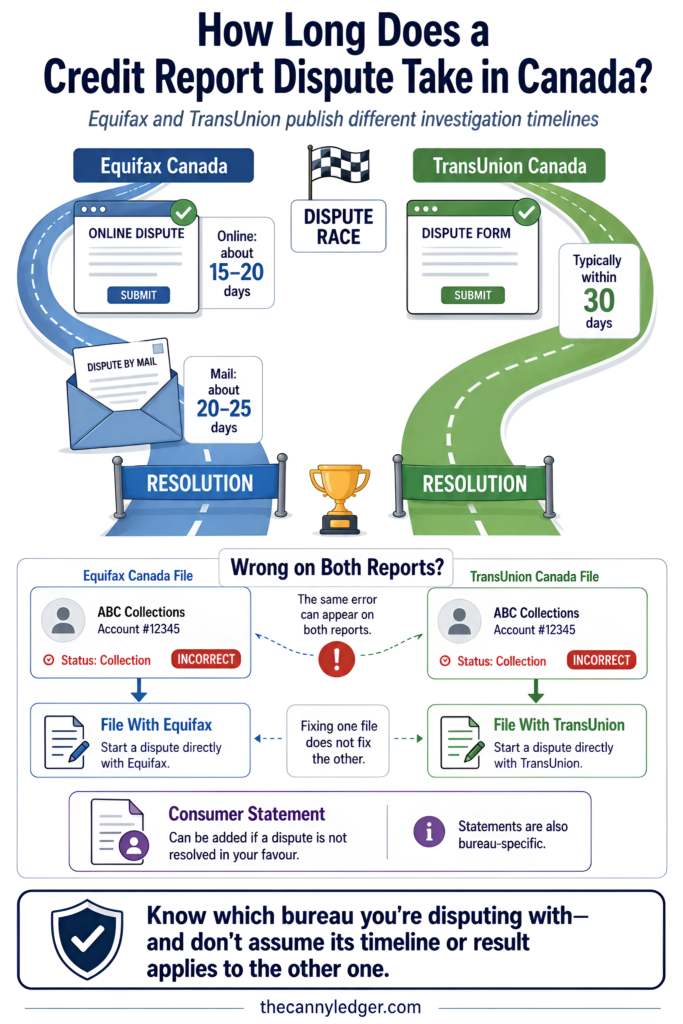
This is where the two companies diverge in a way that’s actually useful to know before you need it. According to Equifax Canada’s own dispute page, the company processes disputes in about 15 to 20 days for online submissions and 20 to 25 days for mailed ones. TransUnion Canada’s own site states its investigations are typically concluded within 30 days of receiving the request, regardless of submission method. That’s a real difference in how long you’re waiting to find out whether an error gets fixed, and it’s worth knowing which bureau you’re dealing with before you assume a timeline based on one company’s process.
Both bureaus let you attach a consumer statement to your file if a dispute doesn’t resolve in your favour, a short written explanation that any future lender pulling your report will see alongside the disputed item. Neither statement transfers between bureaus either, so a statement added at Equifax stays invisible to anyone pulling only your TransUnion file.
Freeze and Lock Aren’t the Same Word for the Same Thing
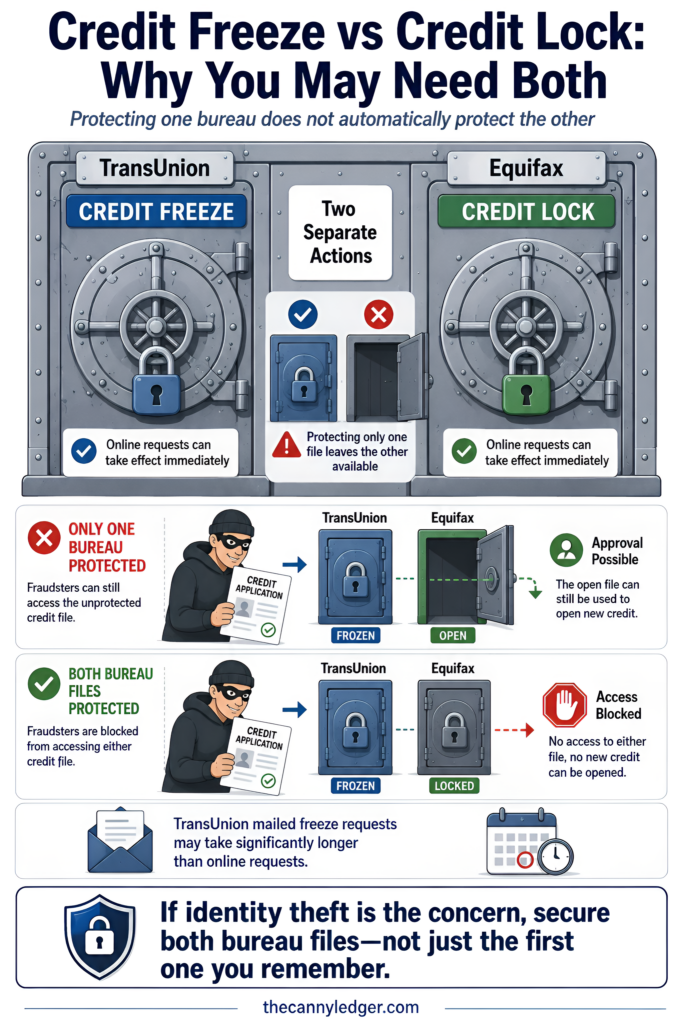
Here’s a distinction that catches people specifically because the two companies use different terminology for what’s functionally a similar protective tool. TransUnion Canada calls its version a credit freeze, and its own page states directly that placing one doesn’t touch your Equifax file at all, since Equifax’s equivalent tool is called a credit lock and has to be requested separately through Equifax. If you’re worried enough about identity theft to freeze your file, freezing only one bureau leaves the other completely open to a fraudulent application, which defeats the purpose of doing it at all.
Timing differs too. TransUnion’s own page states an online freeze request goes into effect immediately, while a mailed request can take up to 30 days to process. Anyone locking down their credit after a real fraud concern needs both actions taken, at both companies, not just one.
Quebec Gets an Escalation Path the Rest of Canada Doesn’t
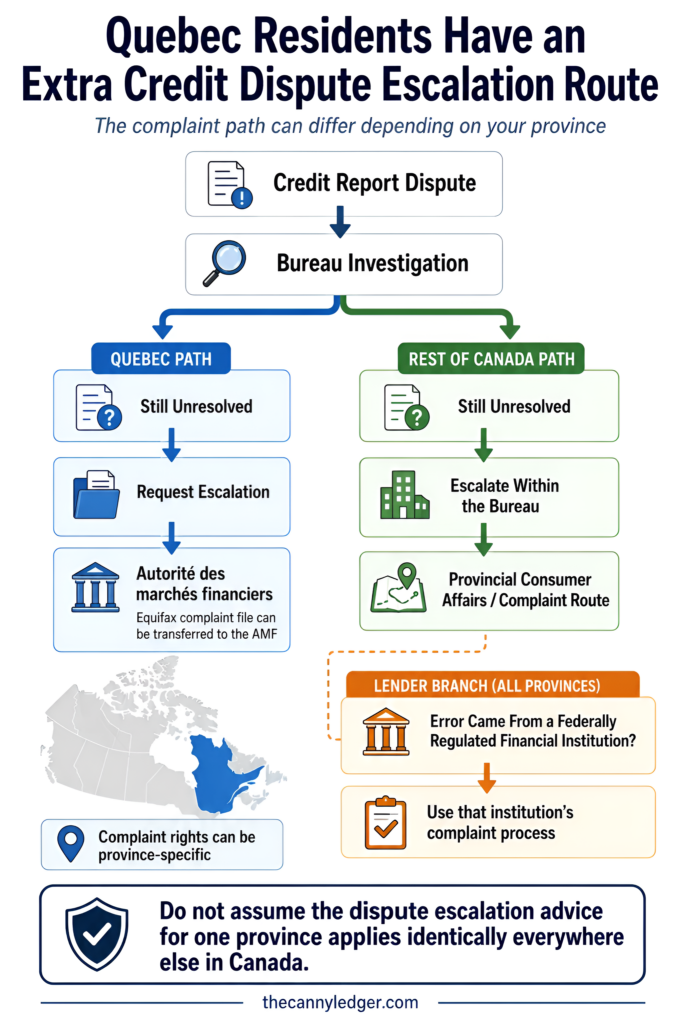
If a dispute with Equifax Canada doesn’t resolve to your satisfaction and you’re a Quebec resident, Equifax’s own complaint process describes a formal path to transfer your complaint to the Autorité des marchés financiers, Quebec’s financial regulator, with Equifax required to hand over all related information to the AMF within 15 days of that request. This is a provincial mechanism that doesn’t exist the same way outside Quebec, where escalation generally runs through your provincial consumer affairs office instead, a distinction worth knowing if you’re comparing notes with someone in a different province and getting a different answer about what to do next.
Beyond the province-specific route, the Government of Canada’s own guidance on checking your credit report confirms the general escalation pattern that applies regardless of which bureau you’re dealing with, ask to speak with someone at a higher level within the bureau if the initial dispute result doesn’t satisfy you, and if the disputed information came from a federally regulated financial institution, that institution is required to have its own complaint procedure with access to an external complaints body as a further step.
What Each One Actually Sells, Beyond Your Report
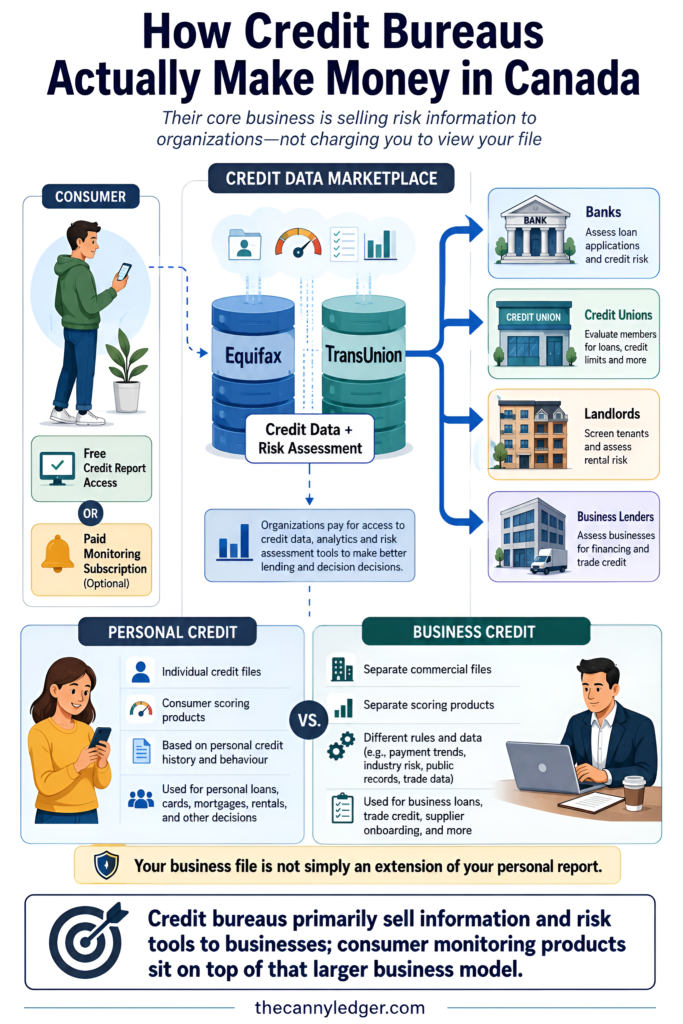
Both companies exist commercially by selling data and risk assessment to lenders, including the banks and credit unions you already do business with, not by charging consumers, which is worth remembering when either one pitches you a paid monitoring product. Equifax and TransUnion both offer free annual reports by law and both sell premium monitoring subscriptions on top of that baseline, along with entirely separate business credit products aimed at lenders assessing companies rather than individuals. If you’re running a small business alongside managing your own credit, it’s worth knowing those are truly separate systems with separate rules, not an extension of your personal file.
What to Actually Check Right Now
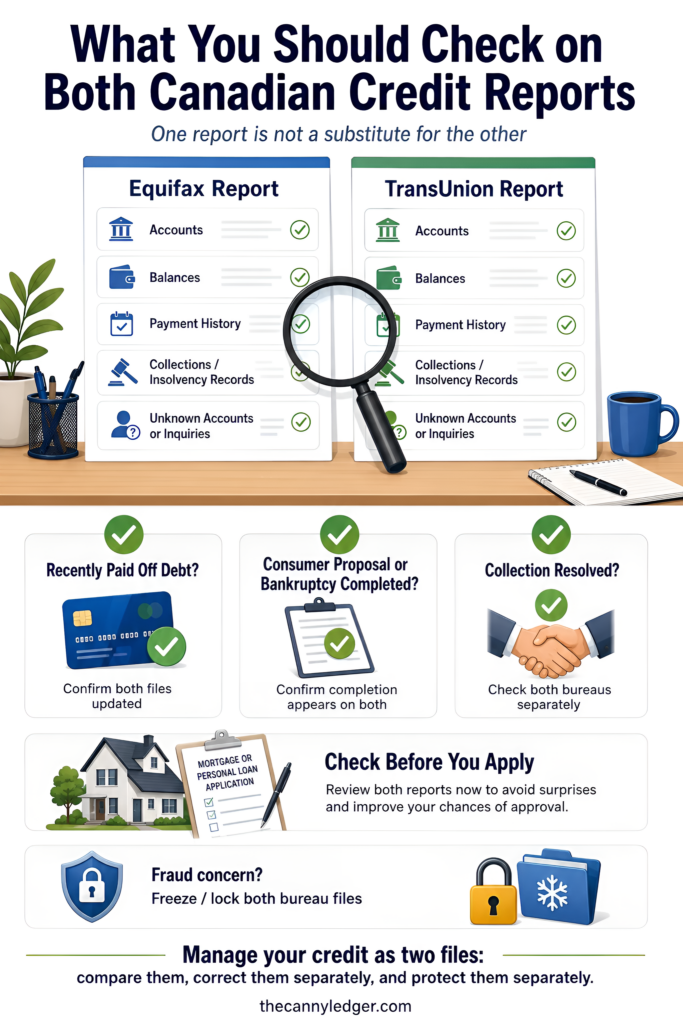
Pull your report from both bureaus rather than treating one as a stand-in for the other, since the gap between them is structural, not occasional. If you’re carrying any debt you’re working through or came out of a bankruptcy or consumer proposal recently, check that the resolution shows correctly at both bureaus specifically, since a completion certificate sent to one company doesn’t automatically update the other. The same applies if a collections account was resolved through direct negotiation with the agency rather than through the bureau’s own dispute process. If something looks wrong, know which bureau’s timeline you’re working with before you assume a fix will land in 30 days everywhere, and before applying for a personal loan or anything larger, checking both files ahead of time beats finding out about a gap mid-application. And if identity theft is even a mild concern, freeze or lock both files, not just the one that came to mind first, since half-measures here leave a real gap open.
Follow-Up Questions People Ask
If I fix an error at one bureau, should I still check the other? Yes, always. The two systems don’t communicate, so an error corrected at Equifax can sit unchanged at TransUnion indefinitely unless you separately dispute it there too.
Does a lender ever pull both reports for the same application? Sometimes, particularly for larger applications like a mortgage, though plenty of everyday applications like a retail credit card only pull one. Which bureau gets pulled depends entirely on that specific lender’s own arrangement, not on any rule that applies across the industry.
Is one bureau generally more accurate than the other? No reliable, current, Canada-specific research supports treating either bureau as consistently more accurate than the other. Errors happen at both, for the same underlying reason, creditors and lenders occasionally report incorrect information to whichever bureau they happen to use.