

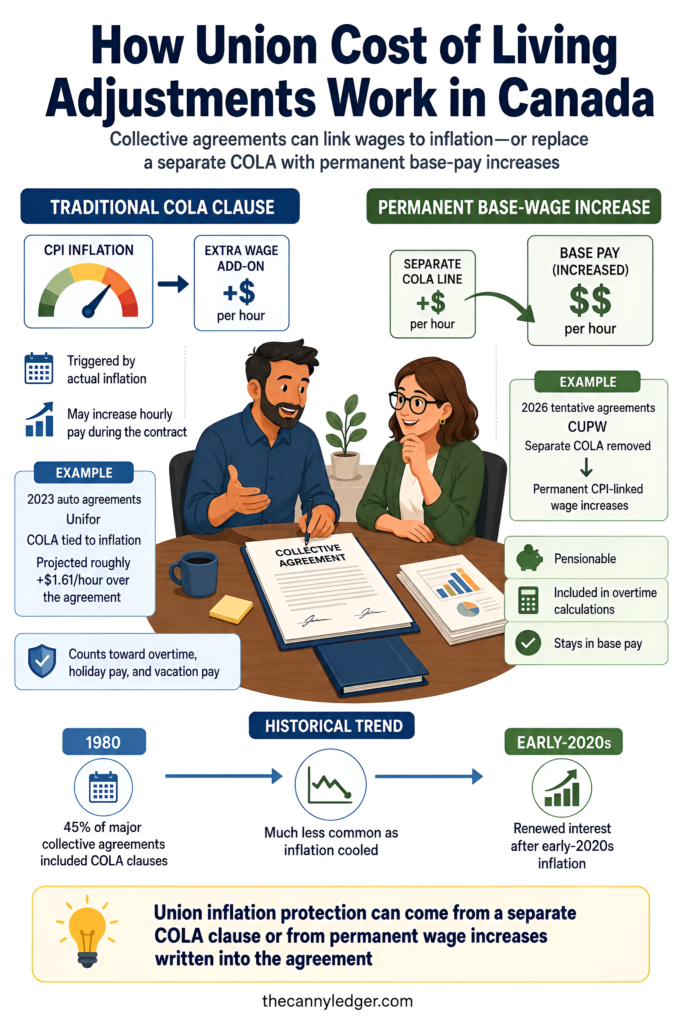
Canada’s postal workers just negotiated their own cost of living allowance out of existence on purpose, and they’re calling it a win. CUPW’s 2026 tentative agreements convert what used to be separate COLA payments into permanent wage increases tied to the average annual change in the Consumer Price Index, a formula the union says protects members more effectively than the old allowance ever did, since the increases become pensionable, count toward overtime calculations, and fold permanently into base pay instead of disappearing the moment the contract expires. It’s a genuinely useful reminder that a cost of living allowance isn’t one fixed thing in Canada. It’s a whole family of different mechanisms, and which one, if any, applies to you depends almost entirely on who you work for.
- COLA Means Something Different Depending On Who’s Paying It
- The Federal Government Runs The Most Formalized System In The Country
- Provinces Run Comparable Programs For Their Own Employees
- Union Contracts Are Where Most Other Canadians Actually See This
- Most Private Sector Employees Simply Don’t Have This At All
- What This Actually Means For Your Own Situation
This piece covers what a COLA actually looks like across Canadian employment, the formal federal program built specifically around it, how it shows up in union contracts, and the honest reality for the large share of workers who don’t have access to anything like it at all.
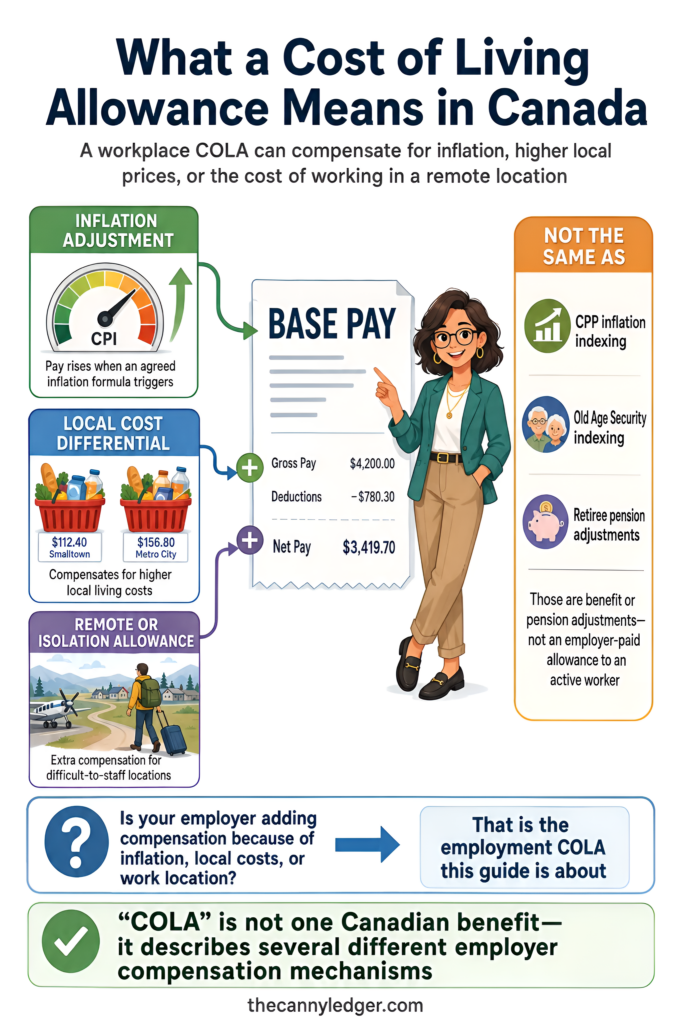
COLA Means Something Different Depending On Who’s Paying It
Before getting into the specific mechanisms, it’s worth separating this from a related but different topic. Government benefit payments like the Canada Pension Plan and Old Age Security get indexed to inflation automatically through their own legislated formulas, and pension plans like the Ontario Public Service Pension Plan and OPTrust apply an annual cost of living adjustment to retirees, both real and both worth knowing about, but neither is an employer paying an active employee more because of where they live or work. A true employment cost of living allowance is something an employer adds to an active worker’s compensation specifically because of local prices, remoteness, or a formal inflation-indexing clause in their contract, and that’s the version this piece focuses on.
The Federal Government Runs The Most Formalized System In The Country
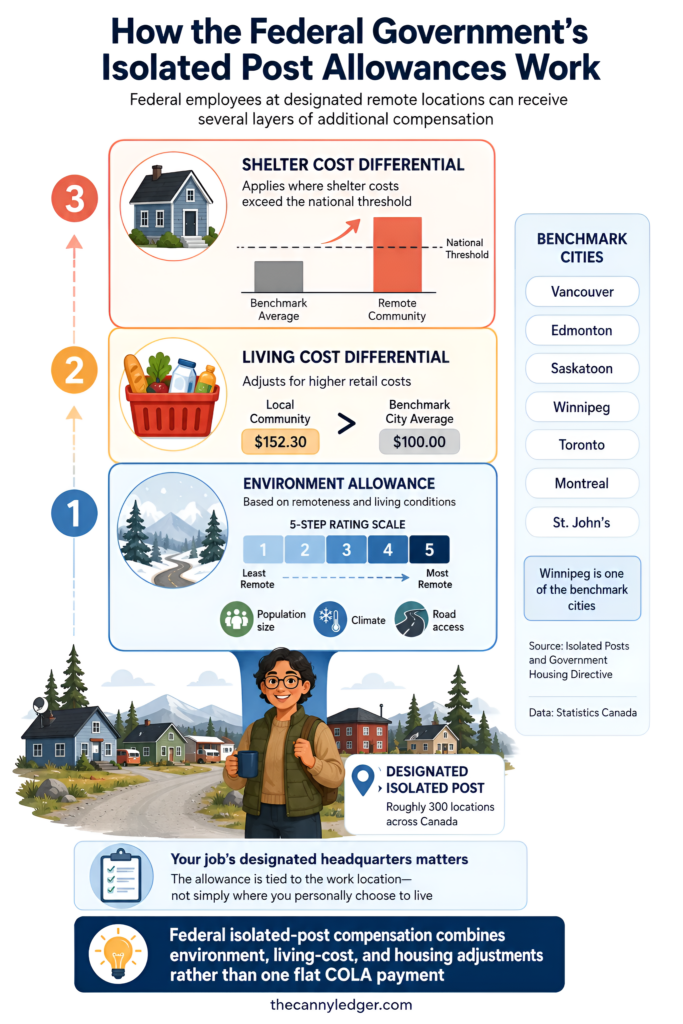
If you’re looking for the single most structured cost of living allowance in Canadian employment, it belongs to the federal public service. The Isolated Posts and Government Housing Directive covers federal employees working at roughly 300 designated locations across Canada, and its purpose is explicit, to offset the genuinely higher cost of living and working somewhere isolated enough that recruiting and retaining staff would otherwise be difficult.
The directive isn’t a single flat payment. It layers together several distinct components, an Environment Allowance rated on a scale of one to five based on factors like population size, climate, and road access, a Living Cost Differential that adjusts for retail price differences, and a Shelter Cost Differential for locations where housing costs run above the national threshold. Statistics Canada itself calculates the underlying price indexes behind these allowances, comparing prices at each isolated post against seven reference cities used as the national benchmark, Vancouver, Edmonton, Saskatoon, Winnipeg, Toronto, Montreal, and St. John’s. Winnipeg’s own cost of living literally functions as one of the yardsticks this entire federal system gets measured against, a detail most Manitobans working outside the public service have never had a reason to know.
Provinces Run Comparable Programs For Their Own Employees
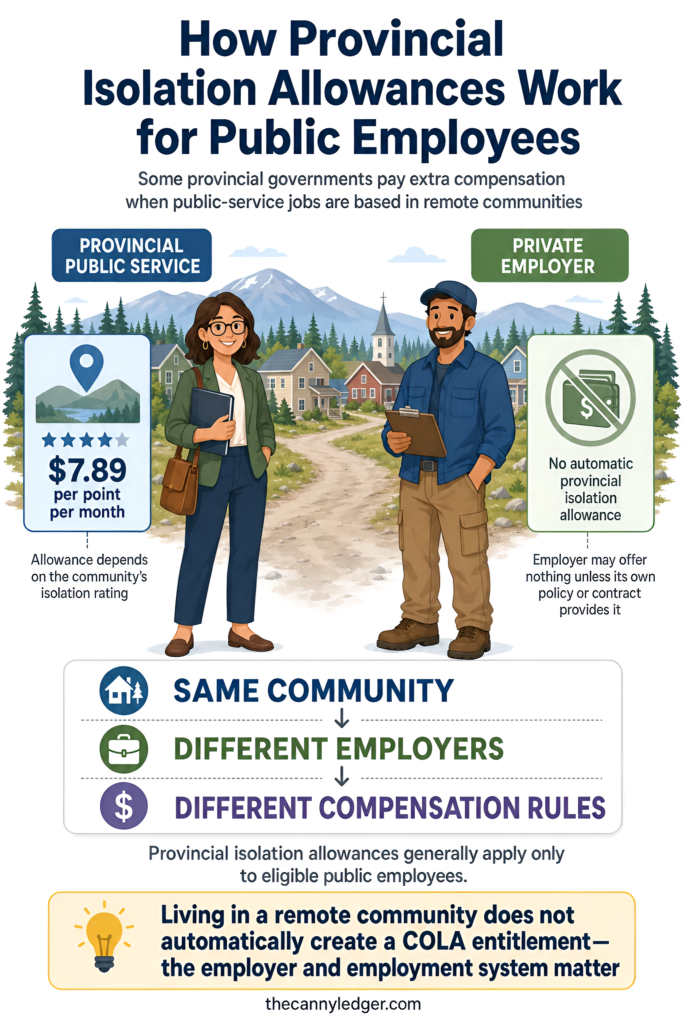
Several provincial governments maintain a parallel version of this same idea for their own workforce. British Columbia’s public service pays an isolation allowance of $7.89 per point per month, based on an isolated location point rating assigned to the community where an employee’s job is headquartered, a more direct, simpler formula than the federal system but built around the same underlying logic. These provincial programs generally apply only to provincial public servants, not to private employers operating in the same remote communities, which means two neighbours doing similar work for different employers in the same isolated town can end up with meaningfully different total compensation once this allowance gets factored in.
Union Contracts Are Where Most Other Canadians Actually See This
Outside the public service, a formal COLA clause shows up almost exclusively in unionized workplaces, and even there it’s become far less common than it used to be. A federal government research paper tracking major collective agreements found that 45 percent of Canadian collective agreements settled in 1980 included a COLA clause, covering nearly 70 percent of unionized workers that year, a share that shrank dramatically as inflation cooled through the 1980s and 1990s. That same research found Ontario retained the highest concentration of COLA clauses among the provinces studied, while federal jurisdiction agreements with the clause mostly dated from before 1991.
Interest in COLA clauses picked back up hard once inflation returned in the early 2020s. Unifor’s 2023 auto sector agreements built in a COLA tied directly to actual inflation, projected at the time to add roughly $1.61 an hour over the life of the contract on top of negotiated base increases, and explicitly structured to count toward overtime, holiday pay, and vacation pay calculations rather than sitting outside them. CUPW’s 2026 agreements represent the opposite instinct working toward the same goal, converting the allowance into permanent, pensionable wage growth instead of keeping it as a separate line that vanishes when the contract ends.
Most Private Sector Employees Simply Don’t Have This At All
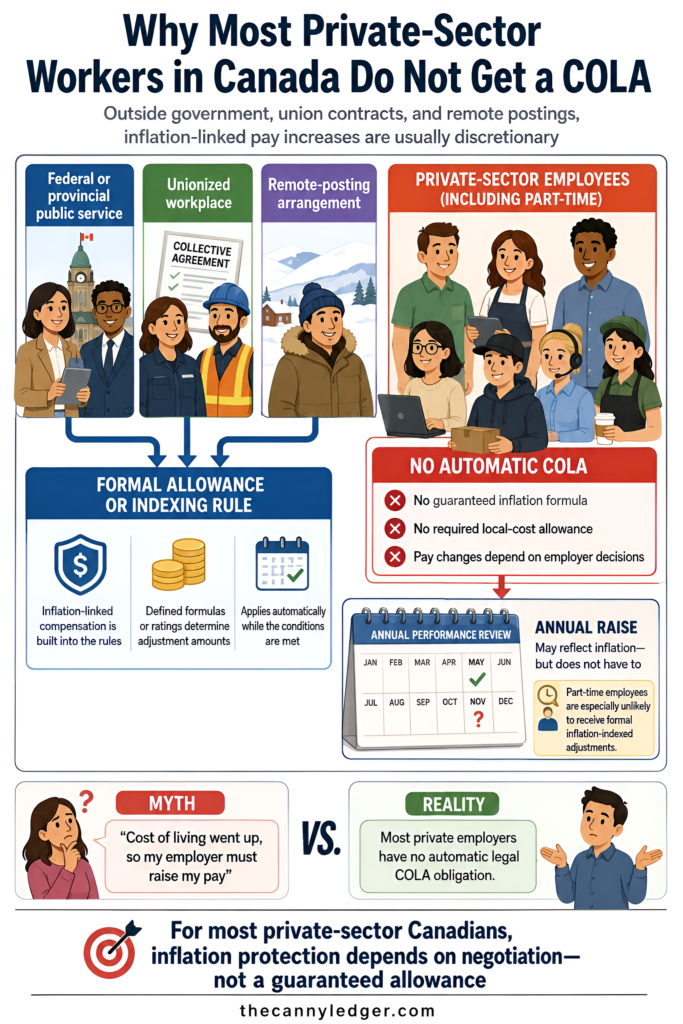
It’s worth being direct about the gap here rather than implying this benefit is more common than it actually is. Outside government employment, a unionized workplace, or a formal remote-posting arrangement, the vast majority of private sector Canadian employees have no structured cost of living allowance whatsoever. This is true even for part-time workers, who rarely see any inflation-indexed adjustment at all regardless of sector. Salary adjustments for inflation, if they happen at all, tend to arrive informally through annual raise decisions rather than through any guaranteed formula, and an employer offering to adjust pay for local cost of living is making a discretionary choice rather than following anything resembling the federal or union systems covered above.
What This Actually Means For Your Own Situation
If you work for the federal government or a provincial public service, checking whether your specific location qualifies under the relevant isolated posts directive is worth five minutes, since eligibility depends entirely on your job’s designated headquarters location, not where you personally choose to live. If you’re in a unionized workplace, your collective agreement is the actual source of truth here, and reading the compensation section directly, rather than relying on what a coworker mentioned once, tells you whether a COLA clause exists and under what conditions it actually triggers. If neither applies to you, comparing your own pay against real, current Winnipeg salary data by profession, or against the minimum wage floor if you’re closer to that end of the scale, and your own living expenses gives you a genuine benchmark to bring into a raise conversation, even without a formal allowance structure backing you up. Your overall income relative to that local benchmark tells you more than a national average ever could. And if you’re negotiating compensation without any of these formal protections, a financial advisor can help you think through what a reasonable inflation-adjusted target actually looks like for your specific situation, since nobody’s employer is going to calculate that number for you automatically.