

Yes, you can hold US stocks in a TFSA, and the capital gains on them are just as tax-free as anything else in the account. The dividends are a different story entirely, and the gap between those two answers is exactly where most explanations of this topic stop short.
- The Capital Gains And Dividend Split
- The Form Every US Stock Holder Actually Needs
- Why An RRSP Handles This Differently Than A TFSA Does
- The Exception That Catches Even RRSP Holders
- The Withholding You Can’t See Happening
- What US Estate Tax Has To Do With Any Of This
- Building A TFSA That Handles US Exposure Sensibly
- The Specific Details People Get Wrong
The Capital Gains And Dividend Split
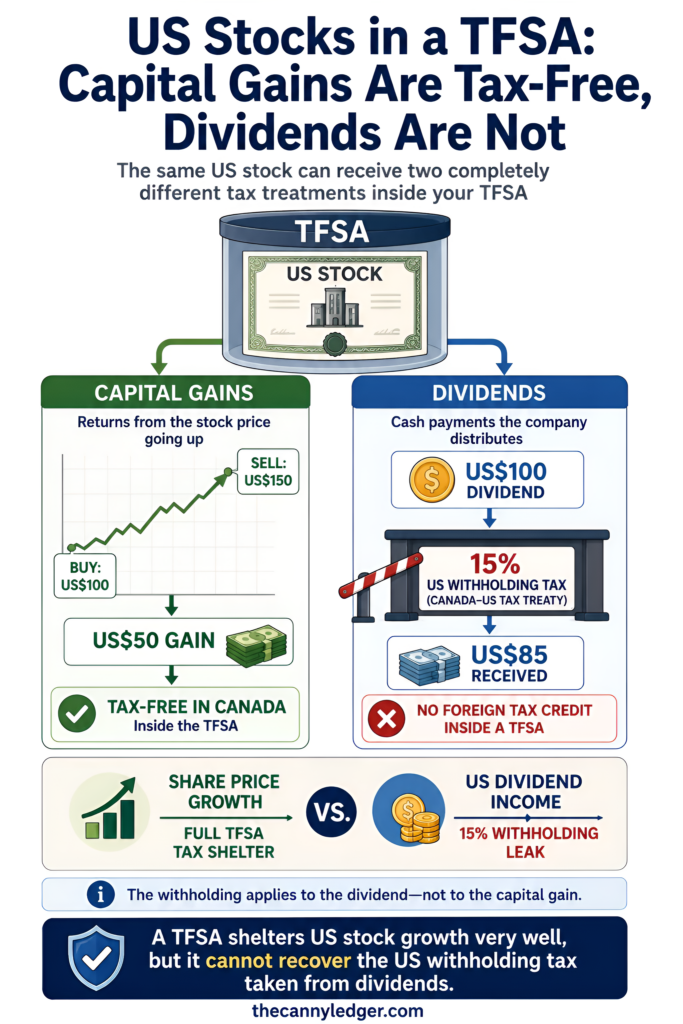
Capital gains earned on US stocks inside a TFSA are fully tax-free in Canada, no different from the treatment a Canadian stock would receive, since the CRA exempts every dollar of growth inside the account regardless of where the underlying company is based. Dividends work under a completely separate set of rules, since the United States imposes a 30 percent withholding tax on dividends paid to non-residents, reduced to 15 percent for Canadian residents under the Canada-US tax treaty, and that 15 percent simply doesn’t come back once withheld inside a TFSA. A US$100 dividend arrives as US$85 after withholding, and unlike a non-registered account, there’s no foreign tax credit available to recover that missing US$15, since TFSA income never gets reported on a Canadian tax return in the first place.
The Form Every US Stock Holder Actually Needs
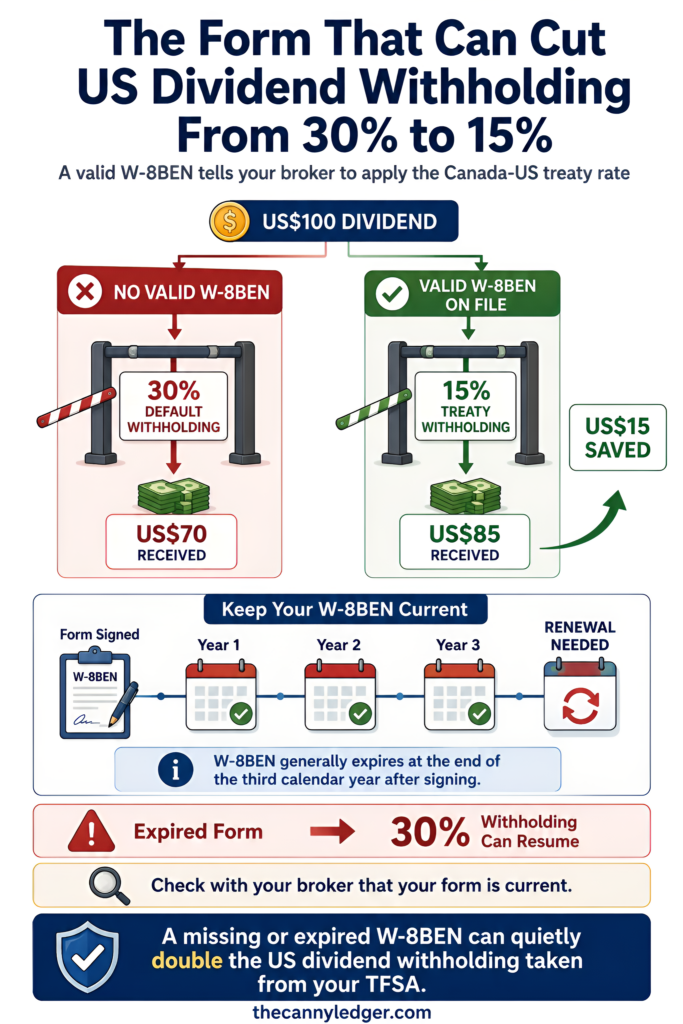
Accessing the reduced 15 percent treaty rate at all requires a valid W-8BEN form on file with your broker, and without it, the full 30 percent default rate applies to every dividend. Most brokers collect this automatically during account setup or the first time you buy a US security, but it isn’t permanent, the form expires at the end of the third calendar year after signing and needs renewing to keep the treaty rate in place. Letting it lapse without noticing means the higher default rate quietly starts applying to your dividends until you catch it and file an updated form.
Why An RRSP Handles This Differently Than A TFSA Does
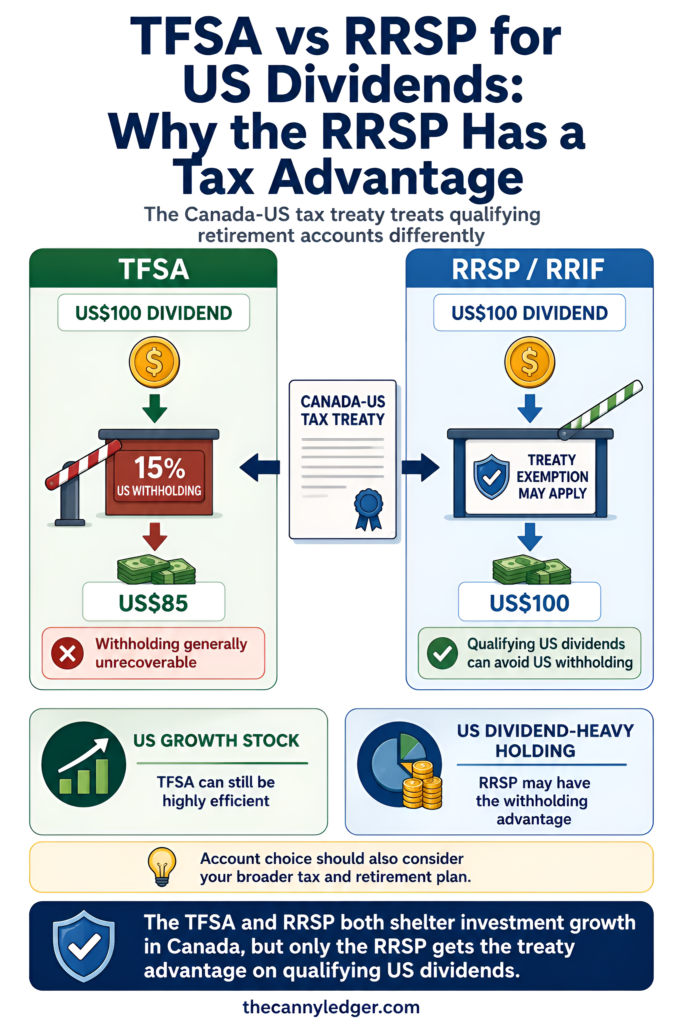
The Canada-US tax treaty specifically exempts dividends and interest earned inside qualifying retirement accounts from US withholding entirely, which covers an RRSP and RRIF but not a TFSA. That distinction is written into the treaty language itself, targeting accounts built for retirement or pension purposes specifically, a category the TFSA doesn’t fall into despite functioning similarly in other respects. Our comparison of TFSA against RRSP covers this specific gap alongside the other structural differences between the two accounts, and it’s exactly why heavy US dividend exposure sometimes fits an RRSP more naturally than a TFSA.
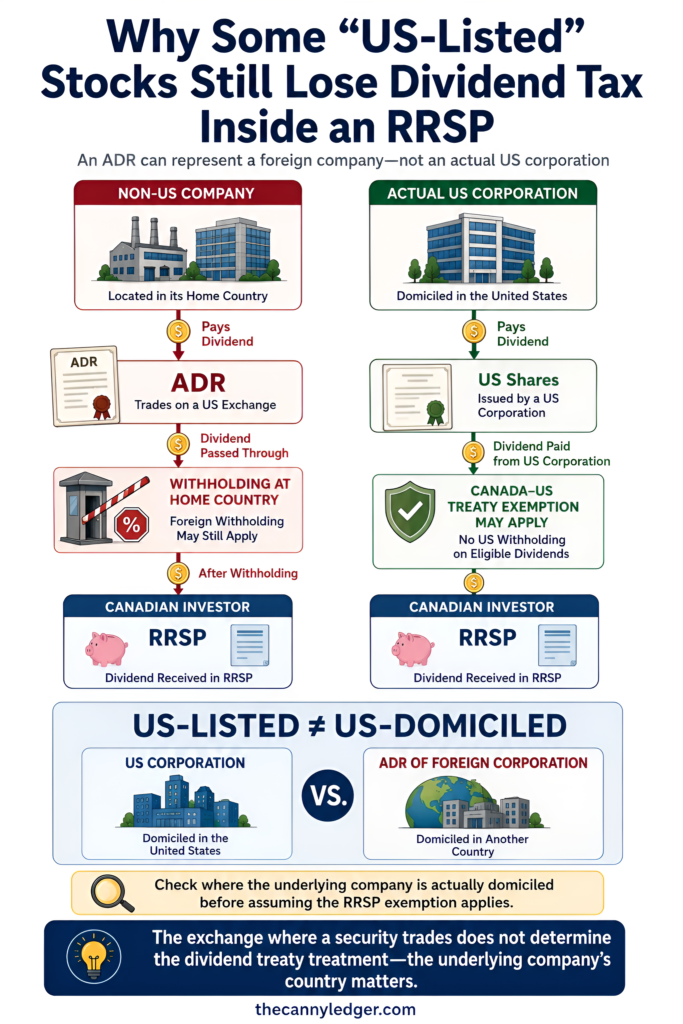
The Exception That Catches Even RRSP Holders
American Depositary Receipts break the pattern entirely, and this trips up investors who assume the RRSP exemption above always applies. ADRs represent shares in a non-US company trading on a US exchange rather than shares of an actual US corporation, and dividends from them get withheld at source regardless of account type, RRSP, RRIF, or TFSA alike, since the treaty exemption only covers genuine US-domestic corporations. A Canadian holding an ADR inside an RRSP specifically to avoid this exact withholding discovers the exemption simply doesn’t apply to that particular security.
The Withholding You Can’t See Happening
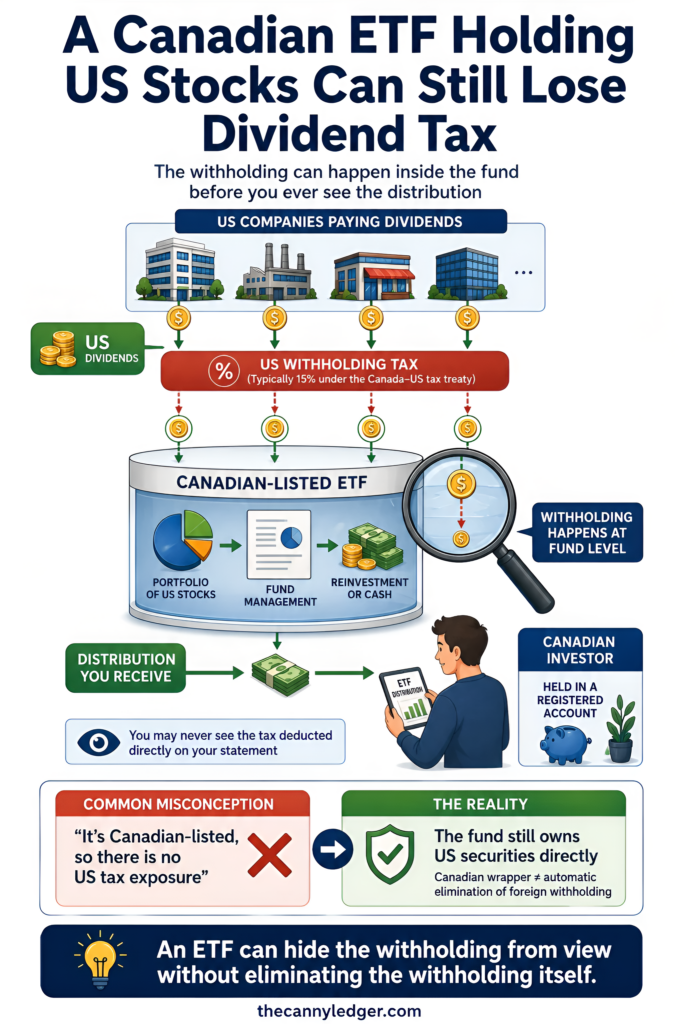
Buying a Canadian-listed ETF that holds US stocks doesn’t sidestep this issue either, it just moves the withholding somewhere less visible. When the fund itself receives US dividends on the underlying holdings, that withholding happens at the fund level before any distribution reaches you, and it’s unrecoverable even inside a registered account, since the fund, not you personally, is the one facing the withholding as a non-resident entity. This is a genuine blind spot for anyone assuming a Canadian-wrapped ETF sidesteps US tax exposure simply because the fund itself trades on the TSX.
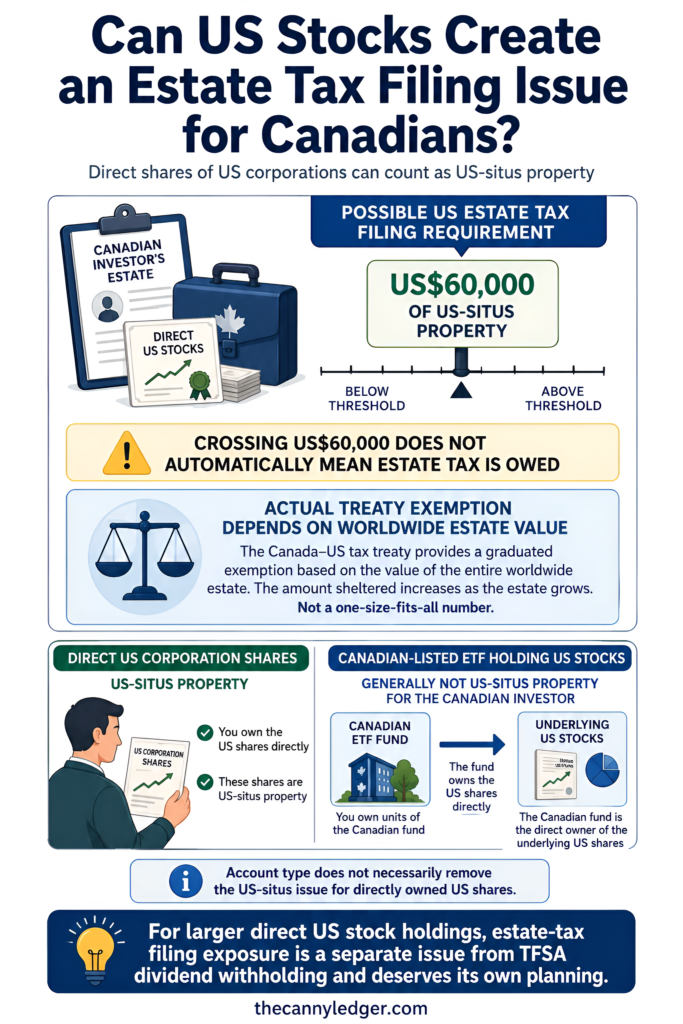
What US Estate Tax Has To Do With Any Of This
Direct ownership of US stocks carries a genuinely separate consideration worth knowing about regardless of which account holds them, and it’s a genuinely different category of risk than the day-to-day tax mistakes covered in our broader guide to TFSA tax traps. The United States treats shares of a US corporation as US-situs property for estate tax purposes, with a filing threshold of US$60,000 in such property for a non-resident, non-citizen estate, a threshold that applies whether those shares sit in a taxable account, an RRSP, or a TFSA. The treaty prorates a much larger exemption against your full worldwide estate, so crossing that US$60,000 filing threshold doesn’t automatically mean owing significant tax, but it can trigger a filing obligation most Canadians holding a handful of US stocks have never heard of. Notably, a Canadian-listed ETF or mutual fund holding the same underlying US companies isn’t treated as US-situs property at all, since the fund itself, not the individual investor, is the direct owner of record.
Building A TFSA That Handles US Exposure Sensibly
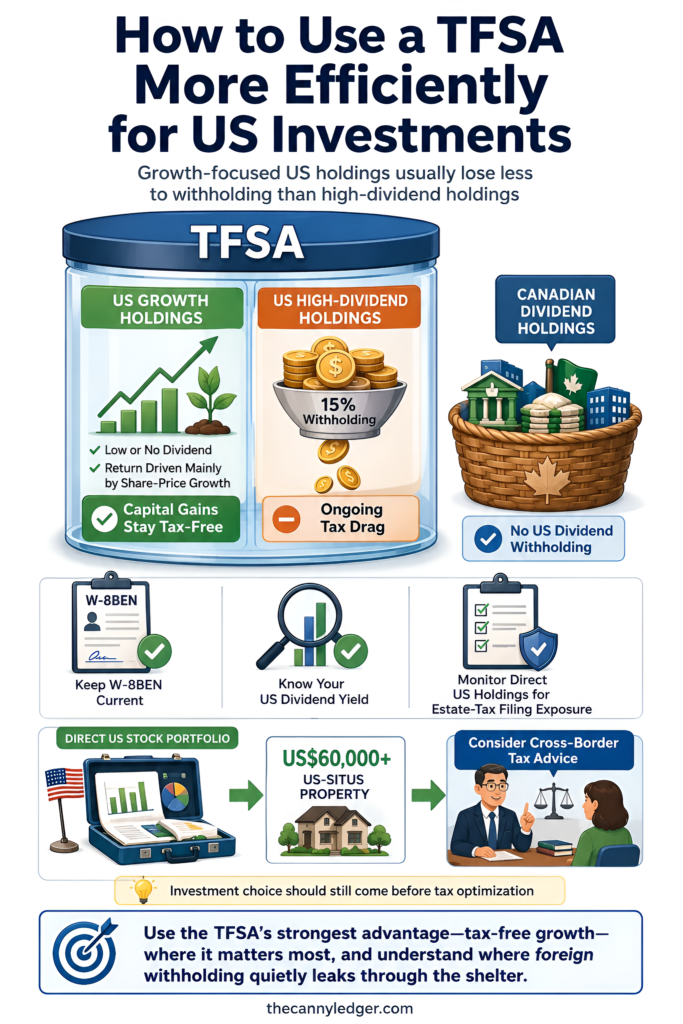
Favour Canadian dividend payers for the income-focused portion of your TFSA, since they capture the account’s tax-free benefit in full without the 15 percent leak US dividends carry, a distinction our full breakdown of TFSA dividend stocks covers directly. Reserve the TFSA’s US exposure for growth-focused holdings that pay little or no dividend, where the tax-free capital gains treatment does real work, since even a low-yield dividend payer whose primary return comes from share price appreciation makes the 15 percent withholding a minor drag rather than a defining cost. If direct US stock ownership inside your TFSA has grown large enough that the US$60,000 estate threshold genuinely applies to you, that’s worth a conversation with a cross-border tax professional rather than something to work out from a blog post, since the actual liability calculation depends on your full worldwide estate. And confirm your W-8BEN is current before assuming you’re getting the treaty rate at all, since a lapsed form silently doubles the dividend tax you’re losing without any notification that it happened, exactly the kind of quiet erosion covered in our broader introduction to how a TFSA works.
The Specific Details People Get Wrong
Does the 15 percent dividend withholding apply to interest earned on US bonds held in a TFSA too? No, US interest paid to a valid W-8BEN filer is generally exempt from withholding entirely, a genuinely different rule from the dividend treatment covered here, since interest and dividends fall under separate treaty provisions.
If my TFSA holds a US-listed ETF that itself invests only in Canadian companies, does the dividend withholding still apply? Generally no, since withholding is tied to where the underlying dividend-paying company is domiciled, not where the fund happens to be listed, though confirming a specific fund’s actual holdings directly is worth doing before assuming this exception applies.
Is the US estate tax filing threshold the same as the amount that actually gets taxed? No, US$60,000 is only the threshold that triggers a filing requirement, and the treaty’s prorated exemption against your full worldwide estate means most Canadians crossing that filing threshold still owe little or no actual US estate tax, though the filing obligation itself doesn’t disappear just because the final liability turns out to be small.