

There’s a version of the FHSA that never buys a home at all, and it still comes out ahead. Contribute the full amount every year, invest it, and if a home purchase never happens, the entire balance rolls into an RRSP tax-free, without touching a single dollar of your regular RRSP room. That’s not a workaround or a loophole, it’s how the account was actually built, and it’s the single biggest reason the FHSA deserves a real comparison against a TFSA rather than being treated as a smaller, more restrictive cousin.
- The Core Trade Both Accounts Make Differently
- Room Works Completely Differently Between the Two
- What Happens When You Withdraw Is the Real Asymmetry
- The FHSA Has an Actual Expiry Date
- What Happens If You Never Buy a Home
- Using Both at Once
- Deciding Where Your Money Goes First
- Questions Worth Sorting Out Before You Open Either
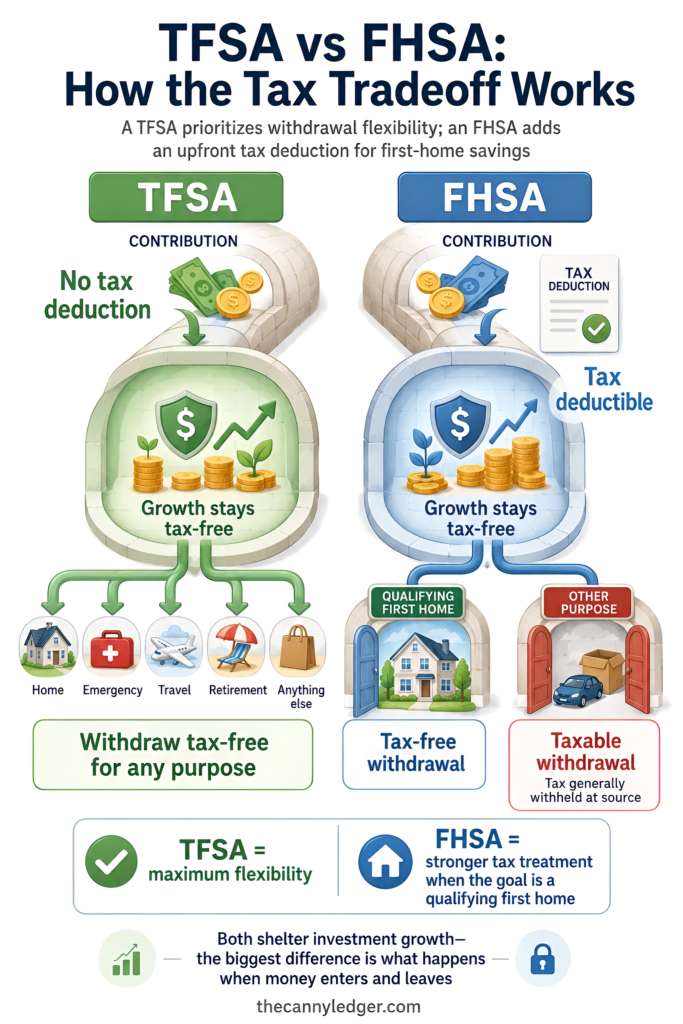
A TFSA gives no tax deduction on contributions but lets you withdraw for any reason, at any time, completely tax-free. An FHSA gives a full tax deduction like an RRSP, but the tax-free withdrawal only applies to a qualifying first home purchase, and unlike a TFSA, that room never comes back once you’ve used it. Both accounts shelter growth from tax entirely, the real differences are in what triggers the tax-free treatment and what happens to your room once you’ve touched it.
The Core Trade Both Accounts Make Differently
A TFSA is straightforward, no deduction going in, no tax coming out, for any withdrawal at any time and for any purpose. An FHSA works more like a hybrid of a TFSA and an RRSP specifically, contributions are fully tax deductible the year you make them, exactly like an RRSP, but a qualifying withdrawal used to buy a first home comes out completely tax-free, exactly like a TFSA. That combination, a real upfront deduction paired with a truly tax-free withdrawal, doesn’t exist anywhere else in the Canadian registered account system, which is exactly why the FHSA gets described as combining the best features of both accounts it’s modeled on.
The catch is that the tax-free side of an FHSA only applies to a specific, defined purpose. Withdraw from an FHSA for anything other than a qualifying home purchase, and the withdrawal gets added to your taxable income and has tax withheld at source, functioning at that point closer to an RRSP withdrawal than a TFSA one.
Room Works Completely Differently Between the Two
TFSA contribution room accumulates automatically the year you turn 18, or become a Canadian resident, whether or not you’ve ever opened an account, a mechanic worth understanding fully on its own. FHSA room works nothing like that. According to Scotiabank’s own explanation of FHSA contribution limits, FHSA room only starts accumulating the year you actually open the account, at $8,000 annually up to a $40,000 lifetime maximum, with unused room carrying forward by a maximum of $8,000 into the following year rather than compounding indefinitely.
That structural difference has a real practical consequence. Someone eligible for years who delays opening an FHSA is permanently losing room they can never recover, since the clock only starts ticking once the account exists, unlike a TFSA where the room was building in the background the entire time regardless of whether an account was ever opened.

What Happens When You Withdraw Is the Real Asymmetry
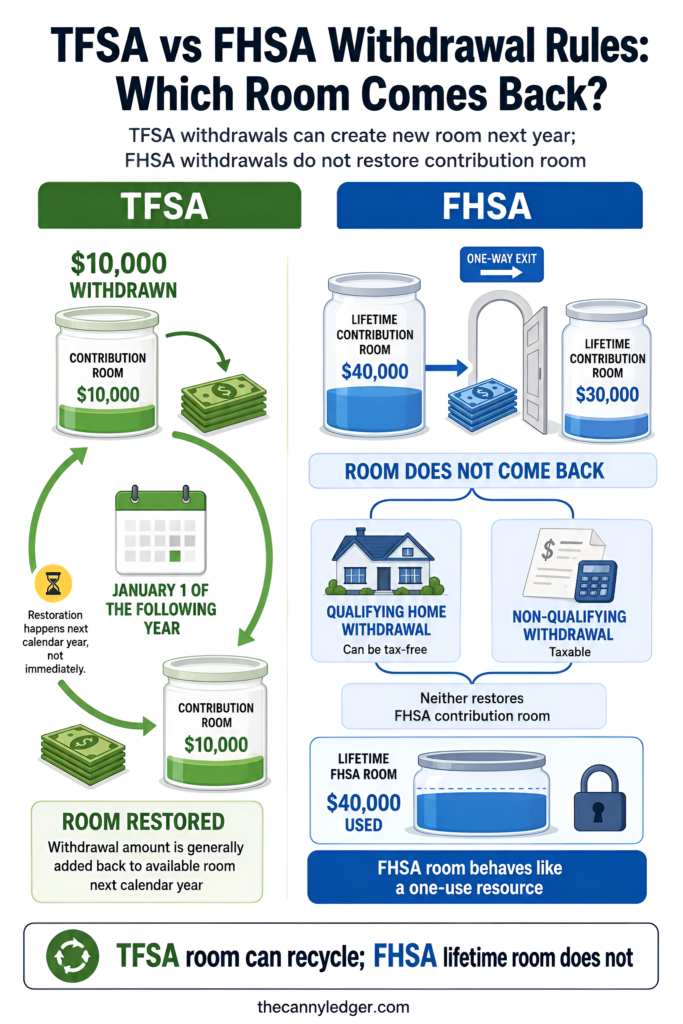
This is the single most important operational difference between the two accounts, and it’s the one most likely to catch someone off guard. A TFSA withdrawal restores that same amount of contribution room, just not until January 1 of the following calendar year. An FHSA withdrawal does no such thing at all, according to RBC’s own FHSA guidance, contribution room is never reinstated after a withdrawal, regardless of whether the withdrawal qualified as tax-free or not. Once you’ve used your $40,000 in lifetime FHSA room, it’s actually gone, there’s no equivalent to a TFSA’s eventual room recovery.
That makes the FHSA a use-it-once account in a way a TFSA simply isn’t, and it changes how you should think about timing contributions. Pulling money out of an FHSA for a reason other than buying a home doesn’t just trigger tax, it permanently shrinks your lifetime contribution capacity in a way a TFSA withdrawal never does.
The FHSA Has an Actual Expiry Date
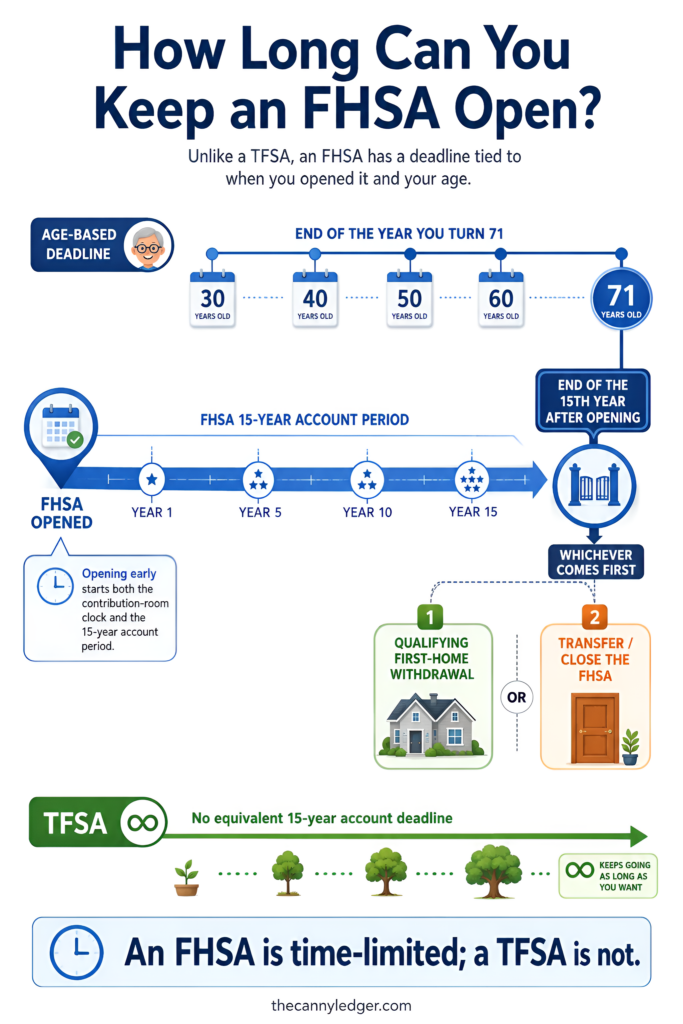
A TFSA can sit open for your entire life with no deadline attached to it at all. An FHSA can’t. According to CIBC’s own overview of the First Home Savings Account, the account has to be resolved, either through a qualifying withdrawal or a transfer, by the end of the 15th year after it was first opened, or by the end of the year you turn 71, whichever comes first. An FHSA opened at 18 has to be used by 33 to capture the qualifying withdrawal benefit specifically, a real deadline with no TFSA equivalent whatsoever.
What Happens If You Never Buy a Home
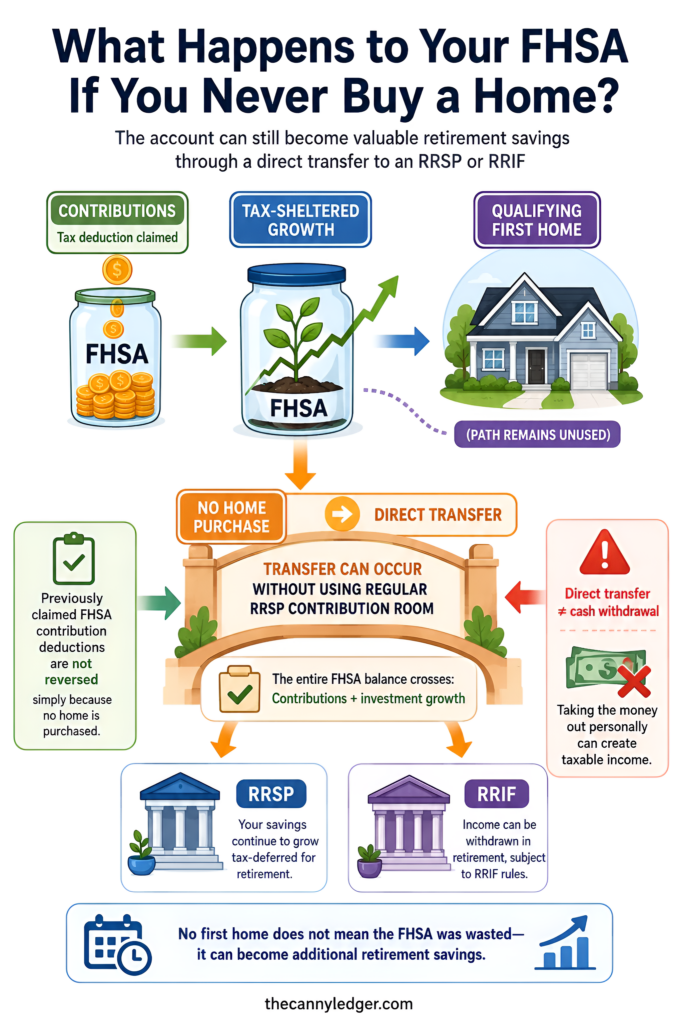
This is where the FHSA’s design turns out to be more forgiving than it first appears, and it’s the detail that removes most of the downside risk of opening one even without a firm home-buying plan. If the deadline arrives without a qualifying purchase, the entire balance, contributions plus every dollar of investment growth, can be transferred tax-free directly into an RRSP or RRIF, and according to multiple independent sources confirming the same CRA rule, that transfer doesn’t use up any of your existing RRSP contribution room at all. The tax deduction you already claimed on every FHSA contribution stays yours permanently too, the CRA doesn’t claw it back just because a home was never purchased.
That combination means an FHSA that never buys a home still delivered a real tax deduction during the contribution years and grew tax-free the entire time, then converts into extra RRSP capacity you wouldn’t otherwise have had. There’s effectively no scenario where opening one and contributing responsibly leaves you worse off than not having opened one at all.
Using Both at Once
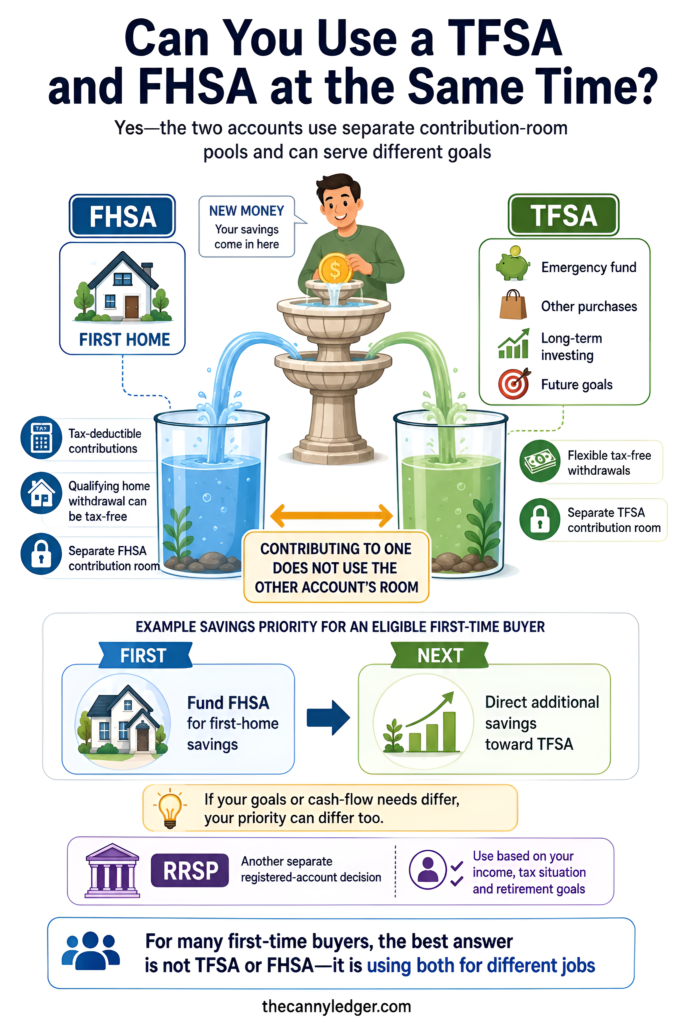
The two accounts draw from entirely separate pools of contribution room, so maxing out a TFSA has zero effect on FHSA room and vice versa, and there’s no reason to treat this as an either-or decision if you can afford to fund both. Someone specifically saving for a first home benefits most from prioritizing the FHSA first, given the upfront deduction and the tax-free qualifying withdrawal, while directing any additional savings beyond that toward a TFSA for goals with no home-purchase deadline attached. A fuller breakdown of how the TFSA stacks up against the other major registered account, the RRSP specifically, is worth reading alongside this comparison, since a first-time buyer is often weighing all three accounts at once rather than just these two.
Deciding Where Your Money Goes First
Open an FHSA as early as possible if a first home purchase is realistically part of your future, even with a small or zero initial contribution, since the 15-year clock and the account’s own room only start once it actually exists, the same practical opening steps that apply to a TFSA largely carrying over here too. Understand that an FHSA withdrawal for anything other than a qualifying home purchase carries real tax consequences and permanently reduces your lifetime room, unlike a TFSA withdrawal that eventually comes back. And don’t let uncertainty about whether you’ll actually buy a home stop you from opening one, since the tax-free RRSP rollover means there’s no real financial downside even if the purchase never happens.

Questions Worth Sorting Out Before You Open Either
Can I transfer money directly from a TFSA into an FHSA without tax consequences? No, moving TFSA funds into an FHSA means withdrawing from the TFSA and separately contributing to the FHSA, which frees up TFSA room for later but doesn’t count as a tax-free transfer the way an FHSA-to-RRSP transfer does.
Does my spouse need their own separate FHSA if we’re buying a home together? Yes, each eligible individual has their own separate FHSA with their own separate contribution room, so a couple buying together can potentially combine up to $80,000 in total lifetime FHSA savings between two accounts.
Can I use both the FHSA and the RRSP Home Buyers’ Plan for the same home purchase? Yes, the two programs are separate and can both be used toward the same qualifying home purchase, though the Home Buyers’ Plan requires eventual repayment into your RRSP while an FHSA withdrawal for a qualifying home does not.