

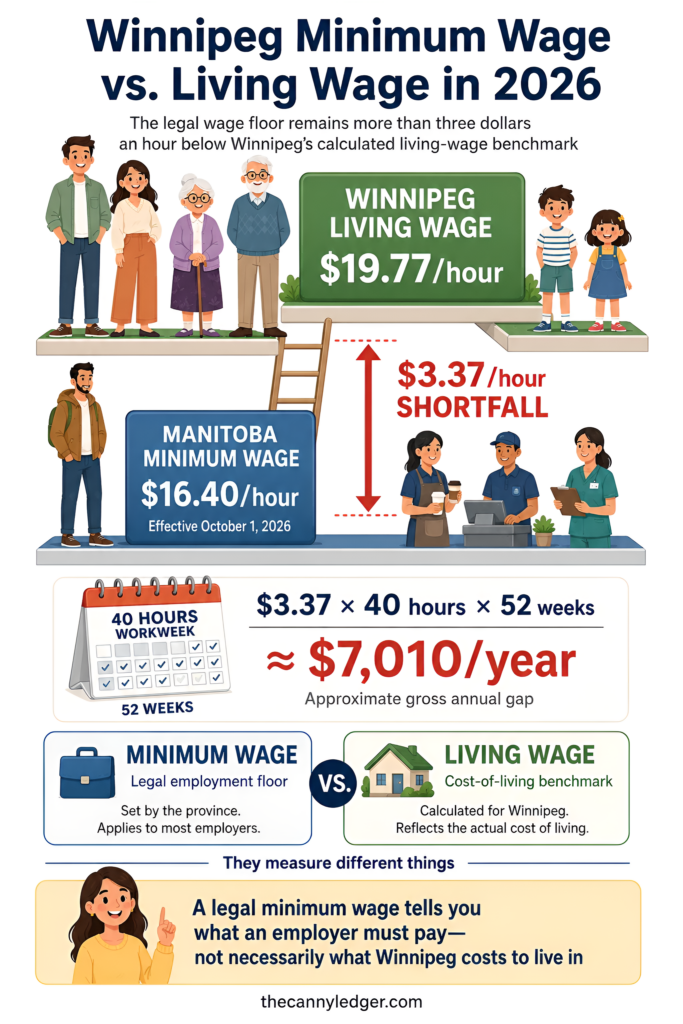
Manitoba’s minimum wage climbs to $16.40 an hour on October 1, 2026, a 40-cent increase the province confirmed in an April announcement tied directly to 2025 inflation. The Manitoba Federation of Labour responded almost immediately with a pointed comparison: citing research from the Canadian Centre for Policy Alternatives, the federation says Winnipeg workers actually need $19.77 an hour just to cover a reasonable standard of living, meaning the new minimum wage still sits more than three dollars below what the city’s own cost of living genuinely demands.
- Manitoba’s Minimum Wage Is Rising Again This October
- The Gap Between Minimum Wage and What Winnipeg Actually Costs to Live
- What “Average Income” Actually Means, and Why Winnipeg’s Own Number Is Older Than You’d Expect
- Median vs Average, and Why the Difference Matters More at the City Level
- How Manitoba’s Minimum Wage Compares to Other Provinces
- Overtime and Other Wage Rules Winnipeg Workers Should Know
- What This Means for Household Budgeting
- Common Questions
- Compare Your Own Income Against These Real Benchmarks
Manitoba’s minimum wage rises from $16.00 to $16.40 an hour effective October 1, 2026, while the calculated living wage for Winnipeg specifically stands at $19.77 an hour according to the Canadian Centre for Policy Alternatives. Winnipeg’s median household income, based on the most recent Statistics Canada Census Profile from the 2021 Census, sits at $80,000 annually, though this figure predates several years of subsequent wage growth and inflation, a limitation worth understanding before treating it as a precise current benchmark.
Manitoba’s Minimum Wage Is Rising Again This October
Manitoba has indexed its minimum wage to inflation annually since 2017, with increases taking effect every October 1 based on the previous calendar year’s Consumer Price Index change, rounded up to the nearest five cents. This year’s 40-cent bump, announced by the province in April 2026, reflects Manitoba’s 2025 inflation rate specifically, lifting the rate from $16.00 to $16.40 an hour. The Employment Standards Code also allows for larger, off-cycle increases if year-over-year inflation exceeds 5 percent during the first quarter of a calendar year, a provision that hasn’t been triggered recently but remains available if inflation spikes sharply enough to warrant it.

The Gap Between Minimum Wage and What Winnipeg Actually Costs to Live
The $19.77-an-hour living wage figure cited by the Manitoba Federation of Labour, drawing on Canadian Centre for Policy Alternatives research, represents what a single full-time worker in Winnipeg would need to earn to cover basic expenses without falling into poverty, a genuinely different calculation than the minimum wage, which reflects a legal floor rather than an actual cost-of-living benchmark. That gap, roughly $3.37 an hour between the new minimum wage and the calculated living wage, works out to nearly $7,000 a year for someone working full-time, a substantial shortfall for anyone earning at or near the legal minimum in this specific city. Federation president Kevin Rebeck was blunt about this exact gap, noting that no one should work full time and still live in poverty, yet that remains the reality for many Manitoba workers earning at the minimum wage floor.
What “Average Income” Actually Means, and Why Winnipeg’s Own Number Is Older Than You’d Expect
Winnipeg’s median household income, per Statistics Canada’s Census Profile from the 2021 Census, sits at $80,000 annually, a figure that reflects income reported at the time of that specific census rather than anything updated more recently at the city level. This is worth being direct about: unlike minimum wage, which updates every single year through a clear, published process, detailed city-level household income data genuinely lags behind by several years, since it depends on the full census cycle rather than an annual survey. National-level income data updates more frequently through Statistics Canada’s Canada Income Survey, with the most recent release covering the 2023 reference year reporting an overall national average income of $111,300 across economic families and individuals combined, though this national figure doesn’t break down cleanly to a current Winnipeg-specific number the way the 2021 Census data does.

Median vs Average, and Why the Difference Matters More at the City Level
At the national level, Statistics Canada’s income data shows a striking gap between the average and median: while overall average income runs above $111,000, the average income for individuals not part of an economic family sits meaningfully lower at $56,100, illustrating how a relatively small share of very high earners pulls the average upward well beyond what a typical single person actually earns. This same dynamic applies at the city level too, meaning Winnipeg’s median household figure, which represents the genuine midpoint where half of households earn more and half earn less, generally gives a more representative sense of a typical household’s actual position than an average figure would, since an average gets skewed by the city’s highest earners in a way the median simply doesn’t.

How Manitoba’s Minimum Wage Compares to Other Provinces
Manitoba’s $16.00 current minimum wage, rising to $16.40 in October 2026, sits in the middle of the national pack, a full dollar above Alberta’s $15.00 rate, which has remained frozen since October 2018, but behind both Ontario’s $17.60 rate and British Columbia’s $18.25 rate, which took effect June 1, 2026. Manitoba’s rate also sits notably below the separate federal minimum wage of $18.15, which applies specifically to federally regulated industries like banking, telecommunications, and interprovincial transportation rather than to most Manitoba workers, who fall under the provincial rate instead. This provincial variation matters directly for anyone comparing job offers or considering a move between provinces, since the specific minimum wage floor, and the broader wage structure built around it, genuinely differs depending on where in Canada you’re actually working.

Overtime and Other Wage Rules Winnipeg Workers Should Know
Beyond the base minimum wage figure, Manitoba’s Employment Standards Code sets standard hours of work at eight hours per day and 40 hours per week, with employees working beyond those thresholds generally entitled to overtime pay at one and a half times their regular wage rate. Workers are also entitled to an unpaid 30-minute break after five consecutive hours of work, a baseline protection that applies regardless of whether an employee earns minimum wage or considerably more. These aren’t obscure technicalities, they’re the actual legal floor governing how most Winnipeg workplaces are required to structure a workday, worth knowing directly rather than assuming your specific employer’s practices automatically match what the law actually requires.

What This Means for Household Budgeting
Given the meaningful gap between Manitoba’s legal minimum wage and Winnipeg’s calculated living wage, a single minimum-wage income genuinely struggles to cover the city’s actual cost of living on its own, a reality reflected in how many Winnipeg households depend on multiple income earners or additional income sources to reach that $80,000 median household figure. Our guide to the Manitoba and Winnipeg personal income tax guide covers how take-home pay actually gets calculated from a gross wage figure, a genuinely necessary next step for translating any of the hourly or annual figures covered here into what actually lands in your bank account. For anyone whose income genuinely doesn’t stretch to cover rent at current market rates, our guide to qualifying for Rent Assist in Manitoba covers a real, available support program worth understanding directly.

Common Questions
Does Manitoba’s minimum wage apply to all workers in Winnipeg equally? Generally yes for provincially regulated employers, which covers the large majority of Manitoba workplaces, though federally regulated industries like banking and interprovincial transportation follow the separate, currently higher federal minimum wage instead.
Is the living wage figure a legal requirement employers have to pay? No, the $19.77 living wage figure is a calculated benchmark from labour and policy research organizations representing what’s actually needed to cover basic costs in Winnipeg specifically, not a legally mandated wage floor the way the minimum wage is.
Why can’t I find a more recent median household income figure specifically for Winnipeg? Detailed city-level household income data comes primarily from Statistics Canada’s full census, conducted every five years, so the 2021 Census figures remain the most granular city-specific data available until the next full census cycle produces updated numbers.
Compare Your Own Income Against These Real Benchmarks
Rather than treating any single figure in this guide as a target to hit, use the minimum wage, living wage, and median household income together to understand where your own household actually sits: whether you’re earning above the legal minimum but still below what Winnipeg’s cost of living genuinely requires, or whether your household income already exceeds the city’s 2021 median and simply needs updating against current prices rather than current earnings. Checking your own gross and net income against Manitoba’s actual tax brackets is the practical next step for turning any of these benchmark figures into a real personal budget. For anyone specifically job hunting in this market, our guides to jobs for new immigrants in Winnipeg and career counselling for newcomers in Winnipeg cover practical next steps for translating these citywide wage benchmarks into an actual job search.