Heating your home and heating your water together account for roughly 75 percent of a typical Manitoba household’s total energy costs, according to Efficiency Manitoba, the province’s energy efficiency agency. Everything else, lighting, appliances, electronics, the stuff most people picture when they imagine their power bill, makes up the remaining quarter. That ratio reframes the whole question of what a Winnipeg heating bill actually costs, since for most homes, the honest answer is simply “most of your energy bill, period,” not a separate line item worth budgeting around on its own.
- Most of Your Energy Bill Is Actually Heating, Not Appliances
- What Natural Gas Actually Costs to Heat With Right Now
- Why Winter Bills Look So Different From Summer Ones
- The Equal Payment Plan Smooths This Out
- A Hidden Tax Detail Specific to Heating Equipment
- Renters: Check Whether Heat Is Already in Your Rent
- What Actually Lowers a Heating Bill
- Common Questions
- Budget for the Season, Not Just the Month
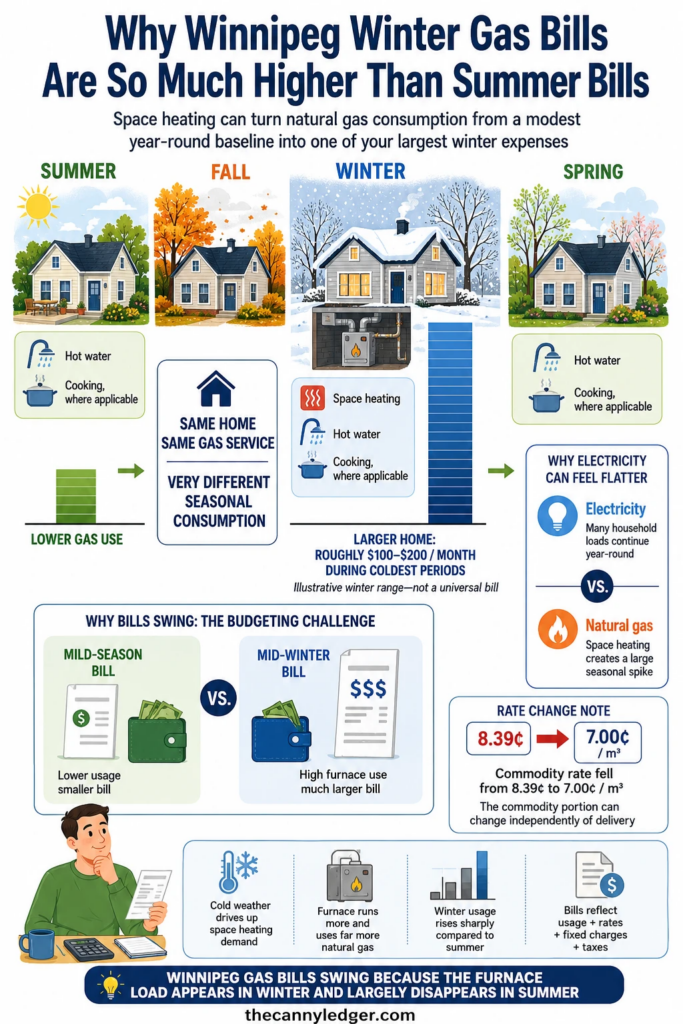
Winnipeg home heating costs run primarily through natural gas, priced at a commodity rate of 7.00 cents per cubic metre as of May 1, 2026, plus a delivery rate of 15.88 cents per cubic metre covering the infrastructure that moves gas to your home. A larger single-family home can see winter natural gas bills climb into the $100 to $200 monthly range during the coldest months, a sharp jump from summer bills that might run a fraction of that once space heating drops out of the equation entirely.
Most of Your Energy Bill Is Actually Heating, Not Appliances
Efficiency Manitoba’s communications team has been direct about this specific breakdown: heating your home and heating your water make up about three-quarters of what you’re actually paying for across both natural gas and electricity combined. This matters enormously for anyone trying to figure out where to focus their energy-saving effort, since improving insulation, sealing drafts, and addressing windows and doors targets the genuinely dominant cost driver, while swapping light bulbs or unplugging electronics, the more commonly cited advice, addresses a comparatively small slice of the total bill.

What Natural Gas Actually Costs to Heat With Right Now
As of May 1, 2026, the commodity portion of Manitoba’s natural gas rate sits at 7.00 cents per cubic metre, a genuine decrease from the previous 8.39 cents, since Manitoba Hydro passes this specific portion through at cost without any markup, reflecting whatever the open market charges for the gas itself. The delivery rate, covering the pipeline infrastructure and related costs of actually getting that gas to your home, rose slightly to 15.88 cents per cubic metre over the same period. Combined, these two components determine your variable natural gas charge, on top of a fixed daily basic charge that applies regardless of how much gas you actually burn in a given month.

Why Winter Bills Look So Different From Summer Ones
Since natural gas usage in most Winnipeg homes is overwhelmingly driven by space heating rather than water heating or cooking alone, your consumption, and therefore your bill, swings dramatically between seasons in a way electricity usage typically doesn’t. A larger home can see winter monthly natural gas bills land in the $100 to $200 range during Manitoba’s coldest stretches, while that same home’s summer gas usage, limited mostly to hot water and cooking, might run to a small fraction of that winter figure. This seasonal swing is precisely what makes natural gas bills feel unpredictable to budget around compared to a relatively flat monthly electricity bill, and it’s the specific problem Manitoba Hydro’s own budget billing tool is designed to solve.
The Equal Payment Plan Smooths This Out
Manitoba Hydro’s Equal Payment Plan lets customers pay both electricity and natural gas bills in equal monthly instalments across the year rather than facing the full seasonal swing directly, calculated based on your household’s actual past energy use. The plan runs on a fixed annual cycle, starting in September and balancing out the following August, when Hydro reconciles whatever you’ve actually used against what you paid, crediting you if you overpaid or charging the difference if you underpaid, before recalculating your new monthly amount for the next cycle. Enrollment timing affects when your equal payments actually begin: signing up between September and March starts your equal payments on your very next bill, while enrolling between April and August delays the start until the following September, when the next full annual term begins. This is a genuinely useful tool specifically for anyone who finds a $180 January gas bill harder to absorb than a flatter $60 monthly charge spread evenly across twelve months, even though the total annual cost works out the same either way.

A Hidden Tax Detail Specific to Heating Equipment
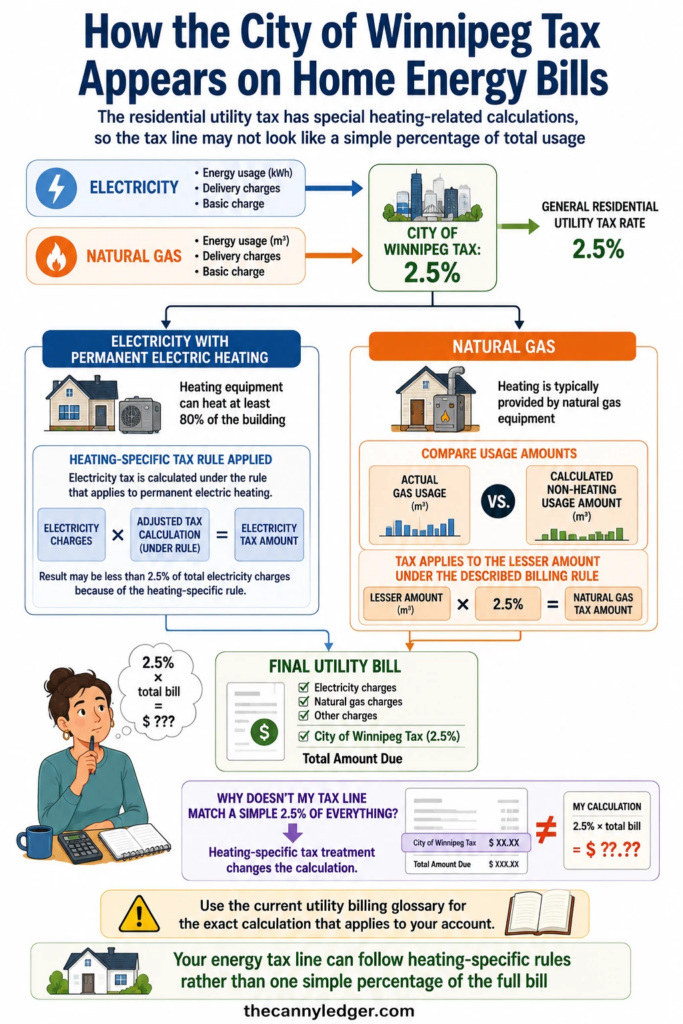
Manitoba Hydro bills carry a City of Winnipeg tax, 2.5 percent on residential services, applied separately on each billing line before being totalled into your final bill. What most residents don’t know is that this tax rate specifically reduces for electricity services where permanently installed heating equipment can heat at least 80 percent of the entire building, and on natural gas specifically, the tax applies to the lesser of your actual usage or a separately calculated non-heating use figure. In practice, this means the tax structure itself is designed to avoid double-taxing the heating-specific portion of your natural gas consumption, a detail worth knowing if you’re ever trying to reconcile exactly why your bill’s tax line doesn’t simply match a flat percentage of your total usage charge.
Renters: Check Whether Heat Is Already in Your Rent
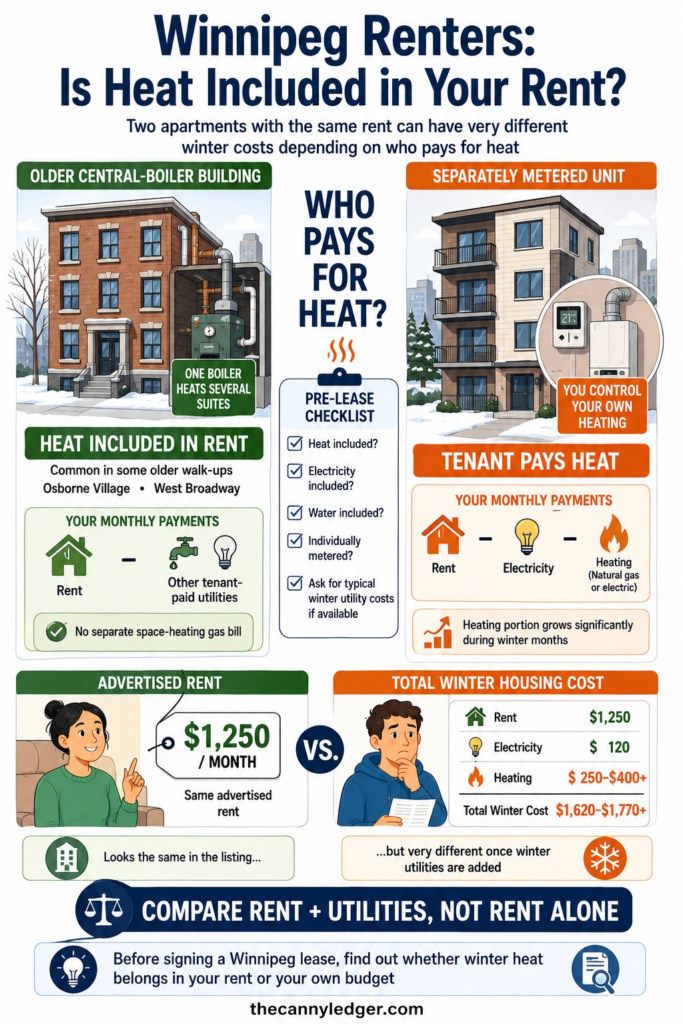
Whether heating costs show up as your own separate bill at all depends heavily on your specific building. Older walk-up apartments in neighbourhoods like Osborne Village and West Broadway commonly include heat directly in the rent, since many of these buildings run on central boiler systems serving the entire building rather than individual unit-level natural gas accounts. Newer purpose-built rental buildings, by contrast, are far more likely to bill heat and electricity separately to each tenant, meaning the winter cost swings described above land directly on your own monthly budget rather than your landlord’s. Our guide to all-utilities-included apartments in Winnipeg covers exactly this distinction in more depth, since confirming which model applies to a specific unit before signing a lease meaningfully changes what your actual total winter housing cost looks like. Our guides to cheap bachelor and studio apartments in Winnipeg and budgeting for a basement suite in Winnipeg both touch on smaller, often older units where heat-inclusion patterns matter just as much to your real monthly cost.
What Actually Lowers a Heating Bill
Given that heating and hot water dominate the total energy bill so heavily, the genuinely effective cost-reduction strategies focus specifically there rather than on smaller appliance-level changes. Improving attic, wall, and basement insulation addresses the single biggest source of heat loss in most older Winnipeg homes, while upgrading or properly sealing windows and doors closes off the second major leak point. Efficiency Manitoba specifically points to these two areas as the highest-impact interventions available to homeowners, ahead of the more commonly discussed but comparatively minor savings from switching light bulbs or reducing standby electronics.

Common Questions
Does the Equal Payment Plan actually save me money, or just spread out the same total cost? It spreads out the same total annual cost rather than reducing it, since Hydro reconciles your actual usage against your payments each August, but the budgeting benefit of predictable monthly amounts is real even though the total you pay over a full year stays the same either way.
Is electricity or natural gas cheaper for heating a Winnipeg home? Manitoba Hydro’s electricity rates rank among the lowest in Canada thanks to the province’s hydroelectric generation, but most Winnipeg homes still rely primarily on natural gas for heating specifically, since gas heating systems are the more common installed infrastructure across the existing housing stock rather than a straightforward cost comparison alone.
Can I switch to a fixed-rate natural gas plan instead of the standard variable commodity rate? Yes, Manitoba Hydro offers both variable quarterly and fixed rate options for the commodity portion of natural gas specifically, and customers can also purchase their gas commodity through an independent marketer instead, though Hydro continues handling delivery either way.
Budget for the Season, Not Just the Month
Rather than budgeting for a single average monthly heating figure, plan around the genuine seasonal swing a Winnipeg winter creates, and consider whether the Equal Payment Plan’s predictability is worth adopting before your first cold-weather bill actually arrives. Confirming whether your specific rental includes heat, checking your home’s insulation before winter rather than after the first high bill shows up, and understanding that heating genuinely is the majority of your energy cost, not a side expense, are the three most useful steps for getting ahead of a Winnipeg winter heating bill rather than reacting to it after the fact.