
Ask ten people which life insurance company is best in Canada and you’ll get ten different answers, and most of them will be right for the person giving them. A business owner optimizing for corporate tax planning wants something different from a retiree who was declined coverage elsewhere and just needs a modest final expense policy. Ranking insurers on a single scale flattens exactly the differences that should be driving the decision.
- The Big Four for Financial Strength
- Best for a Full Range of Permanent Options
- Best for Participating Whole Life
- Best for No-Medical and Guaranteed Acceptance Coverage
- Best for Comparing Multiple Insurers at Once
- Comparing the Options Directly
- What “Best” Actually Depends On
- The Verdict
- Mistakes People Make Choosing an Insurer
- Common Questions About Choosing a Life Insurance Company in Canada
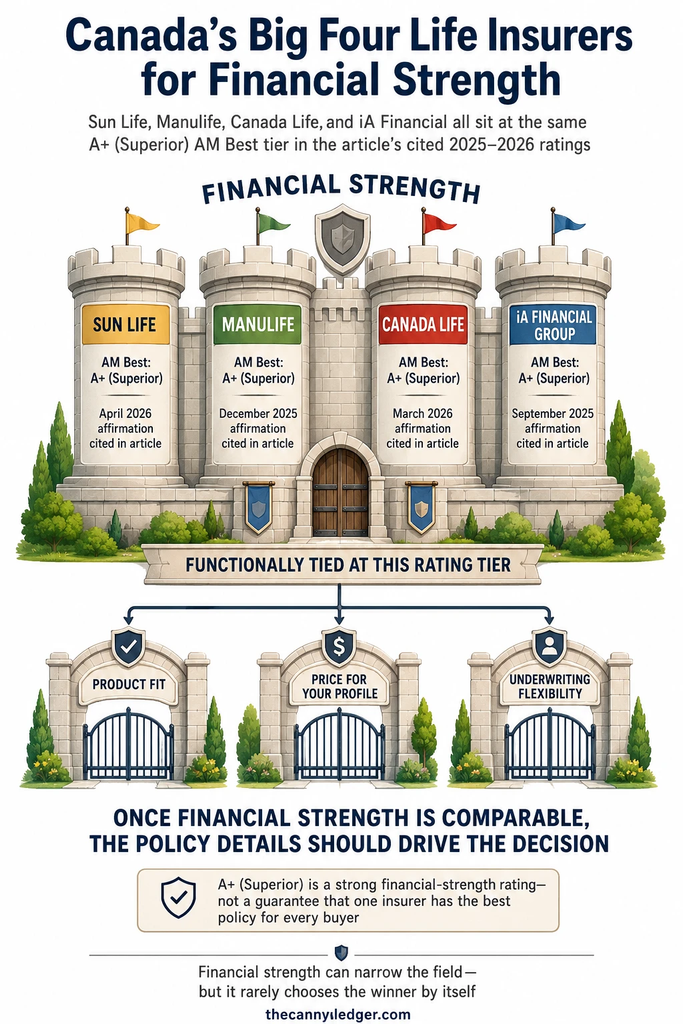
This comparison is built from published financial strength ratings, dividend scale disclosures, product documentation, and rate data current as of 2026, not from personal experience buying or filing a claim with any of these companies. Sun Life, Manulife, Canada Life, and iA Financial Group all carry the same top-tier financial strength rating from AM Best, so the real differences that should drive your choice come down to product fit, price for your specific profile, and how much underwriting flexibility you actually need.
The Big Four for Financial Strength
Four Canadian insurers currently hold AM Best’s A+ (Superior) financial strength rating, the agency’s second-highest tier and a real signal that a company can meet its long-term obligations to policyholders decades into the future. AM Best affirmed Sun Life Assurance Company of Canada’s A+ (Superior) rating in April 2026, citing the group’s strongest balance sheet assessment and dominant market position across Canadian, American, and Asian lines. Manulife’s life and health insurance subsidiaries held the same A+ (Superior) rating as of AM Best’s December 2025 affirmation, backed by what the agency calls very strong balance sheet strength and enterprise risk management.
Canada Life, owned by Great-West Lifeco, carries an identical A+ (Superior) rating confirmed by AM Best in March 2026, and iA Financial Group rounds out the group with its own A+ (Superior) rating affirmed in September 2025. Choosing among these four on financial strength alone is close to a coin flip, since all four sit at the same rating tier, which means the deciding factor for most buyers should shift to product specifics rather than solvency concerns.
Best for a Full Range of Permanent Options
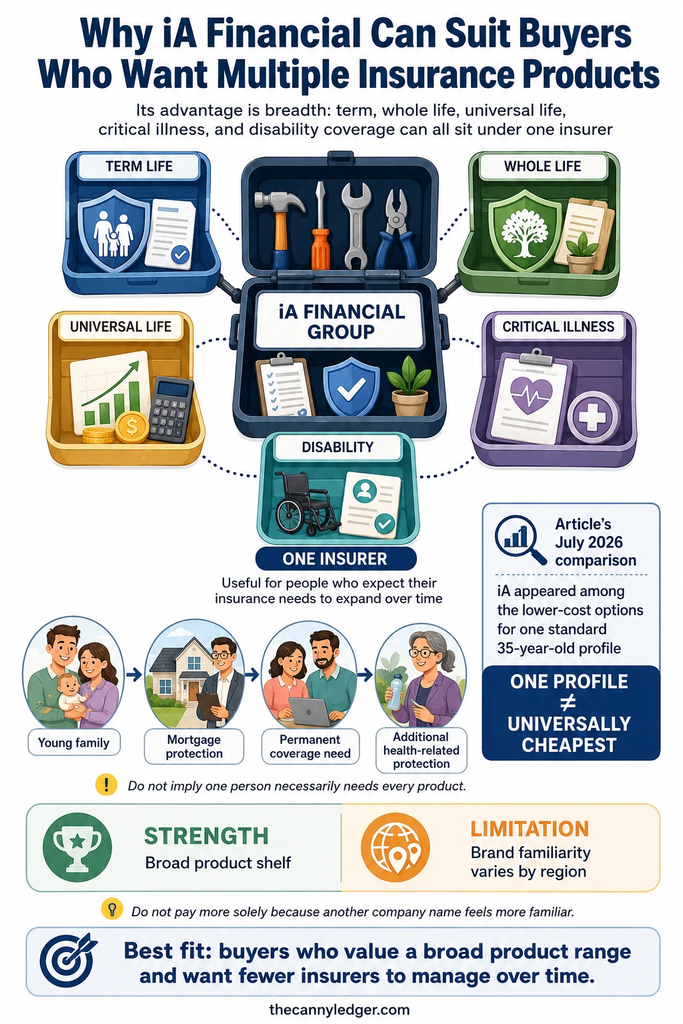
iA Financial Group distinguishes itself less through headline financial metrics and more through the breadth of what it actually offers across term, whole life, universal life, critical illness, and disability products under one roof, making it a common choice for buyers who want to layer coverage types with a single insurer over time. Its pricing has also shown up competitively in direct rate comparisons, landing among the lowest-cost options in a July 2026 insurer comparison table for a standard 35-year-old applicant, alongside Co-operators and Assumption Life. For someone who wants one insurer capable of handling a full personal insurance plan rather than assembling coverage across several companies, iA’s product range makes that consolidation practical.
The trade-off worth naming plainly is that iA doesn’t carry the same brand recognition in English-speaking Canada that it holds in Quebec, where it has operated the longest, and some buyers default to a more familiar name purely on unfamiliarity rather than any actual difference in what’s being offered. That’s a poor reason to pay more elsewhere for identical coverage.
Best for Participating Whole Life
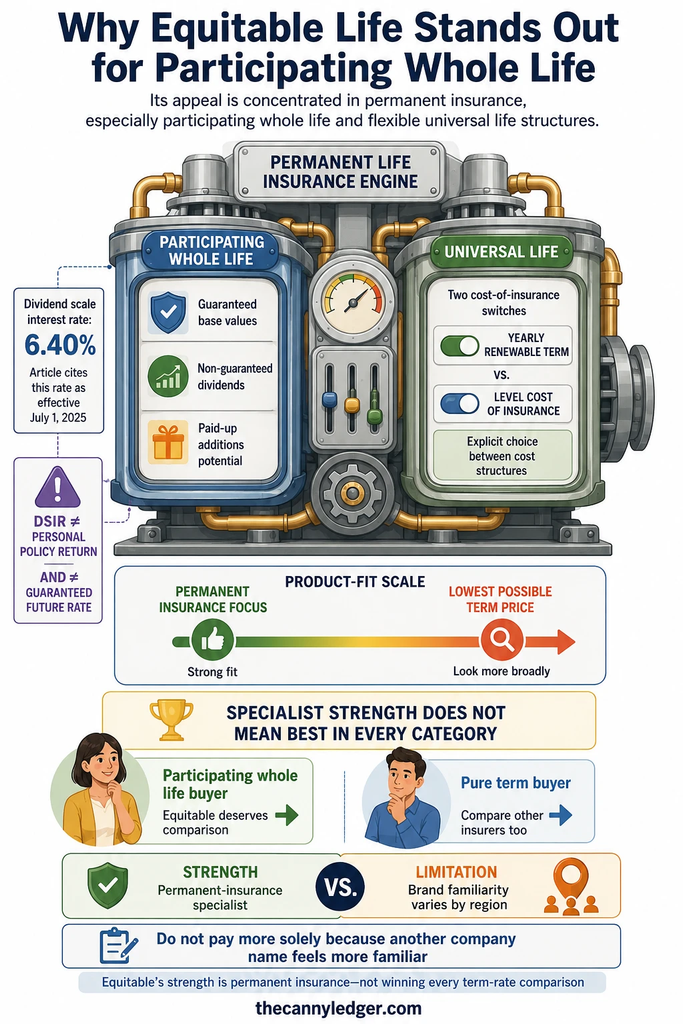
Equitable Life has built a reputation specifically around its participating whole life lineup, and its dividend scale performance backs that reputation with real numbers rather than marketing language. Equitable Life kept its dividend scale interest rate unchanged at 6.40 percent effective July 1, 2025, the highest of the major disclosed rates among Canadian insurers offering participating whole life and universal life products. Equitable also stands out for giving buyers an explicit choice between yearly renewable term and level cost of insurance structures on its universal life products, a decision most insurers leave less transparent at the point of sale.
Equitable isn’t the insurer to shop with for the lowest possible term rate, since its focus and pricing structure are built around permanent products rather than competing on pure term price. Anyone specifically after a low-cost term policy is better served checking iA or the rate comparison covered separately, and treating Equitable as a specialist choice rather than an everything-insurer.
Best for No-Medical and Guaranteed Acceptance Coverage
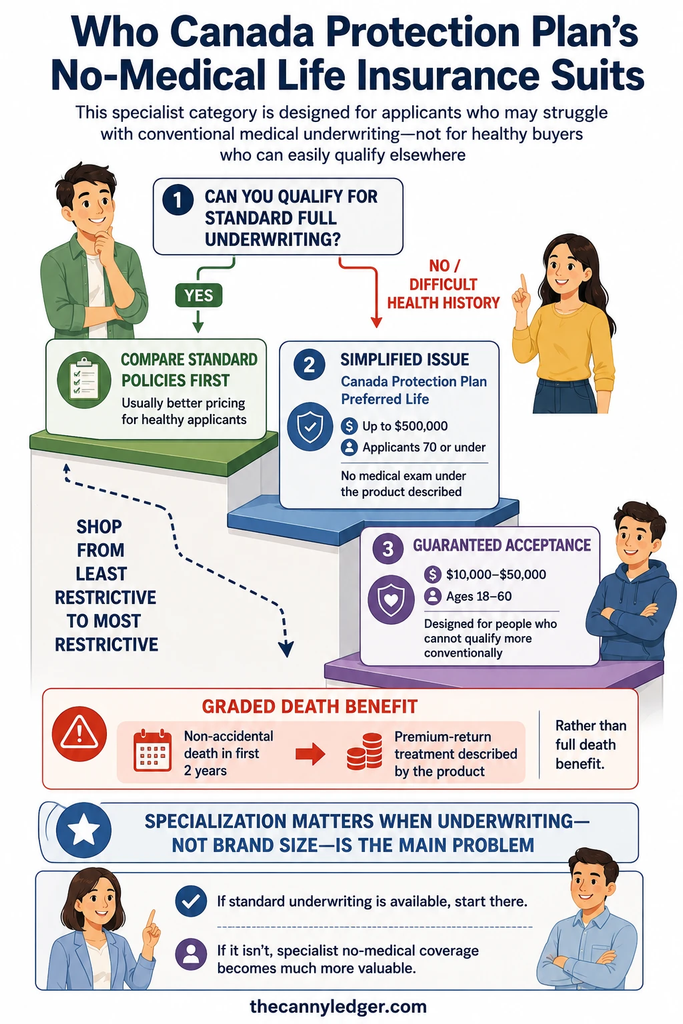
Canada Protection Plan, underwritten by Foresters Life Insurance Company, has built its entire business around the no-medical and simplified issue segment of the market rather than treating it as a side product. Its own guaranteed acceptance product documentation confirms coverage between $10,000 and $50,000 for applicants aged 18 to 60, with a graded death benefit that returns premiums rather than the full benefit if death occurs from non-accidental causes in the first two years. For simplified issue buyers who don’t need guaranteed acceptance, Canada Protection Plan’s Preferred Life product offers coverage up to $500,000 without a medical exam for applicants 70 or under, a meaningfully higher ceiling than the guaranteed acceptance tier and a real option for anyone who has already been declined by a fully underwritten insurer elsewhere.
This is a case where being the specialist matters more than being the biggest name, since none of the four major insurers above build their business around this segment the way Foresters does through Canada Protection Plan. Someone who’s already healthy enough to qualify for standard underwriting is almost always better off applying there first, but for the population this product is actually built for, Canada Protection Plan’s depth of options within the no-medical space isn’t something the generalist insurers match.
Best for Comparing Multiple Insurers at Once
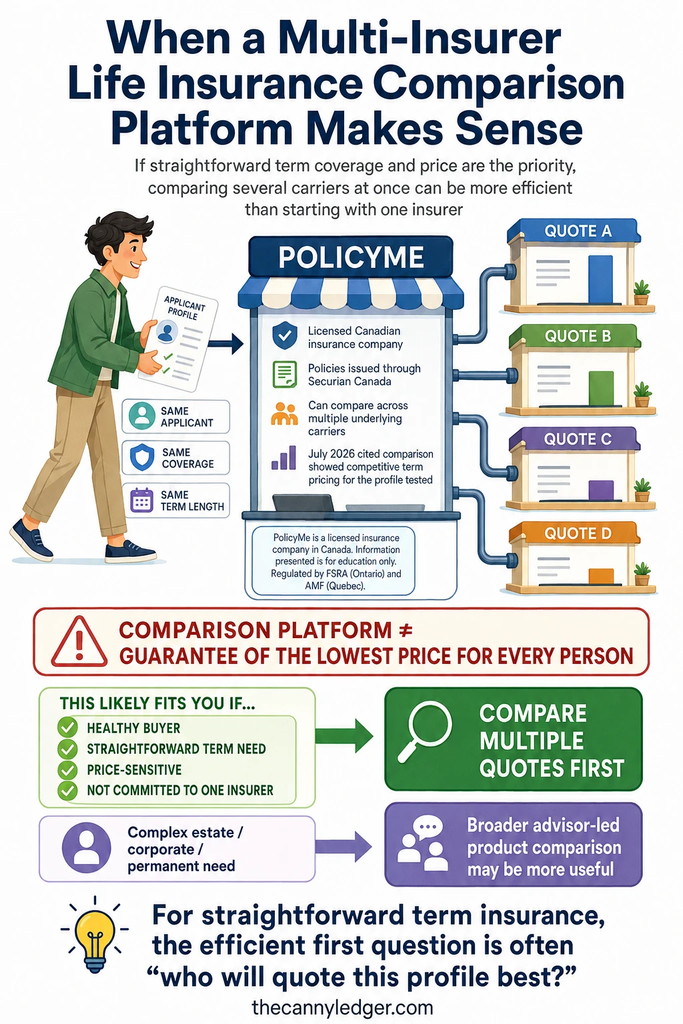
PolicyMe operates differently from the insurers above, functioning as a licensed Canadian insurance company that lets buyers compare and apply across several underlying carriers rather than committing to one company’s product shelf from the outset. It’s licensed with Ontario’s FSRA and Quebec’s AMF and issues policies through Securian Canada, and its own published rate data, sourced directly from actuarial tools insurers themselves use, gave some of the lowest quoted premiums in a July 2026 comparison against Sun Life, ivari, Co-operators, iA, and Assumption Life for identical term coverage.
The limitation is scope rather than trust, since a comparison platform’s own underwritten product is one option among several it shows you, not a guarantee it’s the cheapest for your specific profile every time. For someone who isn’t already committed to a specific insurer and mainly wants the lowest verified price for straightforward term coverage, starting with a platform like this rather than a single company’s direct quote tool is still the more efficient path.
Comparing the Options Directly
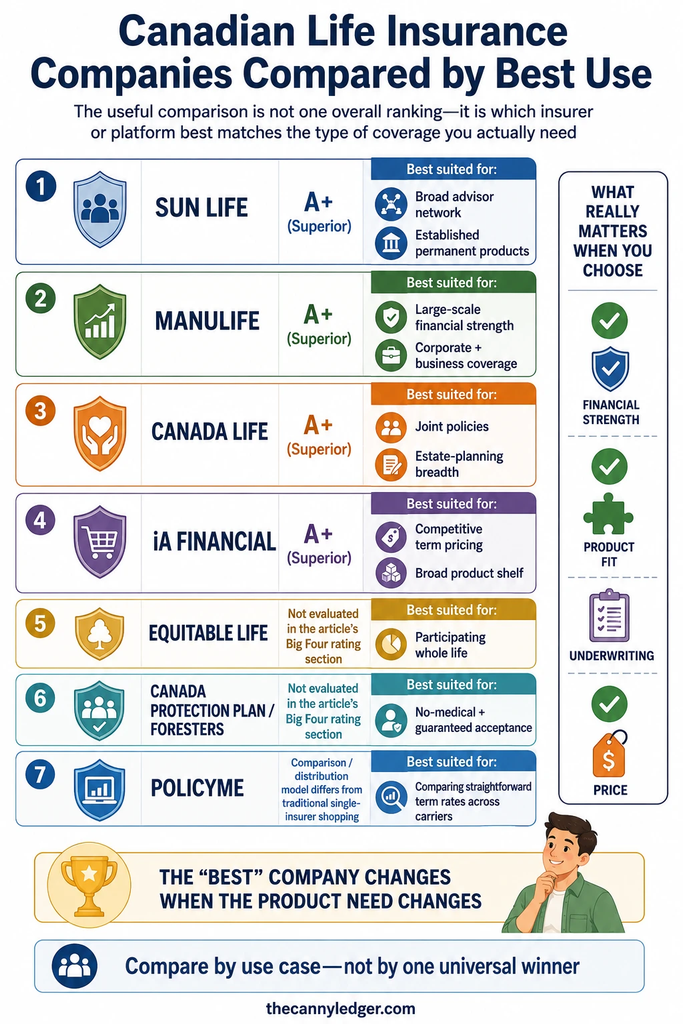
| Insurer | AM Best Rating | Best suited for |
|---|---|---|
| Sun Life | A+ (Superior) | Broad advisor network, established permanent product lines |
| Manulife | A+ (Superior) | Large-scale financial strength, corporate and business coverage |
| Canada Life | A+ (Superior) | Joint policies, estate planning product breadth |
| iA Financial | A+ (Superior) | Competitive term rates, full product range under one insurer |
| Equitable Life | Not covered above | Participating whole life dividend performance |
| Canada Protection Plan (Foresters) | Not covered above | No-medical and guaranteed acceptance coverage |
| PolicyMe | Not covered above | Comparing rates across multiple carriers at once |
What “Best” Actually Depends On
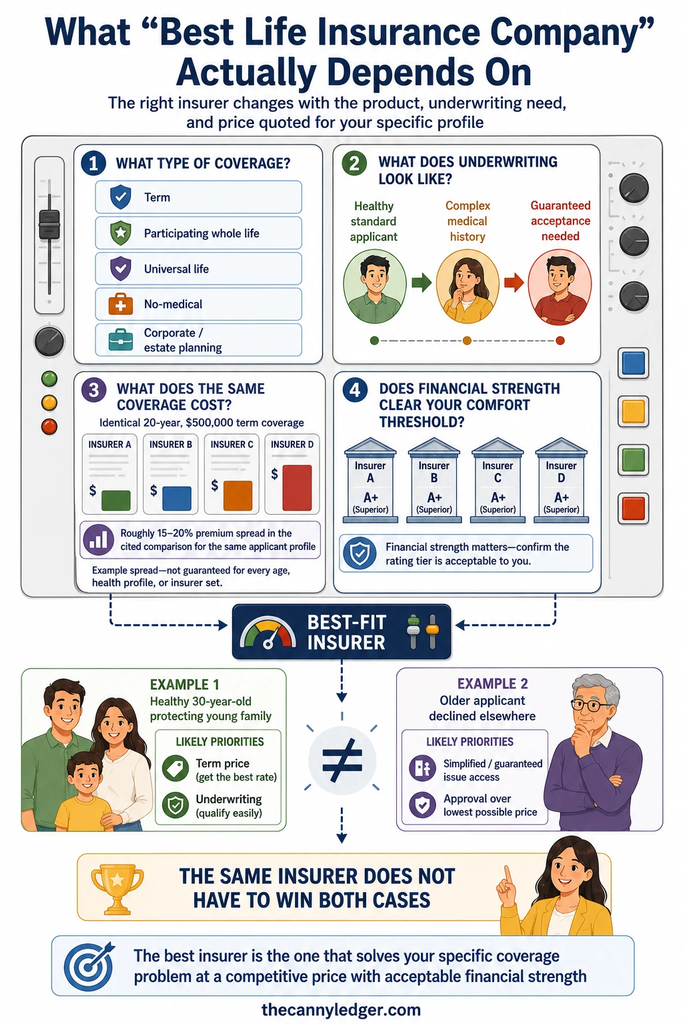
The right insurer for a healthy 30-year-old buying straightforward term coverage to protect a young family looks nothing like the right insurer for a 68-year-old who was declined elsewhere and needs guaranteed acceptance coverage to cover funeral costs. Matching the company to the actual need matters more than chasing a single overall winner, since even the largest, most financially secure insurer in the country isn’t the right fit if its product lineup doesn’t address what you’re actually trying to solve.
Price also isn’t fixed across insurers for identical coverage, and the gap can run meaningfully wide even among companies that all carry strong financial strength ratings. Rate comparisons for identical 20-year, $500,000 term coverage have shown spreads of roughly 15 to 20 percent between the cheapest and most expensive major insurers for the same applicant profile, which is exactly why comparing more than one insurer before committing tends to matter more than which specific company ends up winning on paper.
The Verdict
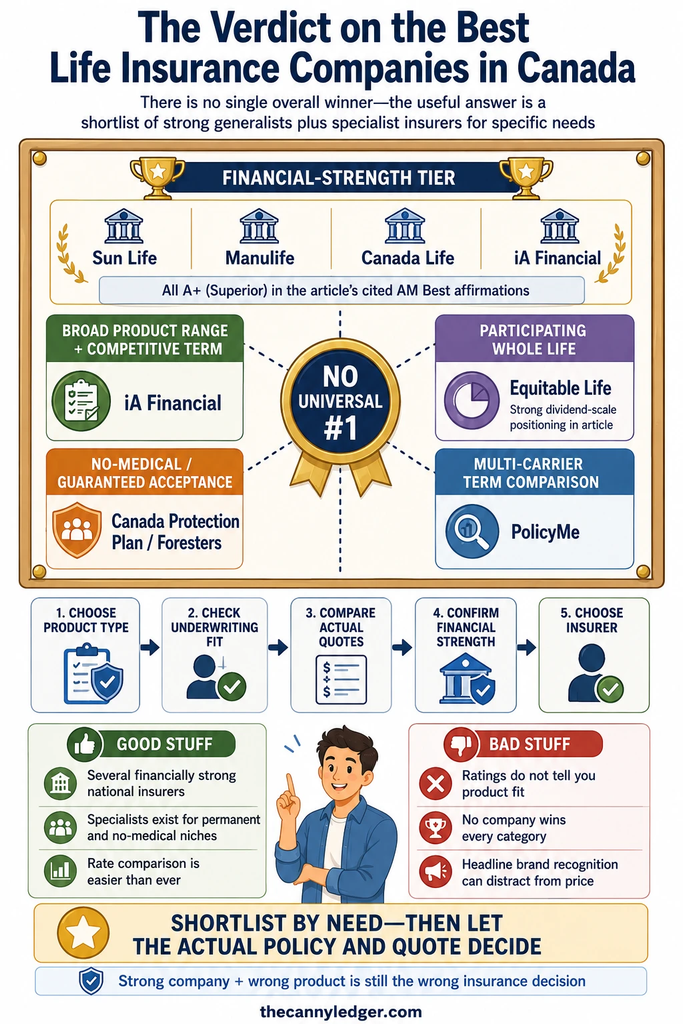
If financial strength alone were the deciding factor, Sun Life, Manulife, Canada Life, and iA Financial are functionally tied, all four sitting at AM Best’s A+ (Superior) tier as of their most recent 2025 and 2026 rating affirmations. Where they actually separate from each other is in the details, iA’s competitive term pricing and product breadth, Equitable’s standout dividend performance for whole life buyers, and Canada Protection Plan’s dominance in a no-medical segment the bigger insurers treat as a smaller side offering.
None of this changes based on who a person is buying coverage for or how large their family is, since the underlying comparison is about the insurer, not the buyer’s circumstances. What does change the right answer is the specific product need, which is why this list resists collapsing into a single winner and why the right move is matching your situation to the section above that actually applies to you.
Good stuff: All four major insurers carry top-tier, publicly verifiable financial strength ratings. Specialized players like Equitable and Canada Protection Plan clearly outperform the generalists in their specific niches. Digital comparison platforms like PolicyMe make direct rate comparison fast rather than requiring separate applications to each insurer.
Bad stuff: Financial strength ratings alone tell you almost nothing about which product actually fits your situation. No single Canadian insurer wins across every category, so treating this as a search for one best company rather than a best-fit exercise sets up the wrong comparison from the start.
Mistakes People Make Choosing an Insurer
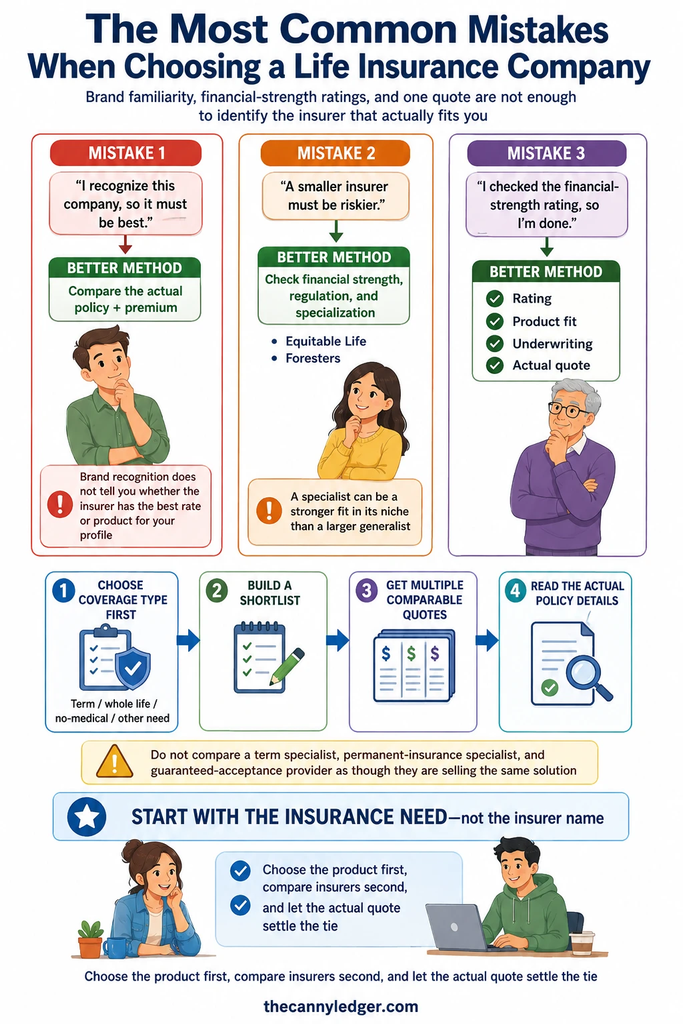
The most common mistake is picking the largest, most recognizable name purely on brand familiarity, without checking whether that insurer’s specific product lineup or pricing actually fits the coverage being sought. A major insurer’s brand recognition says nothing about whether it offers the most competitive term rate for a specific age and health profile, and the insurer comparison data covered in our cost breakdown shows real premium gaps even among top-tier companies.
A second mistake is assuming a smaller or less familiar insurer is automatically riskier, when several of the companies best suited to specific needs, like Equitable Life for whole life or Foresters for no-medical coverage, are established, regulated Canadian insurers with decades of operating history rather than fly-by-night operations. A third mistake is stopping the comparison after checking financial strength ratings alone, since getting quotes from more than one insurer is the only way to see the actual price and product differences that matter once solvency is no longer the deciding factor.
If you’re ready to narrow this down for your own situation, the practical next step is figuring out what type of coverage actually fits your need first, term, whole life, or a no-medical product, since that decision narrows the insurer shortlist far more effectively than starting from a general best-of list and working backward.
Common Questions About Choosing a Life Insurance Company in Canada
Does a higher AM Best rating mean lower premiums? No. Financial strength ratings measure an insurer’s ability to pay claims over the long term, not how competitively it prices a specific policy. A top-rated insurer can be more expensive than a slightly lower-rated one for the exact same coverage.
Is it risky to buy from a smaller Canadian insurer instead of one of the big four? Not inherently. Every life insurer authorized to operate in Canada is required to be a member of Assuris, which protects policyholders up to set thresholds if an insurer fails, and companies like Equitable Life and Foresters have been operating in Canada for decades under the same regulatory oversight as the larger insurers.
Can I buy from more than one insurer at once? Yes, and many Canadians do, holding a term policy from one company and a critical illness or permanent policy from another based on which insurer offered the better product or price for each specific need, an approach our guide to how much coverage you actually need can help you plan around before comparing insurers.