
Ask “how much does life insurance cost” expecting a single number and you’ll end up disappointed, because the honest answer swings by roughly forty times depending on which version of the question you’re actually asking. A healthy 25-year-old non-smoking woman buying a modest term policy might pay $20 a month. A 60-year-old smoker shopping for guaranteed acceptance coverage could pay well over $300. Both of those are real, current Canadian premiums for real products, and neither one tells you anything useful about what you’d personally pay without knowing which variables actually apply to you.
- What a 20-Year Term Policy Actually Costs by Age
- Why Women Consistently Pay Less Than Men
- What Smoking Actually Does to Your Premium
- How Much the Insurer You Choose Actually Matters
- What Coverage Amount and Term Length Actually Do to Your Price
- The Gap Between Term and Permanent Coverage
- What a Health Rating Does to Your Premium
- Why No Medical and Guaranteed Issue Cost So Much More
- What Buying Coverage as a Couple Actually Saves
- Mistakes People Make While Shopping by Price
- Common Questions About Life Insurance Costs in Canada
For a healthy, non-smoking 35-year-old buying a 20-year term policy with $500,000 in coverage, monthly premiums in 2026 run roughly $22 for women and $30 for men across Canada’s major insurers. That figure moves substantially once you change the term length, the coverage amount, your age, your smoking status, or the type of policy you’re buying, which is exactly what the rest of this breaks down using real dated rates rather than vague ranges.
What a 20-Year Term Policy Actually Costs by Age
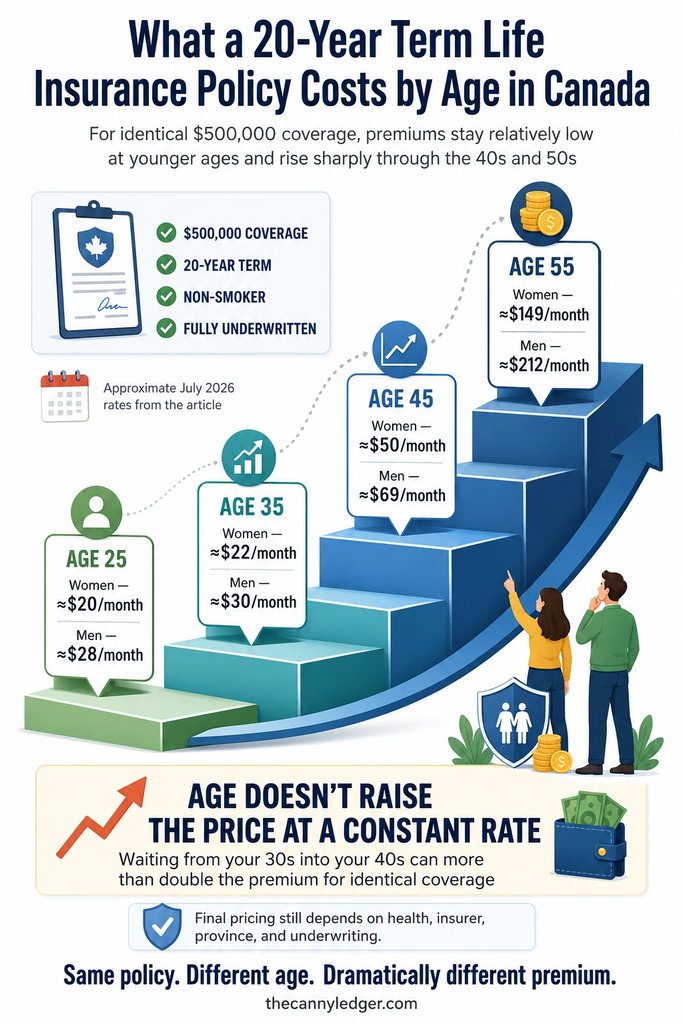
Age is the single biggest lever on your premium, and the jump isn’t gradual. For a $500,000, 20-year term policy, non-smoking women pay approximately $20 a month at age 25, $22 at 35, $50 at 45, and $149 by age 55, according to July 2026 rate data pulled directly from Canadian insurer pricing tools. Non-smoking men on the same policy pay roughly $28 at 25, $30 at 35, $69 at 45, and $212 at 55.
| Age | Women (non-smoker) | Men (non-smoker) |
|---|---|---|
| 25 | $20/month | $28/month |
| 35 | $22/month | $30/month |
| 45 | $50/month | $69/month |
| 55 | $149/month | $212/month |
Approximate monthly cost of a 20-year fully underwritten term policy with $500,000 in coverage, July 2026.
Notice how flat the curve looks between 25 and 35, then how sharply it climbs after 45. That’s not a coincidence in how insurers price risk. Mortality tables barely move in your twenties and thirties, then start rising noticeably as you cross into your late forties and fifties, and your premium follows that curve almost exactly. Someone waiting until 45 to buy the same coverage they could have locked in at 30 isn’t just paying more, they’re paying more than double for the identical policy.
Why Women Consistently Pay Less Than Men
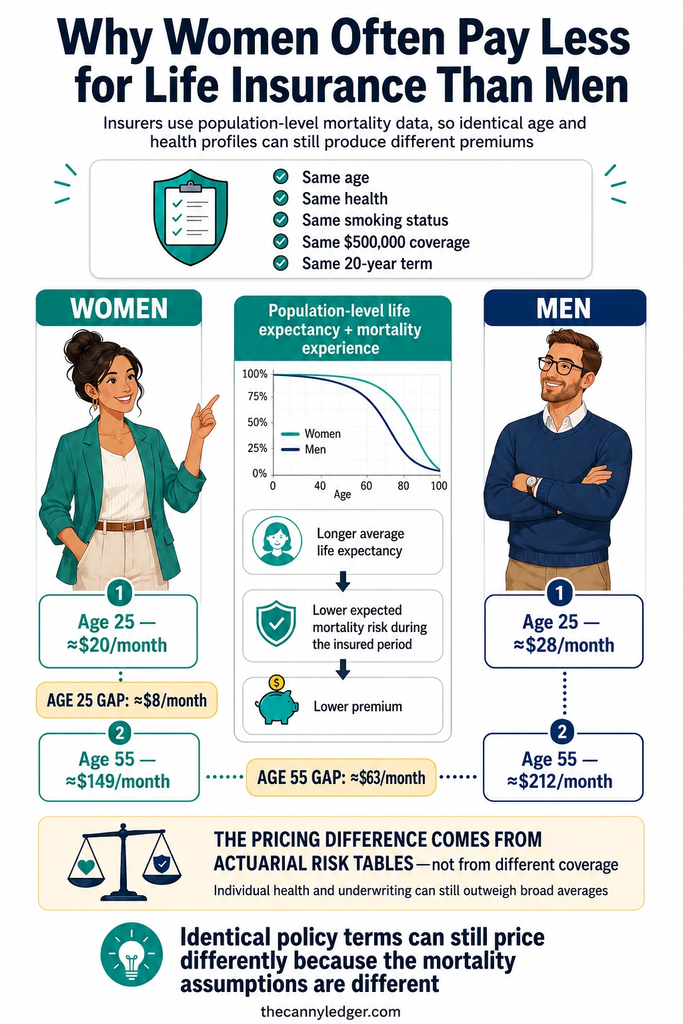
This isn’t pricing discrimination in the way it might first appear, it’s actuarial math based on documented life expectancy gaps. Women in Canada outlive men by an average of several years according to World Health Organization data, and insurers price mortality risk using exactly this kind of population-level statistic. A woman and a man of identical age, health, and smoking status will still see different premiums for the same coverage, purely because the insurer’s pricing tables reflect the actual difference in how long each group is statistically expected to live.
The gap shows up consistently across every age bracket rather than concentrating at one end of the spectrum. At 25, the difference between a non-smoking woman and a non-smoking man buying identical $500,000 coverage runs about eight dollars a month. By 55, that same gap widens to over sixty dollars a month, since the underlying mortality tables diverge further as both groups age.
What Smoking Actually Does to Your Premium
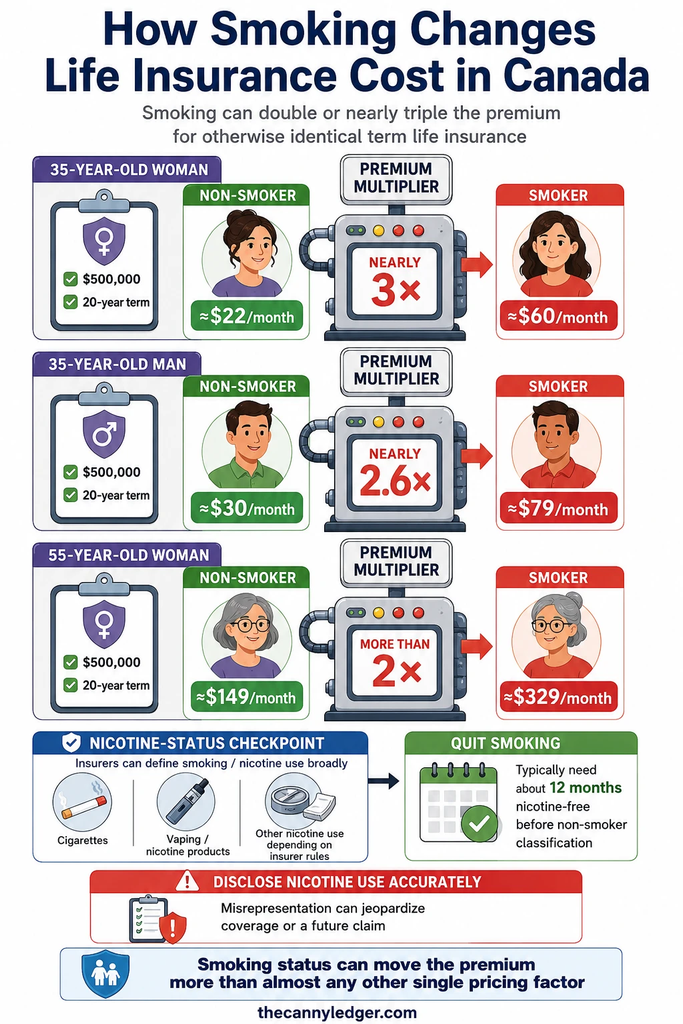
Smoking status changes your premium more dramatically than almost any other single factor within an otherwise identical profile. A 35-year-old non-smoking woman paying around $22 a month for $500,000 in 20-year term coverage would pay closer to $60 a month as a smoker for the identical policy, nearly triple the cost for the exact same coverage amount and term length. The same jump hits men even harder in dollar terms, moving from roughly $30 a month to $79.
That gap only widens with age. A 55-year-old non-smoking woman pays around $149 a month for this coverage, while a smoker of the same age and sex pays closer to $329, more than double. Insurers define smoking broadly enough to catch products beyond traditional cigarettes, and lying about nicotine use on an application isn’t a minor omission, it’s insurance fraud that can result in a cancelled policy or a denied claim for your beneficiaries. Someone who quit smoking generally needs to be nicotine-free for a full year before qualifying for non-smoker rates, so the savings aren’t available the moment you put down the last cigarette.
How Much the Insurer You Choose Actually Matters
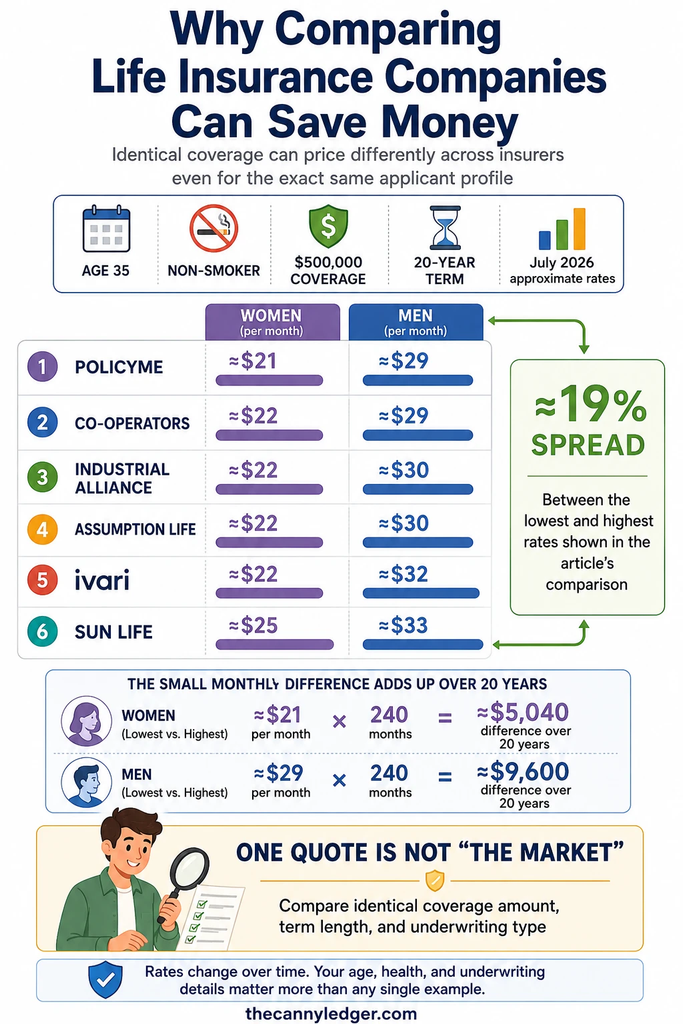
Shopping around actually changes your premium, and the gap between insurers for identical coverage is large enough to justify the extra time it takes to compare quotes. For a 35-year-old buying a 20-year, $500,000 term policy in July 2026, monthly rates ranged from about $21 to $25 for women and $29 to $33 for men across major Canadian insurers offering directly comparable coverage.
| Insurer | Women | Men |
|---|---|---|
| PolicyMe | $21/month | $29/month |
| Co-operators | $22/month | $29/month |
| Industrial Alliance | $22/month | $30/month |
| Assumption Life | $22/month | $30/month |
| ivari | $22/month | $32/month |
| Sun Life | $25/month | $33/month |
That’s roughly a 19 percent spread between the cheapest and most expensive option shown here, on identical coverage, purely based on which insurer underwrites the policy. Over a full 20-year term, that difference compounds into a meaningful sum, which is exactly why comparing quotes from more than one insurer before signing anything is worth the extra half hour it takes.
What Coverage Amount and Term Length Actually Do to Your Price
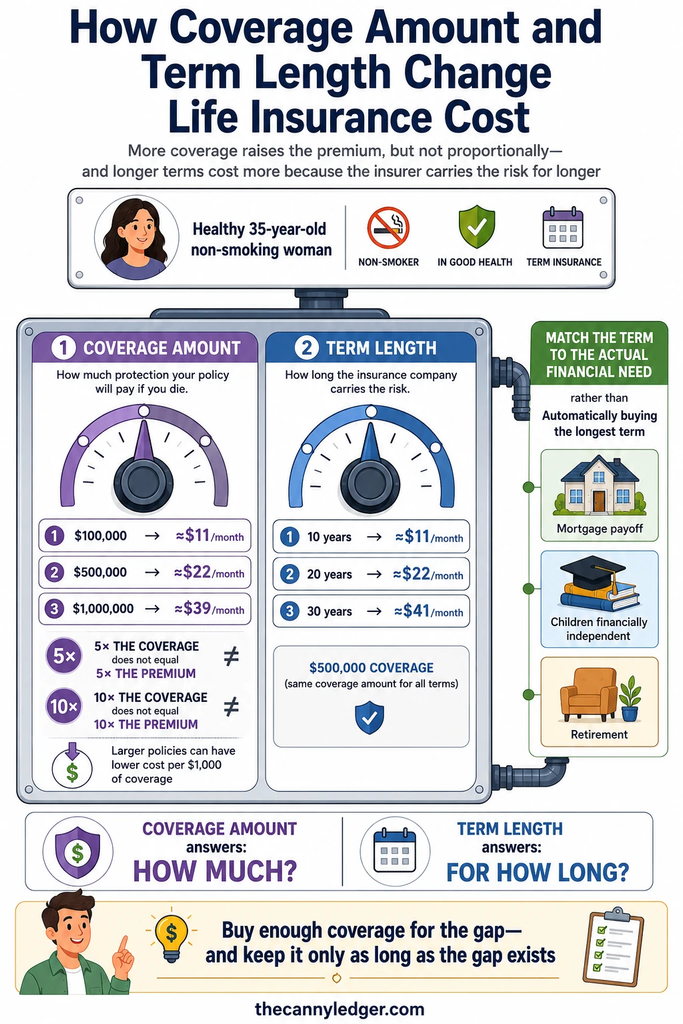
Doubling your coverage amount doesn’t double your premium, and the relationship isn’t linear the way most people assume before they start shopping. For a healthy 35-year-old non-smoking woman, $100,000 of 20-year term coverage runs about $11 a month, while $500,000 of the same term length costs roughly $22, only double the price for five times the coverage. Pushing to $1 million on the same term brings the cost to around $39 a month, still nowhere near ten times the base rate.
Term length moves the number too, though less dramatically than coverage amount does at lower amounts. That same $500,000 in coverage costs approximately $11 a month on a 10-year term, $22 on a 20-year term, and $41 on a 30-year term, since a longer commitment means the insurer is on the hook for a longer window during which a claim could occur. Someone who only needs coverage until a mortgage is paid off or children are grown often does better matching the term length to that specific timeline rather than defaulting to the longest option available.
The Gap Between Term and Permanent Coverage
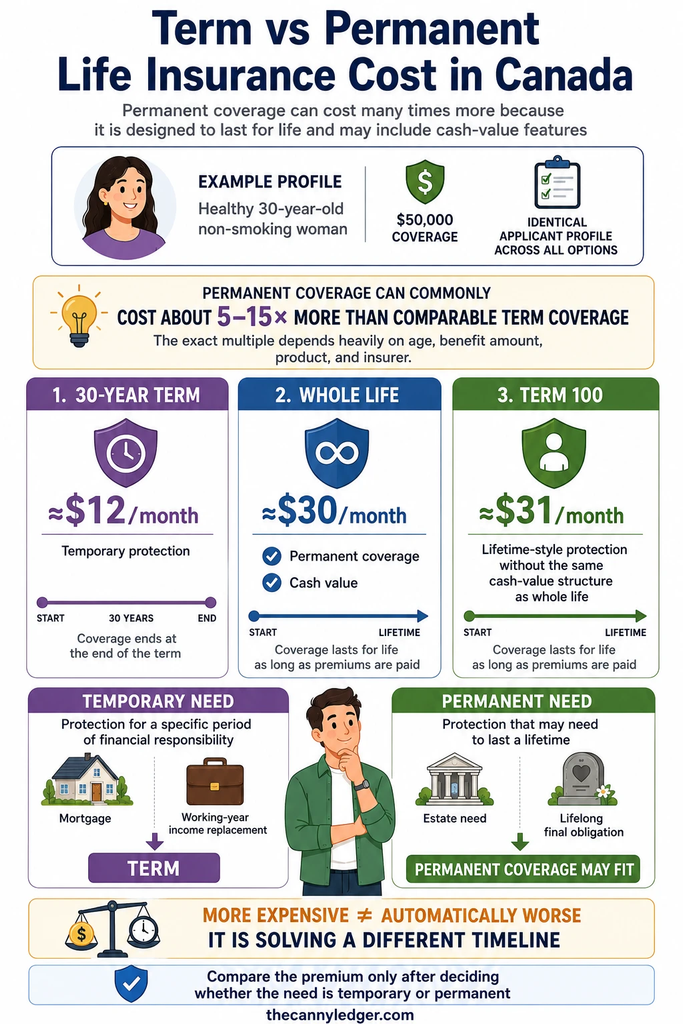
This is where the sticker shock actually shows up for most first-time shoppers, and it’s worth understanding before comparing term and permanent quotes side by side. Whole life, universal life, and Term 100 coverage typically cost five to fifteen times more per month than an equivalent term policy, a gap driven by the guaranteed lifetime payout and, in whole life’s case, the cash value building inside the policy.
For a healthy 30-year-old non-smoking woman, $50,000 of 30-year term coverage runs about $12 a month, while the same $50,000 face amount as whole life coverage costs closer to $30, and as Term 100 coverage costs around $31. None of this makes permanent coverage a bad choice outright, since it’s solving a different problem than term insurance, permanent lifelong protection rather than coverage for a fixed window, but it does mean the premium gap should be a deliberate trade-off rather than a surprise discovered mid-application.
What a Health Rating Does to Your Premium
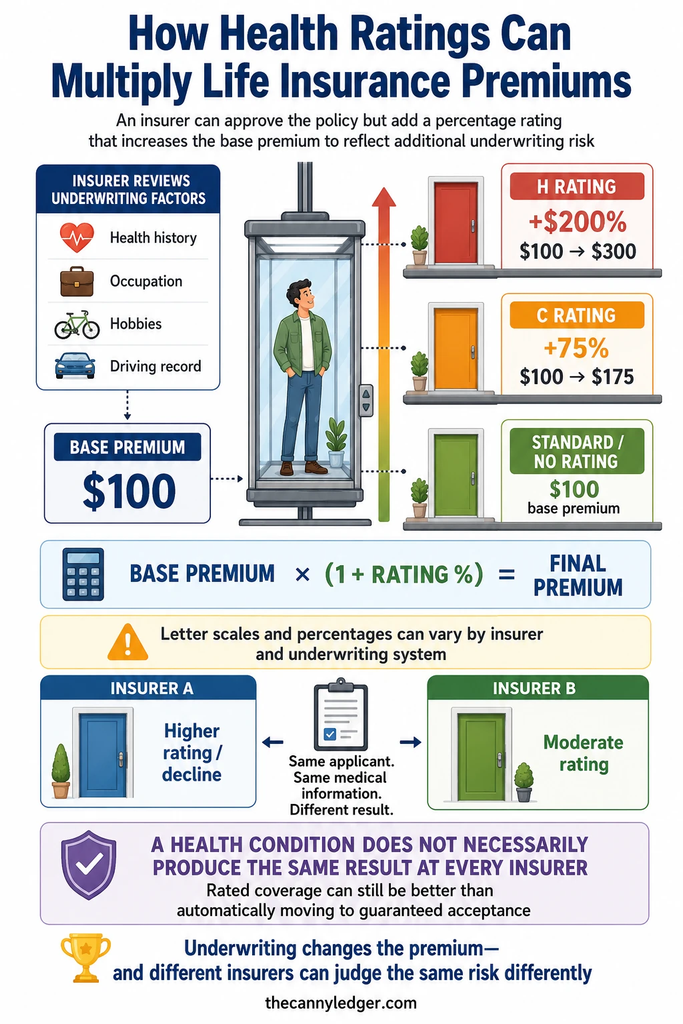
Beyond age, sex, and smoking status, insurers assign a risk rating based on health history, occupation, hobbies, and driving record, and that rating multiplies your base premium in a way that’s rarely explained clearly at the point of sale. Canadian insurers commonly use a rating scale running from no rating up through categories like A through J, each adding a percentage increase to the base premium, calculated as your base rate multiplied by one plus that rating’s percentage.
A C-rated applicant, a moderate rating that might apply to a controlled but real health condition, would pay 75 percent more than an unrated applicant for the identical coverage, meaning a $100 base premium becomes $175. An H rating pushes that same $100 base premium to $300. This is exactly why two people with the same age, sex, and coverage amount can walk away with dramatically different premiums, and it’s also why a health condition that gets you declined by one insurer’s underwriting guidelines might only trigger a moderate rating increase with a different insurer whose guidelines treat that specific condition less strictly.
Why No Medical and Guaranteed Issue Cost So Much More
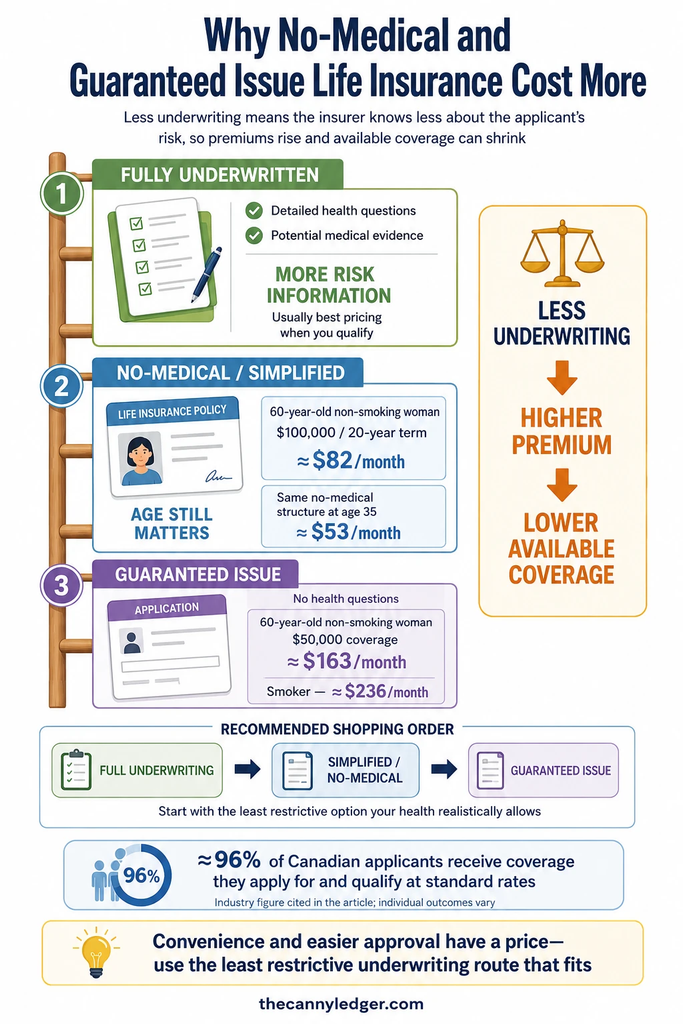
Skipping the medical exam trades a lower barrier to approval for a noticeably higher premium, and the gap is largest at older ages where the underwriting shortcut matters most to insurers. A 60-year-old non-smoking woman shopping for $100,000 of 20-year term coverage pays around $82 a month without a medical exam, compared to roughly $53 a month at 35 for the identical no-medical structure, showing how steeply age compounds with reduced underwriting. Guaranteed issue coverage, which asks no health questions at all, runs even higher, with a 60-year-old non-smoking woman paying around $163 a month for just $50,000 in coverage, smokers paying closer to $236 for the same amount.
This is precisely why a fully underwritten medical exam policy is almost always worth applying for first, since being declined doesn’t follow you into a later application for simplified or guaranteed issue coverage. According to an interview with the Canadian Life and Health Insurance Association’s Director of Policy, around 96 percent of Canadian life insurance applicants actually receive the coverage they apply for and qualify at standard rates, which means the population of people who actually need to skip straight to a no-medical product is smaller than the marketing around these policies sometimes suggests.
What Buying Coverage as a Couple Actually Saves
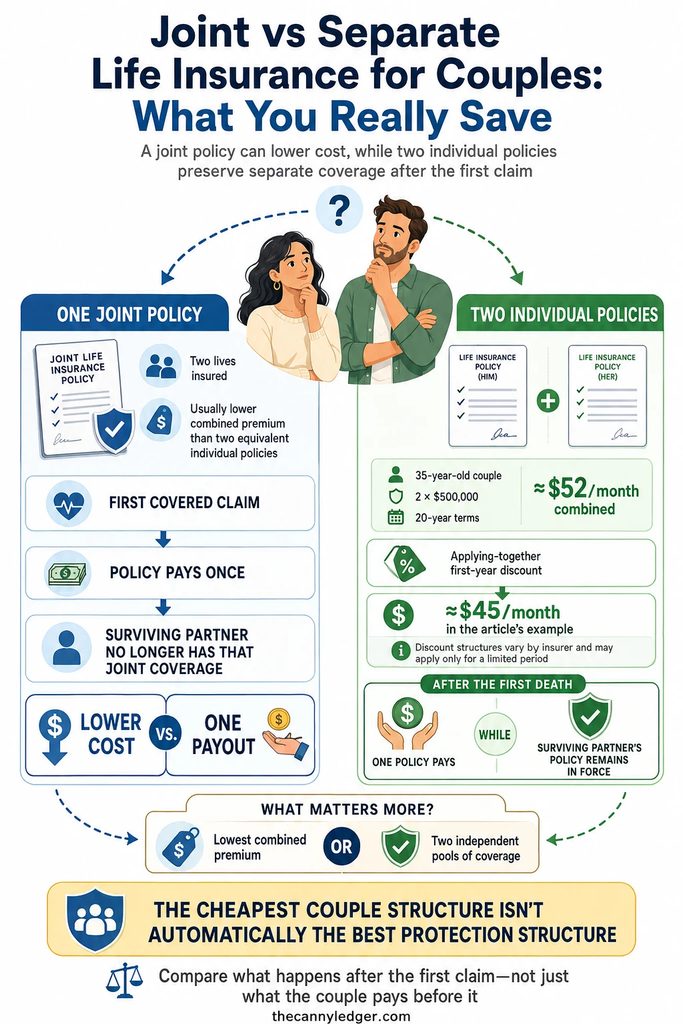
Joint policies and couples discounts both exist in the Canadian market, and they work differently enough to be worth understanding separately before assuming either one is automatically cheaper. A joint policy covering two people under a single contract typically costs less than two fully separate individual policies, but it only pays out once, which means the surviving partner loses their coverage entirely after the first claim. Buying two individual policies while applying together, by contrast, lets some insurers apply a first-year discount to each policy while keeping both people fully and separately insured for the life of their respective terms.
For a 35-year-old couple, industry average pricing for two individual 20-year, $500,000 policies runs around $52 a month combined, while an applied-together discount can bring that closer to $45 in the first year. The difference between this approach and a single joint policy isn’t really about which one is cheaper in isolation, it’s about whether losing coverage after the first death is an acceptable trade for the lower combined premium, a question our comparison of joint life insurance structures covers in more depth.
Mistakes People Make While Shopping by Price
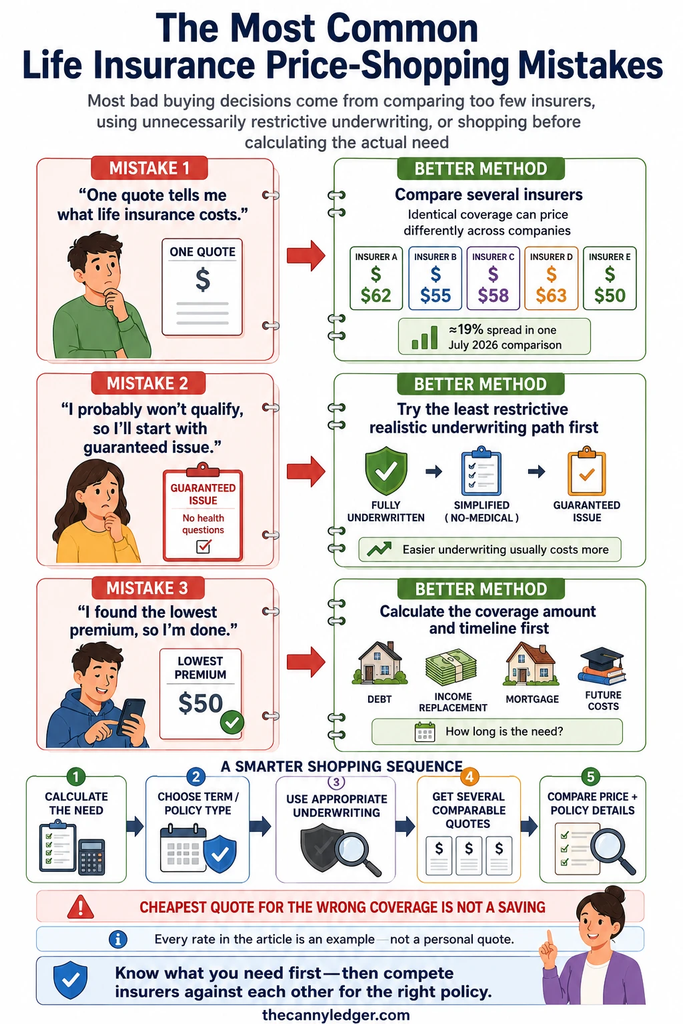
The most common mistake is comparing quotes from only one insurer and assuming the number reflects the market rather than one company’s specific pricing model. Given how much the insurer comparison table above shows rates diverging on identical coverage, settling for the first quote received, especially one offered directly through a bank or existing financial relationship, routinely leaves money on the table that a half hour of comparison shopping would have caught.
A second mistake is defaulting to a no-medical or guaranteed issue policy out of a general assumption that the applicant wouldn’t qualify for anything better, without actually applying for fully underwritten coverage first. Given that the overwhelming majority of applicants qualify at standard rates, skipping straight to the more expensive, lower-coverage option often means paying two to three times more than necessary for coverage that a standard medical exam application would have secured at a fraction of the cost. A third mistake is buying based purely on the lowest available premium without matching the term length and coverage amount to an actual, calculated need, since working out how much coverage you actually need before shopping prevents both underinsuring a real financial gap and overpaying for protection nobody in the household actually requires.
If you’re ready to see where you personally land on these numbers, the practical next step is getting quotes from a few different insurers using your actual age, health profile, and coverage target, since every figure in this article is an average, not a personal quote, and the only way to know your real number is to apply.
Common Questions About Life Insurance Costs in Canada
Is $100 a month a lot to pay for life insurance? For a healthy non-smoker under 50, yes, unless you’ve chosen a long term length, a large coverage amount, or a no-medical product. Smokers, seniors, and anyone shopping for permanent coverage are far more likely to land in that range or above it even with a straightforward, healthy profile.
Does my premium ever increase once I’ve locked in a term policy? No, for a standard level-term policy, your premium stays fixed for the entire length of the term regardless of any health changes that happen afterward, as long as you were honest on your original application. The rate only changes if you renew into a new term or convert to a different product after the original term ends.
Can I lower my premium after my policy is already in force? Generally not by simply asking your existing insurer to reduce it, though you can sometimes reduce your coverage amount to lower the cost, or shop a new policy elsewhere if your health has improved enough to potentially qualify for a better rating than you originally received.