
Type “no medical exam life insurance” into Google and the assumption baked into that search is usually that it’s one product, a single alternative to the needle and the nurse visit that everyone either qualifies for or doesn’t. That assumption causes real financial harm, because no medical exam life insurance in Canada is actually three distinct products layered on top of each other, and picking the wrong one costs people either far more money than they needed to spend or a death benefit that pays out at a fraction of what they thought they’d bought.
- The Three Tiers Nobody Explains Clearly Enough
- What Simplified Issue Actually Asks and What It Doesn’t
- What Guaranteed Issue Actually Guarantees, and What It Doesn’t
- What Happens If You Die During the Waiting Period
- Why This Coverage Costs More Than the Exam Would Have Saved
- The Order Most People Get Backwards
- Taxes and What Happens If Your Insurer Fails
- Mistakes That Show Up After the Policy Is Already Signed
- Common Questions About No Medical Exam Life Insurance in Canada
At the most basic level, no medical exam coverage in Canada means an insurer decides whether to approve you and how much to charge without sending a nurse to draw blood or take your blood pressure, one of several types of life insurance available in Canada built around speed and accessibility rather than the lowest possible price. Depending on which tier you land in, that can still involve detailed health questions and a review of your prescription history, a short handful of yes-or-no questions, or, at the far end, no health information at all beyond your age.
The Three Tiers Nobody Explains Clearly Enough
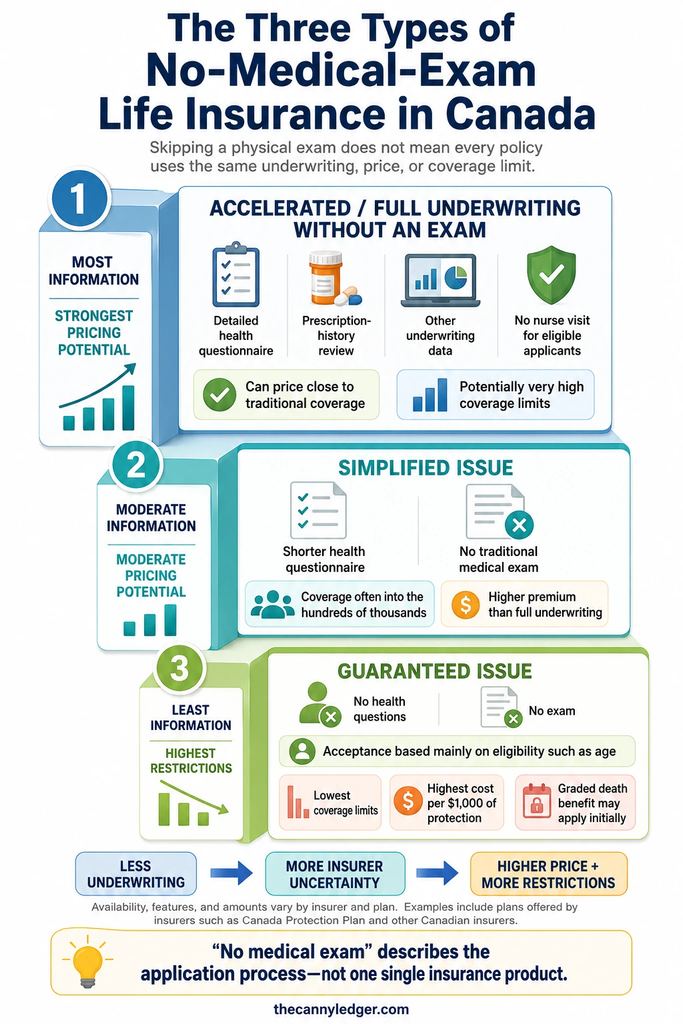
The tier that gets skipped over most often is the one sitting closest to traditional coverage. Several Canadian insurers now offer fully underwritten policies that skip the physical exam entirely for younger, healthy applicants, relying instead on a detailed health questionnaire, a check of prescription drug history, and a look at driving records to reach the same underwriting conclusion a nurse visit would have. This tier prices close to traditional exam-based coverage and can offer coverage well into seven figures, which surprises people who assumed skipping the exam automatically meant a worse deal.
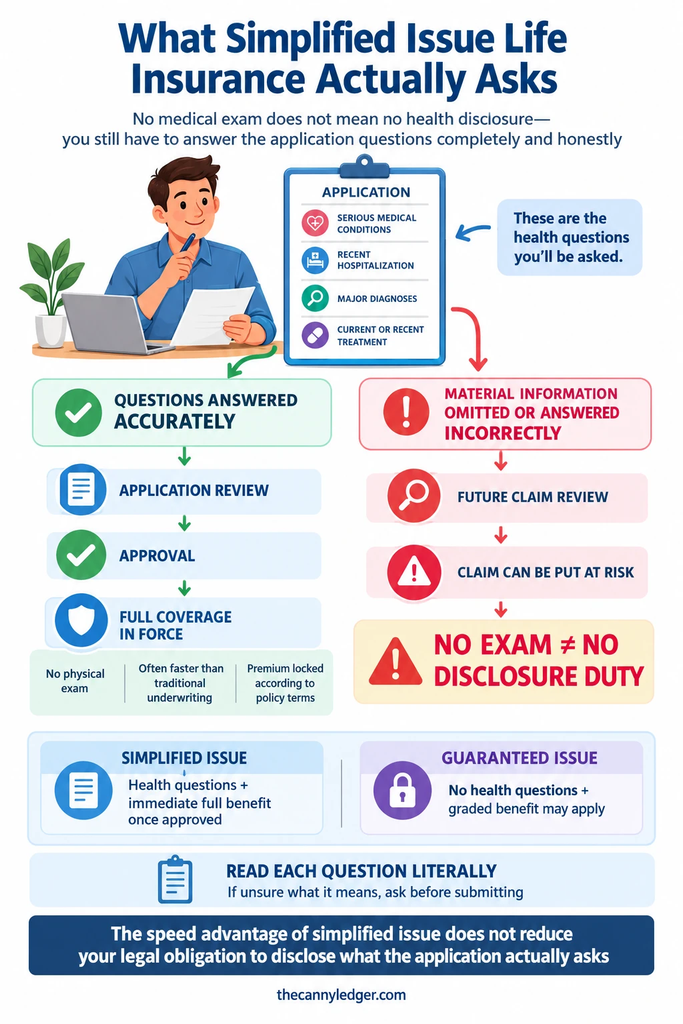
Simplified issue sits in the middle, and it’s the tier most people picture when they search for no medical exam coverage. You answer a shorter set of health questions, typically covering serious conditions, recent hospitalizations, and major diagnoses, without a follow-up medical exam or detailed records pull. Coverage under this tier usually runs into the hundreds of thousands of dollars rather than the low five figures guaranteed issue caps out at, and Canada Protection Plan’s own Preferred Life product page confirms coverage available with no medical exam up to $500,000 for applicants aged 70 or under, rising to a full million dollars with some added underwriting.
Guaranteed issue is the tier built for people who’ve already been turned down elsewhere or who know a health condition would disqualify them from anything requiring questions. There’s no questionnaire, no exam, and effectively no way to be declined if you meet the age window, but the trade-offs are real and worth understanding before treating this tier as a shortcut anyone should take by default. Our broader guide to life insurance in Canada covers where all three of these tiers fit against fully underwritten term and permanent coverage.
What Simplified Issue Actually Asks and What It Doesn’t
The health questionnaire on a simplified issue application isn’t a formality, and misunderstanding that costs people claims down the road. You’re still legally required to answer every question honestly and completely, a duty the Financial Consumer Agency of Canada outlines for any insurance application, and if a claim comes in and the insurer discovers an undisclosed condition that a question directly asked about, they can deny the claim or rescind the policy entirely, even though no exam ever happened. Skipping the needle doesn’t mean skipping the disclosure obligation, and treating a health question as optional because nobody’s checking your blood work in real time is one of the more expensive mistakes people make with this product.
What makes simplified issue attractive isn’t just the speed, though a decision in days rather than the weeks a full exam and lab results can take is a real advantage for someone with a looming mortgage closing or an age cutoff approaching on a term product. It’s that coverage takes effect immediately with no waiting period once approved, the full death benefit applies from day one, and premiums lock in at approval the same way they would under a fully underwritten policy. That last point matters because it’s the detail that separates simplified issue cleanly from guaranteed issue, where the waiting period changes everything about what your family actually receives if you die soon after buying the policy.
What Guaranteed Issue Actually Guarantees, and What It Doesn’t
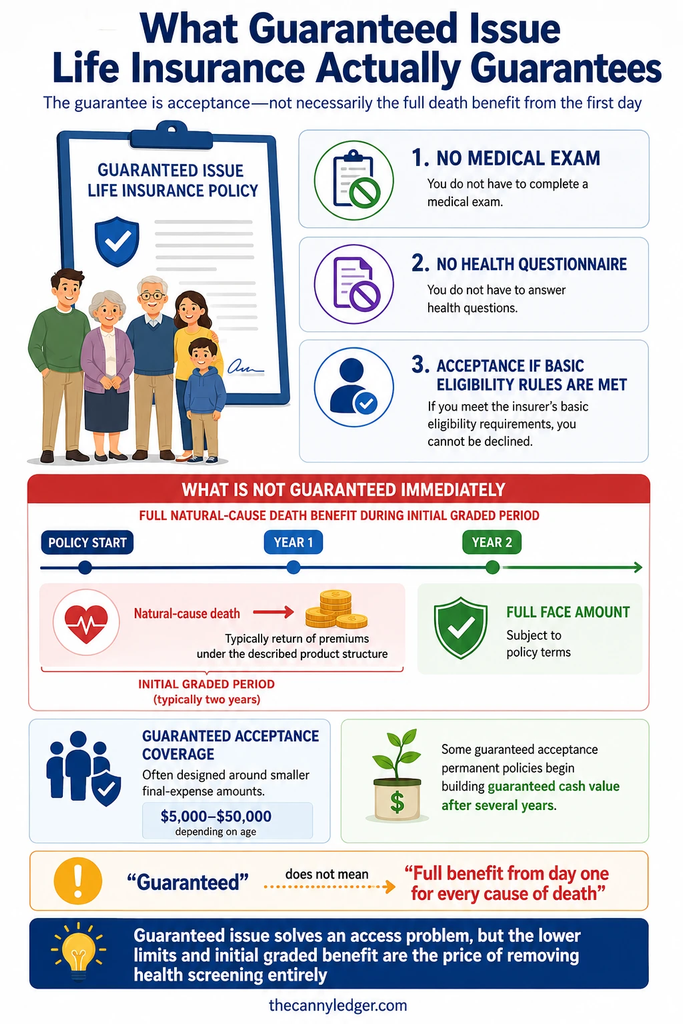
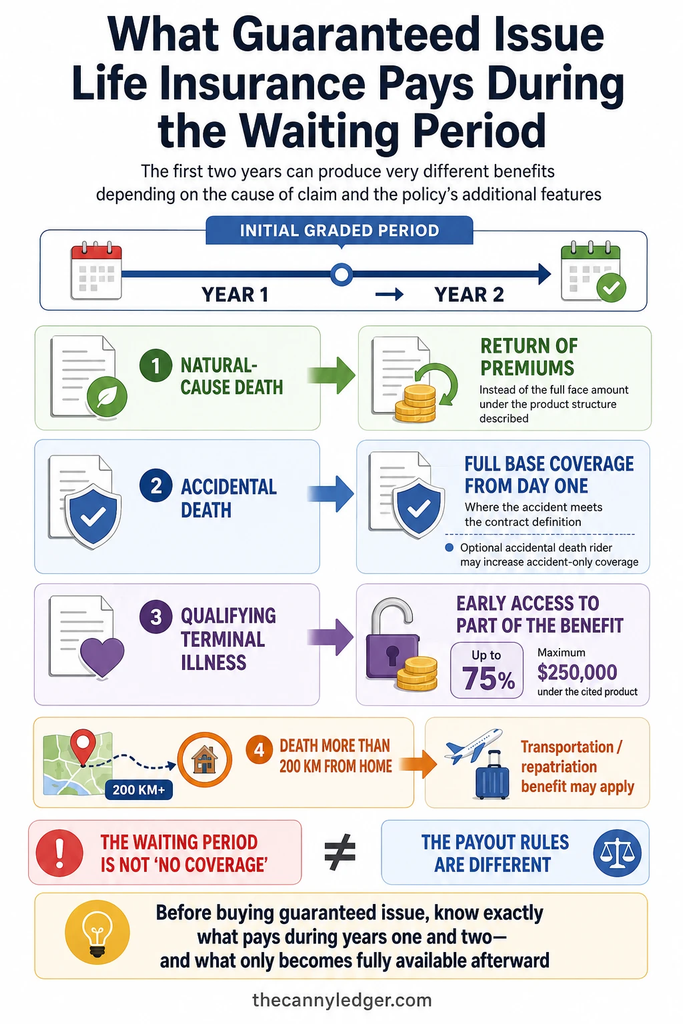
The word guaranteed in guaranteed issue insurance refers only to acceptance, not to the full death benefit being payable immediately, and that distinction is the single most misunderstood fact in this entire category. Nearly every guaranteed issue policy sold in Canada includes a graded death benefit for the first two years, meaning if you die of natural causes during that window, your beneficiary receives a refund of the premiums you paid rather than the coverage amount printed on your policy. Canada Protection Plan’s own guaranteed acceptance product page states this plainly, confirming that the death benefit is limited to a return of premiums if death occurs by other than accidental means in the first two years, with the full coverage amount payable only after that window closes or if death is accidental.
Coverage amounts on guaranteed issue policies are also far lower than most people expect walking in. That same Canada Protection Plan product caps guaranteed acceptance coverage between $10,000 and $50,000 for applicants aged 18 to 60, and between $5,000 and $50,000 for applicants aged 61 to 75. Those figures explain why this tier gets marketed almost exclusively around funeral and final expense planning rather than income replacement or mortgage protection, since the ceiling simply isn’t built for larger financial obligations.
There’s a useful detail buried in the fine print that most no-medical guides skip entirely, and it’s worth knowing whether or not guaranteed issue ends up being the right fit for you. Guaranteed acceptance policies from Canada Protection Plan begin accumulating a guaranteed cash value starting in the fifth policy year, meaning even this stripped-down, no-questions-asked product still builds real equity over time the same way a small whole life policy would, just starting from a much smaller premium base.
What Happens If You Die During the Waiting Period
The graded death benefit isn’t the only protection that applies during those first two years, and the exceptions are worth knowing since they change the actual math on whether guaranteed issue makes sense as a stopgap. Death from an accident, as defined in the policy, pays the full coverage amount from day one with no waiting period at all, which is why insurers sell an optional accidental death rider that stacks additional coverage on top of the base guaranteed issue amount specifically for that scenario. A terminal illness diagnosis also triggers benefits ahead of schedule under most guaranteed issue policies, with Canada Protection Plan’s version paying up to 75 percent of the death benefit, to a maximum of $250,000, once a qualifying terminal diagnosis is confirmed, letting a policyholder access money while still alive rather than waiting for a death benefit that hasn’t graded in yet.
A transportation benefit rounds out the standard package on most Canadian guaranteed issue policies, covering the cost of returning a policyholder’s remains home if death occurs more than 200 kilometres from their principal residence. It’s a narrow, specific benefit that rarely gets mentioned in broader life insurance comparisons, but it’s exactly the kind of practical detail that separates a useful guaranteed issue policy from one that’s charging premium dollars for coverage that looks identical on paper but skips the extras.
Why This Coverage Costs More Than the Exam Would Have Saved
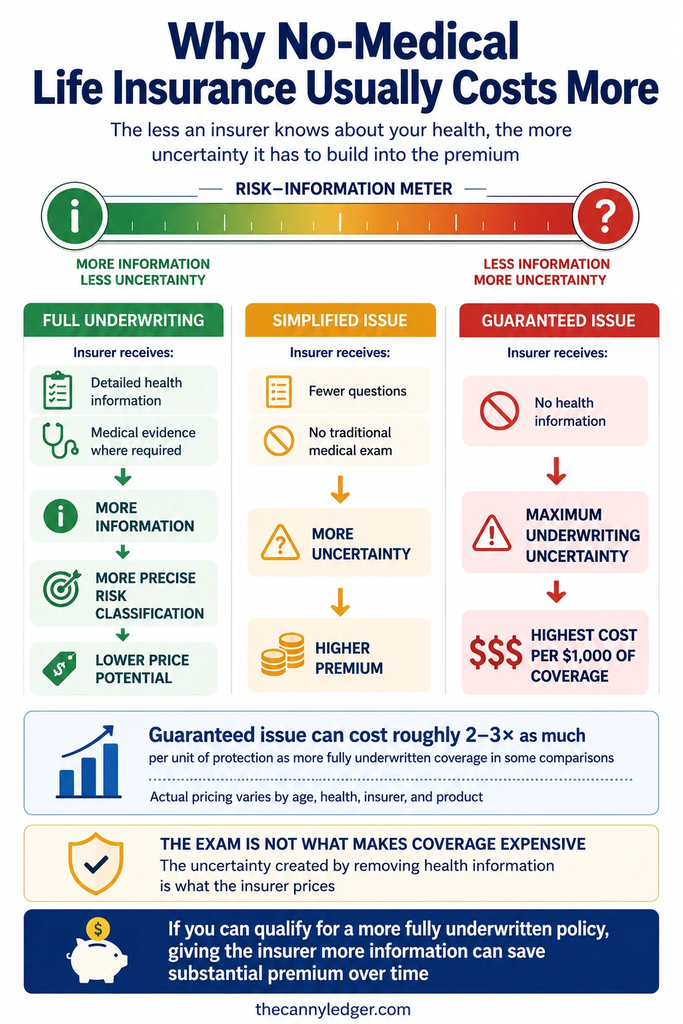
Every layer of reduced underwriting shifts risk from the applicant onto the insurance pool, and the pool responds by charging more. When an insurer skips the exam and the detailed questions, it can’t tell the difference between an applicant who happens to be perfectly healthy and one who’s quietly managing a serious condition, so the premium gets priced as though everyone in that pool carries above-average risk. This is the same actuarial logic behind why a healthy thirty-five-year-old who could easily pass a medical exam ends up paying meaningfully more for a simplified issue policy than they would for fully underwritten coverage of the identical amount, purely because the insurer has less information to work with and prices accordingly.
That dynamic gets more extreme moving from simplified issue to guaranteed issue, where an insurer has zero health information and has to assume every applicant could be in the worst-case health bracket the age window allows. The premium per thousand dollars of coverage on a guaranteed issue policy often runs two to three times what the same face amount would cost under full underwriting, which is the direct cost of removing every screening step rather than some arbitrary markup. Our breakdown of what life insurance actually costs in Canada walks through those per-thousand-dollar comparisons across underwriting tiers in more detail. Understanding that trade-off changes how someone should approach shopping for this coverage, since the cheapest path to adequate protection almost never starts at the tier requiring the least information.
The Order Most People Get Backwards
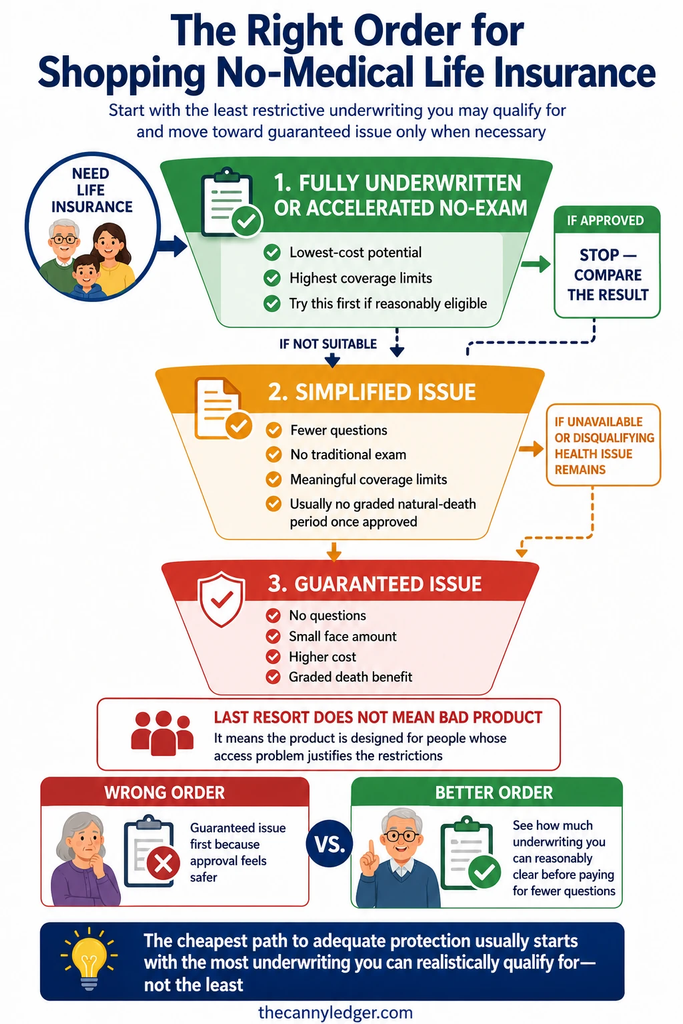
The single biggest mistake in this entire category is starting the search at guaranteed issue because it sounds like the safest bet, when it’s actually the most expensive and most limited option of the three. A more sensible approach for seniors and anyone managing a health condition is to start with fully underwritten or accelerated no-exam coverage first, since that tier offers the lowest cost and highest coverage ceiling for anyone who can actually clear it. If that application comes back declined or the health questionnaire flags a disqualifying condition, simplified issue is the next reasonable stop, offering meaningful coverage amounts without the graded waiting period or the rock-bottom coverage caps that come with guaranteed issue.
Guaranteed issue earns its place at the end of that sequence rather than the start of it, and it’s the right call specifically for people who’ve already been declined elsewhere, who know a serious diagnosis would disqualify them from anything requiring questions, or who simply want a small, certain policy to cover funeral costs without the possibility of denial hanging over the application. Treating it as the default first stop because the phrase no medical exam sounds appealing is exactly the pattern that leaves people paying guaranteed issue prices for coverage a simplified issue policy would have provided at a lower cost and a higher limit.
Taxes and What Happens If Your Insurer Fails
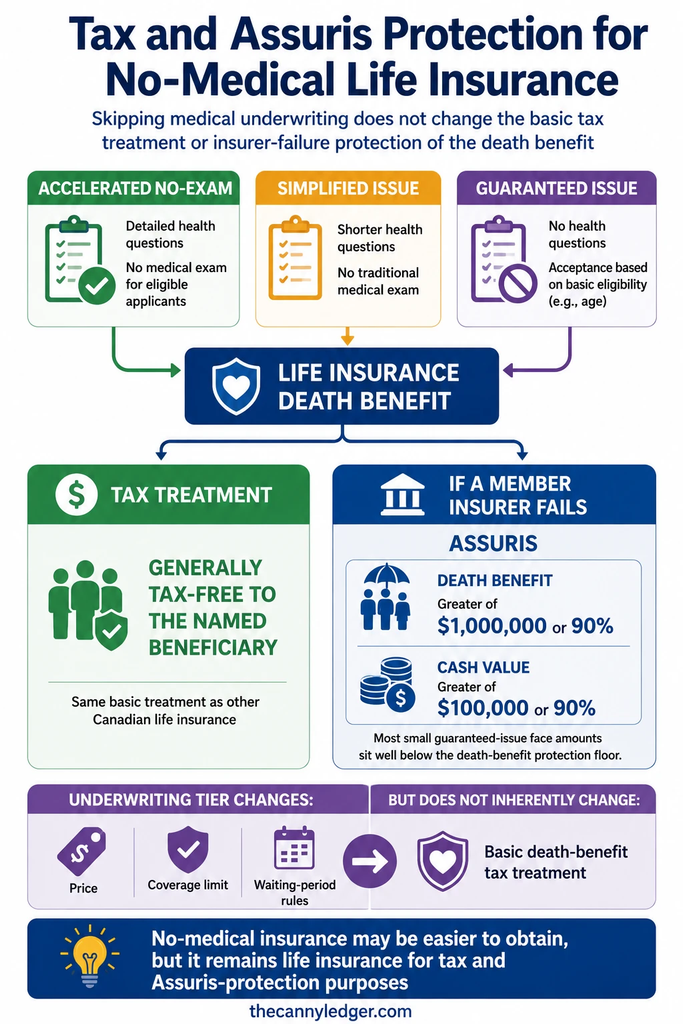
The tax treatment on every tier of no medical exam coverage follows the same rule that the Financial Consumer Agency of Canada confirms applies to life insurance generally. The death benefit reaches your named beneficiary tax-free regardless of which underwriting tier the policy came from, and this applies equally to a $1,000,000 fully underwritten no-exam policy and a $10,000 guaranteed issue plan bought purely for funeral costs.
If the insurer issuing your policy were to fail, which is rare but not something to assume can’t happen, the same protection framework applies here as it does across the rest of the Canadian life insurance industry. Assuris, the industry-funded body responsible for protecting policyholders through an insurer failure, guarantees policyholders retain the greater of one million dollars or 90 percent of their death benefit, and the greater of one hundred thousand dollars or 90 percent of any cash value built up inside the policy. Given that guaranteed issue and most simplified issue face amounts sit well under either threshold, the overwhelming majority of no medical exam policyholders in Canada would be made fully whole in the unlikely event their insurer became insolvent.
Mistakes That Show Up After the Policy Is Already Signed
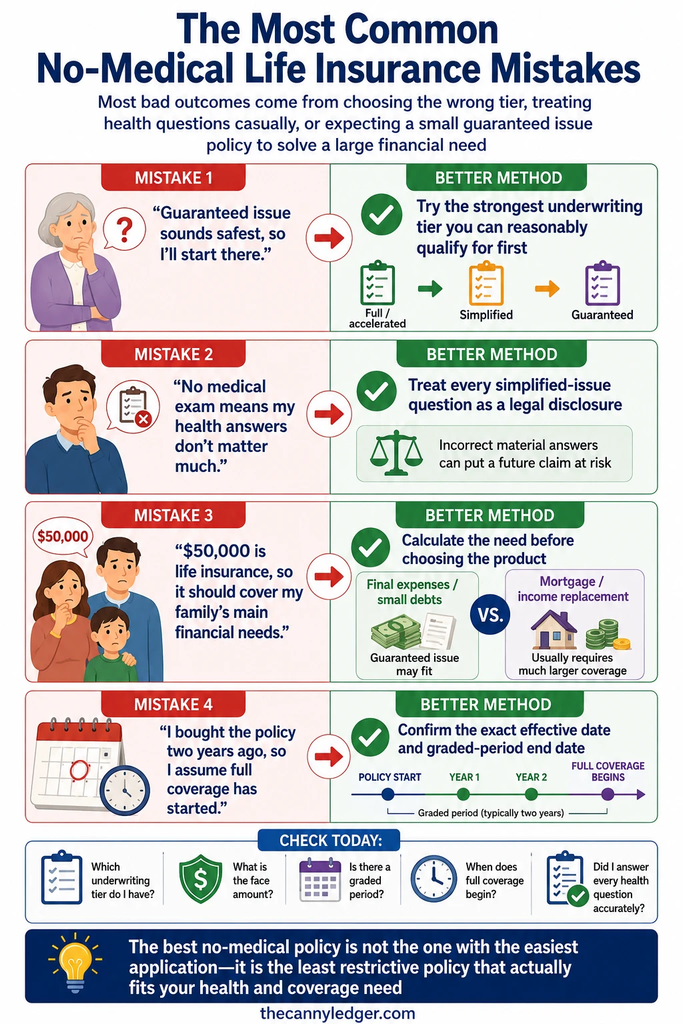
Beyond starting at the wrong tier, the most common error is treating the health questionnaire on a simplified issue application as a box to check quickly rather than a legal disclosure with real consequences. Answering a question about a diagnosis or medication incorrectly, even by accident or through honest forgetfulness, gives the insurer grounds to deny a claim years later during exactly the moment your family needs the payout most, and there’s rarely a way to fix that after the fact once a death claim is already under review.
A second recurring mistake is buying guaranteed issue coverage for an amount that doesn’t actually match the need it’s meant to cover. Because the ceiling tops out around fifty thousand dollars with most Canadian insurers, someone using this tier to plan for a five-figure funeral and some outstanding smaller debts is well served, but someone hoping it will replace lost income or cover a mortgage balance is going to be badly underinsured no matter how much of that ceiling they max out. Working out how much coverage you actually need before shopping any of these tiers avoids that mismatch entirely. A third mistake, subtler than the first two, is letting the two-year graded period lapse from memory rather than treating it as an active planning window, since a policyholder who understands exactly when full coverage kicks in can make more informed decisions about interim coverage, an accidental death rider, or simply timing other financial decisions around that date.
If you’re currently holding a guaranteed issue policy and aren’t certain whether your two-year waiting period has passed, that date is printed on your policy’s effective date and confirmable with a single call to your insurer, and it’s worth checking now rather than assuming, since the gap between what a graded policy pays and what a matured one pays is the difference between a modest payout and full coverage.
Common Questions About No Medical Exam Life Insurance in Canada
Can I be declined for guaranteed issue life insurance in Canada? No, provided you meet the insurer’s age requirements, typically somewhere between 18 and 75 or 80 depending on the company. Guaranteed issue is designed specifically so that health condition, smoking status, or prior declines from other insurers can’t result in a rejected application.
Does simplified issue life insurance ever require blood work or a medical exam later? No. Once you’re approved based on the health questionnaire, the policy is issued and stays in force under those terms, there’s no follow-up exam requirement built into the product structure the way there might be with a fully underwritten policy that includes periodic reviews for certain riders.
Is it worth applying for fully underwritten life insurance first even if I’m fairly sure I’ll be declined? Usually yes, since being declined doesn’t follow you to a simplified or guaranteed issue application in a way that raises your premium there, and the potential savings from qualifying for standard underwriting are large enough that the extra time is almost always worth spending before settling for a no-medical tier.