

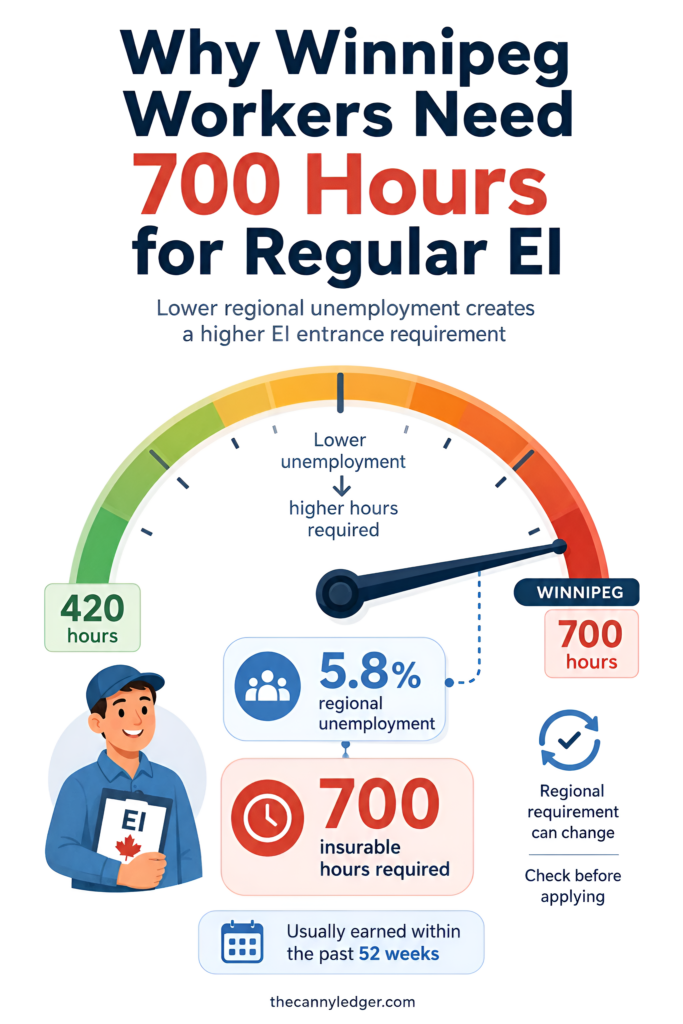
Winnipeg currently sits at 700 insurable hours to qualify for regular EI benefits, the highest requirement that exists anywhere in the country under the program’s sliding scale. That number surprises people who assume Manitoba’s job market is strong enough to make qualifying easier here than in a place with visibly higher unemployment, but the EI system works in reverse: the lower your region’s unemployment rate, the more hours you need to have worked before the program considers you eligible, and as of the current rate period, Winnipeg’s regional unemployment rate sits at 5.8 percent, low enough to trigger the maximum hour requirement rather than a reduced one.
- Winnipeg Currently Needs the Maximum 700 Insurable Hours to Qualify
- What Counts as an Insurable Hour, and What Doesn’t
- How Much You’ll Actually Get Paid
- The One-Week Waiting Period and When Payments Start
- What You Need Before You Apply
- Applying Through My Service Canada Account, Step by Step
- Biweekly Reports Keep the Money Coming
- Special Benefits Use a Different Hour Requirement Entirely
- What Disqualifies You
- Common Questions
- Apply Before You’ve Landed Somewhere New, Not After
To apply for Employment Insurance in Winnipeg, you need at least 700 insurable hours worked in the past 52 weeks under the current regional rate, a Record of Employment from your employer, and an application submitted through your My Service Canada Account, ideally within four weeks of your last day of work. Regular benefits pay 55 percent of your average insurable weekly earnings, up to a 2026 maximum of $729 a week.
Winnipeg Currently Needs the Maximum 700 Insurable Hours to Qualify
EI’s entrance requirement runs on a sliding scale tied directly to your specific EI economic region’s unemployment rate, and Winnipeg’s region has its own rate calculated separately from the province as a whole or from Canada’s national average. For the current rate period, Service Canada’s own regional tool lists Winnipeg’s unemployment rate at 5.8 percent, which falls into the lowest unemployment bracket the program tracks, and that bracket carries the steepest requirement: 700 hours of insurable employment in the qualifying period, which is normally the 52 weeks immediately before your claim starts. At the opposite end of the scale, someone in a region with unemployment above 13 percent would need only 420 hours, less than two-thirds of what a Winnipeg worker currently needs.
This rate isn’t fixed. Service Canada updates regional unemployment rates and their corresponding hour requirements roughly monthly, based on Statistics Canada’s data, so the 700-hour figure reflects the current period specifically and can shift up or down as Winnipeg’s labour market changes. Checking the current rate directly through Service Canada’s regional lookup tool before assuming a specific number applies to your claim is worth the two minutes it takes, since relying on a figure from even a few months ago could mean showing up short of what your actual claim requires.
What Counts as an Insurable Hour, and What Doesn’t
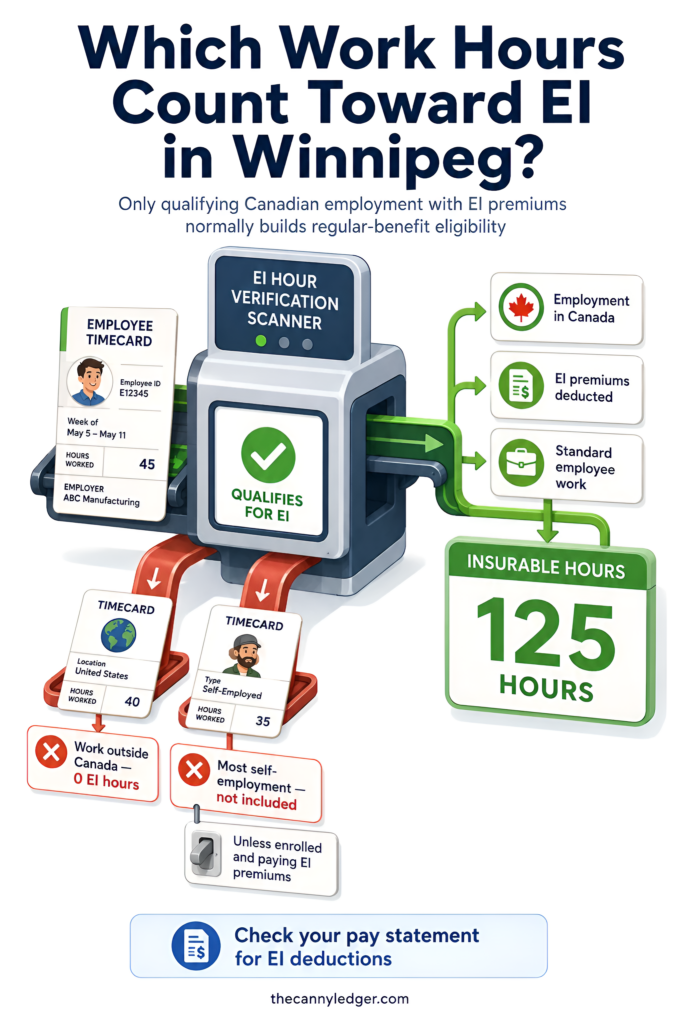
Not every hour you’ve worked counts toward that 700-hour threshold. Insurable hours come specifically from insurable employment in Canada, meaning a job where you and your employer both paid EI premiums on your earnings, which covers the overwhelming majority of standard employee positions but excludes most self-employment income unless you’ve specifically opted into the EI program as a self-employed worker and paid premiums for at least 12 months beforehand. One detail that catches newcomers to Winnipeg off guard specifically: work experience and hours accumulated outside Canada count for absolutely nothing toward EI eligibility, regardless of how many years you worked abroad or how senior the role was. If you immigrated within the past year and haven’t yet built up 700 insurable hours through Canadian employment, you won’t qualify for regular benefits yet, no matter how extensive your work history elsewhere was. Our guide to jobs for new immigrants in Winnipeg covers building that Canadian work history in the first place if you’re still early in the process.
How Much You’ll Actually Get Paid
Once you qualify, EI regular benefits pay 55 percent of your average insurable weekly earnings during your qualifying period, calculated using your highest-earning weeks within that period rather than a flat average across every week you worked. For 2026, that payment is capped at a maximum of $729 a week, based on the annual maximum insurable earnings of $68,900 that took effect January 1, 2026, up from $695 a week in 2025. If your net family income doesn’t exceed $25,921 a year and you or your spouse receive the Canada Child Benefit, you may also qualify for the EI family supplement, which can increase your benefit rate up to 80 percent of your average insurable earnings rather than the standard 55 percent, a detail worth checking specifically if your household includes children and runs on a tight budget.
How many weeks you’re eligible to receive that payment depends on the same regional unemployment rate that set your hour requirement, combined with how many insurable hours you actually accumulated. At Winnipeg’s current 5.8 percent regional rate, the minimum entitlement is 14 weeks and the maximum is 36 weeks, with your specific entitlement landing somewhere in that range based on your total insurable hours worked.

The One-Week Waiting Period and When Payments Start
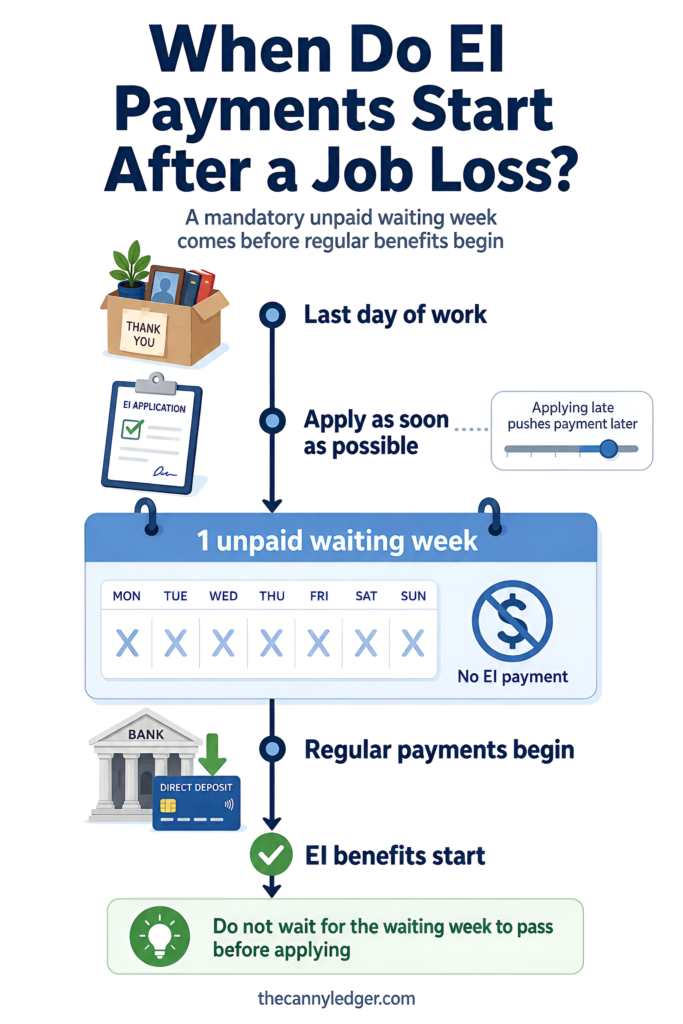
Every EI claim includes a mandatory one-week waiting period at the start, functioning essentially like a deductible, during which no benefits are paid even though you’re otherwise eligible. This isn’t unique to Manitoba or something you can request to have waived under normal circumstances, it’s a standard feature of the program nationally. Applying as soon as possible after your last day of work matters directly because of this waiting period, since delaying your application doesn’t delay the waiting week, it just delays when your first actual payment arrives on the other side of it.
What You Need Before You Apply
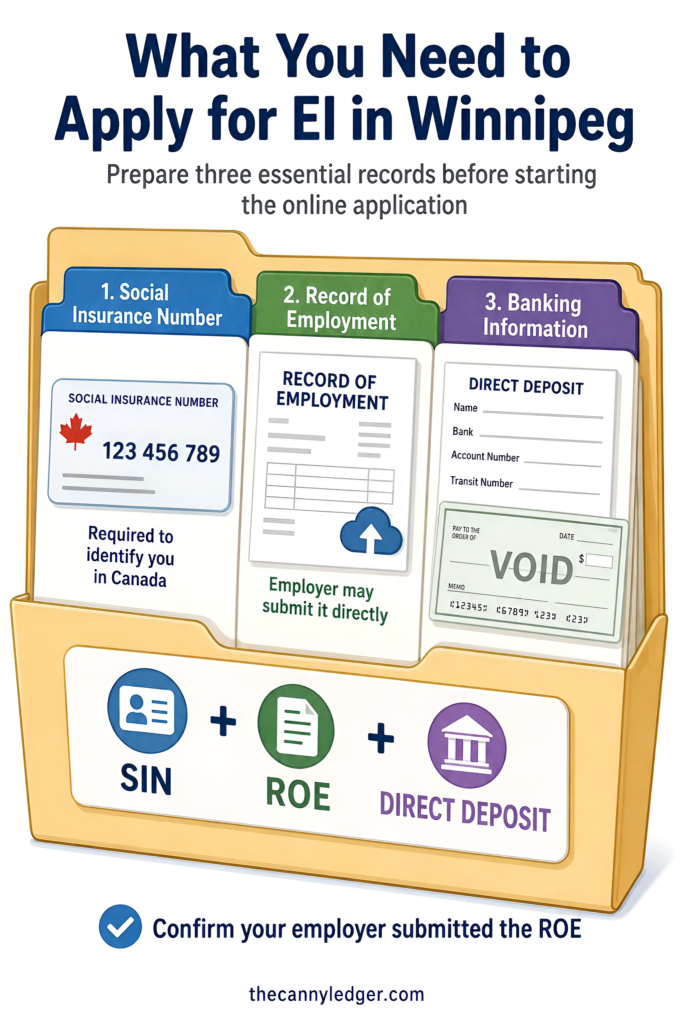
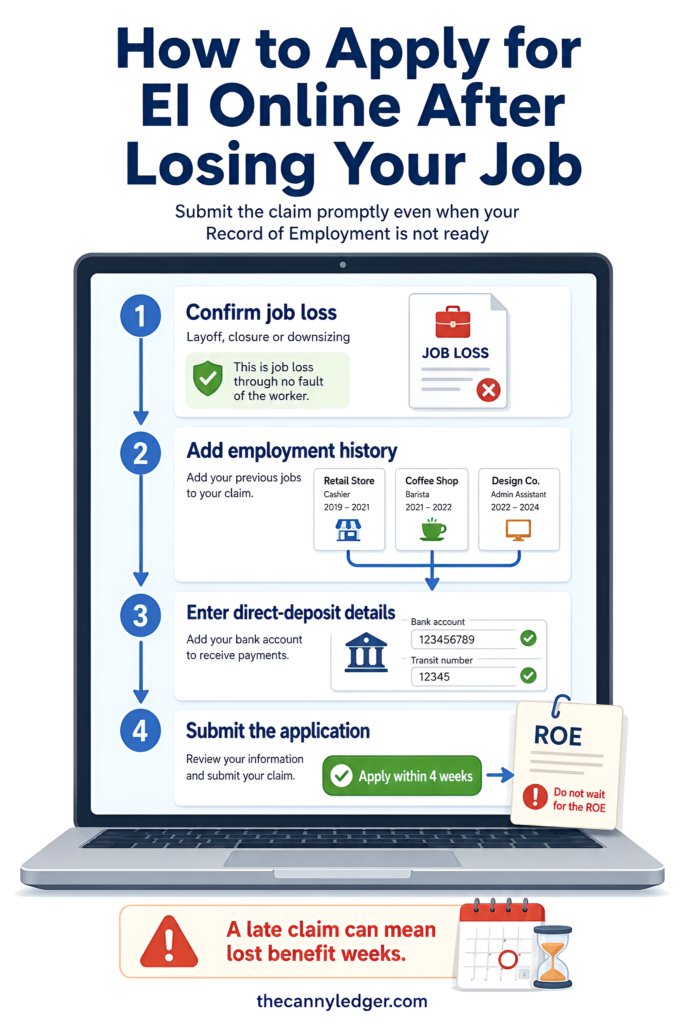
Before starting your application, gather your Social Insurance Number, your Record of Employment from your most recent employer or employers within the qualifying period, and your banking information for direct deposit, since Service Canada pays benefits electronically rather than by mailed cheque in the vast majority of cases now. Most employers submit the Record of Employment electronically directly to Service Canada, which means you often don’t need a physical copy in hand before applying, though it’s worth confirming with your employer that this has actually been submitted, since a missing ROE is one of the most common reasons an otherwise straightforward application gets delayed. If you don’t yet have a Social Insurance Number, or need to confirm your current one is valid, our guide to getting a Social Insurance Number in Winnipeg covers that necessary first step before an EI application can move forward at all.
Applying Through My Service Canada Account, Step by Step
Applications go through your My Service Canada Account online, and the process starts with confirming your eligibility using the reason your employment ended, since regular benefits specifically require that you lost your job through no fault of your own, whether that’s a layoff, a company closure, a seasonal position ending, or a genuine downsizing. From there, the application walks through your personal information, employment history for the qualifying period, and banking details for direct deposit, and Service Canada recommends applying within four weeks of your last day of work even if your Record of Employment hasn’t been issued yet, since applying late can mean losing benefits for the weeks you were eligible but didn’t yet have a claim on file.
Once submitted, processing typically takes a few weeks before your first payment, assuming no additional information or documentation gets requested along the way, which is exactly why applying promptly rather than waiting to see if you find new work first genuinely matters, since the application itself doesn’t obligate you to stop job searching or accept the benefit if your situation changes before it’s processed.
Biweekly Reports Keep the Money Coming
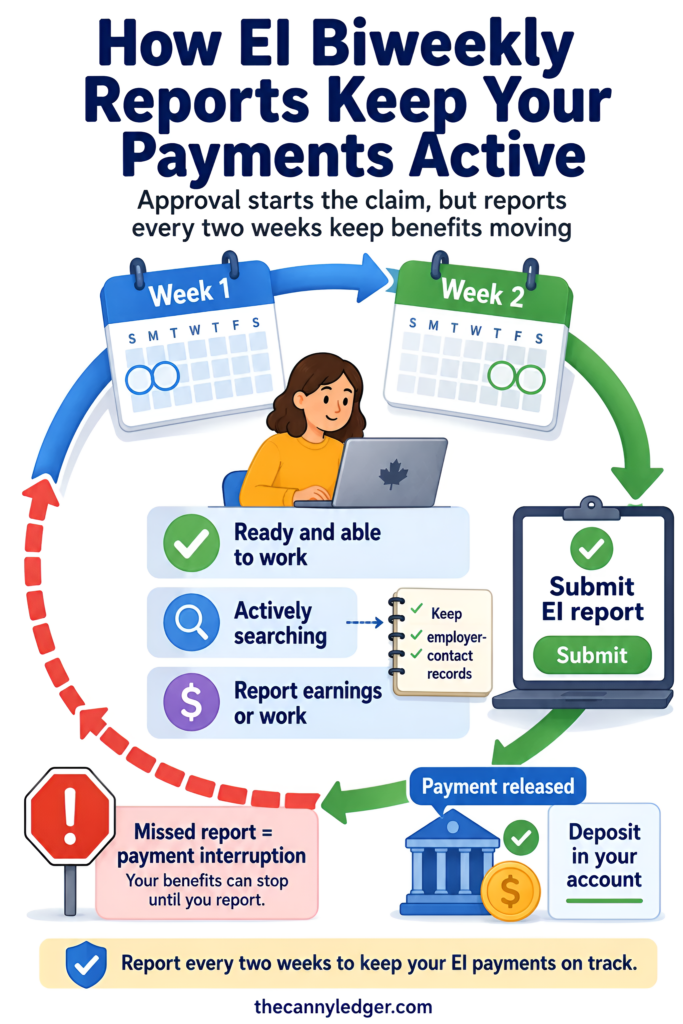
Getting approved isn’t the end of the process. Every two weeks, you’re required to complete an EI report online or by phone confirming you remained ready, willing, and capable of working, and that you actively searched for work during that period, including keeping a written record of the employers you contacted and when. Missing a biweekly report is one of the most common reasons ongoing payments stop unexpectedly, so treating this as a recurring obligation for the full length of your claim, not a one-time task completed at application, matters just as much as the initial application itself.
Special Benefits Use a Different Hour Requirement Entirely
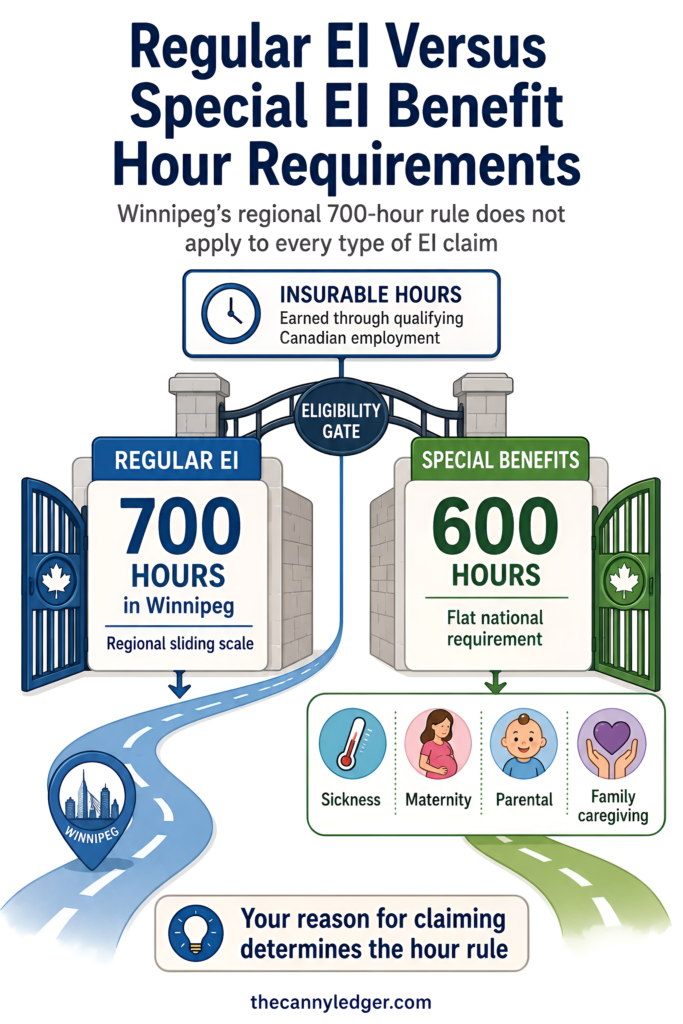
If your situation involves illness, pregnancy, parental leave, or caring for a critically ill family member rather than a straightforward job loss, EI’s special benefits category uses a completely different, flat requirement of 600 insurable hours, regardless of your specific region’s unemployment rate. This is meaningfully lower than Winnipeg’s current 700-hour regular benefits requirement, which matters if you’re close to qualifying for one but not quite the other. Sickness, maternity, parental, and compassionate care benefits all fall under this flat 600-hour rule rather than the sliding regional scale that governs regular unemployment benefits specifically.
What Disqualifies You
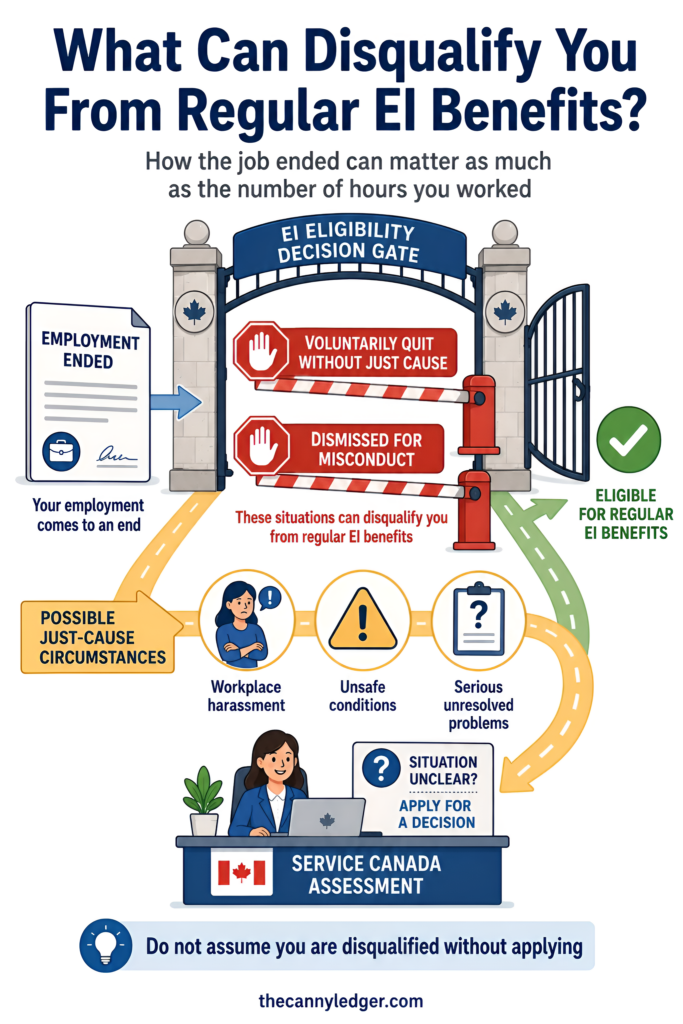
Voluntarily quitting a job without just cause, or being dismissed specifically for misconduct, generally disqualifies you from regular EI benefits entirely, though genuine exceptions exist for situations like workplace harassment, unsafe working conditions, or other circumstances Service Canada recognizes as just cause for leaving. If your situation involves any ambiguity around why your employment actually ended, whether it was truly a layoff versus something closer to a resignation, it’s worth applying anyway and letting Service Canada make the formal determination rather than assuming you’re disqualified and not applying at all, since the assessment considers specific circumstances a general rule of thumb can’t fully capture.
Common Questions
Is EI considered taxable income? Yes, EI benefits are fully taxable, and federal and provincial tax gets deducted directly from each payment, with the total amount reported on a T4E slip at tax time. Our Manitoba and Winnipeg personal income tax guide covers how income like this factors into your overall return.
Can I work part-time while receiving EI regular benefits? Yes, under the Working While on Claim provision, but any earnings during a claim period reduce your benefit payment according to a specific formula, so it’s worth understanding exactly how much you’d keep before assuming part-time income and EI simply stack on top of each other without consequence.
What happens if I don’t have 700 hours yet? You don’t qualify for regular benefits at Winnipeg’s current threshold, though it’s worth checking whether your specific situation might qualify under the flat 600-hour special benefits rule if your circumstance is illness, parental leave, or caregiving rather than standard job loss.
Apply Before You’ve Landed Somewhere New, Not After
The single most common mistake with EI isn’t misunderstanding the hour requirement, it’s waiting to apply because a new job feels imminent or because gathering every document feels necessary before starting the process. Apply within four weeks of your last day of work regardless of how confident you feel about finding something quickly, since the one-week waiting period and processing time both start counting only once your application is actually on file, not once you’ve decided you’re ready to submit it.