

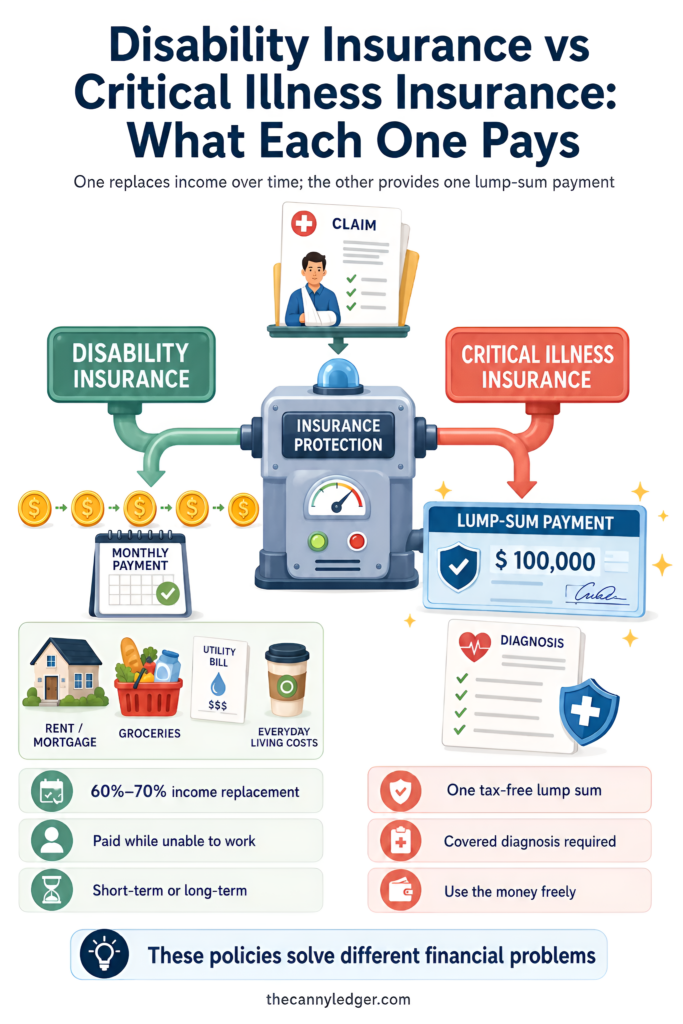
People use “disability insurance” and “critical illness insurance” almost interchangeably, and the mix-up isn’t harmless. Disability insurance replaces a portion of your income while you can’t work, paid out over however long that lasts. Critical illness insurance pays a single lump sum the moment you’re diagnosed with a specific covered condition, regardless of whether you ever miss a day of work because of it. A household that buys one assuming it covers what the other actually covers can discover the gap at the worst possible moment, mid-crisis, rather than while there’s still time to fix it.
- Disability Insurance and Critical Illness Insurance Solve Different Problems
- What CPP Disability Actually Pays, and Who Qualifies
- Manitoba’s Own Disability Income Program Sits Below CPP-D
- Where Private Disability Insurance Fills the Gap
- What Critical Illness Insurance Actually Covers
- Group Coverage vs Buying Your Own
- The Waiting Period and Definition of Disability Actually Matter
- Building Your Own Safety Net
- Common Questions
- Check Your Actual Coverage Before You Need It
Disability and critical illness insurance in Winnipeg both work alongside, not instead of, public programs like CPP Disability and Manitoba Supports for Persons with Disabilities, which provide a baseline but rarely enough to fully replace a household’s income on their own. Private coverage through an employer group plan or an individual policy from an insurer like Manitoba Blue Cross fills the rest, and understanding exactly what each type of policy pays for is the difference between coverage that actually helps and coverage that surprises you.
Disability Insurance and Critical Illness Insurance Solve Different Problems
Disability insurance is built around the concept of income replacement. If an illness or injury keeps you from working, whether that’s for a few weeks, a few years, or permanently, disability insurance pays a percentage of your regular income, commonly somewhere in the range of 60 to 70 percent, on an ongoing basis for as long as you remain unable to work and the policy stays in force. Short-term disability typically covers the first several weeks to months of an inability to work, while long-term disability picks up after that, potentially running until you recover, return to work, or reach a set age like 65.
Critical illness insurance works completely differently. Instead of ongoing income replacement, it pays a single, tax-free lump sum the moment you’re diagnosed with one of a specific list of covered conditions, commonly including cancer, heart attack, and stroke among others, regardless of whether the diagnosis actually stops you from working. There are no restrictions on how you use that lump sum. Some people use it for medical treatment not covered by Manitoba Health, some use it to pay down debt, some use it for home renovations that make daily living easier, and some simply use it to buy breathing room during a genuinely frightening period. The two products aren’t competing options, they’re solving fundamentally different financial problems, and a lot of households benefit from having both rather than treating the choice as either-or.
What CPP Disability Actually Pays, and Who Qualifies
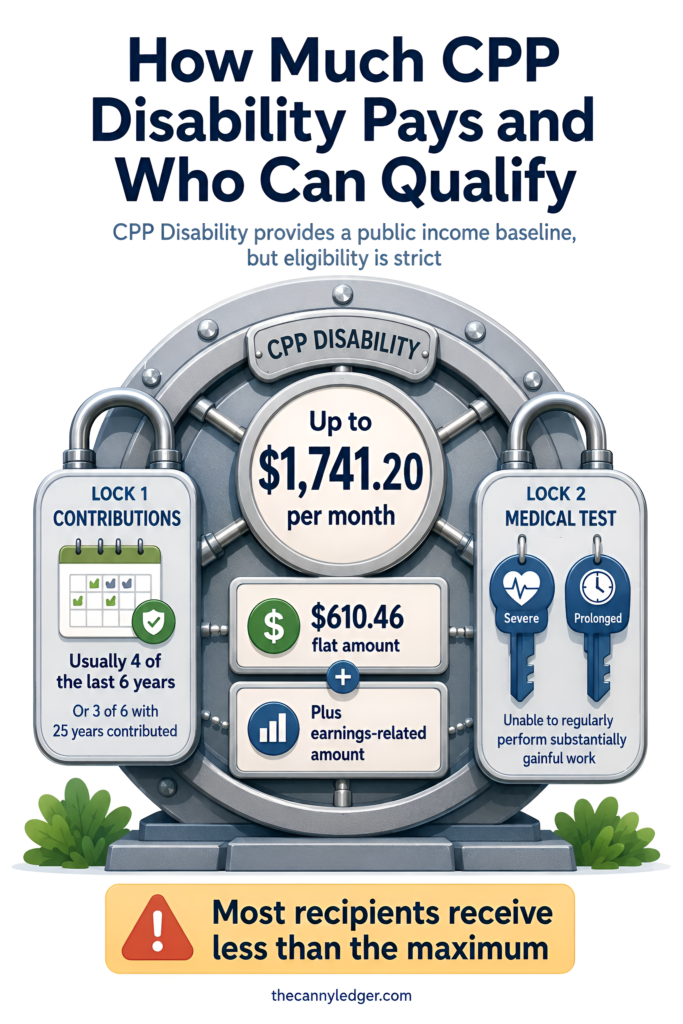
Before considering any private coverage, it’s worth understanding what the public safety net actually provides, since private insurance exists specifically to close the gap this leaves rather than replace it entirely. The Canada Pension Plan Disability benefit, commonly called CPP-D, pays a maximum of $1,741.20 a month in 2026, made up of a flat-rate portion of $610.46 plus an earnings-related portion of up to $1,130.74 based on your CPP contribution history. Most recipients receive considerably less than the maximum, since the earnings-related portion scales with how much you actually contributed to CPP during your working years, and Service Canada’s most recently published figures put the average new benefit closer to the $1,200 range rather than the maximum.
Qualifying requires meeting both a contribution test and a medical test. You need to have contributed to CPP in four of the last six years, or three of the last six years if you have at least 25 years of total valid contributions, and your condition needs to be classified as both “severe,” meaning you’re incapable of regularly pursuing any substantially gainful occupation, not just your specific job, and “prolonged,” meaning the condition is of indefinite duration or likely to result in death. Processing an application typically takes several months, and roughly 60 percent of first-time applications get approved, which means a meaningful share of genuinely disabled applicants face an initial denial and need to appeal, a process worth knowing about upfront rather than discovering after a first rejection feels final.
Manitoba’s Own Disability Income Program Sits Below CPP-D
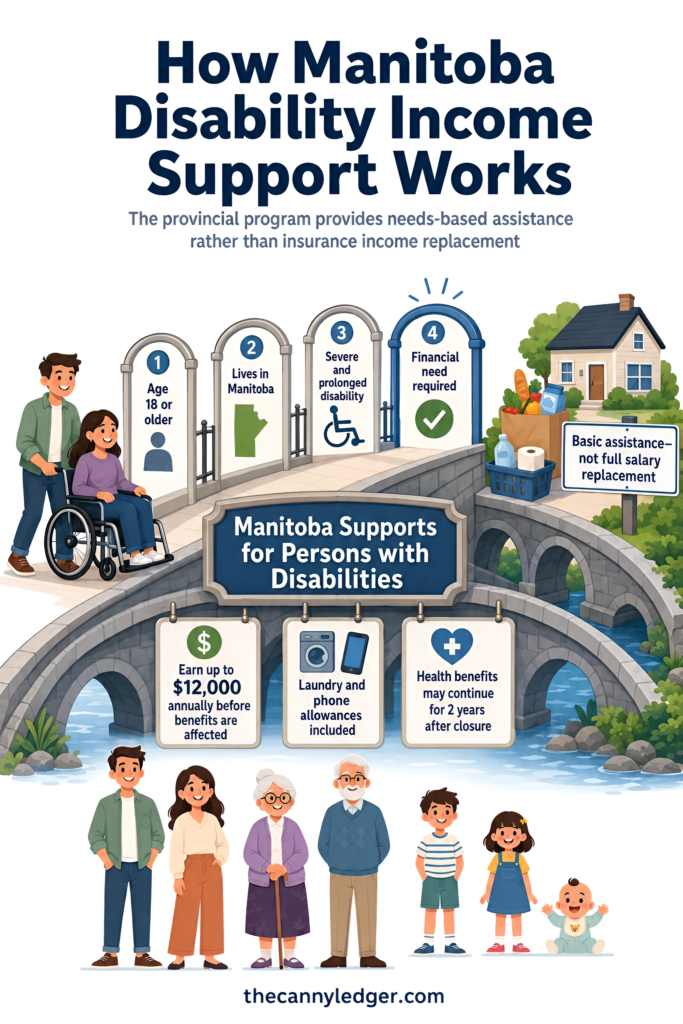
For Manitobans whose situation doesn’t clear CPP-D’s bar, or who need support that starts before a federal application processes, Manitoba runs its own disability income program, and it’s worth knowing this program changed structurally not long ago. Manitoba Supports for Persons with Disabilities, launched in 2023, replaced what used to be called the EIA Disability category for most participants, offering roughly $100 a month more in benefits than the old structure, along with automatic laundry and phone allowances, the ability to earn up to $12,000 a year before benefits are affected, and continued health benefits for up to two years after a file closes. Manitobans who haven’t yet transitioned into the new program, now referred to as having Medical Barriers to Full Employment under the older EIA framework, can still access support through that earlier structure while their eligibility for the newer program is assessed.
Eligibility for Manitoba Supports requires being 18 or older, living in Manitoba, having a severe and prolonged disability that challenges daily living, and being in genuine financial need, and Manitoba indexes the basic needs amount to inflation annually as of April 1 each year. This program functions as income assistance rather than insurance, meaning there’s no premium to pay and no policy to have purchased in advance, but it also means benefit amounts run considerably below what most households actually need to maintain their pre-disability standard of living, which is exactly the gap private disability insurance and CPP-D both exist to help close.
Where Private Disability Insurance Fills the Gap
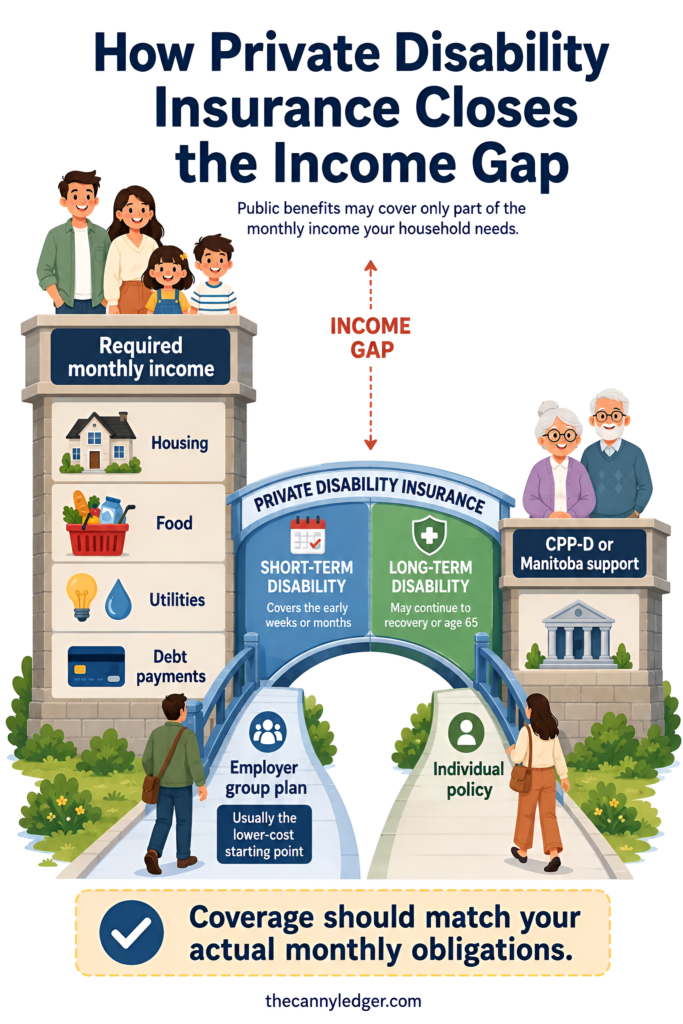
Between CPP-D’s modest maximum and Manitoba’s income-assistance-level provincial program, most households discover a significant shortfall between what public programs pay and what their actual monthly expenses require, and this is precisely where private disability insurance earns its cost. If you have access to group disability coverage through an employer, that’s typically the most cost-effective starting point, since employer group rates and underwriting are generally more favourable than an individual policy purchased on your own. Manitoba Blue Cross offers both short-term coverage, generally kicking in immediately and covering the early weeks of an inability to work, and long-term disability that takes over after roughly 17 weeks and can continue paying replacement income until age 65 or a safe return to work, whichever comes first.
For Manitobans without access to group coverage specifically, self-employed workers, business owners, part-time employees, seasonal workers, or anyone else outside a traditional employer benefits structure, individual disability plans exist specifically for that gap, though they typically come with a medical exam requirement and lower maximum monthly coverage amounts than a comparable group plan would offer.
What Critical Illness Insurance Actually Covers
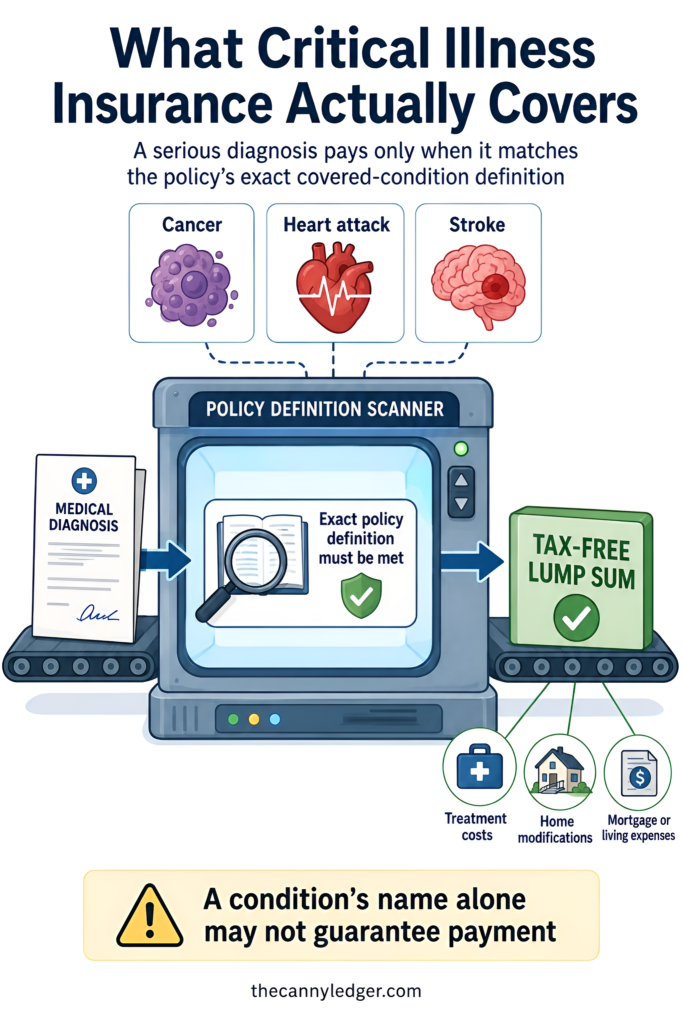
Critical illness policies list specific covered conditions rather than covering any serious diagnosis broadly, so reading exactly what’s on that list before assuming a specific illness would trigger a payout matters enormously. Cancer, heart attack, and stroke form the core of nearly every Canadian critical illness policy, but the exact definitions insurers use for each condition, how advanced a cancer diagnosis needs to be, for instance, can vary meaningfully between insurers and policies, which is worth confirming directly rather than assuming any diagnosis under a covered condition’s general name automatically qualifies. Manitoba Blue Cross offers critical illness coverage primarily through its group benefits plans, with the payout structured as a genuinely unrestricted lump sum, usable for medical treatment, private-duty nursing, home modifications, or simply covering a mortgage payment during a period where working isn’t possible.
Group Coverage vs Buying Your Own
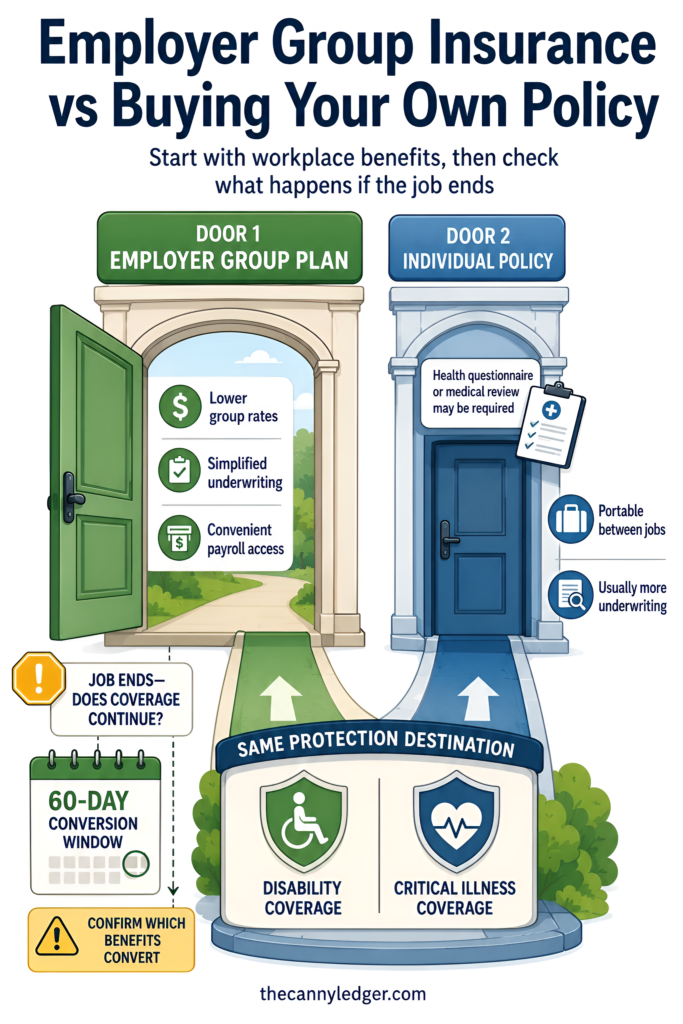
The practical starting point for most Winnipeggers is checking what’s already available through an employer before shopping for an individual policy, since group rates and simplified underwriting generally make employer coverage the more affordable route into both disability and critical illness protection. Where this gets more complicated is exactly what happens if that employment ends. Manitoba Blue Cross’s Blue Choice Conversion plan lets you continue health and dental coverage without interruption if you apply within 60 days of a group plan ending, with no medical questionnaire required and guaranteed approval, though it’s worth confirming directly whether disability and critical illness coverage specifically carry over under a conversion plan or whether those require a separate individual application with full underwriting, since the rules can differ from the health and dental side of a conversion plan.
The Waiting Period and Definition of Disability Actually Matter
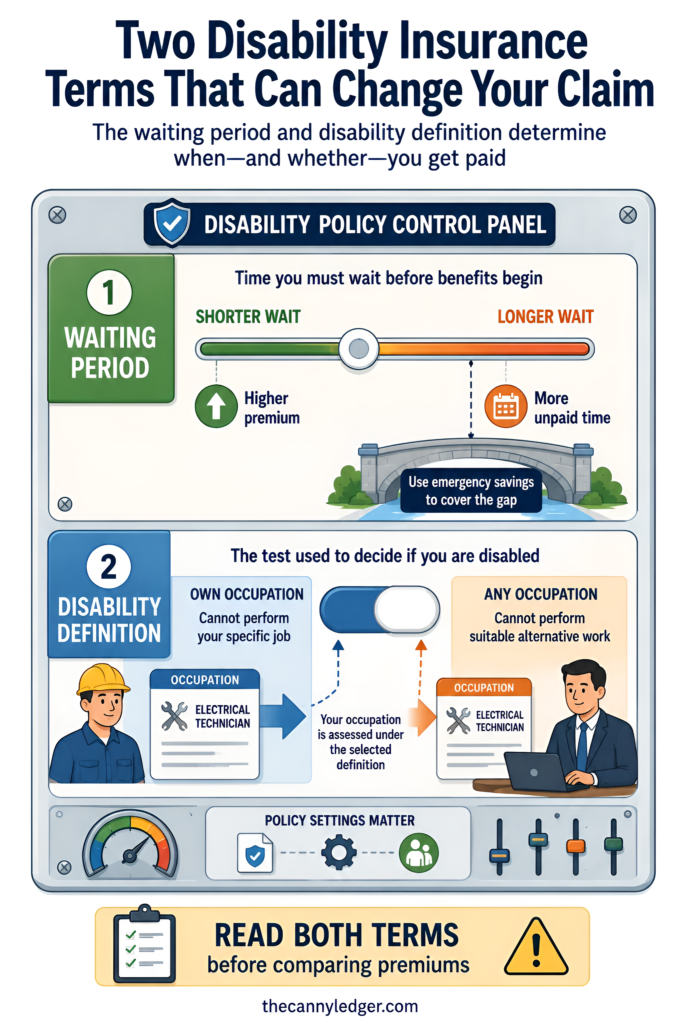
Two details buried in most disability policies genuinely determine how useful the coverage turns out to be when you actually need it. The waiting period, sometimes called the elimination period, is the length of time you have to be unable to work before benefits start, and a longer waiting period means a lower premium but a longer stretch with no income replacement at all, which matters enormously if you don’t have savings to bridge that gap. The definition of disability used in your specific policy matters just as much. An “own occupation” definition pays out if you can’t perform your specific job, even if you could theoretically do different work, while an “any occupation” definition, more common in cheaper policies and most government programs including CPP-D, only pays if you can’t do any job reasonably suited to your training and experience. A specialist whose hands are essential to their work, a surgeon or a tradesperson, for instance, has a genuinely different stake in which definition their policy uses than someone in a role less tied to a specific physical capability.
Building Your Own Safety Net
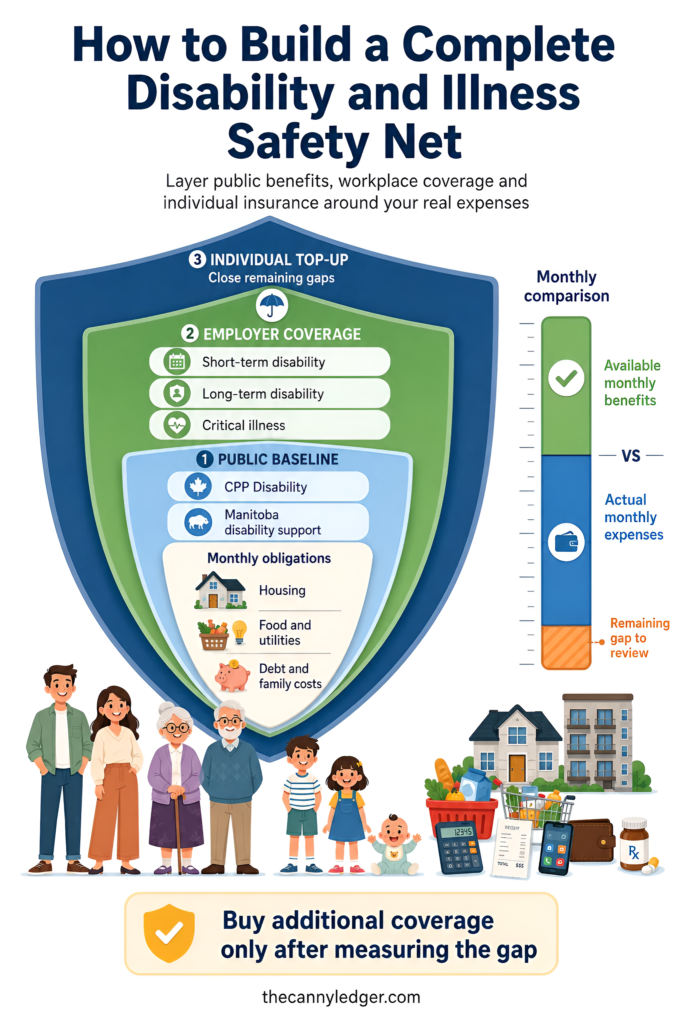
The realistic approach layers coverage rather than relying on any single source. Confirm what CPP-D and, if relevant, Manitoba Supports for Persons with Disabilities would actually provide as a baseline, check what your employer’s group benefits cover for both short-term and long-term disability plus critical illness, and only then evaluate whether an individual policy is worth adding to close whatever gap remains between that baseline and your household’s actual monthly obligations. For anyone building out this picture alongside other coverage, our guides to term vs whole life insurance in Winnipeg and health and dental insurance in Winnipeg round out the broader insurance picture worth weighing together rather than in isolation.
Common Questions
Can I receive CPP Disability and Manitoba Supports for Persons with Disabilities at the same time? Yes, these are separate programs from different levels of government, and receiving one doesn’t automatically disqualify you from the other, though Manitoba’s program does factor in other income sources, including CPP-D, when assessing financial need.
Does the Disability Tax Credit affect my eligibility for these programs? The Disability Tax Credit is a separate tax measure rather than an income support program, though it can open the door to other benefits. Our guide to the Disability Tax Credit in Winnipeg covers how that credit works and how it connects to other disability supports.
Is critical illness insurance worth it if I already have good health coverage through Manitoba Health? Manitoba Health covers medical treatment itself, but a critical illness payout covers the broader financial disruption a serious diagnosis causes, lost income during recovery, mortgage payments, travel for specialist care, none of which Manitoba Health’s coverage touches at all. For a shorter-term income gap specifically, our guide to Employment Insurance in Winnipeg covers a related but separate benefit worth knowing about.
Check Your Actual Coverage Before You Need It
The worst time to discover a gap between what you assumed your coverage included and what it actually pays out is during an active medical crisis, when reading fine print is the last thing anyone has the capacity for. Pull your current group benefits booklet, or request a policy summary from Manitoba Blue Cross or your insurer if you have an individual plan, and confirm the actual waiting period, definition of disability, and covered conditions list before you need any of it, not after.