

A straightforward spousal sponsorship handled by a Winnipeg immigration lawyer can run $5,000 to $8,000 in legal fees, and that number sits entirely separate from the $1,260 the federal government charges to process the same application. Put those two bills side by side and a family sponsoring a spouse from outside Canada is looking at something closer to $6,260 to $9,260 all in, and that’s before biometrics, translations, or a medical exam enter the picture. Most people budgeting for an immigration lawyer only account for one of those two bills, and it’s usually the smaller one.
- Legal Fees and Government Fees Are Two Completely Separate Bills
- What the Government Actually Charges Right Now
- What a First Consultation Actually Costs
- What Full Applications Typically Run
- Where Costs Jump Sharply: Appeals, Refusals, and Litigation
- Why Two Winnipeg Firms Can Quote Very Different Numbers for the Same Service
- When Free or Low-Cost Help Might Cover What You Actually Need
- Common Questions
- What This Actually Means for Your Budget
An immigration lawyer in Winnipeg typically charges $250 to $400 for an initial consultation and $2,300 to $8,800 for full representation on an application, depending on complexity, with spousal sponsorship, appeals, and litigation sitting at the higher end. Government processing fees are charged separately by IRCC and range from $150 for a study permit to $1,590 for an economic-class permanent residence application with the right of permanent residence fee included.
Legal Fees and Government Fees Are Two Completely Separate Bills
This is the single most common point of confusion, and it’s worth being blunt about it upfront. When a lawyer quotes you a price for handling your spousal sponsorship, that number covers their professional time, not the fee the government charges to actually process the application. Those government charges, called processing fees and, for most permanent residence categories, a right of permanent residence fee, get paid directly to Immigration, Refugees and Citizenship Canada regardless of whether a lawyer is involved at all. A lawyer’s invoice and a government receipt are two different documents from two different payees, and a firm’s advertised legal fee almost never includes the government’s cut unless the quote explicitly says so.

What the Government Actually Charges Right Now
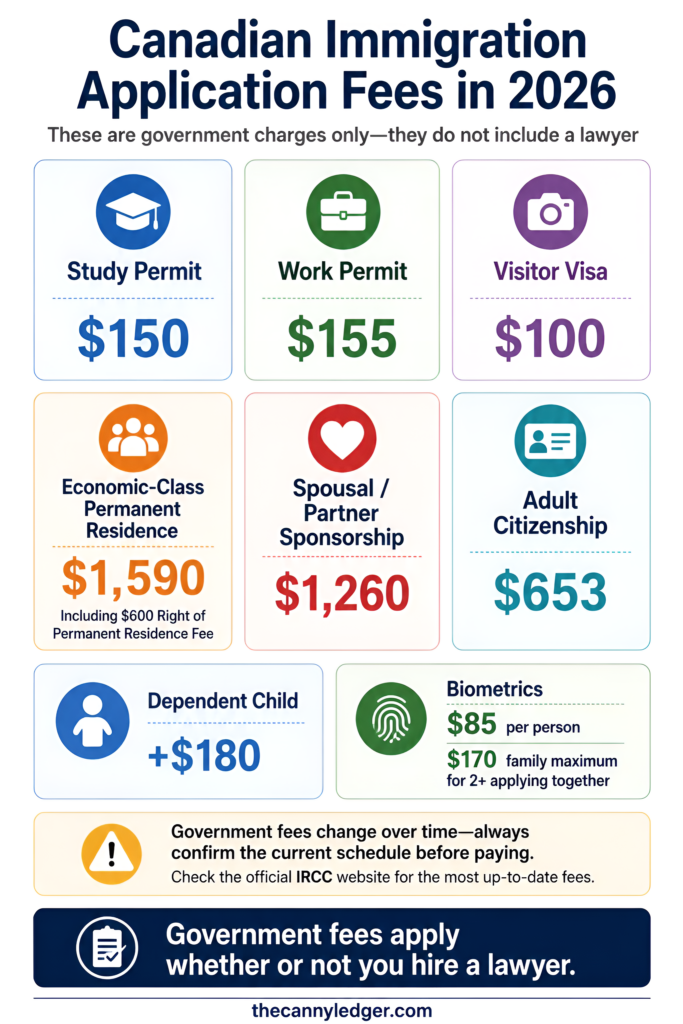
As of July 2026, IRCC’s current fee schedule breaks down like this for the applications people ask about most. A study permit runs $150 per person. A work permit is $155 per person. A visitor visa costs $100 per person. For permanent residence through an economic stream like Express Entry or the Manitoba Provincial Nominee Program, the total comes to $1,590 per principal applicant once the $600 right of permanent residence fee is included, or $990 if that fee is deferred until approval. Sponsoring a spouse or partner, whether they’re inside or outside Canada, costs $1,260 total including the right of permanent residence fee, and adding a dependent child to any application runs an extra $180. Canadian citizenship for an adult costs $653 total, covering both the processing fee and the right of citizenship fee, which climbed to $123 as of March 31, 2026. Biometrics, required for citizens of many countries applying for a visitor visa, study permit, or work permit, add $85 per person or $170 for a family of two or more applying together.
None of these figures include a lawyer. They’re what the government charges regardless of who fills out the paperwork, and they’re worth knowing on their own before a legal fee ever enters the conversation.
What a First Consultation Actually Costs
Consultation pricing varies more than people expect between Winnipeg firms. Clarke Law, one of the few Manitoba immigration firms to publish its fee schedule online, charges $250 plus GST for a 25-minute legal consultation or $400 plus GST for 50 minutes, as of its current April 2026 rate sheet. A&M Canadian Immigration Law Corporation lists a 30-minute legal consultation, described specifically as a review, assessment, and advice session rather than a full form review, at $275 including GST, with that fee credited toward your file if you go on to retain the firm. Not every firm structures things this way. A couple of Winnipeg immigration firms advertise a free preliminary assessment rather than a paid consultation, though that’s typically a shorter intake conversation rather than the same depth of legal advice a paid session covers. We break down exactly which Winnipeg firms currently offer that free option in immigration lawyers in Winnipeg offering free consultations.

What Full Applications Typically Run
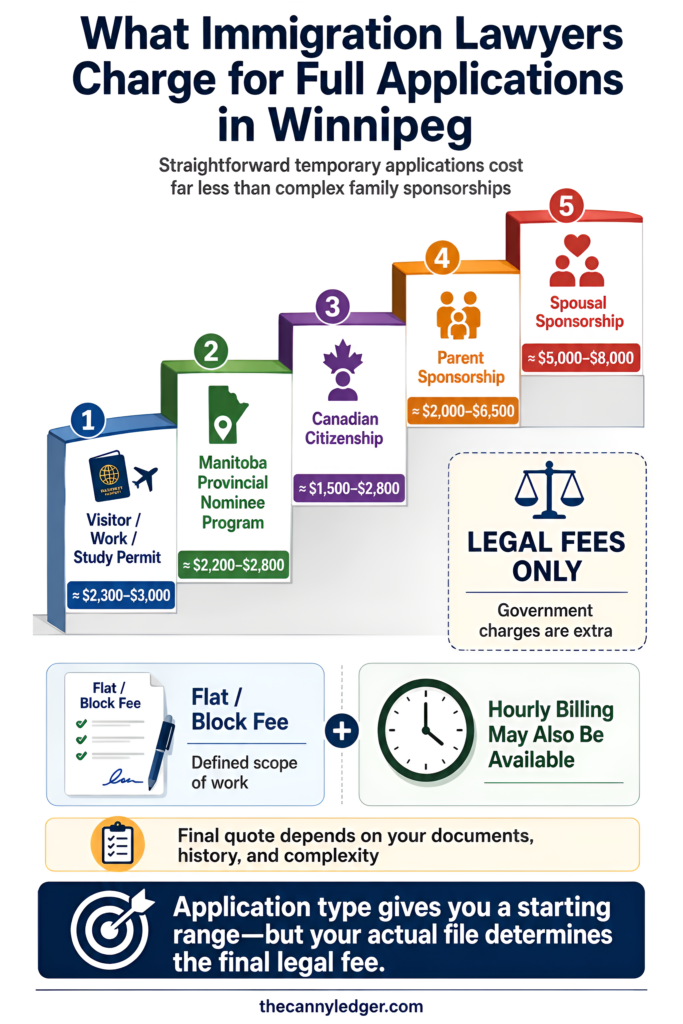
Once you move past the consultation and into actually retaining a firm, most Winnipeg immigration lawyers price by block fee, a flat rate for a defined scope of work, rather than pure hourly billing, though hourly arrangements are usually available too. Based on current published rate sheets from two Winnipeg firms, a temporary resident application, whether a visitor visa, work permit, or study permit handled by a lawyer, generally starts around $2,300 to $3,000 in legal fees. A Manitoba Provincial Nominee Program application for a skilled worker starts in the range of $2,200 to $2,800 depending on the specific stream and whether it’s a student or general applicant. Spousal sponsorship is one of the pricier standard applications, typically landing between $5,000 and $8,000 in legal fees depending on whether the sponsored spouse is inside or outside Canada and how complicated the relationship history is. Parental sponsorship starts around $2,000 to $6,500 depending on the firm and number of parents included. A straightforward Canadian citizenship application through a lawyer runs roughly $1,500 to $2,800.
These are legal fees only, quoted by the firm for their professional work, and every one of them sits on top of whatever the government charges separately for that same application category.
Where Costs Jump Sharply: Appeals, Refusals, and Litigation
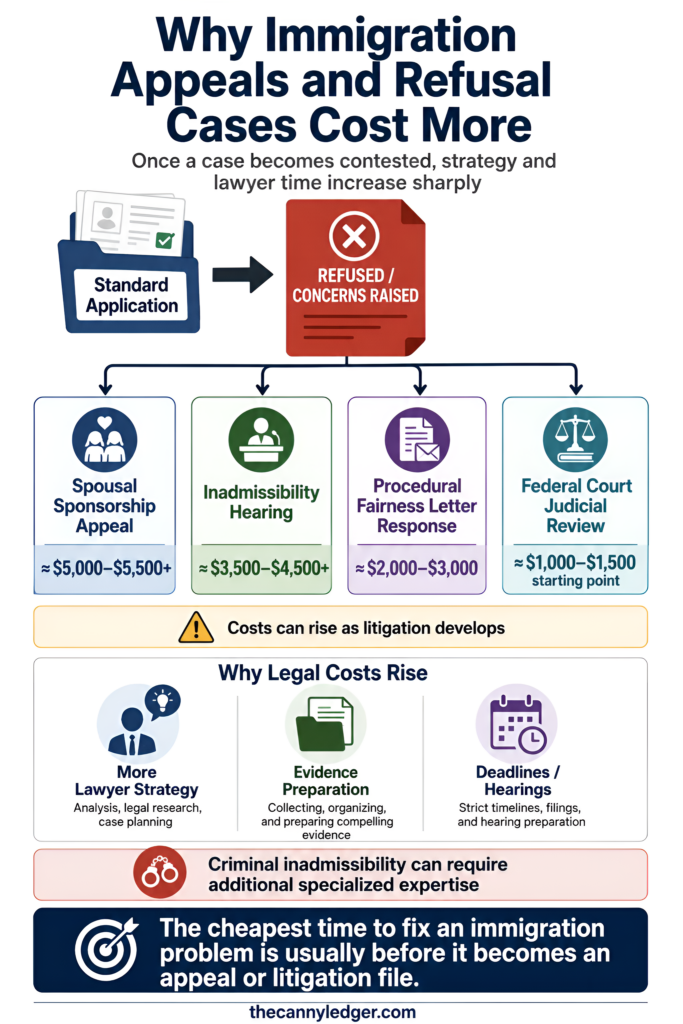
Anything involving a refusal, an appeal, or a hearing costs meaningfully more than a first-time application, and for good reason, since these files require more strategy and more of a lawyer’s direct time under pressure. A spousal sponsorship appeal to the Immigration Appeal Division starts around $5,000 to $5,500. An inadmissibility hearing runs $3,500 to $4,500 and up. A Federal Court judicial review starts lower, around $1,000 to $1,500, but can climb well past that depending on how far the litigation goes. Responding to a Procedural Fairness Letter, the notice IRCC sends when it has concerns about an application before deciding it, typically runs $2,000 to $3,000 on its own. If your case touches criminal inadmissibility specifically, expect it to run higher still, since those files often require both immigration and criminal law expertise working together.
Why Two Winnipeg Firms Can Quote Very Different Numbers for the Same Service
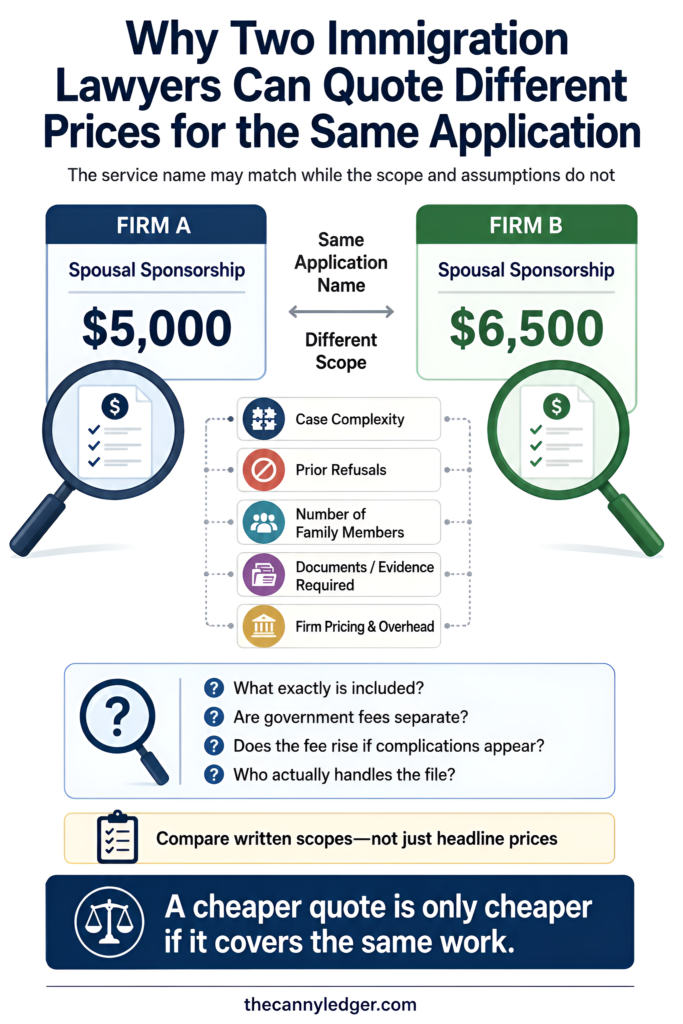
Comparing Clarke Law’s published rates against A&M Canadian Immigration Law Corporation’s published rates for similar services shows real variation, sometimes a difference of a thousand dollars or more for what sounds like the same application type. Some of that comes down to how each firm defines the scope of a “standard” file versus what counts as added complexity. Some comes down to whether the quote is a firm block fee or a starting point that moves depending on your specific documentation, prior refusals, or how many family members are included. And some genuinely comes down to firm size, overhead, and how the lawyer prices their own time relative to competitors. Neither firm’s numbers are wrong, they’re just built around different assumptions about what a typical file for that service actually involves, which is exactly why getting an actual quote for your specific situation matters more than trusting any general price range, including the ones in this article.
When Free or Low-Cost Help Might Cover What You Actually Need
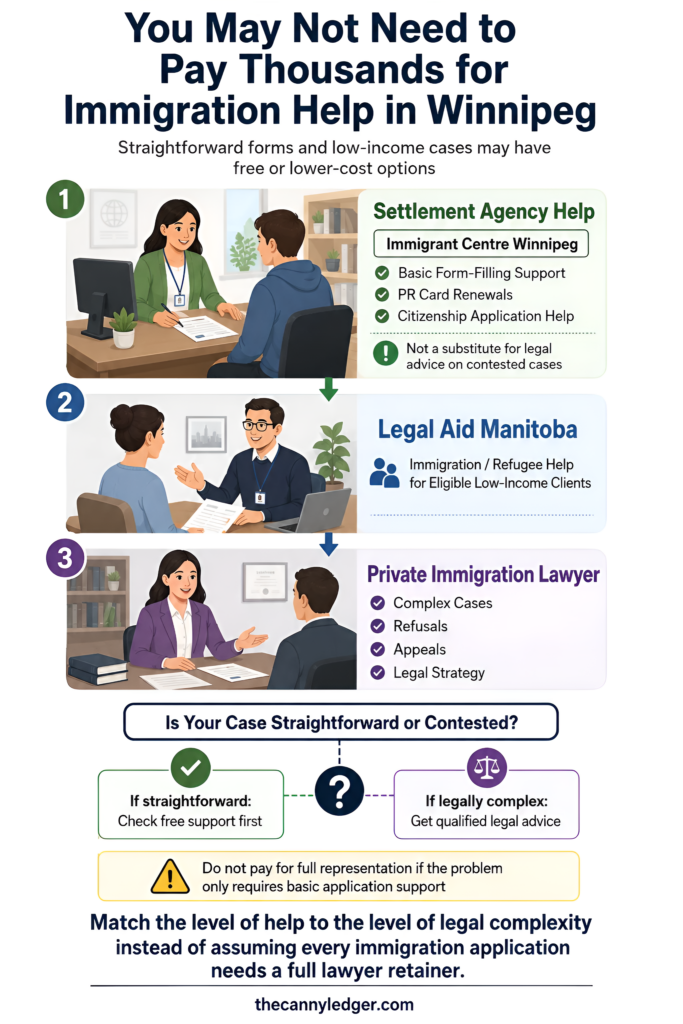
Not every immigration matter needs a $2,000 to $8,000 legal fee attached to it. If your household income is low enough to qualify, Legal Aid Manitoba covers a range of immigration and refugee matters at reduced or no cost, and settlement agencies like the Immigrant Centre in Winnipeg can walk you through straightforward form-filling, like a permanent resident card renewal or a citizenship application, without charging legal fees at all, though they stop short of legal advice on contested or complicated cases. Our guide to free and low-cost immigration help in Winnipeg covers where that line sits and which organizations handle which side of it, and our broader directory of new immigrant services in Winnipeg rounds up other agencies worth knowing about. If your situation is genuinely straightforward, a low-income sponsorship with no prior refusals, for instance, it’s worth having that conversation before assuming a full legal retainer is the only path forward.
Common Questions
Does the consultation fee count toward the total cost if I hire the firm? It depends on the firm. A&M’s published policy credits the consultation fee toward your file if you retain them. Always ask this directly before paying, since it isn’t universal.
Are legal fees the same no matter which Manitoba immigration stream I’m applying through? No. A Manitoba Provincial Nominee Program application and a straight Express Entry application can carry different legal fees even though the government processing fee structure overlaps significantly between them, since the amount of provincial paperwork differs.
Can I negotiate a lawyer’s block fee? Some firms build in flexibility, particularly around payment plans stretched over several months, but the quoted fee itself is generally based on the firm’s assessment of the file’s complexity rather than something negotiated down like a retail price.
What This Actually Means for Your Budget
Treat any immigration lawyer’s quote as one line in a two-line total, not the whole number. Add the government processing fee for your specific application category, factor in biometrics if they apply to you, and only then do you have a realistic full cost. For most straightforward applications in Winnipeg, that combined total lands somewhere between $2,500 and $10,000 depending on the pathway, with sponsorship and litigation matters at the higher end and simple temporary resident applications at the lower end. Getting an actual written quote from a specific firm, ideally after a paid or free consultation where they’ve seen your actual documents, replaces every range in this article with a number you can actually plan around. Whichever firm you end up talking to, the Law Society of Manitoba’s lawyer lookup takes under a minute to confirm they’re licensed before any money changes hands. And if you’re still early in your move to Winnipeg and cost is just one piece of a much longer list, our newcomer’s guide to Winnipeg covers the rest of what tends to come up in the first few months.