

Fareed Ahamed deposited the maximum TFSA contribution every year starting in 2009, and by the end of 2011 his account had grown to $617,317.24. Between 2009 and 2017, the CRA assessed roughly $114 million in taxes from TFSA audits broadly, with about 10 percent of that total coming from accounts the agency determined were carrying on a business rather than simply investing. The Tax Court of Canada’s decision in Ahamed v The King, 2023 TCC 17, was affirmed on appeal in Canadian Western Trust Company v The King, 2024 FCA 108, and that case became the test case for the specific 10 percent of audits described above, a ruling that now shapes how every active trader’s TFSA gets evaluated if the CRA decides to look closely.
How These Audits Actually Start
CRA scrutiny of a TFSA rarely begins with a court filing. It typically starts with a request for trade logs and broker statements after the account’s growth pattern draws attention, usually a balance that expanded far faster than ordinary contributions and market returns could explain on their own. From there, the agency builds a picture of trading frequency, holding periods, and the account holder’s background before deciding whether to reassess. An audit request alone doesn’t mean a reassessment is coming, since most TFSAs reviewed this way don’t end up taxed, but the request itself is the first real signal that an account’s trading pattern has crossed into territory worth a closer look.

The Six Factors Explained One By One
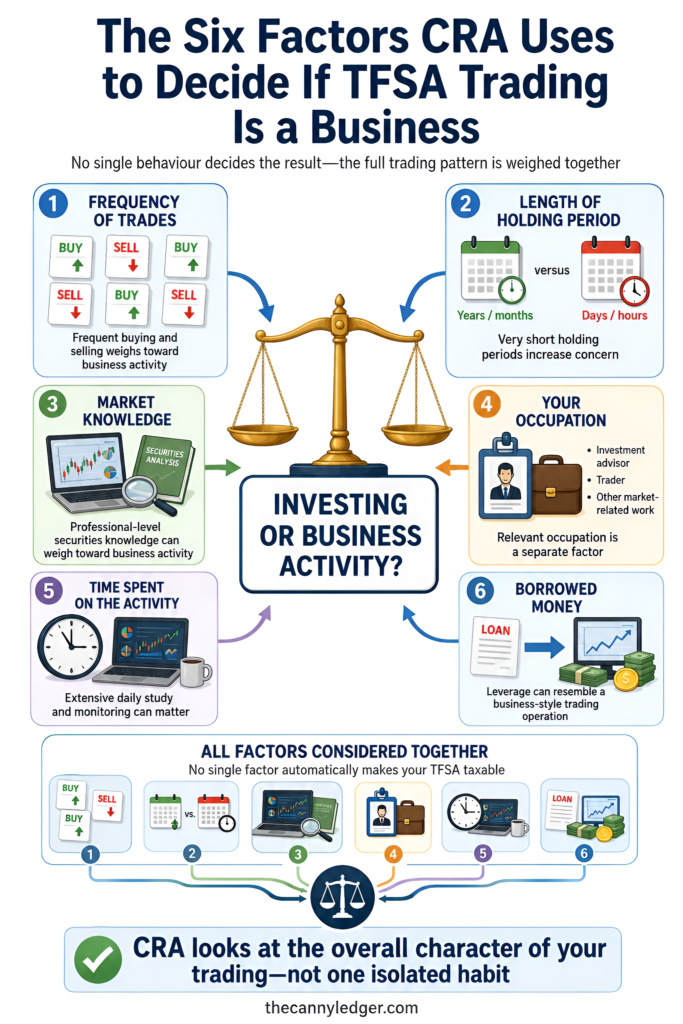
The test CRA and the courts apply traces back to Interpretation Bulletin IT-479R, Transactions in Securities, an archived bulletin the CRA’s own current guidance still directs taxpayers to for determining whether securities activity counts as business income. Frequency of transactions looks at how often trades happen, with a high volume of buys and sells weighing toward business activity. Period of ownership examines how long each position gets held, and positions measured in days or hours rather than months or years weigh against ordinary investing. Knowledge of securities markets considers whether the account holder has genuine sophistication or professional background in trading, which Ahamed had as a working investment advisor. Whether securities transactions form part of the holder’s ordinary occupation is a related but distinct factor, since someone whose day job already involves markets carries an inherent disadvantage here. Time spent studying the market and researching individual positions is weighed on its own, since a holder devoting substantial hours to the activity looks less like a passive investor. And whether the purchases were financed with borrowed money factors in too, since using debt to fund positions inside the account reads as a business-style use of leverage rather than simple saving.
No single factor decides the outcome on its own, and the courts weigh all six together against the specific facts of each case rather than applying a rigid checklist.
Is There A Fixed Number Of Trades That Crosses The Line
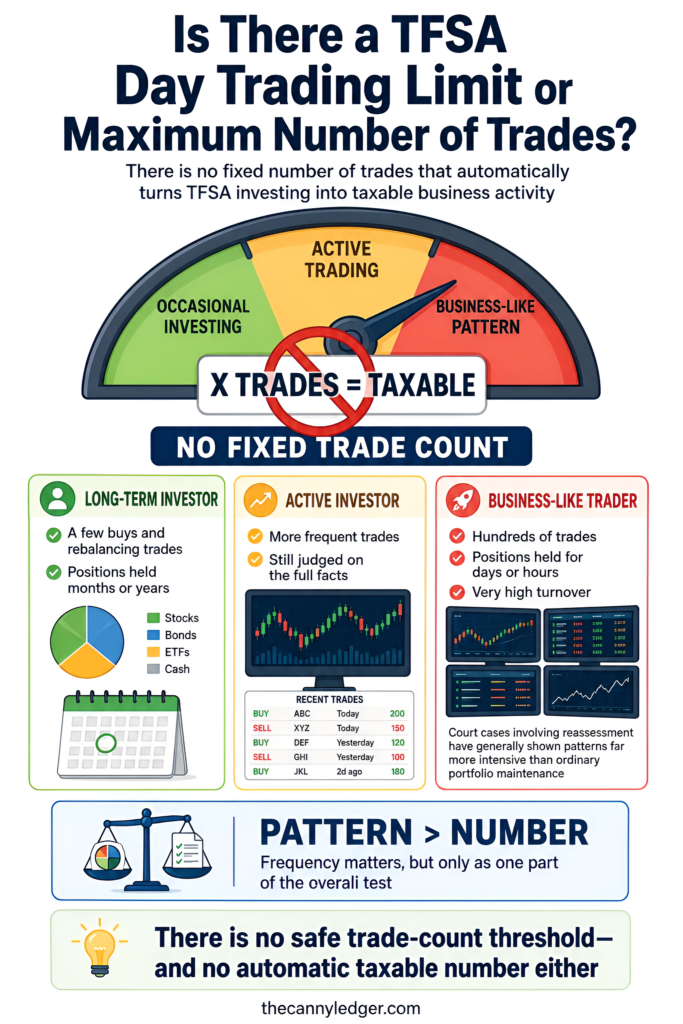
No specific trade count exists in the legislation or the case law that automatically triggers reassessment, and this is worth being precise about since the myth of a fixed threshold circulates constantly. The determination comes from the overall pattern rather than counting transactions against a number, though the reassessed cases that have gone to court, Ahamed’s included, generally involved hundreds of trades a year, holding periods measured in days rather than weeks, and turnover that dwarfed the account’s actual size. A retail investor placing a handful of rebalancing trades annually sits in an entirely different category from someone running multiple trades daily, even without a specific number separating the two.
What The Tax Actually Costs If You Cross The Line
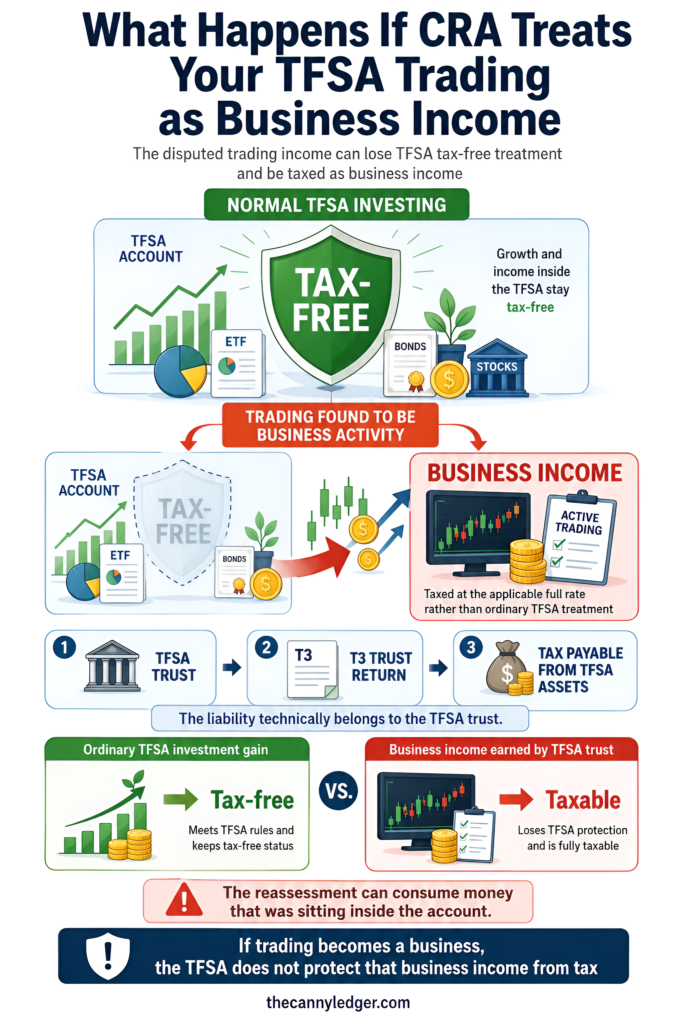
Business income found inside a TFSA loses the tax-free treatment entirely and gets taxed at the full marginal rate, not the preferential rate that would apply to an ordinary capital gain outside the account. The liability technically falls on the TFSA trust itself rather than the individual directly, which is why a reassessed account ends up filing its own T3 trust return separate from the holder’s personal tax filing. That structural detail doesn’t soften the financial impact in any real sense, since the trust’s tax bill still comes out of the same TFSA money the reassessment was triggered by in the first place.
What Stays Completely Outside This Risk
The overwhelming majority of TFSA holders never come anywhere near this line, and it’s worth stating plainly rather than leaving the impression that active investing of any kind is dangerous. Buying shares and holding them for years, even a concentrated position in one or two stocks that grows substantially over time, stays firmly inside ordinary investing regardless of how large the account eventually becomes. The pattern that gets reassessed looks nothing like patient, long-term holding, it looks like the specific combination of frequency, short holding periods, and professional-grade market engagement that defined Ahamed’s account specifically.

Where Your Own Trading Actually Sits
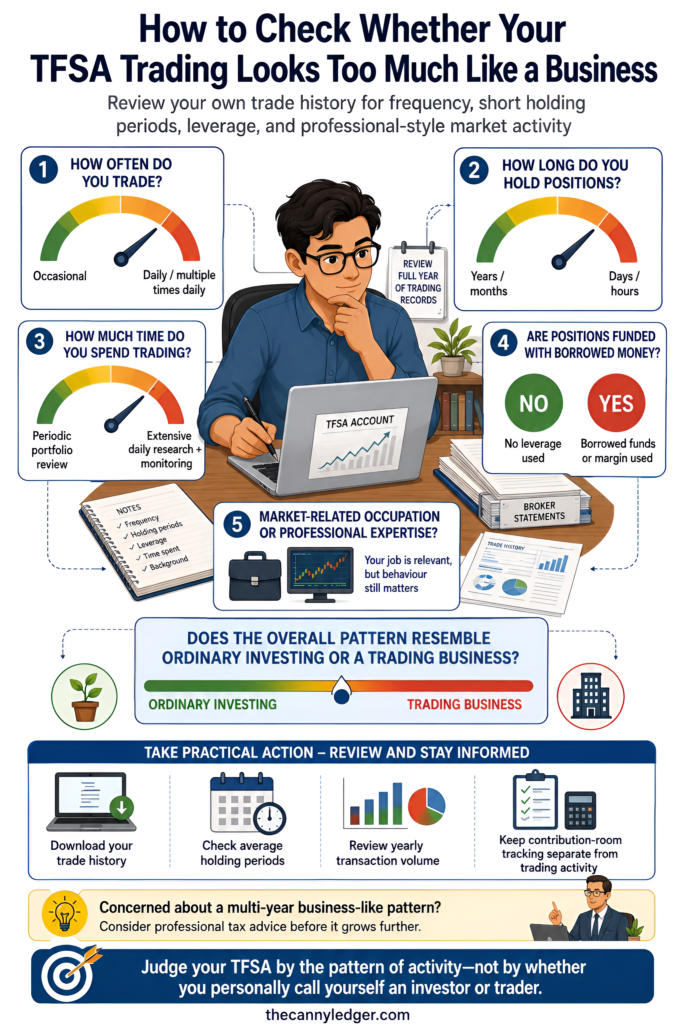
Pull your own trading history and look honestly at holding periods and frequency before assuming your activity is safe simply because you’re not a professional trader, since the factors weigh your actual behaviour rather than your job title alone. If your TFSA trading looks meaningfully different from ordinary buy-and-hold investing, whether through daily transactions, very short holding periods, or borrowed money funding positions, that’s worth addressing before the pattern accumulates over multiple years the way Ahamed’s did. Our broader look at TFSA tax traps covers where this risk fits alongside the other ways a TFSA can generate unexpected tax, and understanding how to check your contribution room matters just as much for anyone actively trading, since frequent buying and selling makes tracking your actual position considerably harder than it is for a passive holder.
What The Ahamed Precedent Actually Settled
Did Ahamed’s professional background as an investment advisor make his case worse than an amateur trader’s would have been? Yes, his knowledge of securities markets and the fact that trading formed part of his professional life both weighed directly against him under the six-factor test, though the court’s reasoning makes clear an amateur trader with a similar frequency and holding-period pattern could face the same outcome.
Why did the case name change between the Tax Court decision and the Federal Court of Appeal ruling? The Tax Court decision was issued as Ahamed v The King, while the appeal was filed and decided as Canadian Western Trust Company v The King, since the TFSA trustee, not Ahamed personally, is the party legally responsible for the trust’s tax filings and therefore the party named in the trust-level appeal.
Does the CRA’s audit activity in this area suggest it’s actively looking for more accounts like Ahamed’s? The scale of the 2009 to 2017 audit program, roughly $114 million assessed with a meaningful share tied to business income findings, indicates this has been a genuine, sustained area of CRA attention rather than an isolated pursuit of one unusual case.