

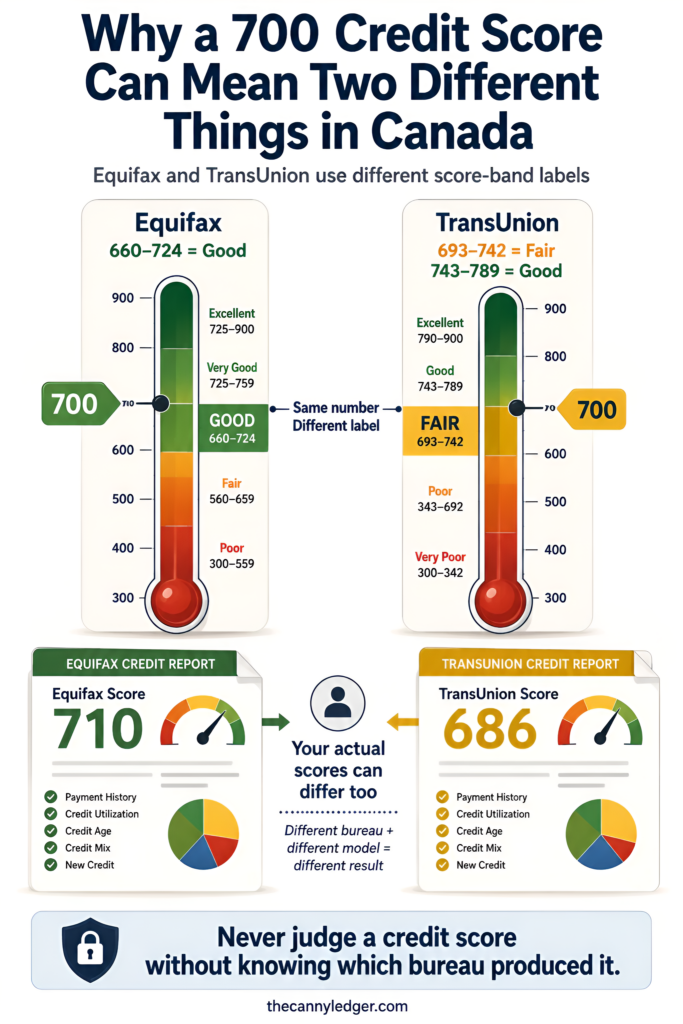
A 700 is a good credit score in Canada. A 700 is also a fair credit score in Canada, teetering on the edge of good, depending entirely on which of the two bureaus produced it. Equifax and TransUnion don’t just calculate your number differently, they label the exact same range differently too, and almost nobody checking their score through a banking app or a free monitoring service realizes which scale they’re actually looking at. That gap alone explains a lot of the conflicting advice floating around about what counts as good.
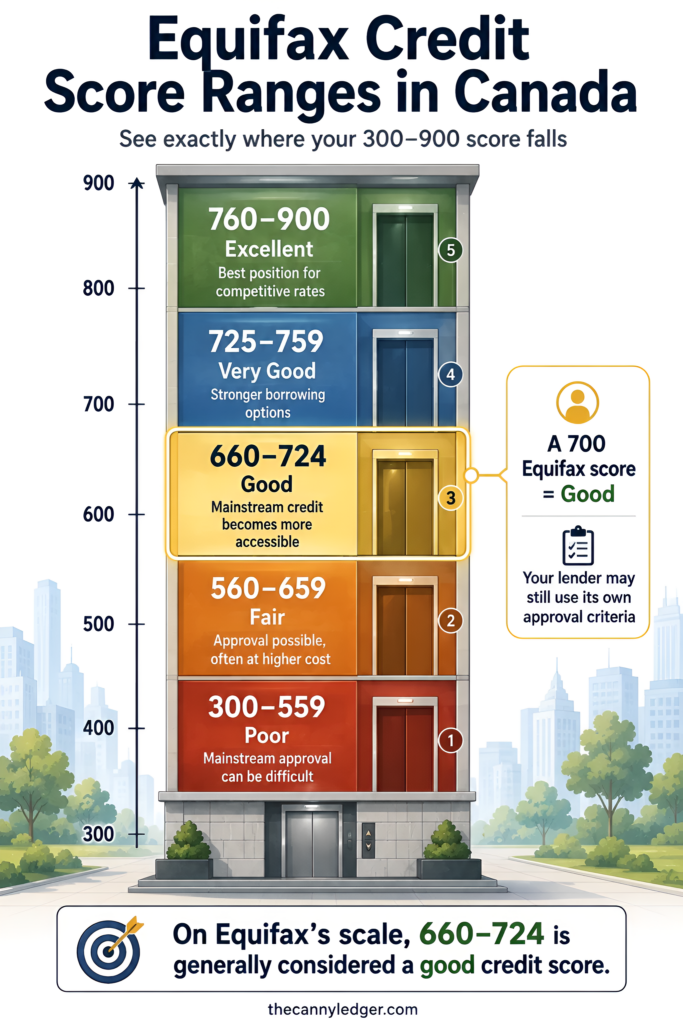
A good credit score in Canada generally sits between 660 and 724 on Equifax’s scale, the bureau most free apps and lenders default to. Scores below that are considered fair or poor, while 725 and above moves into very good and excellent territory, unlocking progressively better rates. That’s the short answer. The full picture depends on which bureau, which lender, and which product you’re actually applying for.
The Full Equifax Tier Breakdown
On Equifax’s 300 to 900 scale, the tiers run in five bands. A score from 300 to 559 is considered poor, and borrowers here typically struggle to get approved through mainstream lenders at all. From 560 to 659, you’re in fair territory, where approval is possible but usually through alternative lenders charging a real premium for the added risk. Good spans 660 to 724, the range where most Canadians land and where standard products from mainstream banks and credit unions become genuinely available. Very good runs 725 to 759, and excellent covers everything from 760 up to the theoretical maximum of 900. Our full breakdown of credit score ranges in Canada covers what changes at each specific boundary in more depth.
Why TransUnion’s Version Of Good Looks Completely Different
This is the part that trips up more people than any other piece of this topic. TransUnion uses the same 300 to 900 numerical range as Equifax, but its tier boundaries sit meaningfully higher across the board. Where Equifax calls 660 to 724 good, TransUnion’s good range runs from roughly 743 to 789. What Equifax calls fair, 560 to 659, TransUnion pushes all the way up to 693 to 742. A score of 700 genuinely means something different depending on which report you’re holding, good on one, fair on the other, and that’s before accounting for the fact that your actual Equifax and TransUnion numbers can differ by 10 to 50 points in the first place, entirely separate from how each bureau labels the result.
The practical takeaway isn’t to panic over which label applies to you. It’s to stop treating “good” as a single universal number and start checking which bureau a specific lender actually pulls before assuming you already know where you stand with them.
What Good Actually Unlocks, And What It Doesn’t
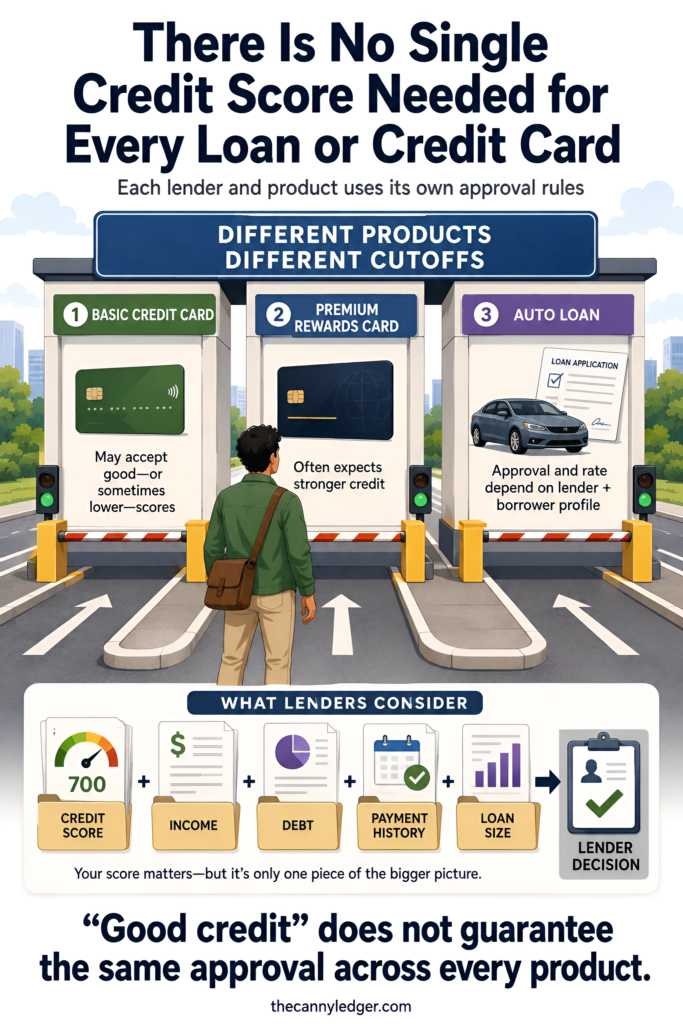
Landing in the good range genuinely opens real doors. At 660 and above on Equifax’s scale, you’ll generally qualify for standard credit cards, personal loans, and car loans from mainstream banks rather than needing an alternative lender. For mortgages specifically, though, good isn’t necessarily enough to clear the line that matters most. Many A-lender banks look for a score closer to 680 for their most competitive insured mortgage products, with the genuinely best rates often reserved for borrowers well into the very good or excellent range.
The dollar difference between those tiers is real and worth seeing in actual numbers rather than a vague warning. Take a $500,000 mortgage on a 25-year amortization. At a representative excellent-credit insured rate of 4.19 percent, the total interest over the full amortization comes to roughly $304,600. Nudge that same mortgage to a 4.99 percent rate, more typical of a borrower sitting in the lower end of the good range or just below it, and total interest climbs to about $371,600, a difference of roughly $67,000 for the identical loan amount. Fall out of A-lender territory entirely and into a B-lender product around 6.99 percent, common for scores below the mainstream threshold, and total interest jumps to nearly $550,000, close to a quarter million dollars more than the excellent-credit scenario. Our guide to what credit score you need for a mortgage breaks down that specific threshold in full.

Credit Cards And Car Loans Follow The Same Logic, Different Numbers
Credit card issuers and auto lenders both use their own internal cutoffs rather than a single shared standard, which means “good” unlocks different specific products depending on who’s asking. A premium travel rewards card typically wants to see very good or excellent territory before approval, while a standard no-fee card is often accessible well within the good range or even slightly below it. Our dedicated pieces on the credit score needed for a credit card and the score needed for a car loan cover both of those specific thresholds directly, since the honest answer varies enough by product that a single number here wouldn’t serve either question well.
Good Is The Average, Not The Ceiling
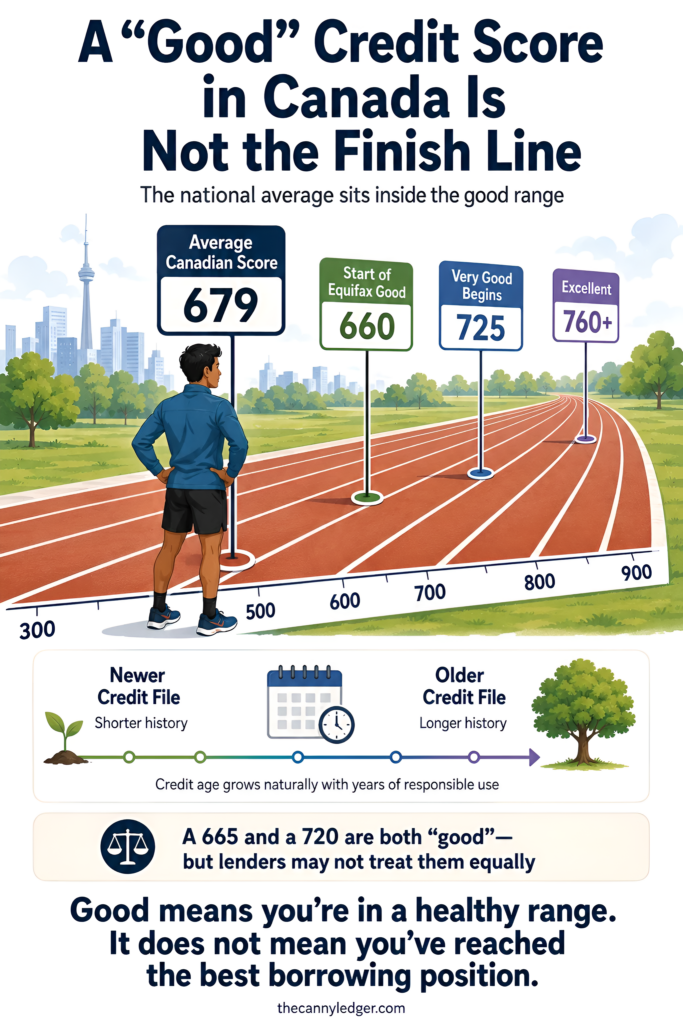
It’s worth being direct about where good actually sits relative to everyone else. Borrowell’s own 2026 data puts the average Canadian credit score at 679, squarely inside the good range but close enough to its lower boundary that plenty of Canadians technically sitting in good are still closer to fair than they might assume. Landing in good means you’re performing roughly in line with the national average, not that you’ve maximized what your credit history can do for you. The gap between the bottom of good and the top of excellent, 660 versus 900, represents a genuinely enormous range of outcomes squeezed under labels that can make a 665 and a 720 sound more similar than they actually are in practice.
Age plays a real role here too, and it’s worth not reading too much into a good-but-not-excellent score if you’re early in building credit. Younger Canadians average meaningfully lower scores simply because length of credit history counts for real weight in the calculation, and that gap closes naturally over years of steady, on-time behaviour rather than through any dramatic single fix.
Moving From Good To Something Better
Check both your Equifax and TransUnion numbers specifically before assuming you know your standing, since the label attached to the exact same behaviour can differ meaningfully between the two. Our guide to Canada’s credit bureaus covers how to pull both for free. If a mortgage or another major purchase is on your horizon, find out directly which bureau your specific lender pulls from rather than assuming the number you’re already tracking is the one that matters to them. And if you’re sitting in good but want to close the gap toward very good or excellent, our full guide to improving your credit score covers exactly which moves carry the most weight and roughly how long each one realistically takes to show up in your number.